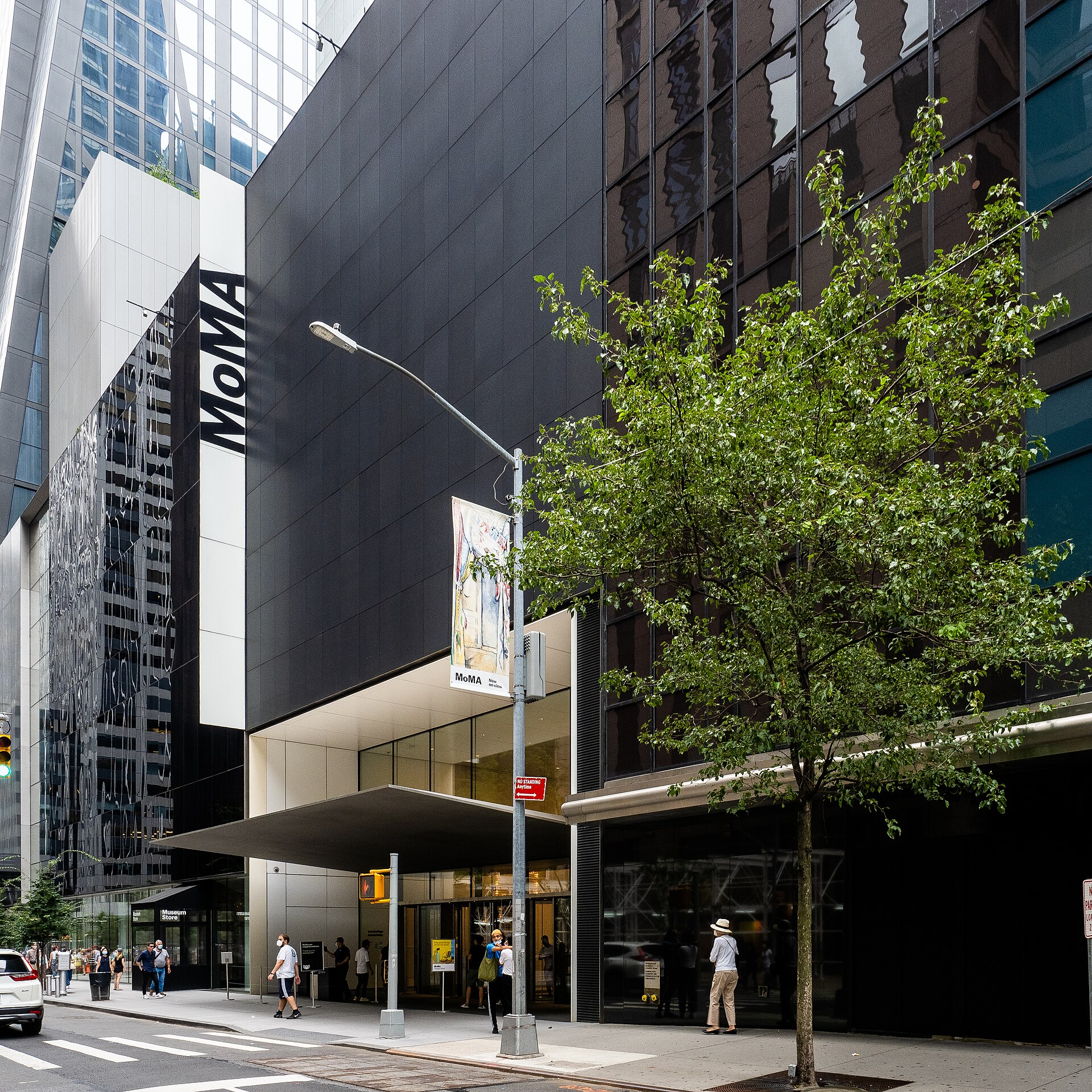
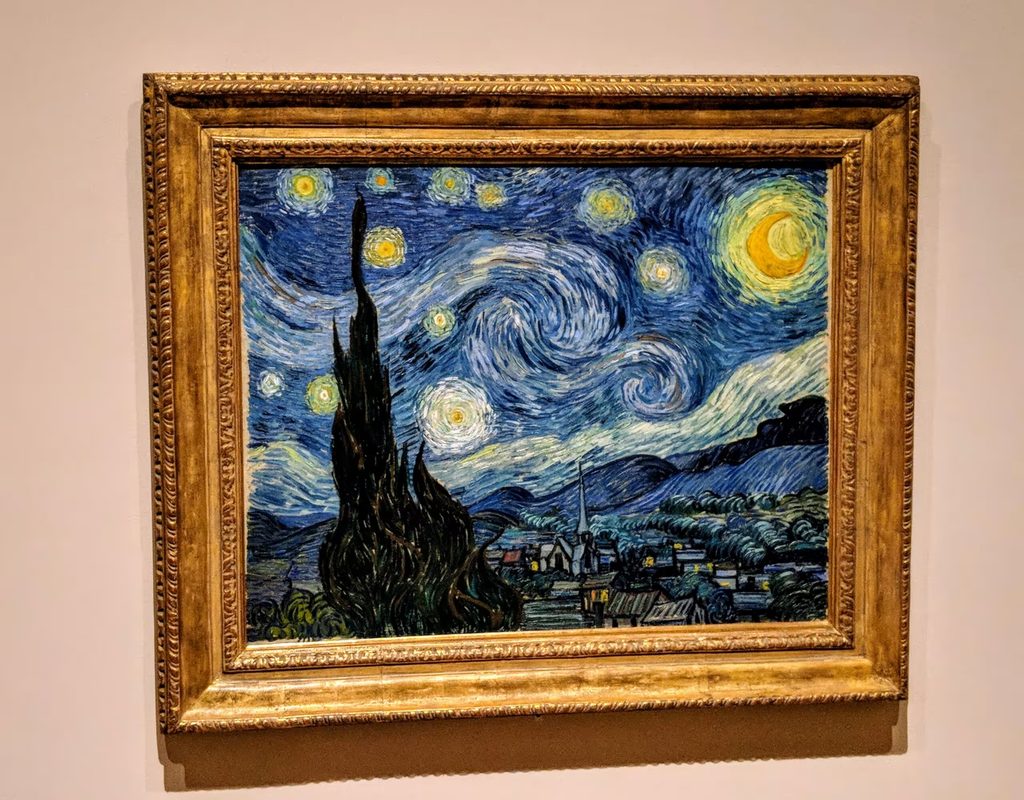
The Museum of Modern Art (MoMA) on 53rd Street in Manhattan is one of the most visited museums in the United States and an essential stop on any New York City itinerary. It is home to Van Gogh’s The Starry Night and Picasso’s Les Demoiselles d’Avignon.
But there is one detail that guidebooks rarely explain: only about 2,000 of the 200,000 works in the collection are displayed on the walls at any given time, and the galleries are regularly rearranged. Therefore, before heading to the museum to see a particular painting, it is worth checking whether it is currently on display at all.
Interesting Facts About the Museum of Modern Art (MoMA)
- This was the first museum in America dedicated exclusively to modern art. It was founded by Abby Rockefeller, the wife of John Rockefeller, who was strongly opposed to the museum and modern art in general.
- Thanks to an exhibition that opened on November 4, 1935, Vincent van Gogh, who had been underappreciated during his lifetime, gained worldwide recognition. In addition to oil paintings and drawings, the exhibition featured excerpts from the artist’s letters.
- In 1939–1940, MoMA set a high standard for museums around the world by presenting works by Picasso, the greatest artist of his time, in its galleries.
- From 1947 to 1953, MoMA transferred works of art to the Metropolitan Museum of Art as they moved from the category of modern art into the category of classical art. If the agreement between the two museums had not been terminated, MoMA would have lost a large portion of its collection.
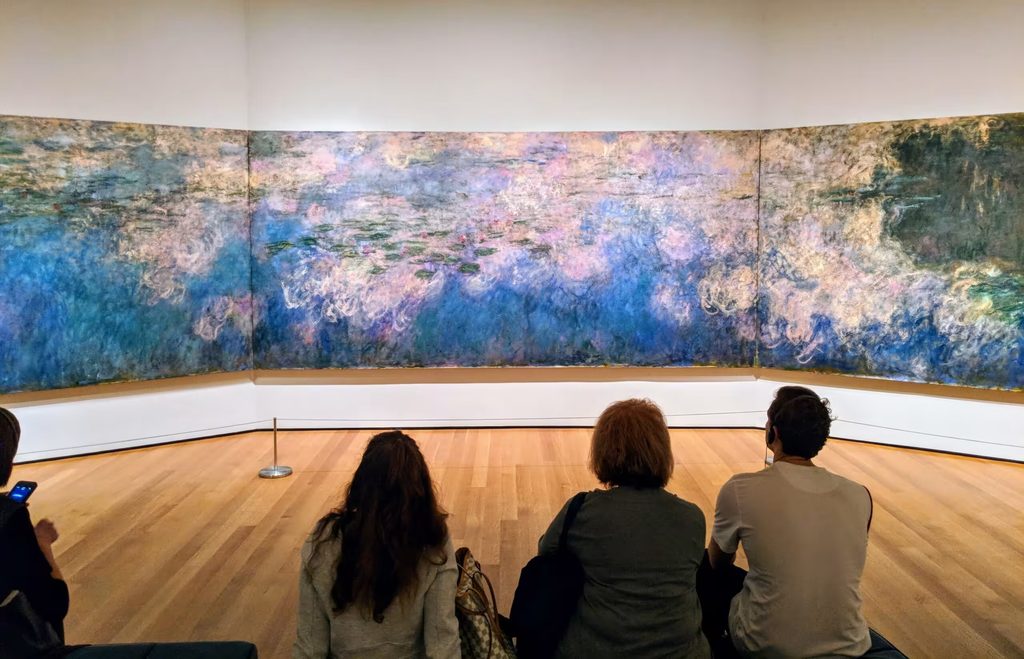
- In 1958, a fire destroyed Monet’s five-meter-wide Water Lilies. The Water Lilies displayed at MoMA today were acquired as replacements.
- MoMA’s Film Department is the oldest museum film archive in the United States. Founded in 1935, it preserves more than 30,000 films.
- The permanent collection galleries are rearranged every 6–9 months. Before visiting the museum, it is best to check whether the painting you are interested in is currently on display on the moma.org/collection website.
- MoMA was renovated and expanded under the direction of Japanese architect Yoshio Taniguchi. Some of its innovations, such as the flow of space, continue to provoke mixed reactions to this day.
- The museum’s first director, Alfred Barr, was only 27 years old.
- New York State residents can enter for free on Fridays from 5:30 p.m. to 8:30 p.m., but advance reservations are required.
Architecture of the Museum of Modern Art (MoMA)
Modern MoMA is not a single building but the result of a series of additions, which is one reason the museum is still not the easiest place to navigate.
The first museum building was designed by architects Philip Goodwin and Edward Durell Stone on a site donated to the museum by the Rockefeller family. It was the first building in Manhattan constructed specifically as a museum in the International Style. The term “International Style” itself was coined at MoMA.
Architect Philip Johnson created the Abby Aldrich Rockefeller Sculpture Garden for the museum — a quiet courtyard with marble terraces and a wall that blocks out the noise of the street. He later added the East and Garden Wings, quadrupling the museum’s exhibition space.
In 1984, the museum made one of the most unexpected decisions in its history: MoMA sold the development rights above its site to a developer, who built the 52-story Museum Tower residential skyscraper above the museum. The taxes paid by the tower’s residents went toward bonds that financed the museum’s expansion, designed by architect César Pelli. The same model was later used by Carnegie Hall and the Metropolitan Museum of Art.
In 2004, the museum closed for two and a half years for renovations. Following a closed competition, Japanese architect Yoshio Taniguchi was selected to design the new building. After MoMA reopened, it faced a controversy: admission increased to $20, making it the most expensive museum ticket in the United States at the time.
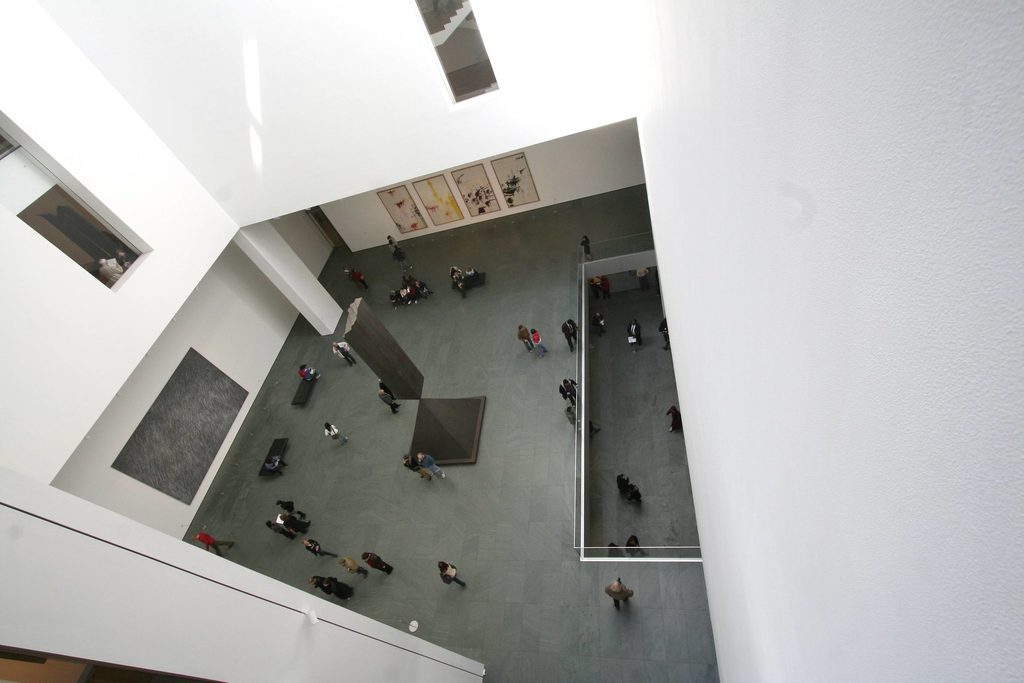
The most recent expansion, completed in 2019, was designed by Diller Scofidio + Renfro at a cost of $450 million. The museum’s total area grew to 65,774 square meters, free street-level galleries that can be visited without a ticket were added, along with the West Wing inside the skyscraper designed by architect Jean Nouvel. The main visual attraction of the new wing is a blade-like staircase weighing approximately 70 tons, suspended from the ceiling without a single side support.
Collection of the Museum of Modern Art (MoMA)
The permanent collection is arranged approximately chronologically by floor:
- 5th floor (1880–1950) — Van Gogh, Picasso, Monet, Dalí, Matisse, Klimt;
- 4th floor (1950–1980) — Warhol, Jasper Johns;
- 3rd floor — architecture, design, and photography, including unusual objects for an art museum such as a Bell-47D1 helicopter and the @ symbol;
- 2nd floor — the collection from the 1980s to the present day;
- 1st floor and lower level — free street-level galleries, the sculpture garden, and movie theaters.
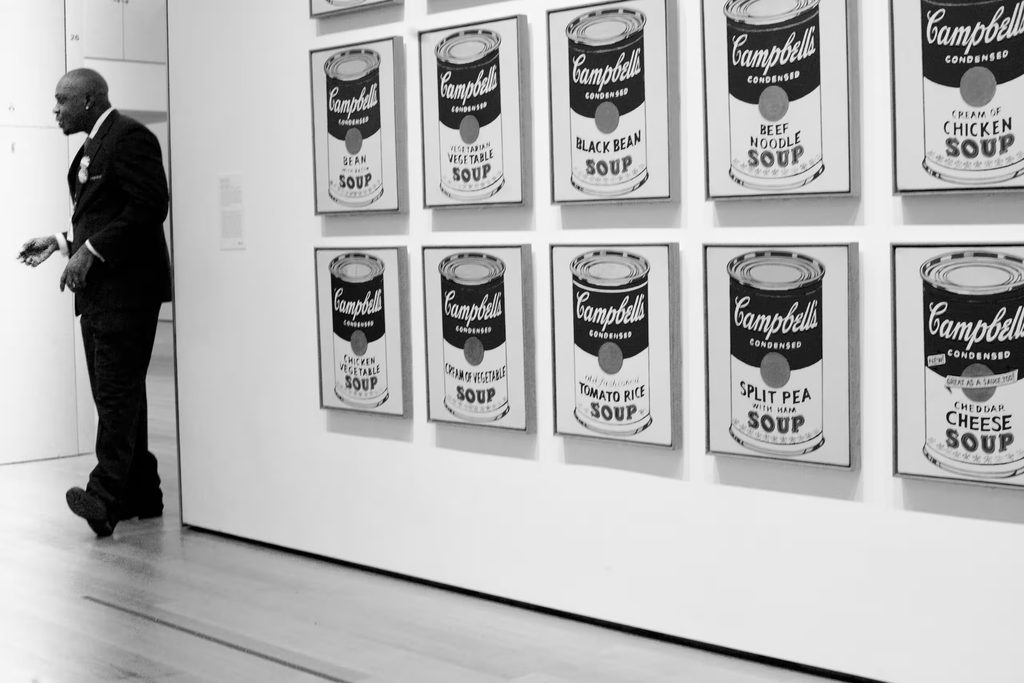
Among the works worth visiting the museum specifically to see are Van Gogh’s The Starry Night (Gallery 501), which is actually a surprisingly small canvas measuring just 73 × 92 cm; Picasso’s Les Demoiselles d’Avignon (Gallery 502); Monet’s Water Lilies triptych (Gallery 515); Dalí’s The Persistence of Memory, which is surprisingly no larger than a sheet of A4 paper; Warhol’s Campbell’s Soup Cans and Gold Marilyn; and Frida Kahlo’s Self-Portrait with Cropped Hair.
The most important thing to know before visiting: the museum officially rearranges its permanent collection galleries every 6–9 months, updating approximately one-third of the galleries at a time. This means a particular work may temporarily be off display. You can check this on the moma.org/collection website — each work’s page indicates “On view” with the gallery number or “Not on view.” Only about a dozen key works are on permanent display, including The Starry Night and Les Demoiselles d’Avignon.
History of the Museum of Modern Art (MoMA)
MoMA was founded in 1929 by three women collectors whom their contemporaries called the “adamantine ladies.” Its first director was 27-year-old Alfred Barr, who also developed the museum’s fundamental concept: painting, design, architecture, and film would be presented on equal terms.
In 1933, Barr drew the famous diagram of the museum as a torpedo moving through time: anything that ceased to be modern was supposed to move on — for example, to the Metropolitan Museum of Art. The idea was formalized in an agreement in 1947, but the agreement was terminated in 1953. Nevertheless, the principle never completely disappeared: MoMA still sells some works from its collection to acquire new ones, doing so more frequently than any other major American museum.
On April 15, 1958, a fire broke out in the museum building. One employee died, and one panel of Monet’s Water Lilies triptych was destroyed. After the fire, MoMA received an insurance payout and in 1959 purchased the current triptych from the artist’s son. This is how Monet’s dedicated gallery came into being.
Over the past two decades, the museum has repeatedly found itself at the center of controversy: over the steady increase in admission prices, from $12 in 2004 to $30 today; over selling works from the collection to fund new initiatives; over the demolition of the neighboring American Folk Art Museum building in 2014; and over protests concerning the composition of the museum’s board of trustees in 2021–2024.
The Museum of Modern Art (MoMA) in Pop Culture
MoMA is not only a temple of art but also a place that has long been part of popular culture.
The museum has been used as a filming location several times. Woody Allen filmed scenes inside MoMA for Manhattan (1979), while director John Cassavetes used the museum for his independent drama Shadows (1961).
But MoMA’s strongest connection to popular culture comes through its design collection, which blurs the line between art and everyday objects. The museum houses the first Sony Walkman, a New York City subway map that was once widely criticized but is now considered a design classic, and a Bell-47D1 helicopter — the same model that appears in the television series MASH*.
In 2012, the museum officially added 14 video games to its collection as examples of interactive design, including Pac-Man, Tetris, and The Sims. In 2010, curator Paola Antonelli added the @ symbol to the collection — not as a physical object, but as the idea of using the symbol in electronic mail.