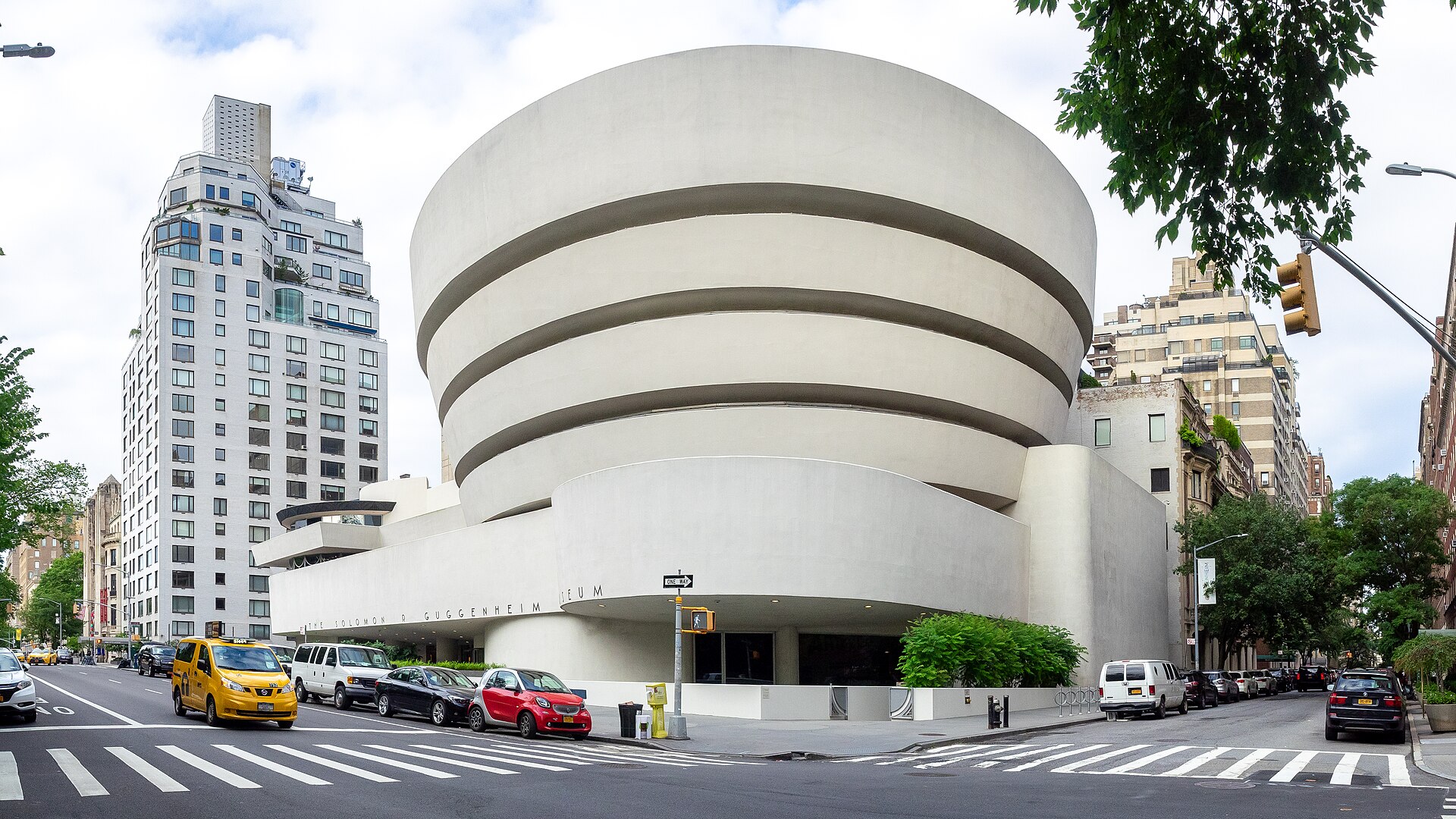
The Solomon R. Guggenheim Museum is one of the most famous museums in New York and the main landmark of Museum Mile. It is easy to recognize by its unusual spiral building on Fifth Avenue, designed by architect Frank Lloyd Wright. The museum’s collection includes 8,000 works of art, ranging from Impressionism and Post-Impressionism to contemporary art. Visitors explore them as they descend along the spiral ramp.
Interesting Facts About the Guggenheim Museum
- The collection is twenty years older than the building. It opened to the public in 1939 under the name Museum of Non-Objective Painting.
- The museum’s architect, Frank Lloyd Wright, received the commission in 1943, when he was 76 years old, and worked on the project for 16 years.
- Construction did not begin until 1956. Before that, the project was delayed by the war, material shortages, rising costs, and conflicts within the museum itself.
- The facade was originally supposed to be made of marble and, according to one of Wright’s ideas, painted red. In the end, it was made of sprayed concrete and painted. During restoration, conservators found the original yellowish-brown color beneath layers of white paint.
- Wright claimed that next to his museum, the Metropolitan Museum of Art would look like a “Protestant barn.” The criticism from others was no gentler: people compared the museum building to an upside-down washing machine and a corkscrew.
- The ramp is approximately 432 meters long and rises at a slope of about 5 percent, while the walls are tilted at 97 degrees to accommodate easels.
- Three years before the museum opened, artists signed a collective letter protesting the idea of displaying their works on the building’s sloping walls.
- The shootout scene in the film The International (2009) was not filmed in the museum itself, but in a full-scale replica built outside Berlin at a cost of 1.6 million dollars.
- The building has been a UNESCO World Heritage Site since 2019.
The History of the Guggenheim Museum
Solomon Guggenheim was born into a family of mining magnates. He began collecting art in the 1890s. In 1926, he met artist Hilla von Rebay, who introduced him to the European avant-garde and the idea of non-objective art. Guggenheim became fascinated with the new movement and completely transformed his collection. He began buying works by Wassily Kandinsky and other abstract artists. His apartment at the Plaza Hotel was the first place where he showed his collection to the public.
In 1937, Guggenheim established the Solomon R. Guggenheim Foundation, and in 1939, the foundation opened the Museum of Non-Objective Painting. Hilla von Rebay became its director. By the early 1940s, the collection had grown so much that it became clear that the museum needed a permanent building of its own.
In 1943, Guggenheim and Rebay wrote to Frank Lloyd Wright. It was his first major commission in New York. He agreed to take on the project and even stated that he had never before seen a properly designed museum. Guggenheim chose a site next to Central Park for the building.
However, construction materials were difficult to obtain during the war, and prices rose sharply afterward. Wright also constantly argued with the clients about lighting and how the paintings should be displayed. In 1953, the city’s Department of Buildings refused to issue a permit for the project.
Solomon Guggenheim died in 1949 and never saw the completed building. Wright proposed reducing the project so that it could be finished during the client’s lifetime, but Guggenheim did not want to give up the original design.
In 1952, the museum received its current name, the Solomon R. Guggenheim Museum. That same year, Hilla von Rebay stepped down as director and was replaced by James Johnson Sweeney. He believed that architecture should support art rather than compete with it, so he soon began arguing with Wright. They disagreed about the color of the walls, the slope of the galleries, and the upper windows. By 1958, they were no longer speaking directly, and Harry Guggenheim acted as an intermediary between them.
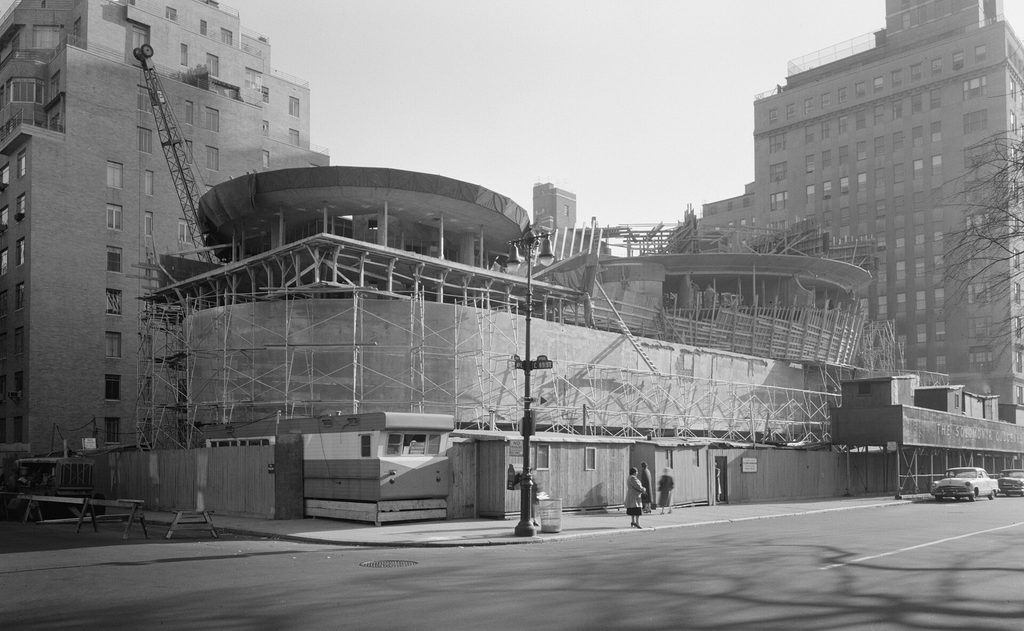
The demolition of the old buildings on the site began on May 6, 1956, and construction started in August. In the end, the museum cost approximately twice as much as the original estimate.
Frank Lloyd Wright died in April 1959, six months before the museum opened. The new building was shown to journalists on October 20, and the museum officially opened to the public on October 21.
From 1990 to 1992, the museum closed for a major renovation that cost 24 million dollars. The architectural firm Gwathmey Siegel built a ten-story addition on 89th Street, restored the upper windows along the ramp that had previously been sealed, and nearly doubled the exhibition space.
From 2005 to 2008, the exterior of the museum underwent restoration. By that time, numerous cracks had appeared in the facade.
The Architecture of the Guggenheim Museum
The complex consists of three parts. The main one is the six-story rotunda on the south side. A four-story building called the “monitor” in the original drawings is attached to it on the north side. It now houses the Thannhauser Collection. A ten-story addition built in the 1990s stands to the northeast. The rotunda and the monitor are connected by a “bridge” on the second floor. The main entrance from Fifth Avenue is located underneath it.
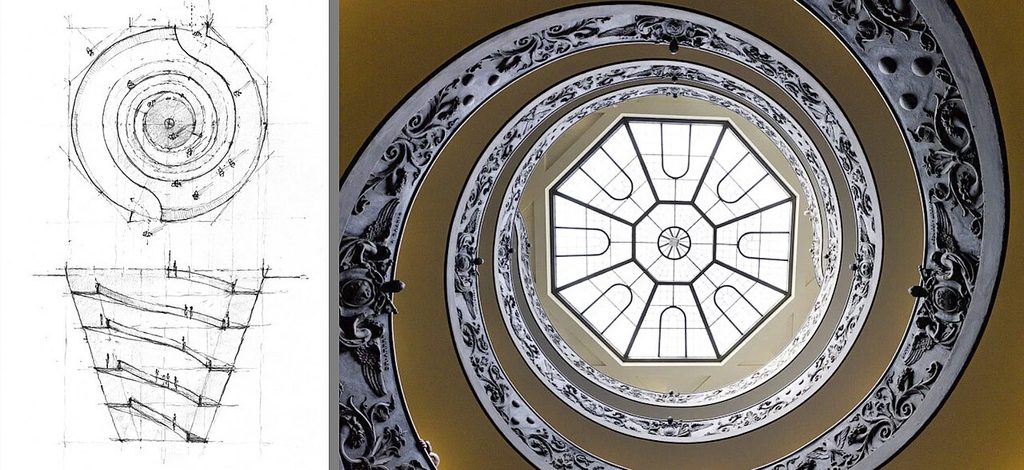
Inside, everything is built around a spiral. A reinforced concrete ramp approximately 432 meters long rises upward at a slope of about 5 percent. It becomes wider as it rises, from 7.6 meters at the bottom to 9.8 meters at the top. The walls are tilted at 97 degrees. A glass dome approximately 29 meters high covers the central atrium.
Wright wanted the paintings to hang at a slight angle, like they would on easels, while the low ceiling would create a more intimate space. The museum’s new director, James Johnson Sweeney, decided to do things differently: the walls were painted white, and the paintings were hung from metal rods.
Wright gave the building’s forms symbolic meanings. In his design, the circle represented infinity, the triangle represented structural unity, the spiral represented organic growth, and the square represented completeness. The circle is repeated throughout the building, from the plan of the rotunda to the metal arcs in the floors and the pattern of the pavement in front of the entrance.
Wright planned to clad the facade in marble, but contractor George Cohen used sprayed concrete instead. This made the construction less expensive. Wright’s and Cohen’s names were placed next to each other on a tile on the exterior of the building. For Wright, this was a rare case in which the builder’s name appeared alongside his own. The concrete was covered with an ivory-colored coating. Later, during restoration, the original yellowish-brown color was discovered beneath layers of white paint.
The new architecture sparked a great deal of controversy. The museum was compared to a giant corkscrew, a washing machine, and a marshmallow. Some artists feared that the unusual architecture would distract attention from the paintings and signed a letter of protest. Architectural critic Lewis Mumford also opposed the project, arguing that its form was not connected to its function.
At the same time, the museum had its defenders. Emily Genauer called it the most beautiful building in America. The project was also supported by architects Philip Johnson and Edward Durell Stone.
Over time, the building received official recognition. In 1986, the American Institute of Architects included the museum in its “Twenty-Five Year Award” program and recognized it for its architectural significance. In 1990, the museum and its interiors were designated a New York City landmark. In 2005, it was added to the National Register of Historic Places. In 2008, it was designated a National Historic Landmark, and in 2019, it was added to the UNESCO World Heritage List.
The Guggenheim Museum Collection
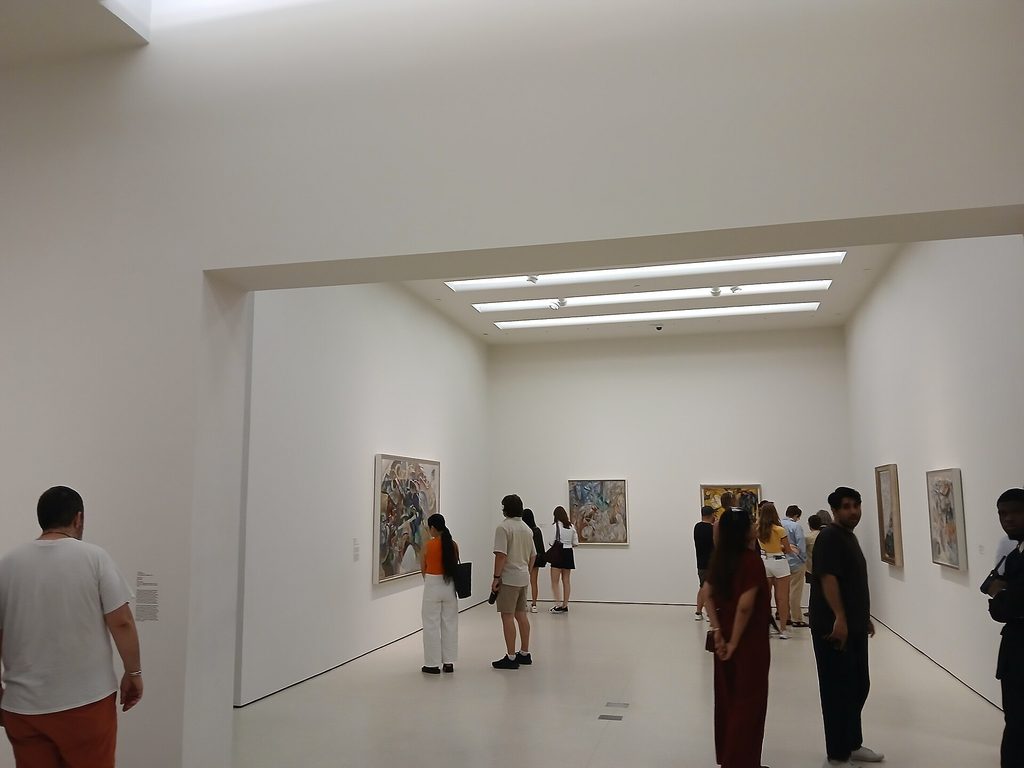
The collection officially contains around 8,000 works, but the museum can display only a small portion of them at any given time. After the 1992 renovation, approximately 6 percent of the collection was on display. Unlike many major museums, the Guggenheim does not divide its collection into separate departments. The permanent collection is usually displayed in the side galleries, while the rotunda is used for major temporary exhibitions.
The main parts of the collection include:
- The Founding Collection. In 2007, 620 works by more than 60 artists were brought together in a separate gallery named after the museum’s founder, Solomon R. Guggenheim. The collection contains particularly many works by Wassily Kandinsky, with more than 150 pieces. Kandinsky was one of the pioneers of abstract art: he was among the first artists to create paintings in which color, line, and form were more important than the depiction of specific objects. Other well-known works include Green Violinist by Marc Chagall, The Yellow Cow by Franz Marc, Woman with a Fan by Jean Metzinger, and The Accordionist by Pablo Picasso.
- The Karl Nierendorf Collection, purchased in 1948, contains approximately 730 works. Nierendorf was a German art dealer and gallery owner who primarily collected German Expressionism, an early twentieth-century movement in which artists deliberately distorted forms and used color to convey emotions. Artists represented in this collection include Paul Klee, a Swiss-German master known for his distinctive abstract compositions; Oskar Kokoschka, one of the best-known Austrian Expressionists; and Joan Miró, a Spanish artist whose work developed on the border between Surrealism and abstraction.
- Twenty-eight works from the collection of Katherine Dreier, which entered the museum in 1953. Dreier was an artist and collector who, together with Marcel Duchamp and Man Ray, founded Société Anonyme, one of the first organizations in the United States to systematically introduce the public to European and American modern art. This part of the collection includes works by Alexander Archipenko, a Ukrainian-American sculptor who experimented with empty spaces within sculptures; Constantin Brâncuși, one of the major figures in modern sculpture; Alexander Calder, creator of the famous kinetic sculptures known as mobiles; as well as Marcel Duchamp, Juan Gris, El Lissitzky, Piet Mondrian, and Kurt Schwitters. At different times, all of these artists moved away from traditional ideas about what a work of art should be.
- The Justin K. Thannhauser Collection, acquired in 1963. Thannhauser was a German art dealer who spent many years collecting and exhibiting modern French art. The original collection consisted of 73 works by Impressionist, Post-Impressionist, and French modernist artists. It includes works by Renoir, Manet, Pissarro, Cézanne, Van Gogh, and 32 works by Picasso. Among them are Moulin de la Galette and The Ironer. The dedicated Thannhauser gallery shows how European painting gradually moved from realistic representations of the world toward the freer forms of modernism. Critic John Russell wrote that, for twentieth-century art, the collection was roughly what the Frick Collection was for earlier art.
- The Hilla Rebay Legacy. The museum received more than 600 works in 1971, four years after Rebay’s death, following a lengthy legal battle. Rebay was an artist, collector, and one of the most important figures in the early history of the museum. She spent years persuading Solomon Guggenheim to collect modern non-objective art and became the first director of his foundation.
- The Gianna and Giuseppe Panza Collection, acquired in 1990, focuses on Minimalism and the art that developed after it. Minimalist artists deliberately rejected complex subjects and decoration, using simple geometric forms, repetition, and industrial materials. The collection includes works by Carl Andre, Dan Flavin, Donald Judd, Robert Ryman, Richard Serra, and James Turrell. Some works existed only as drawings when they were acquired: the artists created them specifically for particular spaces.
- Two hundred photographs by Robert Mapplethorpe, acquired in 1992. Mapplethorpe was an American photographer known for carefully composed black-and-white portraits, photographs of flowers, and nudes. This was the first major acquisition of twentieth-century photography by the Guggenheim and marked the beginning of a dedicated photography program at the foundation. In 2001, the museum acquired the Bohen Foundation collection, consisting of approximately 275 works by 45 artists working with video, film, and other new media.
If you are visiting the museum to see specific works, look out for The Yellow Cow by Franz Marc, Paris Through the Window by Marc Chagall, Morning in the Village after Snowstorm by Kazimir Malevich, Violin and Palette by Georges Braque, The Eiffel Tower by Robert Delaunay, The Poet by Pablo Picasso, Sad Young Man on a Train by Marcel Duchamp, Red Balloon by Paul Klee, The Tilled Field by Joan Miró, Three Studies for a Crucifixion by Francis Bacon, Cubi XXVII by David Smith, and works by Mark Rothko.
It is also worth visiting the Thannhauser Gallery. It brings together works by Renoir, Manet, Cézanne, Seurat, Van Gogh, and Degas, artists who significantly changed European painting in the late nineteenth and early twentieth centuries. Nearby are several important early works by Picasso, including Moulin de la Galette and The Ironer.
Temporary Exhibitions
The rotunda, with its long continuous ramp, is not particularly well suited to traditional museum displays, but its space works well for large-scale thematic exhibitions. Instead of simply hanging paintings on the walls, curators can build an entire exhibition along the spiral and use the full volume of the building.
Notable exhibitions have included Africa: The Art of a Continent (1996), dedicated to art from different regions of Africa; China: 5,000 Years (1998), a broad history of Chinese art; and The Art of the Motorcycle (1998), which displayed actual motorcycles directly on the ramp. In 2001, the museum presented Brazil: Body and Soul, followed in 2004 by Aztec Empire, dedicated to Aztec culture and history.
In 2005, the Guggenheim presented RUSSIA!. The exhibition covered several centuries of Russian art, from ancient icons to works by Ilya Repin and Mikhail Vrubel, followed by Malevich and Chagall, and finally contemporary artists.
In 2016, one of the most unusual works in the museum’s history appeared in the rotunda: America by Maurizio Cattelan. It was a fully functional gold toilet installed in a museum restroom. Visitors were allowed to use it, so the artwork was simultaneously an exhibition piece and a perfectly ordinary toilet.
The Guggenheim Museum in Film
Wright’s spiral is an excellent filming location, and several movies have been shot there:
- Men in Black (1997). A chase after an alien leads Agent J to the museum, where the fleeing alien jumps from the roof. The spiral geometry adds a sense of movement to the scene.
- The International (2009). The shootout between Clive Owen and the bank’s hired assassins is the most famous scene associated with the museum, but it was not actually filmed there. A full-scale replica of the interior, approximately 36 meters wide, was built in an abandoned locomotive depot outside Berlin because the real building was covered in scaffolding for restoration at the time. The replica cost approximately 1.6 million dollars to build and took ten weeks to complete. Instead of paintings, video art was hung on the walls to avoid the complications of insuring valuable artworks.
- The museum was also used as a filming location for Hamlet (2000), starring Ethan Hawke, and Woody Allen’s Small Time Crooks (2000).