The Brooklyn Botanic Garden is the kind of place that reveals itself differently with every visit and every season. You go once for the cherry blossoms and find yourself returning in October for the maples, in June for the roses, in January for the orchids. It is 52 acres that somehow contain the whole world’s flora — planted, tended, and kept alive through over a century of care, on a site that was once a dump, in a borough that contains multitudes.
Interesting facts about Brooklyn Botanic Garden
- It was built on a garbage dump. The ground beneath the cherry trees and rose gardens was used as a dump during the construction of Prospect Park.
- Over 200 cherry trees grow at Brooklyn Botanic Garden, the oldest of which were planted in 1921.
- The annual Sakura Matsuri cherry blossom festival is one of the largest cherry blossom celebrations outside Japan.
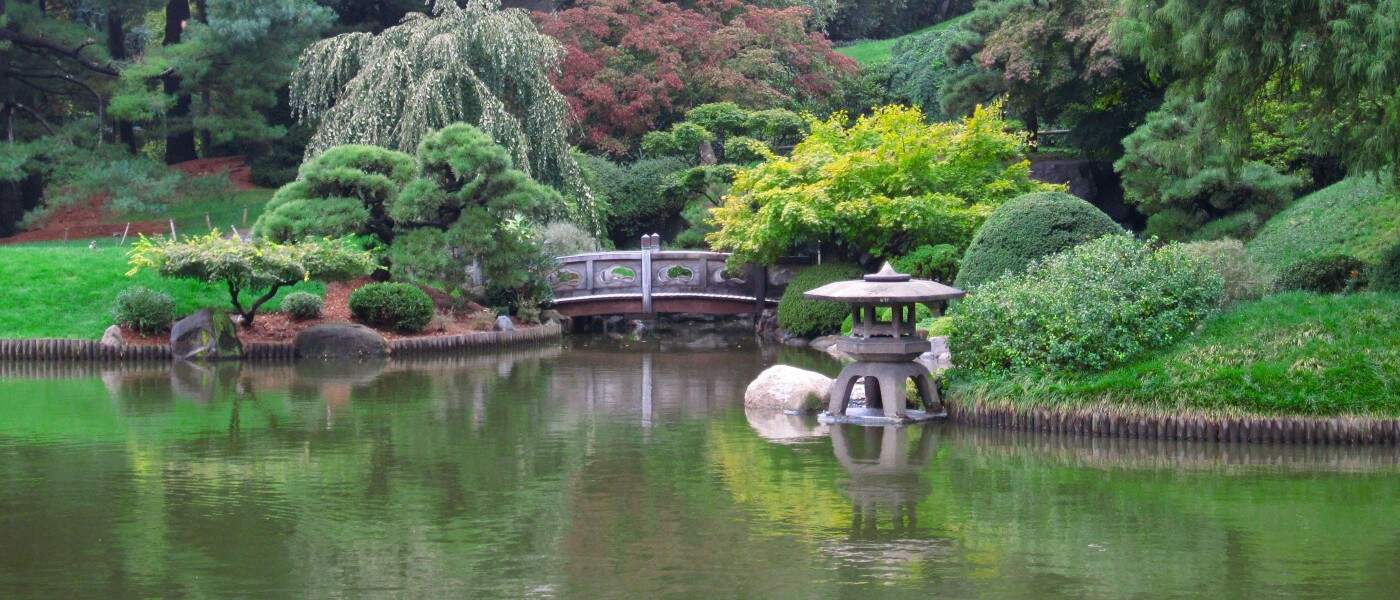
- The Japanese Hill-and-Pond Garden was among the first in America. Designed in 1915 by Takeo Shiota, it was one of the first Japanese-style gardens in an American public park.
- The Cranford Rose Garden was built on a subway tunnel. Today it contains over 5,000 rose bushes with more than 1,400 different varieties.
- A celebrity walk with 151 names, including Barbra Streisand and Walt Whitman, runs through Brooklyn Botanic Garden.
- In 2006, a rare Sumatran corpse flower bloomed in the Steinhardt Conservatory. The plant blooms once every several years and smells like rotting flesh. It drove a dramatic spike in attendance and became front-page news in New York.
What to see and do at Brooklyn Botanic Garden
The Japanese Hill-and-Pond Garden
One of the jewels of the entire garden. Designed by Takeo Shiota in 1915, this three-acre landscape recreates the layered atmosphere of a traditional Japanese garden. There is a central pond, arched bridge, stone lanterns, a torii gate. Seasonal plants shift through the year: cherry blossoms in spring, water lilies in summer, blazing maples in fall.
Cherry Walk is the most photographed place in Brooklyn each spring. Over 200 cherry trees create an unbroken canopy of pink and white blossoms, typically peaking in mid-to-late April. The annual Sakura Matsuri festival, held at peak bloom, transforms the garden into a celebration of Japanese culture with performances, workshops and food.
Cranford Rose Garden
The Cranford Rose Garden was unveiled in 1928 with over 1,000 rose varieties. Since then it has grown into one of the most significant rose collections in the country, with peak blooming in June and a second flush in late August.
Steinhardt Conservatory
A greenhouse complex divided into distinct climate zones: the Warm Temperate Pavilion (Mediterranean plants, olive trees, aromatic blossoms), the Tropical Pavilion (lush and humid, with orchids and giant lily pads), the Desert Pavilion (cacti and succulents from around the world). On cold winter days, this is where the garden truly earns its worth — a step inside feels like leaving New York entirely.
One of the finest bonsai collections in the United States, housed in a dedicated space within the Steinhardt Conservatory. Some specimens are decades or even centuries old.
Shakespeare Garden
Opened in 1925 this intimate garden contains only plants mentioned in the works of William Shakespeare. It’s a small, literary corner of the garden that rewards slow walking and close attention.
Native Flora Garden
The very first garden planted at Brooklyn Botanic Garden in 1911. A self-guided audio tour is available, sharing knowledge of these plants and their medicinal and cultural uses.
Rock Garden
It contains alpine plants arranged around 18 boulders left behind by glaciers during the Ice Age. It is, in the most literal sense, older than the city.
History of Brooklyn Botanic Garden
The site of the future garden had been used by the Parks Department as a dump while Prospect Park was being built. Glacially carved and waterlogged, the terrain was considered too difficult to develop. Then, in 1897, the New York State Legislature had a better idea: why not make a botanic garden?
The land was originally purchased by the City of Brooklyn as part of its Prospect Park acquisition, and the site — 39 acres at first — was formally set aside for a botanical garden. The project came to life in 1910, when botanist Charles Stuart Gager became the first director. He envisioned the garden as “an animated textbook in botany.” Fortunately, the people around him also wanted it to be beautiful.
The landscape design was entrusted to the Olmsted Brothers — sons of Frederick Law Olmsted, the genius behind Central Park. McKim, Mead & White were brought in to design the garden’s buildings. The garden officially opened on May 13, 1911, a date chosen to honor the botanist Carl Linnaeus.
Visitor Information
📍Brooklyn Botanic Garden / 990 Washington Avenue, Brooklyn, NY 11225
Hours: Tuesday through Sunday, 10:00 AM – 6:00 PM
Admission: $22 and pay-what-you-wish admission on weekday winter visits
Website: bbg.org