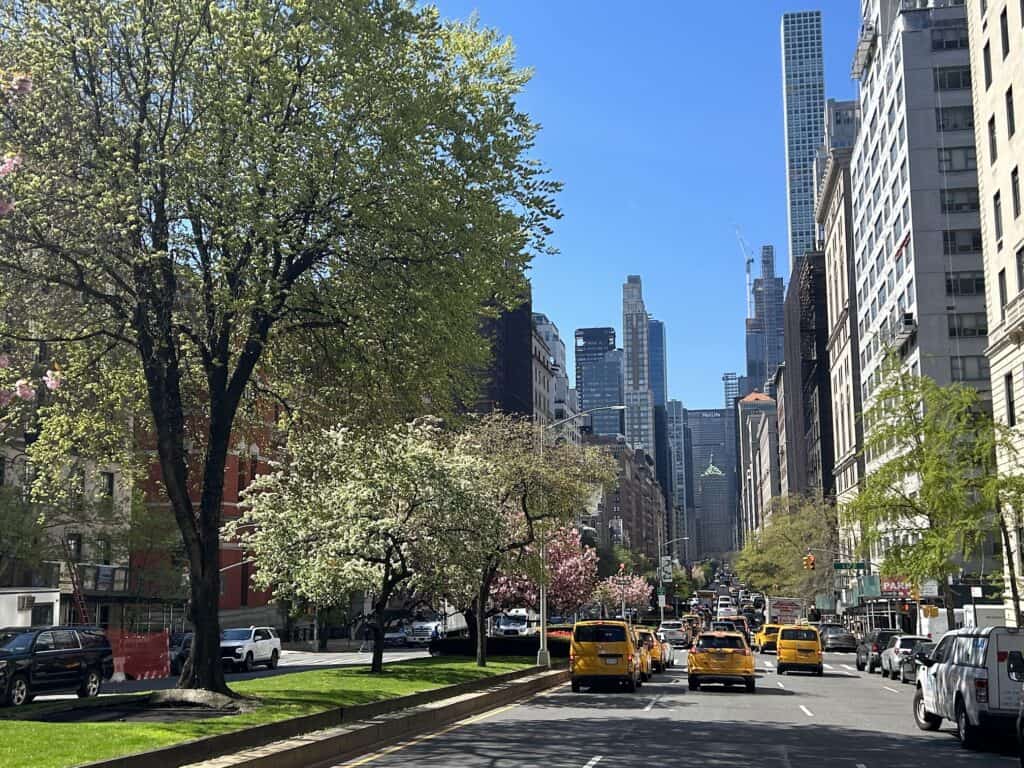
People often say, “I have heard this name all my life,” about Park Avenue, but few can actually explain what is there. Yet it is one of the most prestigious streets in Manhattan, running through the center of the city from north to south. It is home to major corporate headquarters and some of the most expensive residential buildings.
Interesting facts about Park Avenue in New York
- The avenue runs directly above the tunnels of the Metro-North Railroad. This is a legacy of the old tracks leading to Grand Central Terminal.
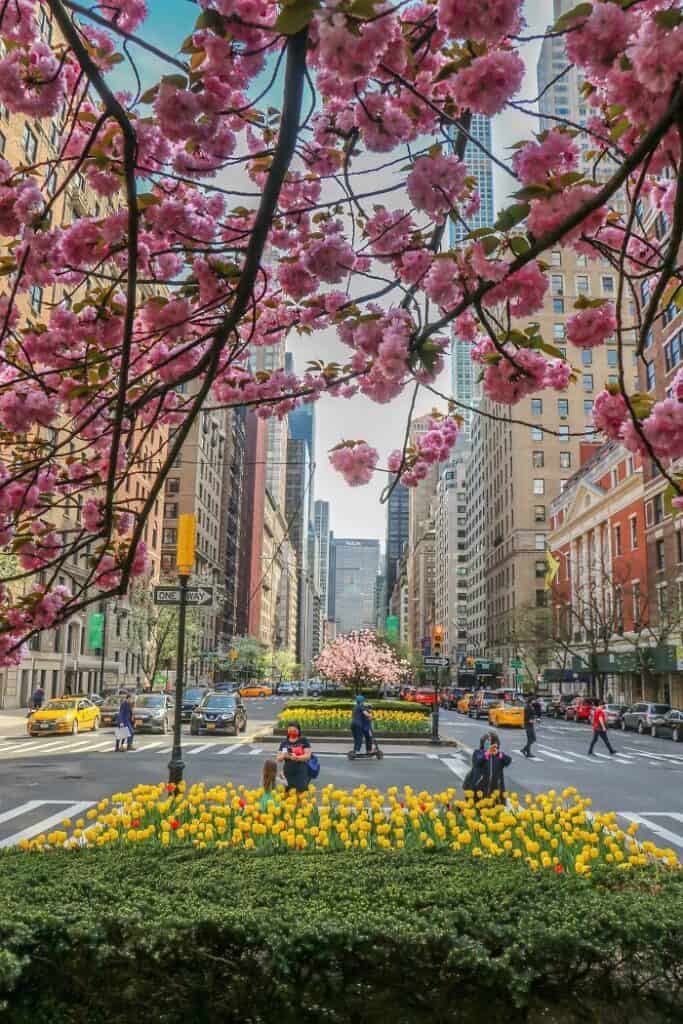
- In Midtown, Park Avenue is decorated with green medians filled with flowers and sculptures that are regularly updated. These flower beds are one of the street’s visual trademarks.
- After the construction of Grand Central Terminal in the early twentieth century, luxury residential buildings began to be actively developed above the tracks, significantly increasing the status of the area.
- Park Avenue is home to the Seagram Building, designed by Ludwig Mies van der Rohe, one of the most famous examples of modernist architecture in the world.
- Along the avenue are luxury residential buildings with separate entrances for staff — a historical legacy of wealthy New York families.
- To purchase an apartment on Park Avenue, a buyer must pass an approval process. As a result, developers have refused sales to celebrities due to their public visibility.
- Park Avenue changes its name in southern Manhattan: south of 14th Street it becomes Fourth Avenue. This section often hosts seasonal installations and outdoor art projects, turning the street into an open-air gallery.
What Park Avenue is and where it is located
📍 Park Avenue, New York, NY — is a wide boulevard in Manhattan that stretches from south to north roughly from 32nd Street to 96th Street, after which it transitions into East Harlem and continues toward the Bronx in a very different form. The “main” section runs from Grand Central Terminal at 42nd Street to 96th Street.
A green strip of flower beds runs down the center of the avenue. In spring, tulips bloom there; in autumn, chrysanthemums. The landscaping is maintained by the nonprofit organization Fund for Park Avenue, which has operated on private donations since the 1970s.
The meaning of the name Park Avenue
The name is historically ironic. Until the end of the nineteenth century, open railway tracks of the New York Central Railroad ran along the avenue, and the entire area was a dirty industrial corridor filled with steam locomotive smoke. In 1903, the tracks were moved underground, covered over, and the avenue was literally rebuilt as a respectable boulevard. Grand Central Terminal, which opened in 1913, became the logical culmination of this transformation.
That is also why the Metro-North Railroad still runs beneath Park Avenue today — trains to Connecticut and along the Hudson River depart literally beneath your feet as you walk along the boulevard.
Architecture of Park Avenue
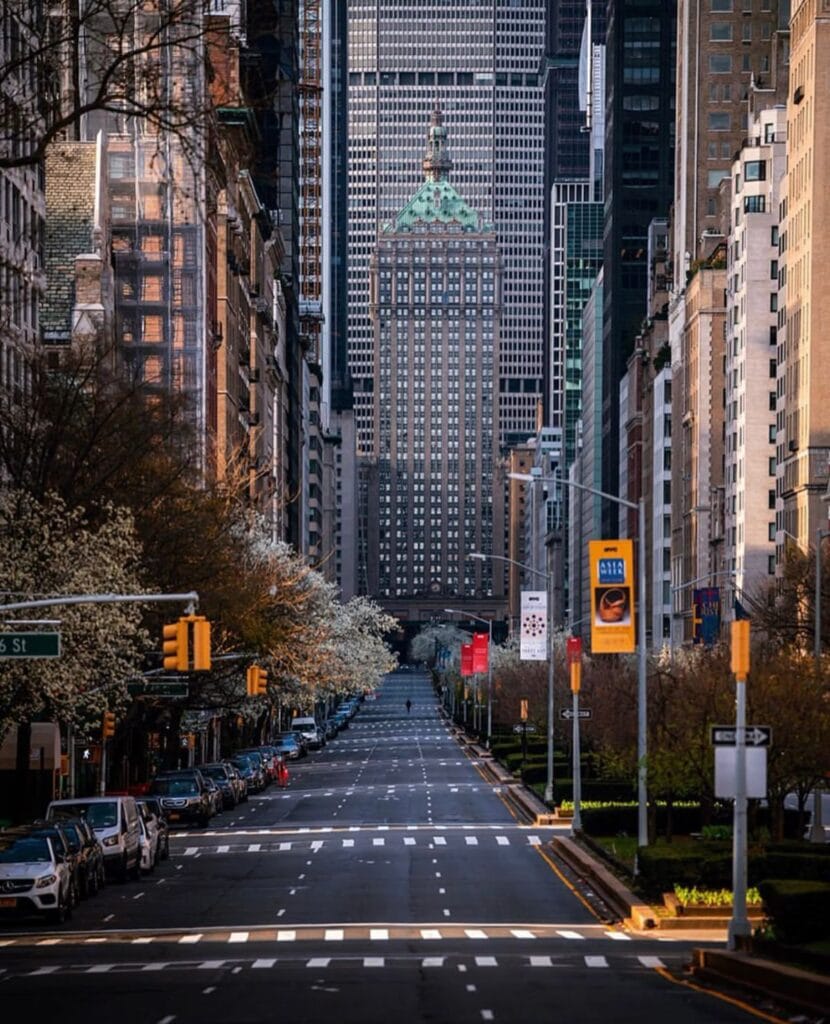
Park Avenue is like a living textbook of twentieth-century American architecture. If you walk north from 42nd Street, you can observe three distinct eras in sequence.
Beaux-Arts and interwar classicism (40th to 50th Streets)
Here stand solid brick towers from the 1920s and 1930s — expensive residential buildings with grand entrances, doormen, and marble lobbies.
Mid-century modernism (50th to 60th Streets)
This area features some of the best examples of American corporate modernism:
- 📍 Lever House / 390 Park Ave, New York, NY 10022 — built in 1952 by Skidmore, Owings and Merrill. The first skyscraper in New York with a glass curtain wall from floor to ceiling and the first with an open plaza at street level. A true architectural revolution. Today, the building is a landmark, and sculptures stand in its courtyard: a garden trowel and a handkerchief by Claes Oldenburg and Coosje van Bruggen.
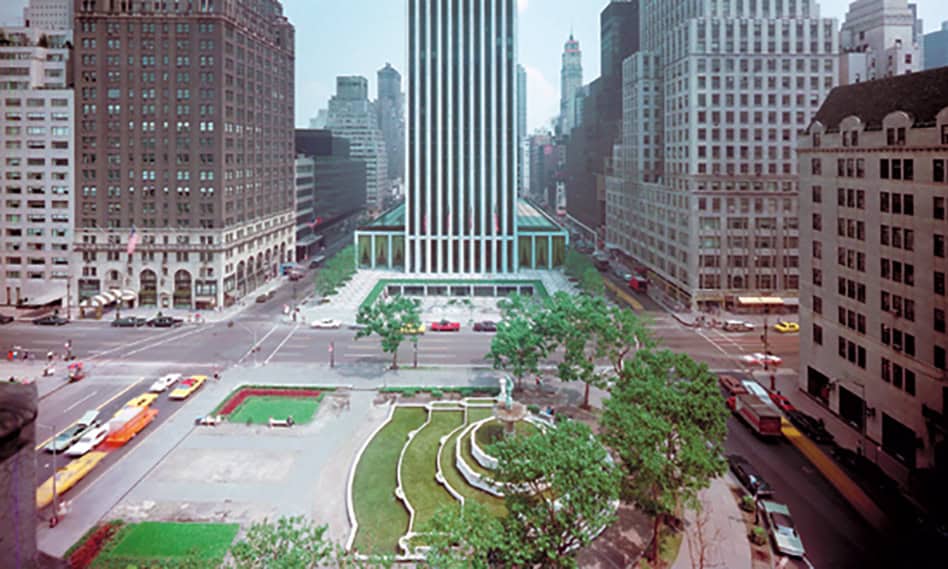
- 📍 Seagram Building / New York, 10022 — a masterpiece by Ludwig Mies van der Rohe, completed in 1958. Bronze structural elements, amber glass, and perfect proportions. It is perhaps the most influential skyscraper in history, setting the standard for corporate towers for the next fifty years. In front of the building is a wide marble plaza with fountains, deliberately set back from the street line. Inside, the legendary restaurant The Grill still operates.
- 📍 MetLife Building / 200 Park Ave, New York, NY 10166 — located directly above Grand Central Terminal and long one of the largest office buildings in the world by floor area.
Postmodernism and contemporary architecture (above 60th Streets)
Buildings become more diverse, with more intricate architectural details. Around the 90th Streets, the avenue changes character dramatically — beyond 96th Street begins East Harlem, which feels like a completely different city.
Sculptures in the courtyard of Lever House on Park Avenue
In the courtyard of 📍 Lever House / 390 Park Avenue, New York, New York 10022, there are currently two sculptures by the duo Claes Oldenburg and Coosje van Bruggen:
- Plantoir, Red — a five-meter-tall bright red garden trowel. This is a typical Oldenburg approach: take an ordinary object and make it monumental. Plantoir first appeared on the roof of the Metropolitan Museum of Art in 2002, then traveled around the world, with versions in Porto and Grand Rapids. The New York version is the third.
- Architect’s Handkerchief — a sculpture inspired by a photograph of Ludwig Mies van der Rohe with a handkerchief in his breast pocket. Since the Seagram Building stands directly across the street, the dialogue between the sculpture and the building feels especially natural.
The most expensive apartments in New York on Park Avenue
Park Avenue embodies American old money. It is one of the most expensive residential addresses not only in New York, but in the world.
Interestingly, a building’s board can refuse a buyer. Anyone who wants to live on Park Avenue must pass approval by a board of directors, which can reject an application without explanation. According to legend, several Hollywood stars were once denied apartments here because they were considered too public.
The average price of an apartment in the best buildings ranges from five to twenty million United States dollars, while penthouses can sell for forty to sixty million.
Park Avenue Armory
The Park Avenue Armory is a well-known cultural venue in New York, famous today for theater and musical performances held in a richly decorated building. However, it was originally built as a military facility.
The building was constructed between 1877 and 1881 for the Seventh Regiment of the New York State National Guard. This regiment consisted of wealthy New York residents, members of high society, including financiers, lawyers, and industrialists. They formed one of the most prestigious military units in the United States, considered elite both in composition and equipment.
Park Avenue in popular culture
Park Avenue frequently appears in films, often as a symbol of old money or corporate power. It is featured in the television series Succession, and characters in Kramer vs. Kramer and dozens of other New York stories pass through it. If you have watched anything about wealthy New Yorkers, Park Avenue has most likely already appeared in it.