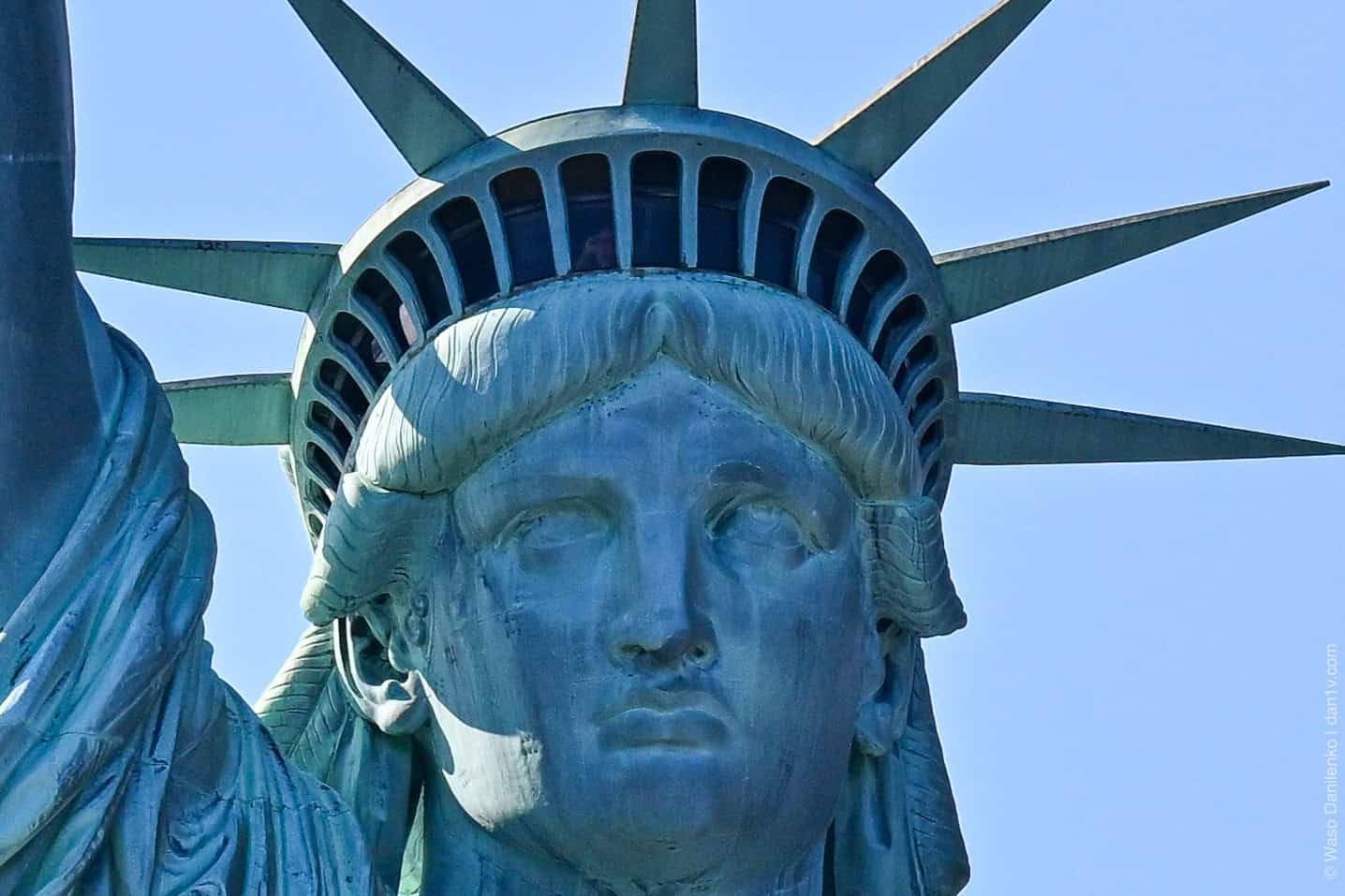
Statue of Liberty in New York is one of the most recognizable symbols in the world and an iconic image of American history. The monument represents democracy and independence — the core values on which the United States was built.
Lady Liberty has long served as a guiding beacon for millions of people seeking a new life. For immigrants arriving in New York Harbor, her silhouette was the first symbol of hope and the beginning of a new journey.
Over time, the statue has become not only a national landmark but also a global cultural symbol, reflected in film, literature, and world history.
Interesting Facts About Statue of Liberty
- The total height of the Statue of Liberty from the ground to the tip of the torch is 93 meters.
- Originally, the statue had a golden-pink hue.
- The seven rays on the crown symbolize the seven seas and seven continents, emphasizing the universality of freedom.
- Broken chains and shackles lie at the statue’s feet, symbolizing liberation from tyranny and slavery.
- The statue’s right foot is slightly raised, symbolizing a step forward—movement toward freedom and progress.
- The torch is covered with a thin layer of gold and illuminated by external spotlights.
- The Statue of Liberty was not entirely a gift from France—Americans also funded part of its construction.
- From its opening until 1902, the statue officially functioned as a lighthouse.
- Despite its massive weight, the statue is flexible and sways in the wind.
- Replicas of the Statue of Liberty exist in France, Japan, Brazil, and other countries.
- In 1984, the statue was added to the UNESCO World Heritage List.
What to see on Liberty Island besides the statue itself
There are several options for excursions to the Statue of Liberty. Depending on the type of ticket, you can choose different formats for exploring the landmark.
Basic tickets to the island allow you to visit the statue itself and see the pedestal. With more expensive tickets, you can climb up to the pedestal and visit the Statue of Liberty Museum. And the most expensive, but also the most valuable in terms of impressions, option is a tour to the crown of the Statue of Liberty.
The statue itself and Liberty Island
With a basic ticket, you will be able to land on Liberty Island and freely walk around its territory. From the viewing platforms around the pedestal, some of the best views of Lower Manhattan and Ellis Island open up.
The pedestal of the the Statue of Liberty
For an additional fee, you can purchase a ticket that includes access to the pedestal. Inside there is an observation deck from which an impressive view of the bay and the city opens. You can go up to the pedestal by elevator or by stairs. This option is well suited for those who want to see the statue more closely but are not ready to climb into the crown via a long spiral staircase.
Tour to the crown of the Statue of Liberty
The most popular and limited in number of tickets option is the tour to the crown of the Statue of Liberty. You will have to climb a narrow spiral staircase with about 160 (!) steps inside the statue itself. From the small windows in the crown, a unique view of New York Harbor opens.
We described the tour in more detail in this article:
Tickets to the crown must be booked in advance, sometimes several months ahead.
Statue of Liberty Museum
On Liberty Island there is the Statue of Liberty Museum. The exhibition includes original drawings, historical photographs, personal belongings of the creators of the monument, as well as the first torch of the statue, which was used before the reconstruction of the 1980s.
The museum is included in the price of a standard ticket to the island.
Excursion to Ellis Island
For a deeper immersion into the history of the Statue of Liberty and immigration to the United States, you can visit Ellis Island. It also houses the National Museum of Immigration. We described the tour in more detail in the article:
Where the Statue of Liberty is located and how to get there
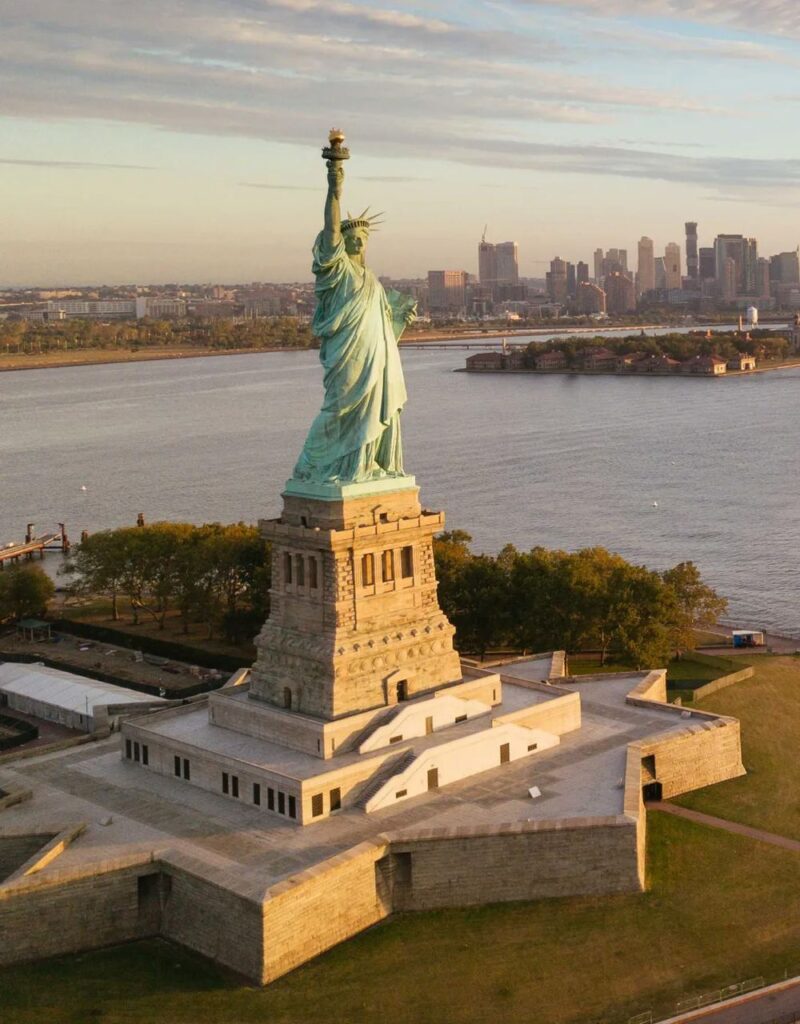
The monument stands approximately three kilometers to the southwest of the southern tip of Manhattan Island. In addition, the Statue of Liberty is located to the south of Ellis Island. Together, these two islands form the Statue of Liberty National Monument.
You can reach the statue only by water, using special ferries that depart from the following piers:
- Lower Manhattan, Battery Park / 1 Battery Place, New York, NY 10004, USA
- Liberty State Park / 1 Audrey Zapp Drive, Jersey City, NJ 07305, USA
Who gave the Statue of Liberty to America: the history of the main landmark of New York
The idea of creating the monument arose in France in 1865, in the house of the thinker and opponent of slavery Édouard de Laboulaye. He proposed to present the statue to the United States for the centenary of the Declaration of Independence, in order to mark the alliance between France and America, as well as the victory over slavery in the American Civil War.
The sculptor Frédéric Auguste Bartholdi, who was present at that meeting, became inspired by the idea. According to different versions, either the sculptor’s mother Charlotte or Isabella Boyer, the widow of Isaac Singer, posed for the face of the statue.
The project became a joint one: France paid for the statue itself, and the United States paid for the pedestal. In France, funds were raised through lotteries, charity concerts, and donations from entrepreneurs.
In the United States, fundraising progressed extremely slowly due to the economic depression and the lack of interest in other states, which considered it a “New York project.” The situation was saved by publisher Joseph Pulitzer, who in his newspaper New York World launched sharp criticism of the wealthy and called on ordinary citizens to donate at least one dollar.
Engineering solutions and construction
Work on the statue in Paris took 9 years. To implement such a large-scale figure (with a height of 46 meters), innovative solutions were required.
First, this is the internal framework. Gustave Eiffel created a flexible steel skeleton that allowed the copper shell of the statue to sway in the wind without being destroyed. The second innovation was the outer shell of the Statue of Liberty. It is made of copper sheets only 2 mm thick.
Journey and opening
By 1884, the statue was fully assembled in Paris. To deliver it to the United States, the monument was disassembled into 350 parts, packed into 214 crates, and sent aboard the French frigate “Isère.” In June 1885, the cargo arrived in New York Harbor.
The grand opening took place on October 28, 1886, in the presence of President Grover Cleveland. Although the gift was delayed by 10 years for the anniversary of independence, it instantly became a symbol of the nation.
During the first 16 years, the statue officially served as a lighthouse, but its light was too weak for navigation. In 1924, the statue was declared a national monument, and in 1956, Bedloe’s Island was officially renamed Liberty Island.
Height and dimensions of the Statue of Liberty in New York
The total height of the entire structure from the ground to the tip of the torch is 93 meters. The total weight of the monument exceeds 200 tons.
Precise calculations were required so that the figure would look proportional at such a gigantic scale. For example, the size of the head from the top to the chin is 5.26 meters, and the width of the face is 3.05 meters.
Interestingly, despite its enormous mass, the statue has flexibility: with a wind speed of 50 miles per hour (about 80 km/h), the figure itself can sway by 7.62 cm, and its torch — by 12.7 cm.
The Statue of Liberty as a symbol of democracy and independence

The full name of the monument is “Liberty Enlightening the World,” and each element of its composition carries a deep symbolic meaning related to the ideas of democracy, independence, and liberation from oppression.
Main elements of symbolism
In the raised right hand, the statue holds a burning torch, which symbolizes enlightenment and illumination of the “path to freedom.” It is intended to pierce the “darkness of ignorance and human oppression.”
Interesting fact: the modern torch is covered with 24-carat gold, which shines brightly in the rays of the sun.
The seven rays of the crown personify freedom spreading over the seven seas and seven continents (according to Western geographical tradition). According to another version, this is a symbol of sunlight or divine origin, referring to the images of the Roman goddess Libertas or the god Helios.
In the left hand, the statue holds a legislative tablet (tabula ansata). It bears the date of the adoption of the US Declaration of Independence — “JULY IV MDCCLXXVI” (July 4, 1776), which emphasizes the supremacy of law and the triumph of independence.
At the feet of the statue lie broken shackles and torn chains. This element symbolizes liberation from tyranny, slavery, and oppression. The idea of creating the monument was inspired, among other things, by the victory in the Civil War.
The statue does not stand motionless. Its right foot is raised on the toe, which creates the impression that the figure is walking, moving forward toward progress.
The Statue of Liberty in pop culture
Over time, the Statue of Liberty ceased to be just an architectural monument and turned into one of the most recognizable images of global mass culture. Its silhouette regularly appears in cinema, literature, and music.
The Statue of Liberty in cinema
The image of the monument is often used as a symbol of America, freedom, and global scale. One of the most famous scenes in the history of cinema is the ending of the film “Planet of the Apes,” where the half-destroyed statue becomes a symbol of the collapse of civilization.
In the film “The Day After Tomorrow,” the statue is covered with ice during a global climate catastrophe. And in the blockbuster “Cloverfield,” viewers see the torn-off head of the statue falling onto the streets of Manhattan.
The Statue of Liberty in literature
A significant role in shaping the perception of the monument was played by the sonnet “The New Colossus” by the poet Emma Lazarus. Its lines “Give me your tired, your poor…” made the statue a symbol of hope for immigrants. Since then, the image of the Statue of Liberty has often been used in books as a metaphor for the dream of a new life or as a symbol of American ideals.
Secrets and legends of the Statue of Liberty
Even such a famous symbol as the Statue of Liberty holds secrets and stories that rarely appear in tours.
The torch has been closed for almost 110 years
After the explosion at the Black Tom ammunition depot in 1916 (German saboteurs blew up a warehouse of shells near the statue), the torch was seriously damaged. Tourist access to the torch balcony was closed and has never been reopened. Today, no one goes up there — only maintenance workers.
The statue was supposed to stand in Egypt
Before taking on the American project, Bartholdi tried to sell the idea of a giant figure to the Egyptian Khedive Ismail. He proposed placing a colossal statue of an Egyptian peasant woman with a lamp at the entrance to the Suez Canal in Port Said and naming it “Egypt Carrying the Light to Asia.” The project was rejected due to high cost. The artist later adapted the idea for the American context — and it was a success.
The island used to be called Gallows Island
Until 1956, the official name of the island was Bedloe’s Island, but it had long been popularly called “Gallows Island,” because in colonial times criminals were executed here. Congress voted to rename it Liberty Island only in 1956.
There were no women at the opening
At the opening ceremony in 1886, despite the fact that the statue depicts a woman — the goddess of liberty Libertas — only men were present. Women were simply not given tickets. Suffragists, in protest, rented several boats and circled around the island, shouting protests through megaphones.
Visitor information
Ferry terminal: Battery Park, New York, NY 10004
Schedule: 9:00–17:00 (last departure back at 18:30)
Price: from $24.50
Website: statuecruises.com
Metro: Bowling Green (lines 4, 5) or South Ferry (line 1)
Time required: 3–4 hours with Ellis Island, 1.5–2 hours — statue only