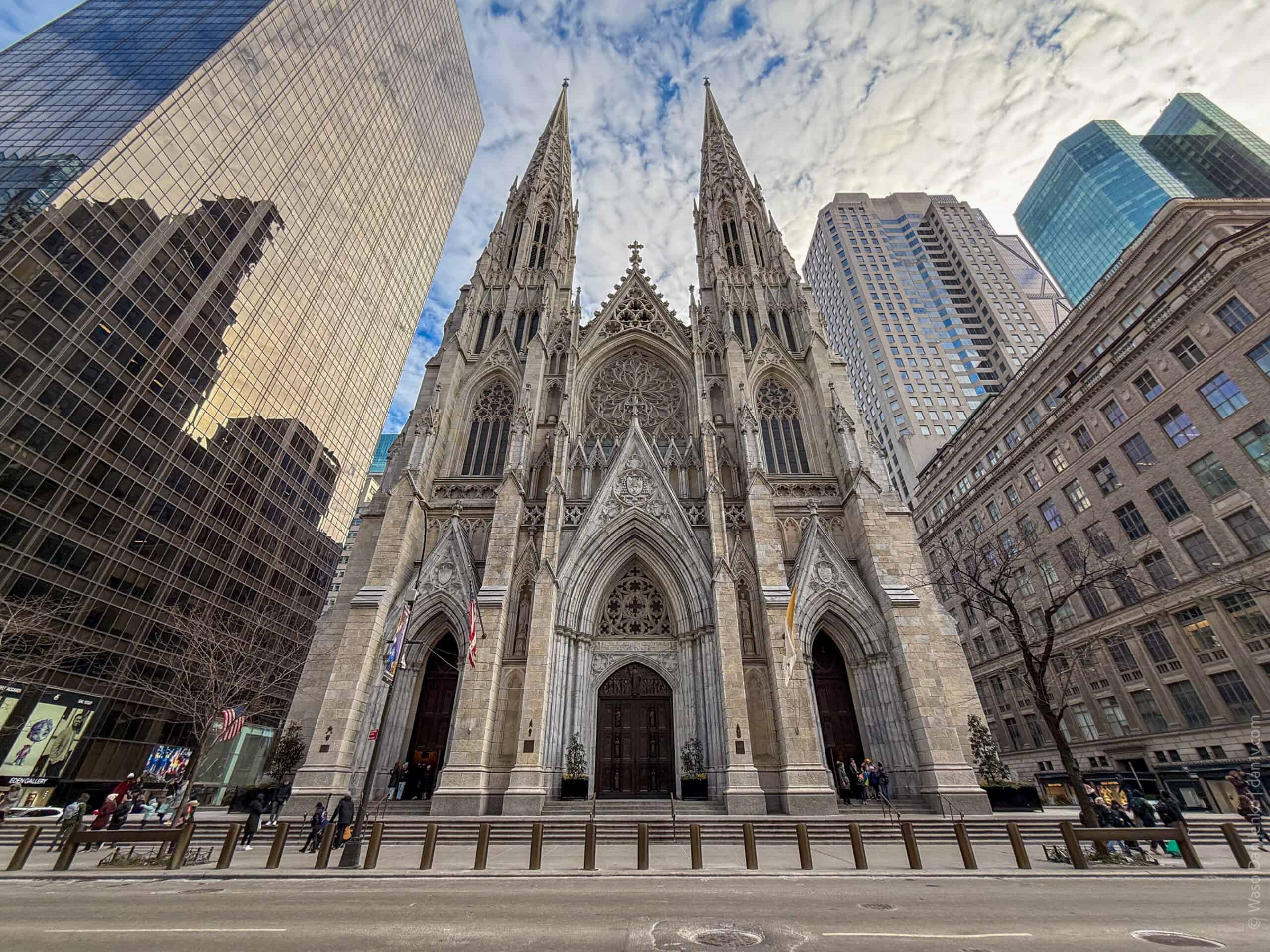
Imagine walking down Fifth Avenue past the windows of Saks Fifth Avenue, Gucci, and the Apple Store, and suddenly seeing a snow-white Gothic church. St. Patrick’s Cathedral, against the backdrop of Rockefeller Center and glass skyscrapers, looks as if it was teleported here from medieval Europe.
It is the main Catholic church in New York City, and over five million people visit it annually — even more than the Statue of Liberty.
Interesting facts about St. Patrick’s Cathedral
- The cathedral’s spires were the tallest in New York City when it was built in 1888. However, just a few years later, skyscrapers began to rise nearby.
- During construction, workers stumbled upon an ancient Irish Catholic cemetery. The remains were reburied beneath the cathedral, where they remain to this day.
- When Pope John Paul II visited New York in 1979, he stopped here. Since then, the cathedral has become a must-see for every pope visiting the city.
- Every year on March 17, St. Patrick’s Day, a parade takes place along Fifth Avenue, and a solemn mass is celebrated inside the cathedral.
- The $200 million restoration from 2012 to 2015 was funded by parishioners, corporations, and the city. It is one of the most expensive restorations of a religious building in U.S. history.
- The design of the main entrance doors was the work of a studio financed by the Kennedy family. Each door weighs approximately 9 tons, yet opens with surprising ease.
- In 1995, Victor Hugo Bermudez, a security guard who shot and killed a burglar, died near the cathedral’s walls. His story became one of the symbols of New York in the 1990s.
- All the archbishops of New York are buried in the cathedral’s crypt, including Cardinal Fulton Sheen, a candidate for beatification.
The history of St. Patrick’s Cathedral
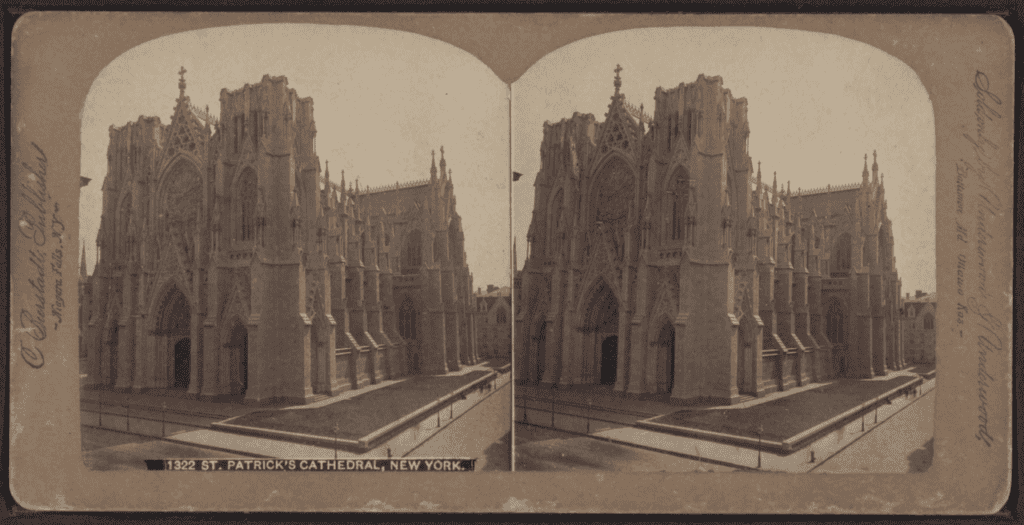
The cathedral’s history begins in the 1850s, when the Fifth Avenue site was still on the outskirts of the city, and most New Yorkers couldn’t understand the point of building a huge cathedral there. Archbishop John Hughes thought otherwise.
In 1853, he announced plans to build a new cathedral. The press called the project “Hughes’s Folly,” as Midtown was practically a wasteland at the time. In 1858, construction began under the direction of architect James Renwick, Jr., already famous for his Grace Church in Greenwich Village.
However, the Civil War halted construction from 1861 to 1865. The cathedral stood unfinished for over a decade.
The cathedral’s grand opening took place on May 25, 1879. More than 4,000 people attended the ceremony, even though the building’s spires were not yet completed. Completed by 1888, they comprised two towers, each approximately 100 meters high. At the time of their completion, the spires were the tallest in New York City.
Lady Chapel, an elegant chapel behind the altar, was built between 1927 and 1931. Rockefeller Center was being built concurrently, and New York City began to expand around the cathedral, becoming more vertical.
In 1976, the cathedral was designated a National Historic Landmark. From 2012 to 2015, it underwent a major $200 million restoration.
The architecture of St. Patrick’s Cathedral
The cathedral is built in the Neo-Gothic style — an American interpretation of medieval European Gothic. Architect James Renwick Jr. was inspired by the cathedrals of Cologne and Reims, but adapted them for the American context. He chose to use white marble instead of dark stone to achieve a lighter, more festive appearance.
Key Features
- The cathedral is approximately 100 meters long, with a nave 46 meters wide. By European standards, it is a medium-sized church, but for New York, it is monumental.
- The spires reach 100 meters. In 1888, it was the tallest structure in the city. Today, 30 Rockefeller Plaza (259 meters) stands nearby, yet the cathedral still holds its own.
- The cathedral contains 70 stained-glass windows, most of which were made in Europe — in France, Germany, and England — in the 19th and 20th centuries. The 1930 Kilgen organ contains 9,500 pipes. It is one of the largest organs in the United States, creating incredible acoustics inside the cathedral.
- The cathedral seats 2,200 people, so lines for large masses and celebrity funerals can stretch for several blocks.
- Materials and Details
- Construction cost $1.9 million in the 19th century, an astronomical sum at the time. The main materials are white marble from New York and Massachusetts, as well as limestone. It is the white color that makes the cathedral so recognizable against the gray-brown backdrop of Fifth Avenue.
Inside, marble is practically everywhere: on the floors, altars, and columns. The bronze and marble high altar was crafted in Rome. The canopy above it was the work of architects from Tiffany & Co.
What to see inside St. Patrick’s Cathedral
Admission is free, but there’s so much to see inside that 40-60 minutes will fly by. Below is a convenient route through the cathedral.
Bronze Doors
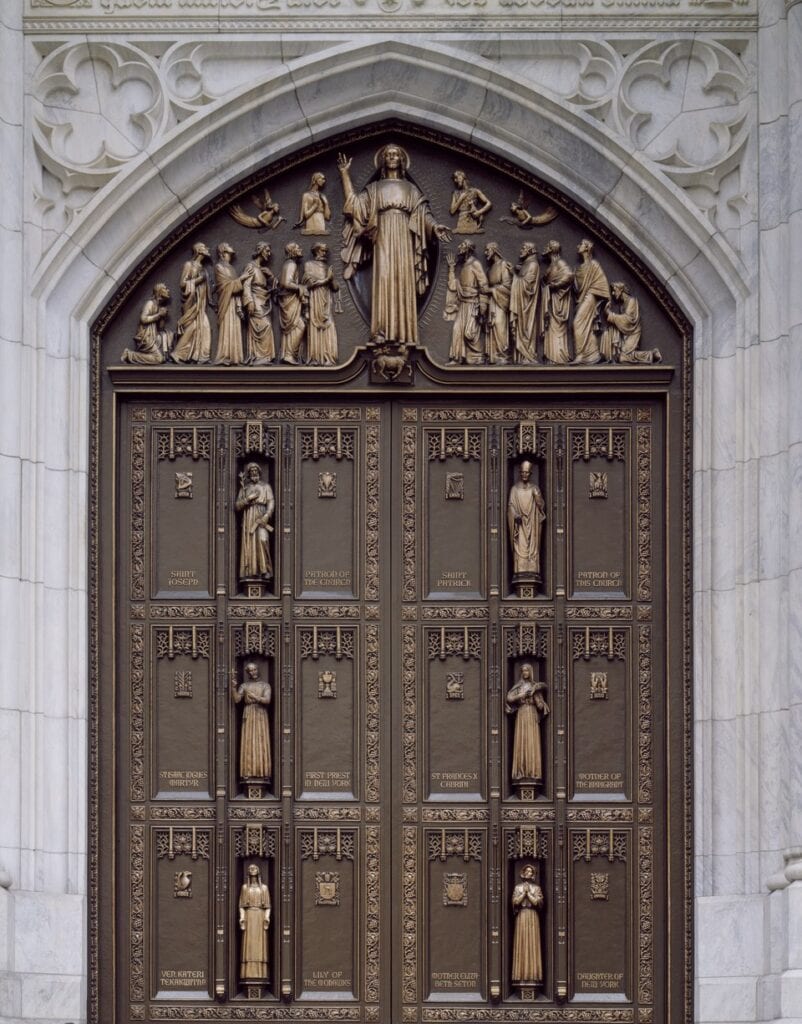
Before entering, stop at the main entrance. Three bronze doors were cast in Florence and depict scenes from the Bible and images of saints. Each weighs over 4 tons and can be opened with one hand. This isn’t magic, but the precise mechanics of hinges: a 19th-century engineering feat.
Above the doors are busts of Popes Francis, Benedict XVI, John Paul II, and Paul VI. All four visited the cathedral in person. A small token of respect for those who came here from Rome.
Main Nave
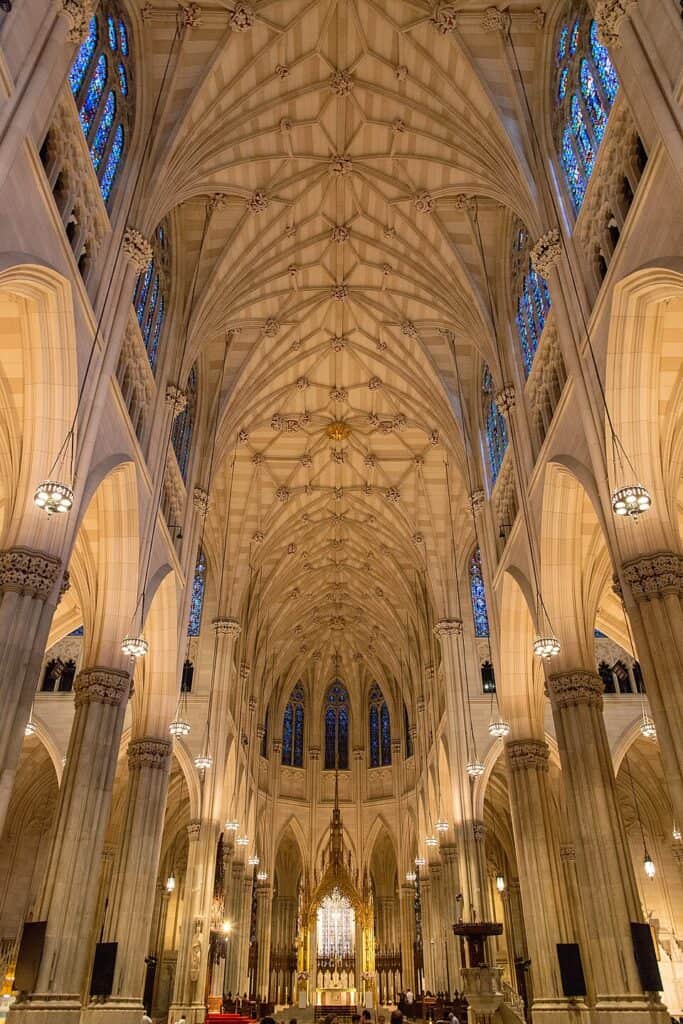
Once you enter and your eyes adjust to the semi-darkness, look up. Slender marble columns support ribbed cross vaults that soar 33 meters above the central nave. This is approximately the height of a 10-story building. This space creates the feeling of a Gothic cathedral.
Sunlight filters through the stained-glass windows and falls on the marble floor in patches of color. On a clear day, this is especially striking. In the morning, rays of light come from the east and illuminate the left side of the nave; by midday, they spread across the center.
The building is designed in the shape of a Latin cross. The main entrance is at the base, and the transverse entrances are in the arms of the cross. This is not just symbolic, but also convenient: from Madison Avenue, one can enter through the side entrance and find themselves directly in the chapel area.
Stained Rose Window
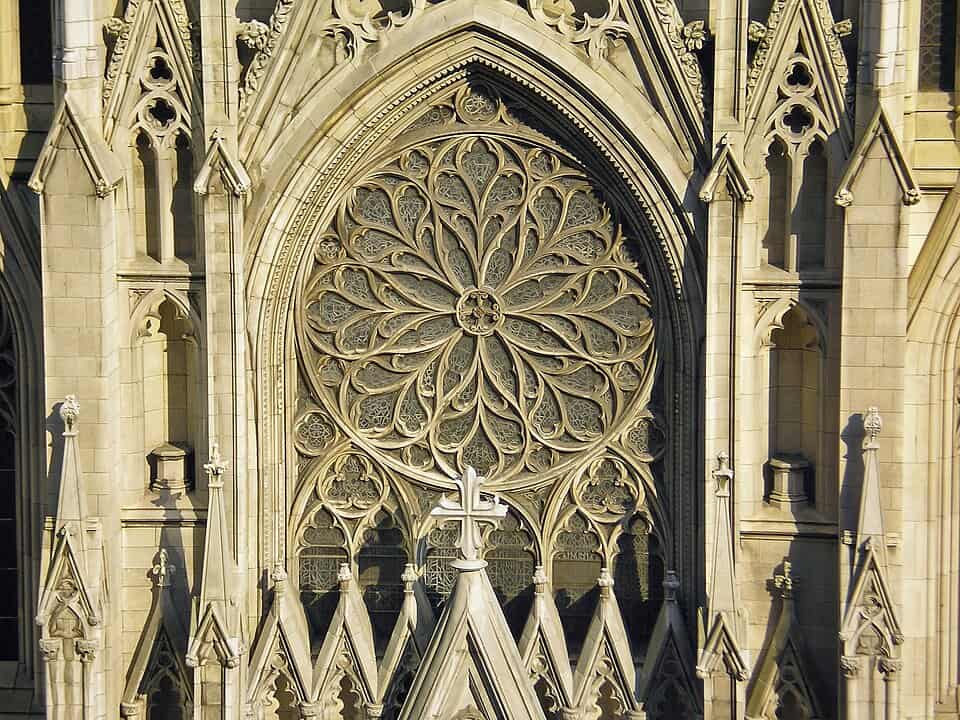
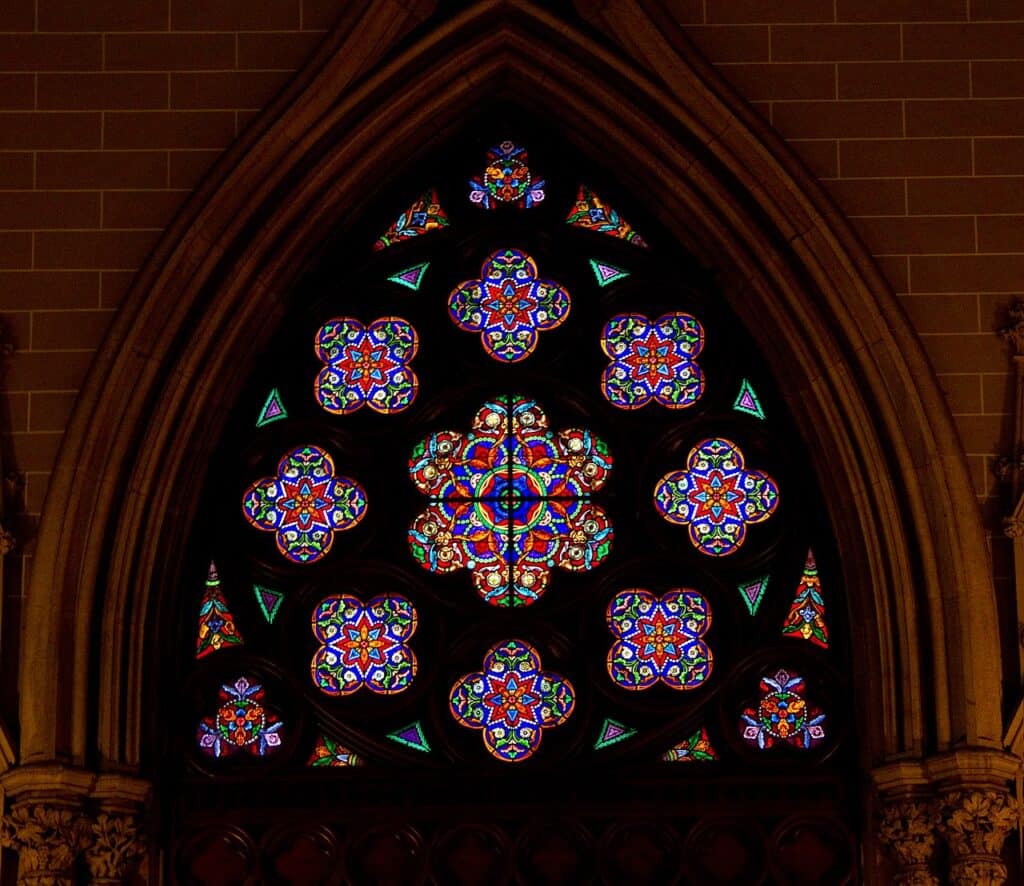
Above the main doors is a stained rose window, 8 meters in diameter, composed of 3,000 hand-cut pieces of glass. It was created by Boston-based Charles Connick, one of the greatest masters of 20th-century stained glass, who studied the techniques of Chartres Cathedral in France. Connick achieved something rarely achieved in the 20th century: the stained glass doesn’t look “new” but blends seamlessly with the 19th-century Gothic style.
The window is divided into 12 outer sections, each depicting a moment in the life of Christ — from the Annunciation to the Ascension. The symbolism is also well-thought-out: the round shape signifies eternity, and the rose is a reference to the Virgin Mary in the Catholic tradition. The rose is best viewed in the morning, when the sun shines from the south and the stained glass literally glows from within.
Two Organs
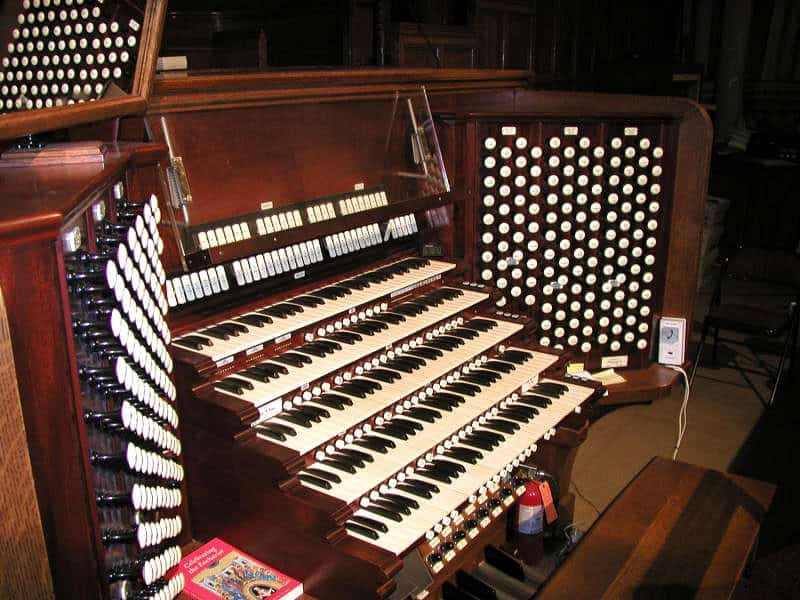
The cathedral has two organs. The gallery organ is located in the choir loft, beneath the rose window at the Fifth Avenue entrance. The choir organ is located in the north aisle next to St. Joseph’s Chapel.
The gallery organ was dedicated on February 11, 1930. Its construction took three years and cost $250,000. It contains 7,855 pipes, ranging in length from 32 feet to half an inch. The long pipes run horizontally through the north and south triforiums.
The organ’s wooden façade is one of the most beautiful in the country, decorated with angels and Latin inscriptions. The choir organ is more modest in appearance, but it is used for daily Masses.
Both organs are connected by a single control console; fiber-optic cables allow both consoles to control the gallery, choir, and nave organs simultaneously. In total, the cathedral has over 9,000 pipes. If you attend Mass, sit closer to the middle of the nave: the acoustics are best there.
High Altar and Canopy
At the center of the cathedral is the sanctuary, with the high altar covered by a bronze canopy nearly 17 meters high. This structure resembles a small architectural canopy over the altar. Similar designs exist in St. Peter’s Basilica in Rome, where Bernini’s canopy is located. While the scale here is certainly more modest, the effect is similar: the altar feels like a separate architectural object within a larger space.
Altar of Saints Michael and Louis
Along the aisle behind the altar is the Altar of Saints Michael and Louis, built by Tiffany as a gift from the family of Jacqueline Bouvier Kennedy. It is one of two altars in the cathedral created by Tiffany & Co.
Pietà
Near the north transept stands the Pietà, a statue of the Virgin Mary holding the body of Christ. Most tourists pass it by, looking at the stained glass windows and not noticing the sculpture in the side nave.
The Pietà in the cathedral is three times larger than Michelangelo’s original in St. Peter’s Basilica in Rome. The sculpture was created by the American artist William Partridge and installed in the late 19th century. It is a monumental work, and that’s why it’s odd to miss it even if you know it’s there.
12 Side Chapels
The cathedral has 12 side chapels, each dedicated to a specific saint or theme. These are not more niches — each chapel is designed as an independent space with its own altar, stained glass windows, and sculptures. A few that stand out:
Chapel of Our Lady of Guadalupe: In 1991, the Archbishop of Mexico City donated a painting to the cathedral, and since then, this chapel has been especially popular among Latin American parishioners. On December 12, the chapel is filled with flowers.
Chapel of St. Elizabeth Seton: Designed by Paolo Medici of Rome, it is dedicated to Elizabeth Ann Seton, the first American woman to be canonized.
Chapel of Our Lady of Częstochowa: Added in honor of the Polish Virgin Mary, it is one of the few new additions to the historic interior.
The north transept also contains seven “Way of the Cross” sculptures that were presented at the 1893 World’s Fair in Chicago.
The Founders’ Stained Glass Window
Above the south transept is the Founders’ Stained Glass Window. It depicts Saint Patrick preaching to the peasants, and the cathedral’s architect, James Renwick the Younger, presenting his design to Archbishop Hughes. This is a rare instance of an architect being immortalized within the building itself—usually, only saints and donors were honored in cathedrals.
Lady Chapel
In the center of the circumambulation behind the altar is the Lady Chapel—a sacred space reserved for prayer and contemplation. Speaking and photography are prohibited here. It is the only place in the cathedral where this rule is truly observed — and for this reason, it has a distinct atmosphere.
The chapel is separated from the apse by a 48-foot (15 m) high glass wall, which rests on a 23-foot-wide glass beam. The wall is framed in a minimalist bronze frame. The combination of Gothic stone carving and nearly invisible glass is one of the most unexpected architectural solutions in the interior.
The chapel contains 15 stained-glass windows depicting the mysteries of the Rosary — five for each of the three cycles: joyful, sorrowful, and triumphant. The stained-glass windows were created by Paul Vincent Woodroffe of Chipping Camden, England, between 1912 and 1930. Incidentally, the same artist was a renowned children’s book illustrator.
Crypt
Under the main altar is the crypt — the burial place of prominent Catholic figures. Eight archbishops who served the Archdiocese of New York, as well as Pierre Toussaint, are buried here.
The entrance to the crypt, hidden behind the altar, was once closed with a heavy stone slab that required six men to lift.
Pierre Toussaint, a former slave, barber, and philanthropist, became the first layman to be buried in the crypt. His remains were transferred here from Old St. Patrick’s Cathedral at the insistence of Cardinal O’Connor. His candidacy is being considered by the Vatican for beatification.
Visitors information
📍622 5th Ave, New York, NY 10022
Hours: daily 6:30 AM – 8:45 PM
Admission: Free
Website: saintpatrickscathedral.org