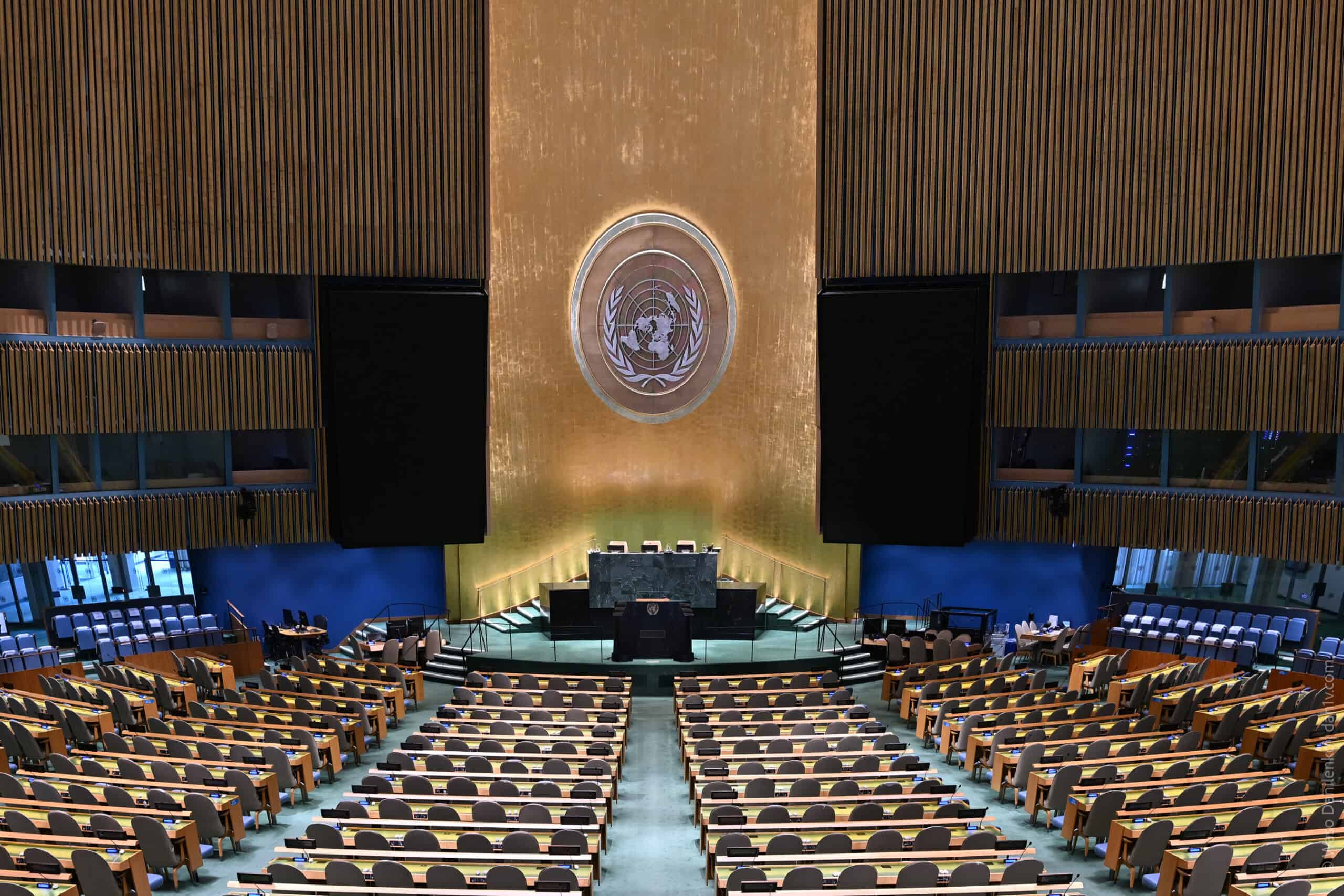
Every September, leaders of nearly two hundred countries gather in New York. Most of the speeches they deliver at the UN are forgotten the next day. But some remain forever. The General Assembly Hall has heard many things: threats and tears, revolutionary manifestos and quiet words of hope. Here are ten speeches from this podium that shook the world and made history forever.
1. Universal Declaration of Human Rights (1948)
After World War II, which shocked the world with the Holocaust and mass atrocities against civilians, the international community recognized the need for a universal human rights document. Within the newly created UN, a special commission was formed under the leadership of Eleanor Roosevelt, which spent two years working on the text, harmonizing the interests of different cultures and legal traditions.
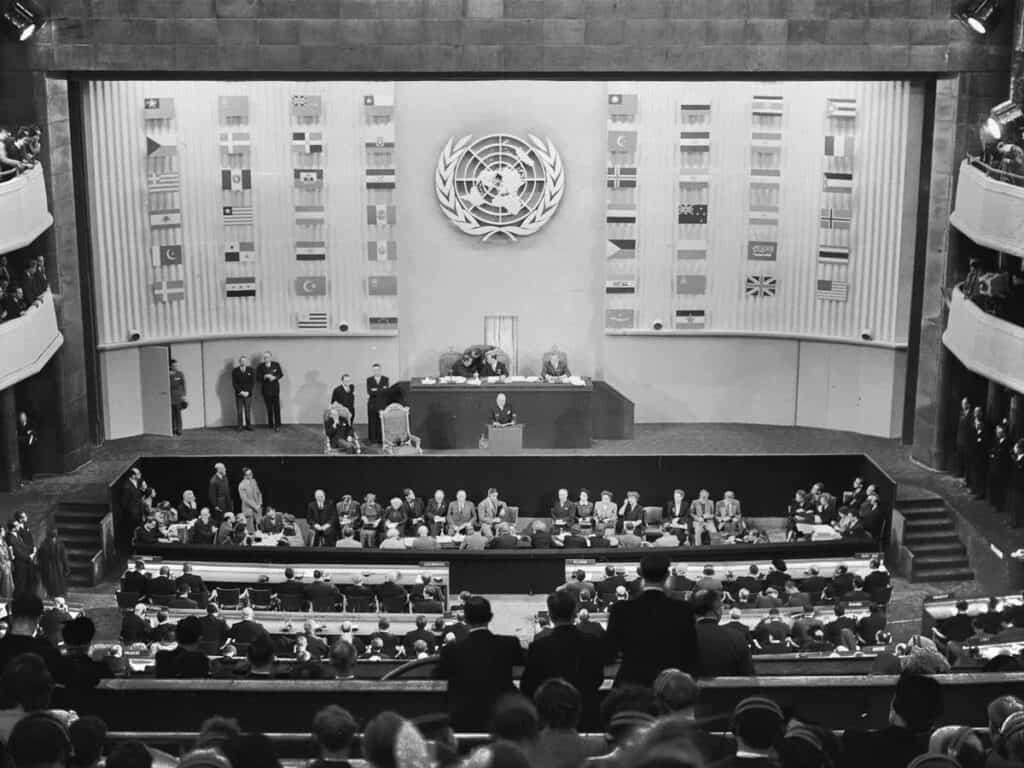
On December 10, 1948, in Paris, the UN General Assembly adopted the Universal Declaration of Human Rights — a 30-article document proclaiming the equality of all people in dignity and rights, freedom from torture and slavery, and the right to a fair trial, work, and education.
The Declaration is not legally binding, but it has become the moral foundation of international law, formed the basis of hundreds of national constitutions, and has been translated into more than 500 languages. Every year, December 10 is celebrated as Human Rights Day.
2. Fidel Castro’s Speech (1960)
In September 1960, Cuban leader Fidel Castro arrived at the UN General Assembly in New York for the first time in an extremely tense atmosphere – relations between Cuba and the United States were rapidly deteriorating after the 1959 revolution, and the Cold War was reaching a new peak.
The visit itself was fraught with controversy: American authorities restricted the Cuban delegation’s travel, and it ostentatiously moved from a luxury hotel to the Teresa Hotel in Harlem, where Castro met with Nikita Khrushchev and Malcolm X – a gesture that became a powerful political symbol.
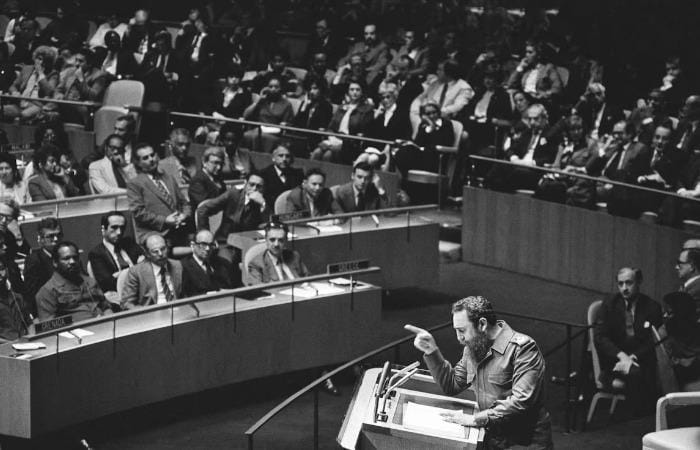
Castro’s speech at the UN podium on September 26, 1960, lasted approximately four and a half hours and remains one of the longest speeches in the organization’s history. He denounced American imperialism, defended the Cuban people’s right to sovereignty and the nationalization of industry, and expressed solidarity with anti-colonialist movements in Africa, Asia, and Latin America.
The speech became a manifesto for the Third World — a non-Western world seeking its own path in the face of the confrontation between the two superpowers — and brought Castro widespread fame far beyond Cuba.
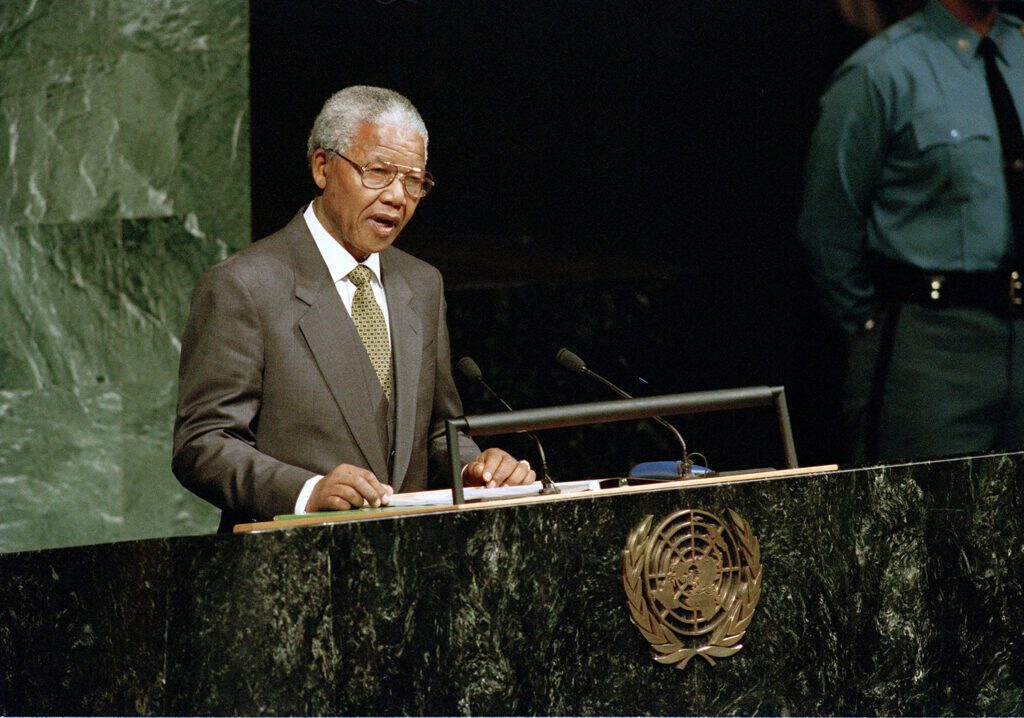
3. Nelson Mandela’s Speech (1998)
In September 1998, Nelson Mandela addressed the UN General Assembly at a special moment – he was nearing the end of his term as President of South Africa, and the world was experiencing the euphoria of the Cold War, which, however, had failed to bring the promised prosperity to the countries of Africa and the Global South. Mandela had 27 years of imprisonment, the Nobel Peace Prize, and his role as the leading symbol of the struggle against apartheid behind him – his voice on the world stage carried exceptional moral authority.
In his speech, Mandela called for a profound reform of the international order: he spoke of the need to forgive the debts of the poorest countries, the HIV/AIDS catastrophe in Africa, and the responsibility of rich countries to the rest of the world. He warned against a unipolar world, where one power dictates the rules to others, and insisted that the UN must become a truly democratic institution, not a tool of the powerful.
The speech was perceived not simply as a political speech, but as the testament of a man who had dedicated his life to the struggle for dignity — and who was now addressing all of humanity.
4. Khrushchev and the Boot (1960)
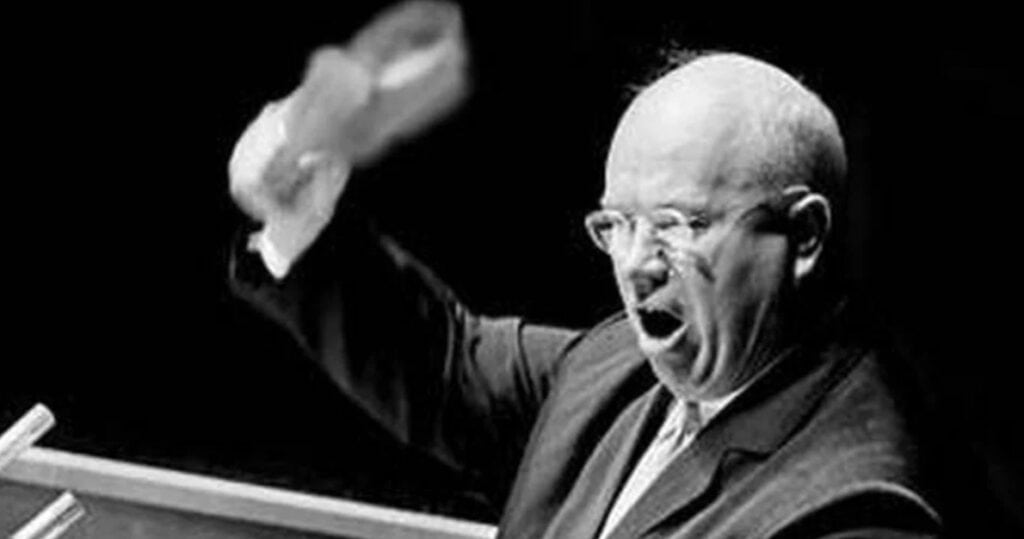
In October 1960, Nikita Khrushchev attended a UN General Assembly meeting in New York City — a rare occurrence for a sitting Soviet leader. During one of the sessions, Philippine delegate Lorenzo Sumulong criticized Soviet policy in Eastern Europe. In response, Khrushchev removed his shoe and began banging it on the table. The exact circumstances of the incident still differ slightly among sources, but the event itself has been widely documented by journalists and diplomats present.
Khrushchev spent several weeks in New York and spoke from the podium repeatedly. In his speeches, he demanded a restructuring of the UN, including replacing the post of Secretary-General with a collegial body of three representatives — from the Western bloc, the socialist bloc, and neutral countries.
This shoe incident occurred against a backdrop of already strained relations between the USSR and the United States following the downing of an American U-2 spy plane in May of that year. Assembly President Frederic Bols called the chamber to order, breaking his gavel in the process.
5. John F. Kennedy’s Speech (1961)
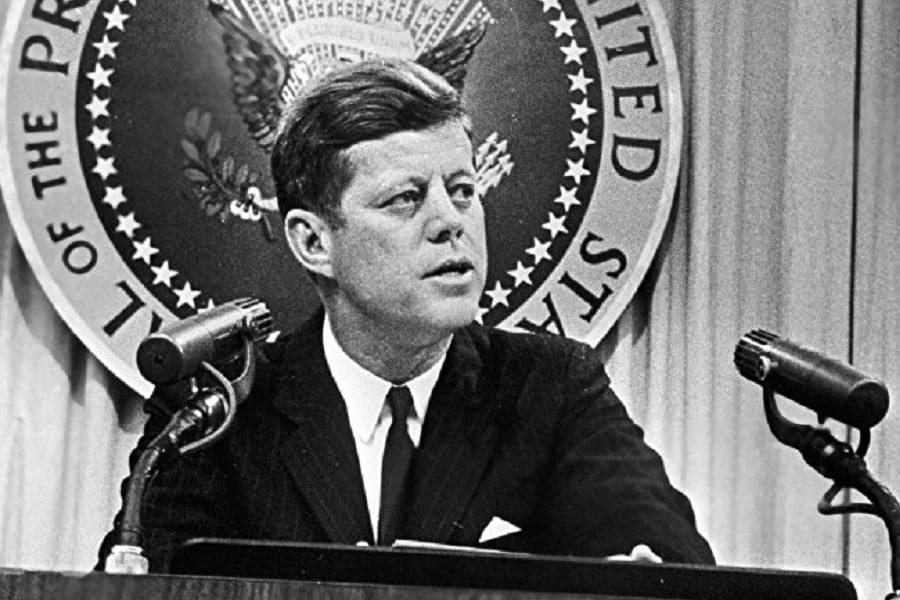
On September 25, 1961, Kennedy took to the UN podium at a tense moment: UN Secretary-General Dag Hammarskjöld had died a week earlier, the Berlin Crisis was in full swing, and the Bay of Pigs operation had failed four months earlier.
The president presented a six-point program for general disarmament under international control, calling for the extension of the UN Charter to outer space and an end to colonialism through free plebiscites in every corner of the planet. The key formula of the speech was challenging the USSR not to an “arms race,” but to a “peace race”: to move step by step toward complete disarmament.
The speech came against the backdrop of the space race, in which the USSR was still leading: Gagarin had flown into space five months earlier. Kennedy proposed making space exploration a joint peace project — an idea Khrushchev rejected at the time, but rhetorically it had a huge impact.
The speech cemented the image of the new American president as a leader capable of speaking not in the language of bloc confrontation, but in the language of universal human interests — and it is in this that its significance extended far beyond the scope of a single meeting.
6. Yasser Arafat with an olive branch (1974)
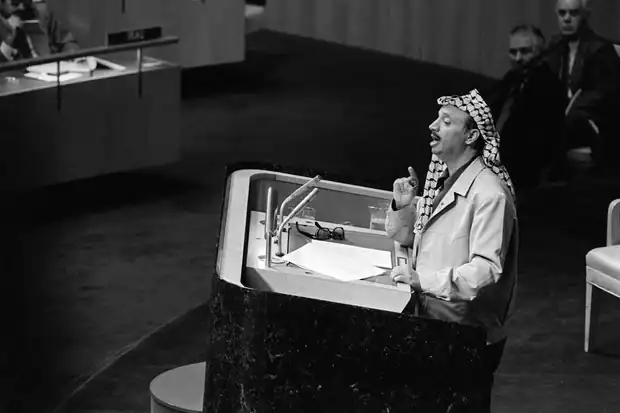
On November 13, 1974, Yasser Arafat became the first representative of a non-governmental organization invited to address the UN General Assembly, with rights almost equal to those of state delegations. Appearing at the podium with a pistol holster on his belt, he uttered the now-historic phrase: “I come with the olive branch of peace in one hand and the weapon of a freedom fighter in the other — do not let the olive branch fall from my hands.”
The speech lasted nearly two hours: Arafat outlined the history of the Palestinian people, drew a sharp distinction between Zionism and Judaism, and demanded the creation of a single democratic state throughout Palestine.
The political consequences of the speech were immediate and tangible: just two weeks later, the General Assembly recognized the PLO as the sole legitimate representative of the Palestinian people and granted it permanent observer status at the UN. This was a turning point in the internationalization of the Palestinian issue – from a regional conflict, it finally transformed into a central issue on the global agenda, where it remains to this day.
7. UN Conference on the Environment (1997)
In December 1997, at the Conference of the Parties to the UN Framework Convention on Climate Change in Kyoto, Japan, 84 countries signed the first-ever legally binding international agreement to reduce greenhouse gas emissions.
Developed countries made specific numerical commitments — an average reduction of 5.2% of emissions compared to 1990 levels by 2008–2012. The very fact of reaching consensus was hailed as a diplomatic breakthrough: for the first time, economic interests of states were formally subordinated to environmental commitments.
However, the gap between the protocol’s letter and its actual implementation proved enormous. The United States signed the document but never ratified it — the Senate blocked ratification, fearing economic losses and citing the exemption of large developing countries from the obligations.
Canada withdrew from the protocol in 2011. Nevertheless, the Kyoto Protocol became the architectural foundation for all subsequent climate diplomacy, including the 2015 Paris Agreement, which was largely built on its lessons.
8. Sustainable Development Goals (2015)
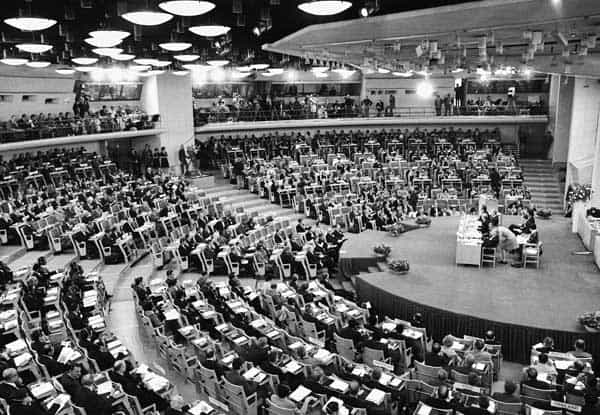
In September 2015, at a special UN summit in New York, 193 countries unanimously adopted the 2030 Agenda for Sustainable Development — a document comprising 17 global goals and 169 specific targets, ranging from ending extreme poverty and hunger to ensuring quality education, gender equality, and combating climate change.
Unlike the Kyoto Protocol, the SDGs are not a legally binding treaty — they are a political commitment, a framework for national development strategies.
The scale of consensus was unprecedented: rich and poor countries, which had previously differed on the very definition of “development,” came together at the same table to agree on a common goal. The SDGs replaced the Millennium Development Goals (2000–2015) and incorporated the experience of their partial failure.
Critics pointed to vague wording and a lack of enforcement mechanisms; Supporters countered that it was precisely the document’s universality and flexibility that ensured its adoption by every UN member without exception, which in itself is a rare diplomatic achievement.
9. Special Session on COVID-19 (2020)
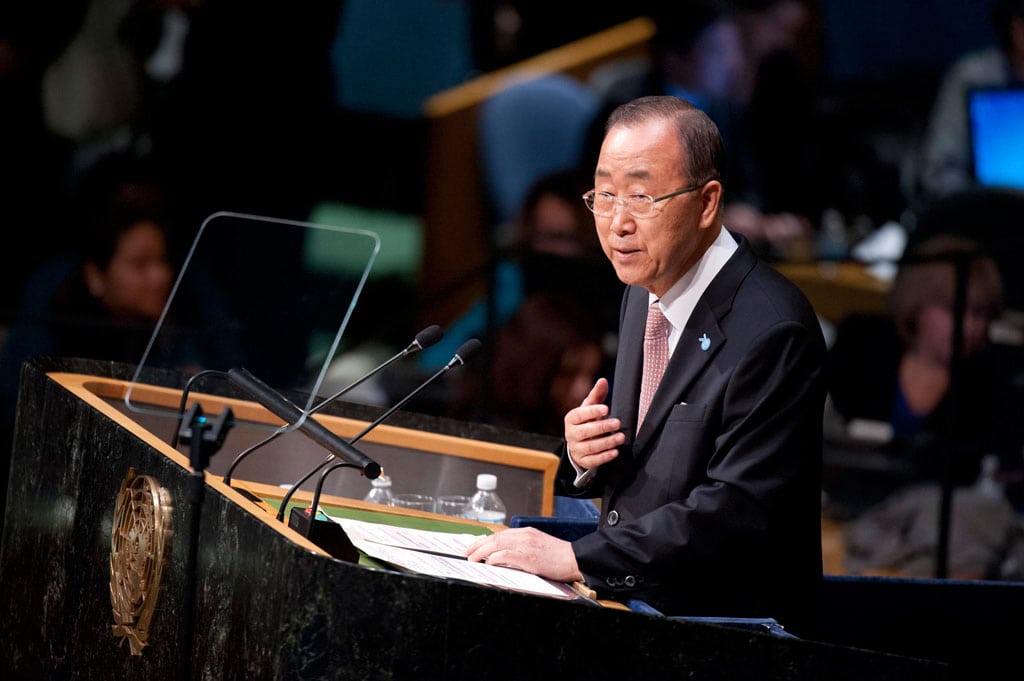
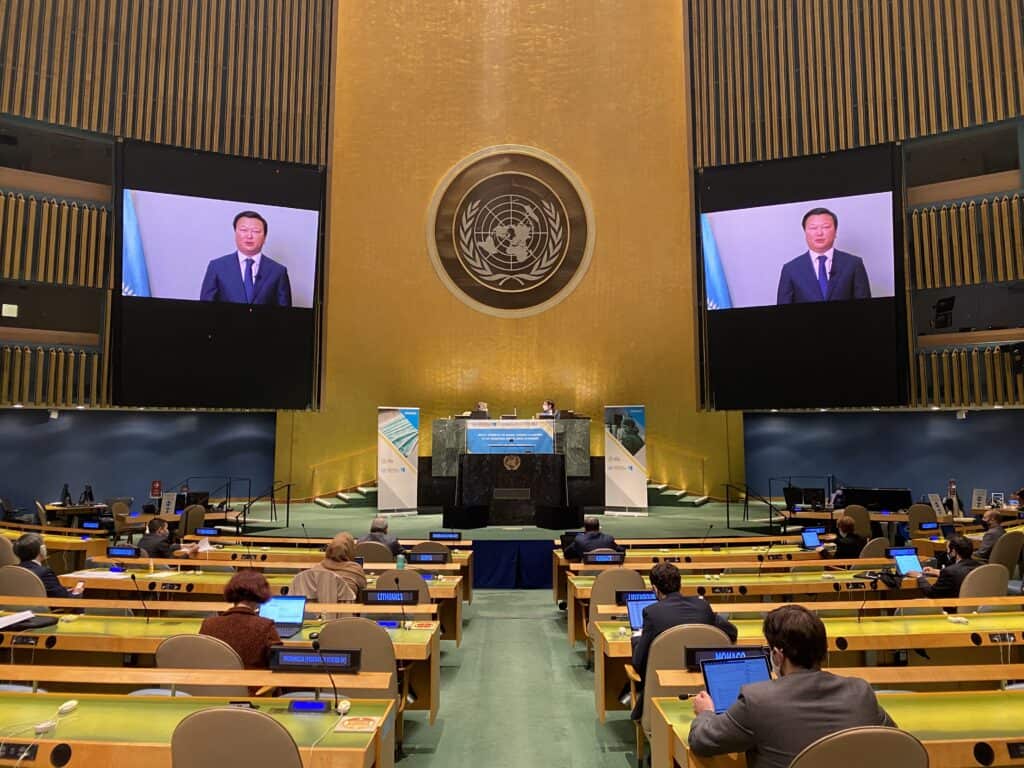
In December 2020, the General Assembly held a special session dedicated to the coronavirus pandemic, and its format was historic: for the first time in the UN’s 75-year history, heads of state and ministers spoke primarily remotely, from their capitals.
The pandemic made impossible what had seemed an unshakable tradition — the annual gathering of world leaders in New York. The central themes were equitable access to vaccines, coordination of international medical aid, and preventing rich countries from hoarding all the doses.
The session exposed sharp contradictions, which the pandemic only exacerbated: between global interdependence and national vaccine nationalism, between calls for solidarity and real competition for resources.
The adopted declaration called for “universal, fair, and equitable access” to vaccines, but no mechanisms for its implementation emerged. Nevertheless, the session marked a structural shift: the hybrid format has since become a permanent practice at the General Assembly, forever changing the logistics and rhythm of the planet’s premier diplomatic forum.
10. Malala Yousafzai’s Speech (2013)
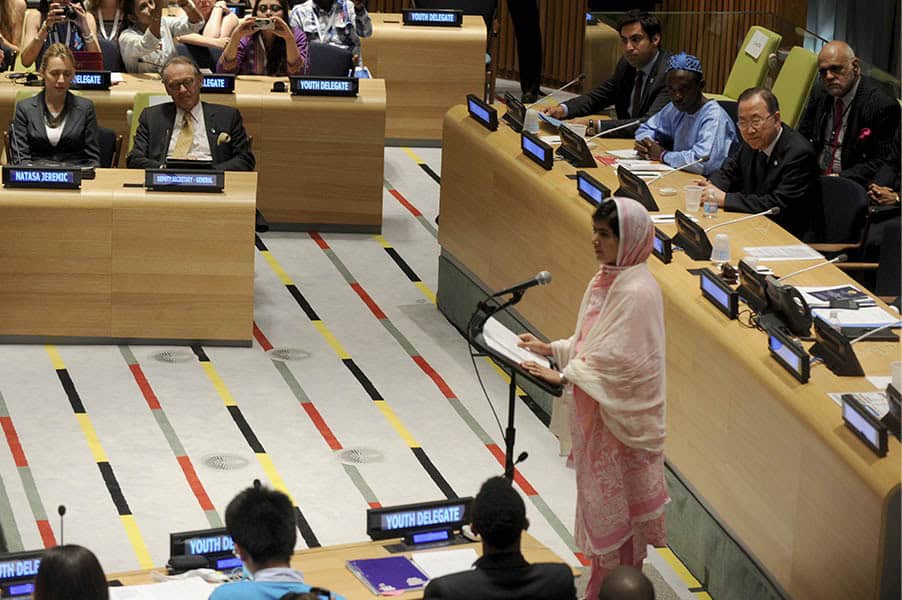
On July 12, 2013, on her sixteenth birthday, Malala Yousafzai took the podium at the United Nations in New York.
Nine months earlier, the Taliban had shot her in the head on a school bus in Swat, Pakistan, for openly writing and speaking out about girls’ rights to education. Surviving a grievous wound, she not only refused to remain silent but turned her story into a political message: “One child, one teacher, one book, and one pen can change the world.” The UN audience gave her a standing ovation.
The speech had both an immediate practical effect and long-term symbolic implications. Yousafzai demanded that world leaders ensure free and compulsory education for every child and end child labor and child marriage.
In 2014, at age 17, she became the youngest Nobel Peace Prize laureate in history. Her story reshaped the global conversation about education: from an abstract right to the concrete story of a specific girl, visible and heard.