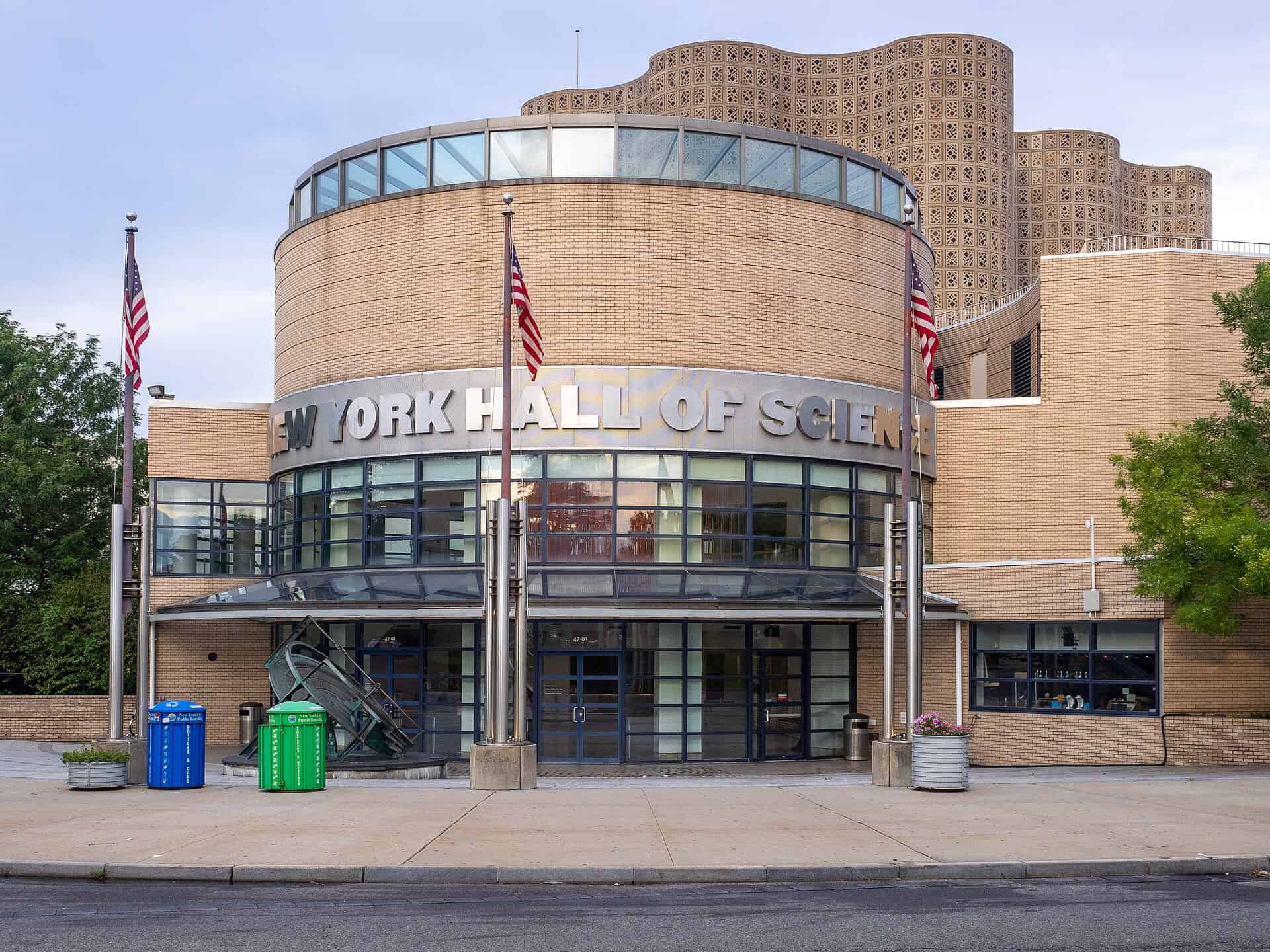
New York Hall of Science is the city’s only interactive science center. It’s located in Flushing Meadows Park in Corona, Queens. People come here with children, but even adults leave feeling like they’ve spent the day not in a museum, but inside a large, living experiment.
After all, it houses more than 400 interactive exhibits, real NASA open-air rockets, and the largest science playground in the United States. New York Hall of Science is also located in one of Queens’ most distinctive buildings, adorned with a wavy concrete wall covered with 5,000 panels of cobalt-blue glass.
Interesting facts about the New York Hall of Science
- The Great Hall is one of the few remaining pavilions from the 1964–65 World’s Fair. Most of the buildings were demolished immediately after the fair closed.
- In 1970, an Atlas rocket exploded in the parking lot. Afterward, a fence and lights were erected around Space Park.
- An early plan called for building a nuclear reactor right inside the museum for educational purposes. In 1966, the US Atomic Energy Commission proposed $5 million for this, but the project fell through.
- In 2021, Hurricane Ida flooded the museum’s basement with over a million gallons of sewer water. Restoring the museum took over a year.
What to see and do in the New York Hall of Science
Great Hall and Permanent Exhibitions
Exhibits on biology, chemistry, and physics. The museum’s concept is built around the “Design, Make, Play” approach. Here, visitors don’t read signs; they touch, twist, build, and test hypotheses. The Great Hall is divided into several zones:
- Human Plus — a zone about technology for people with disabilities. Not boring social media, but an honest conversation about how technology expands the body’s capabilities.
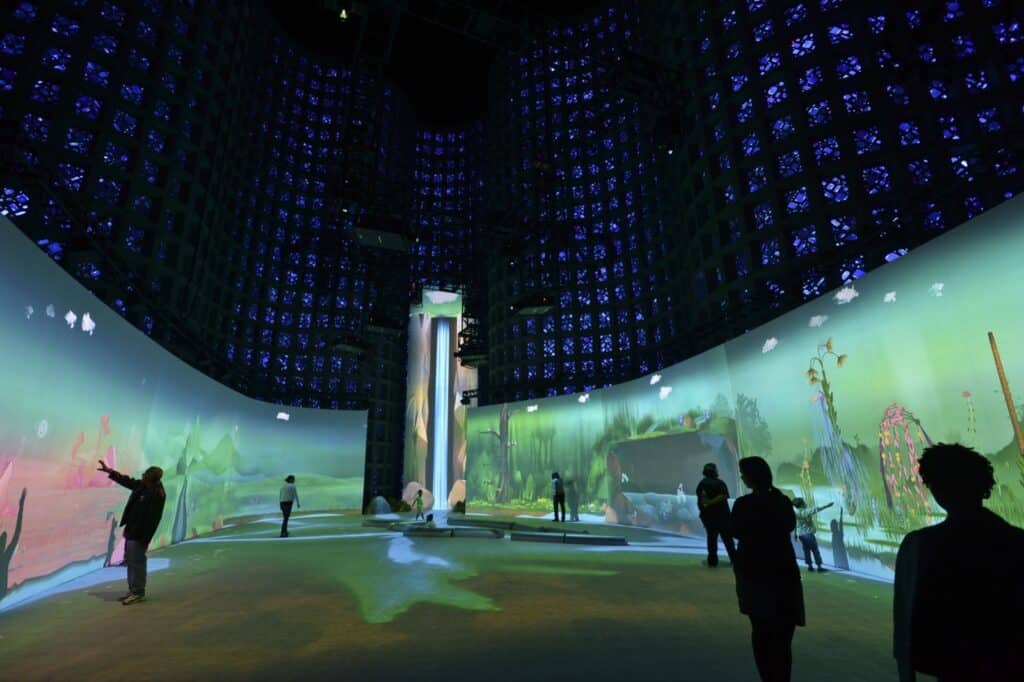
- Connected Worlds — an immersive digital ecosystem spanning the entire hall, where visitors’ actions influence the virtual world on giant screens. One of the most photogenic halls in the museum.
- Design Lab — a space where visitors solve engineering problems: building prototypes, testing, and redesigning. Suitable for all ages, but especially suitable for children 8 and up.
- CityWorks, the largest new exhibition in over a decade, explores the city’s invisible systems, including sewer systems, electrical grids, and subway tunnel construction. Some exhibits directly reference the history of the museum itself, which in 2021 experienced flooding due to the overflow of the city’s stormwater drainage system.
- Happiness, a permanent exhibition in the north building, explores the science of well-being. An unexpected choice for a science museum, but it works.
Rocket Park — Real NASA Rockets
The open area in front of the museum features authentic artifacts from the space race: a Gemini-Titan II rocket, a Mercury-Atlas D rocket, and a Saturn V F-1 engine. These are all real objects from the 1964–65 era, when NASA was just beginning to master the technologies of the lunar program. Rocket Park is included in the price of a regular admission.
Rocket Park Mini Golf
A nine-hole miniature golf course where every hole is a physics lesson. Propulsion, gravity, the launch window, and gravity assist become clearer as you try to put the ball past a model rocket. Recommended for ages 6 and up.
Science Playground — Largest Science Playground in the United States
This 2,800-square-foot outdoor science playground is the largest science playground in the United States. Designed by BKSK Architects, with landscape design by Lee Weintraub. Inside, there are slides, swings, a water zone (in summer), an “energy wave” (a 150-foot system of connected rods and balls that children ride on a wave of kinetic energy), talking tubes, windmills, and sand machines with blocks and conveyors. For the little ones, there’s a separate “Serpent Path” area.
NYSCI Explainers — Live Science Shows
This team of staff members puts on demonstrations and lectures for children and adults right in the halls. Visitor favorites include “Cool Chemistry,” “Flight,” and “Air Cannon.” They’re interactive, engaging, and never overly tedious.
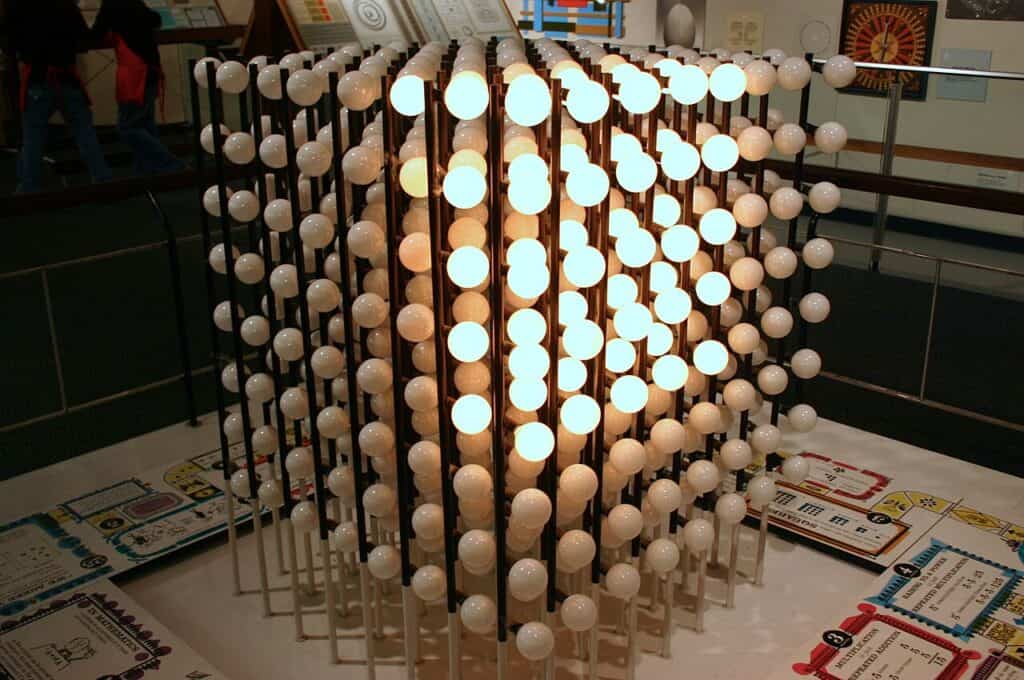

Films in the 3D/2D Theater
A small theater inside the museum shows scientific films. Included with NYSCI Plus or purchased separately (approximately $6).
The History of the New York Hall of Science
Flushing Meadows Park, where the museum stands today, is a place steeped in history. In the late 19th and early 20th centuries, it was an industrial wasteland and ash dump. Even Fitzgerald described it in The Great Gatsby as a “valley of ashes.” However, for the 1939 and 1964 World’s Fairs, urban planner Robert Moses transformed the area into a beautiful park.
The New York Hall of Science opened in 1964 as the fair’s science pavilion. It was conceived as a meeting place with the future: the first exhibit, titled “Rendezvous in Space,” was dedicated to space exploration. This was the height of the space race with the USSR.
After the fair closed in 1965, most of the pavilions were demolished, but the science hall was preserved and converted into a full-fledged museum in 1969. However, it didn’t last long: funding dried up, and in 1979 the building closed for restoration. It reopened in 1986 as a new kind of interactive science center, where exhibits can be touched.
Since then, the museum has survived several expansions (in 1996 and 2004), Hurricane Ida in 2021, which flooded the basement with sewer water, and a pandemic. After a full restoration, it reopened in October 2022, and in 2025, it launched its largest new exhibition in a decade, CityWorks.
The Architecture of the New York Hall of Science
Architect Wallace Kirkman Harrison, who also worked on Rockefeller and Lincoln Centers, designed the museum’s main building, the Great Hall. It’s unlike anything else in New York, with its undulating walls and cage-like shape. This is no coincidence, but a nod to biology.
The building is clad in cobalt-blue glass panels, created using the dalle de verre (glass-in-concrete) technique. Depending on the time of day, the light inside shifts from a cool purple to almost ultraviolet.
The building initially faced criticism; for example, the New York Times in 1978 called it a “futuristic Stonehenge.” But then architecture critic Justin Davidson called it “one of New York’s most captivating interiors,” despite its gloomy exterior. In his 1995 book, Robert Stern described the building as fusing “timeless drama with technological modernity.”
In 1999, the Queens Historical Club designated the building a Queensmark — a local landmark.
Over time, the original Great Hall was augmented by an entrance rotunda (Beyer Blinder Belle), a glass north wing (Todd H. Schliemann / Ennead Architects, 2004), and an outdoor area featuring rockets and a playground.
Visitor information
📍 47-01 111th Street, Corona, Queens, NY 11368 (Flushing Meadows–Corona Park)
Subway: Line 7, 111th Street station (a few minutes’ walk)
Hours: Tuesday 10:00 AM–2:00 PM, Wednesday–Sunday 10:00 AM–5:00 PM
Tickets: from $22, children from $19. Free admission every Friday from 2:00 PM–5:00 PM (main exhibition only; online reservations open Friday morning at 9:00 AM).
Website: nysci.org