Broadway is not just a street and not just a theater district. It is an entire genre, an industry, and a cultural phenomenon. Forty-one theaters with more than five hundred seats each, fifteen million spectators per year, and two billion United States dollars in revenue per season. And yet only three of them are located on Broadway itself. All the others stand on cross streets.
Interesting facts about Broadway in New York
- Broadway as a theatrical phenomenon is more than two hundred years old. The first significant theater, Park Theatre, opened in 1798.
- The Theater District formed in the early 1900s around Times Square, where theaters moved from downtown in search of cheaper rent.
- The 2024–2025 season became the highest-grossing in Broadway history: 1.89 billion United States dollars in revenue, 14.7 million spectators, and an average attendance rate of 91.2 percent.
- The average ticket price in the 2024–2025 season was about 129 United States dollars. However, for top productions such as Othello starring Denzel Washington and Jake Gyllenhaal, ticket prices reached 921 United States dollars.
- The record for the longest-running show belongs to The Phantom of the Opera: 13,981 performances over 35 years, from 1988 to 2023.
- The Tony Awards are the main theater award in the United States, presented annually since 1947. They are the Broadway equivalent of the Academy Awards for cinema and the Grammy Awards for music.
- No subway line was ever built directly under Broadway. It is believed that wealthy residents strongly opposed it. However, the Theater District is served by dozens of subway stations within a few blocks.
Iconic Broadway theaters
A theater is considered Broadway if it has more than five hundred seats. Here are some of the most famous ones.
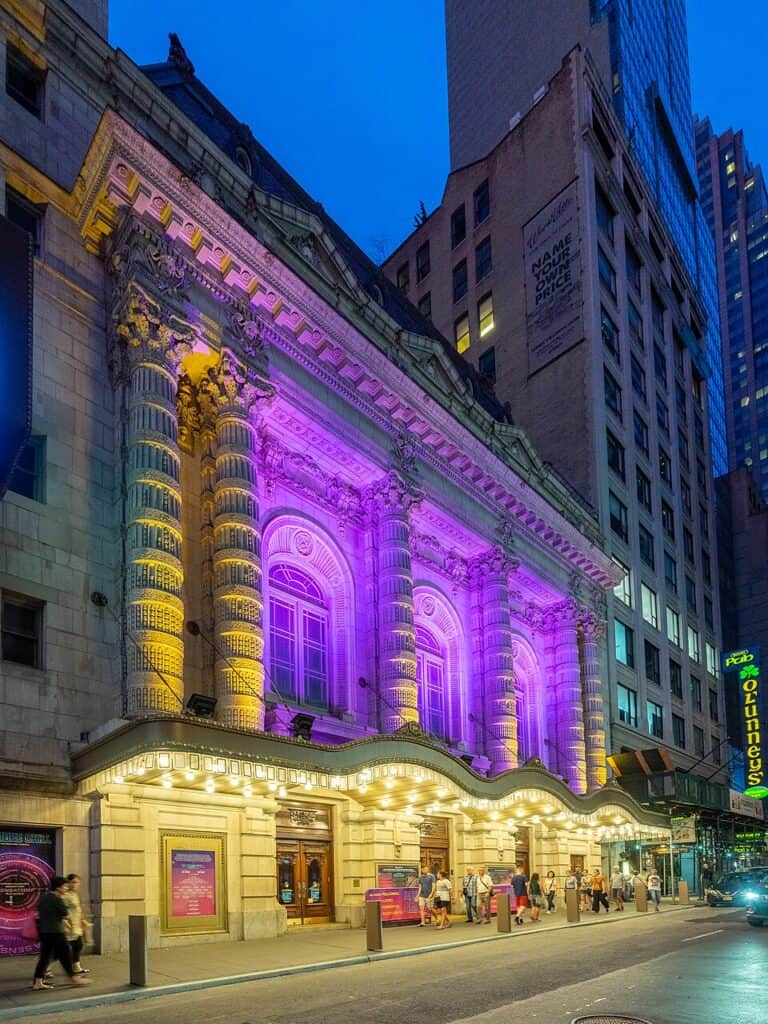
Lyceum Theatre (1903)
📍 149 W 45th St, New York, NY 10036
The oldest continuously operating Broadway theater. Built in the Beaux-Arts style by architects Herts and Tallant. Here, audiences can still experience the atmosphere of early Broadway, as the theater has preserved its original interiors.
New Amsterdam Theatre (1903)
📍214 W 42nd St, New York, NY 10036
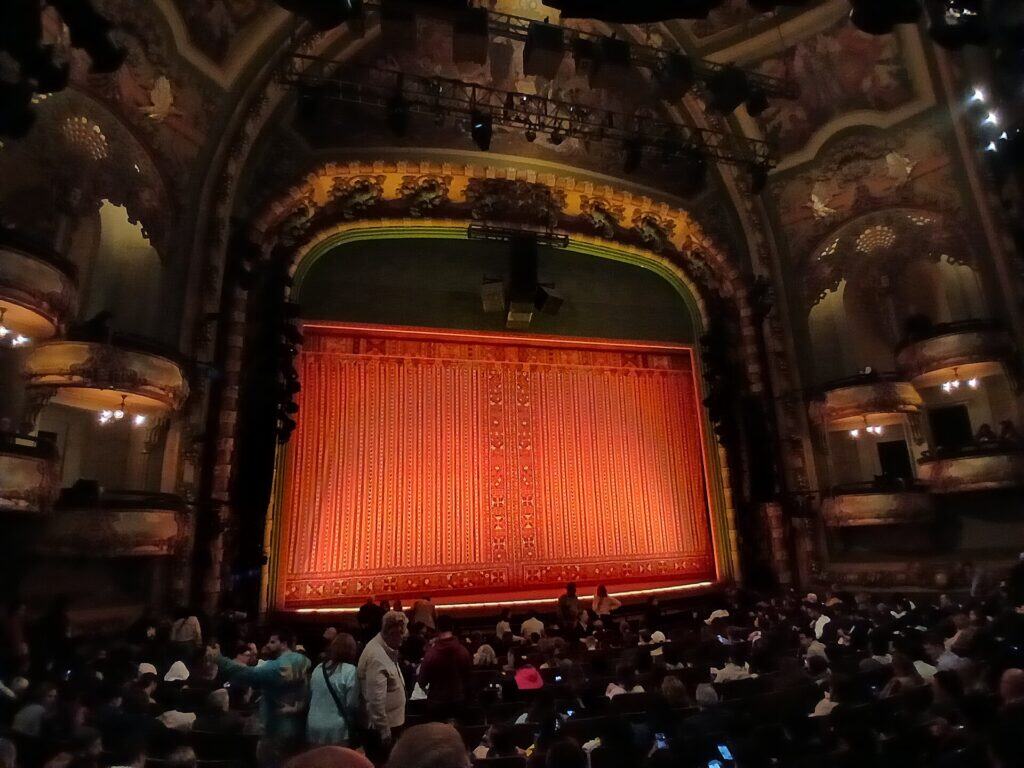
An Art Nouveau masterpiece restored by the Walt Disney Company in the 1990s. It once hosted the Ziegfeld Follies, the legendary variety shows of the early twentieth century.
Majestic Theatre (1927)
📍245 W 44th St, New York, NY 10036
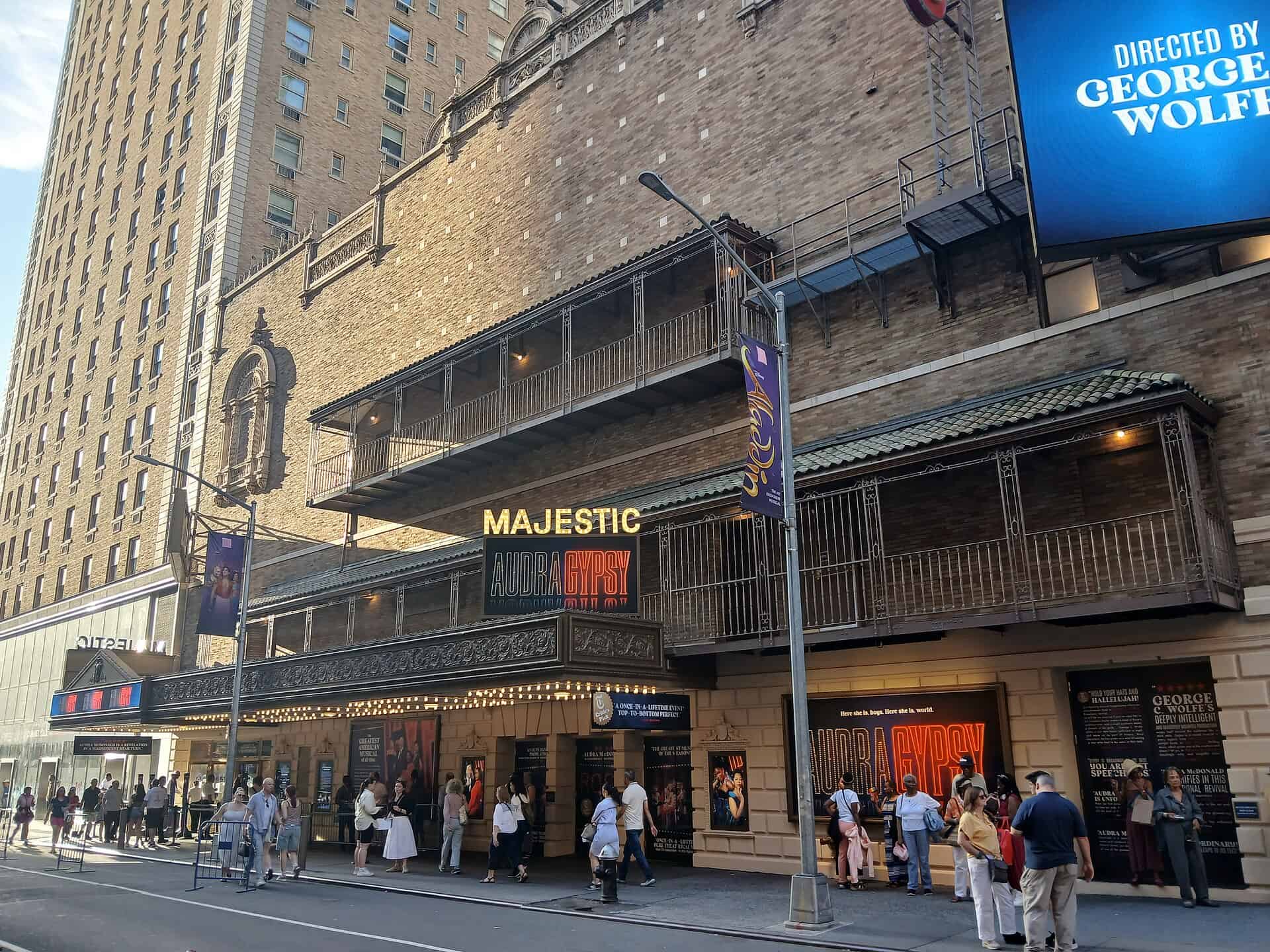
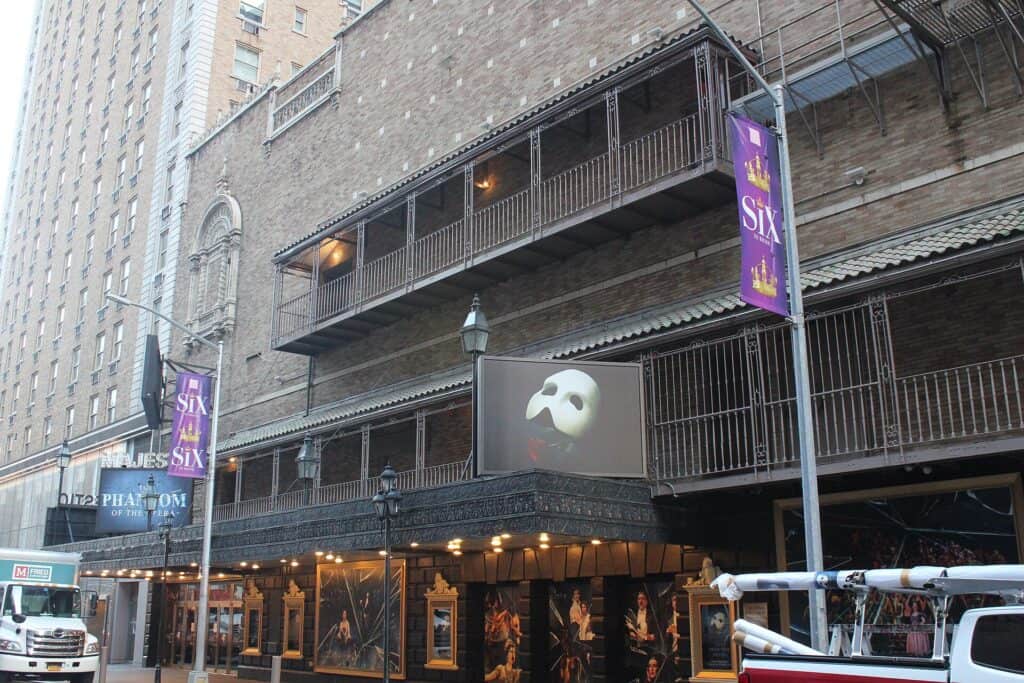
The largest Broadway theater with 1,800 seats. The Phantom of the Opera ran here for 35 years, and this hall was specifically designed so that the famous chandelier could “fall” over the audience.
Richard Rodgers Theatre (1925)
📍226 W 46th St, New York, NY 10036
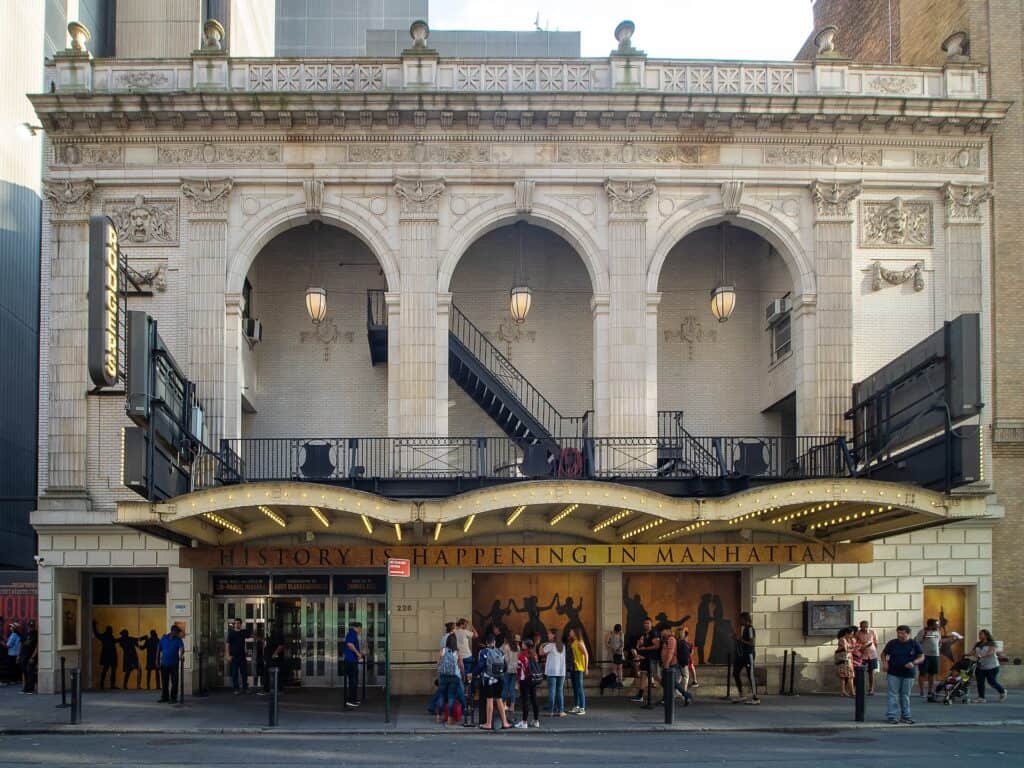
The theater where Hamilton premiered in 2015, a musical that transformed Broadway. It is named after composer Richard Rodgers.
Gershwin Theatre (1972)
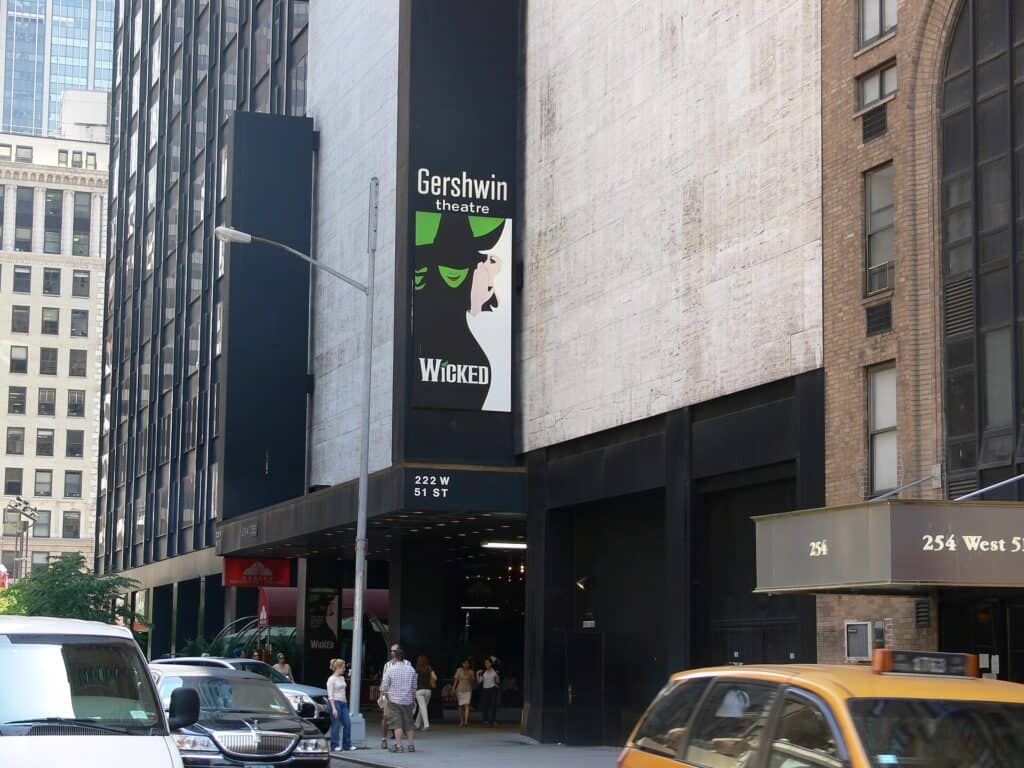
📍 222 W 51st St, New York, NY 10019
The largest Broadway theater by seating capacity, with about 1,900 seats. It has been home to the musical Wicked since 2003.
Winter Garden Theatre (1911)
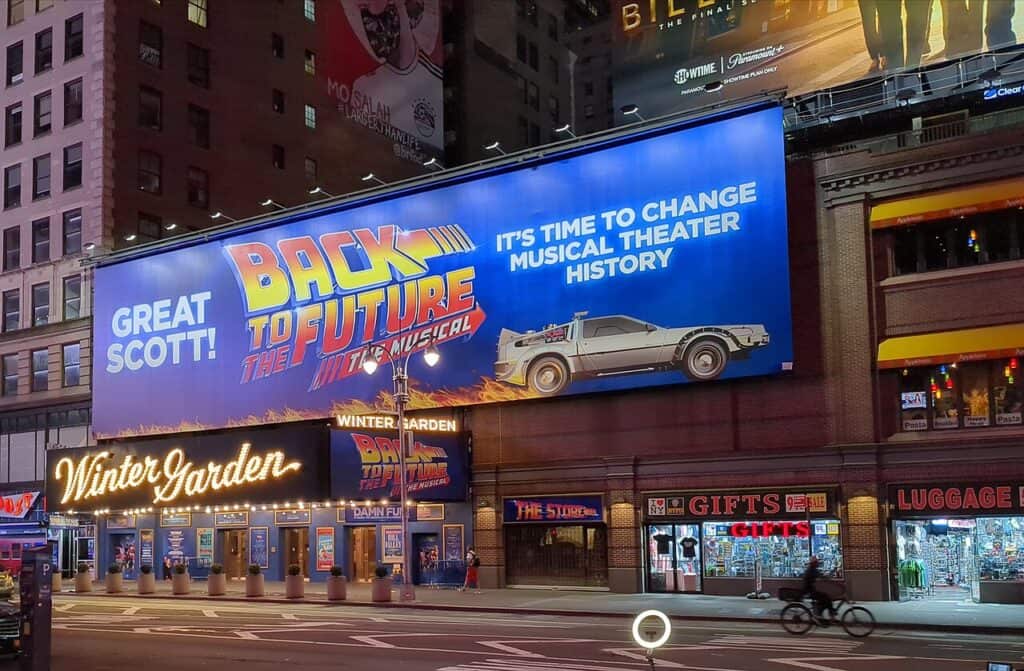
📍1634 Broadway, New York, NY 10019
One of the three theaters located directly on Broadway. Cats ran here for 18 years, and in 2025 it hosted Good Night, and Good Luck starring George Clooney.
Ceremonies and traditions
Tony Awards
The Tony Awards have been presented annually since 1947 by the American Theatre Wing, which was founded in 1917 to support the theater community during the First World War. The ceremony is the main social event of the Broadway season and is broadcast on national television.
Dimming of the Lights
When a prominent Broadway figure passes away, the lights on all theater marquees in the Theater District are dimmed for exactly one minute in tribute.
History of Broadway
Early theaters
The word “Broadway” comes from the Dutch “Bredeweg,” meaning “wide road.” This is what Dutch colonists called the trail originally laid out by Native Americans.
The first known theatrical performance in New York took place in 1732 in a small hall on Nassau Street with a capacity of about three hundred people. More substantial venues began to appear by the end of the eighteenth century: Park Theatre (1798) became the first major theater in the city, followed by Bowery Theatre (1826) and Astor Place Theatre (1847).
Move to Times Square
Until the end of the nineteenth century, theaters were scattered across Manhattan. In 1895, theater impresario Oscar Hammerstein the First built the Olympia Theatre in an area then known as Longacre Square, informally called “Thieves’ Lair.”
The choice seemed irrational: the district was dangerous and underdeveloped, and electric lighting had not yet reached it. However, this decision sparked a revolution.
In 1904, The New York Times moved its headquarters to a new building on the same square, which was then renamed Times Square. One by one, theaters began relocating there, attracted by lower rents.
In the 1920s and 1930s, dozens of new theaters were built around Times Square, firmly establishing the area as the center of American theatrical life. By 1987, twenty-five Broadway theaters had been designated as New York City landmarks.
The Golden Age of Broadway
The postwar period became known as the Golden Age of Broadway. This was when the musical fully developed as a genre.
The key figures of this era were Richard Rodgers and Oscar Hammerstein the Second, the grandson of the impresario mentioned earlier. Their musicals defined the sound of a generation: Oklahoma! (1943), Carousel (1945), South Pacific (1949), and The Sound of Music (1959).
Difficult times
By the 1960s, Broadway began to lose its audience. There were several reasons: the rise of color television, the growth of cinema, cultural shifts such as the civil rights movement and the Vietnam War, and most importantly, the rapid decline of Times Square and Midtown. The area became unsafe, filled with adult cinemas and drug activity. New York in general was considered a city best avoided, especially at night.
The revival came from London: Andrew Lloyd Webber brought large-scale productions to Broadway — Cats (1982) and The Phantom of the Opera (1988). They attracted millions of tourists and restored Broadway’s must-see status. In the 1990s, the Walt Disney Company renovated the deteriorating New Amsterdam Theatre on 42nd Street and staged The Lion King there in 1997.
Broadway today
The twenty-first century brought a technological revolution to Broadway, including stage effects, light-emitting diode screens, and projections, as well as greater racial and gender diversity. Perhaps the most significant phenomenon of recent decades is the musical Hamilton (2015), which combined hip-hop with theater and reshaped expectations of what a musical can be.
The COVID-19 pandemic in 2020 was the most serious blow in Broadway’s history: theaters were closed for eighteen months, from March 2020 to September 2021. This was the longest pause in Broadway history, longer than both world wars. However, the industry recovered, and the 2024–2025 season set an all-time revenue record.
Stories and secrets of Broadway
When light became more important than the show
At the beginning of the twentieth century, architects realized the advertising potential of electric light bulbs, leading to a true “lighting boom.” The first electric billboard for the play The Red Mill was installed in 1903. Dozens followed, and soon the entire district shone so brightly that it earned the nickname “The Great White Way.” In 1927, neon lights appeared on Broadway, adding color to the streetscape.
Illuminated signs became such an essential part of Broadway that today there is a regulation in the Theater District requiring building owners to maintain a certain level of exterior lighting.
The ghost of the New Amsterdam Theatre
Legend has it that the theater is haunted by the ghost of an actress who died in 1920 in Paris under mysterious circumstances. She accidentally drank a mercury chloride solution intended for external use. For decades, security guards and staff have reported sightings of a female figure on balconies and backstage.
Broadway was almost demolished
In the 1980s, New York developers seriously considered demolishing historic theaters to build office skyscrapers. The situation was similar to what happened with Grand Central Terminal in the 1960s.
The rescue came from playwright Joseph Papp, founder of Shakespeare in the Park and the Public Theater. He organized the “Save the Theatres” campaign, bringing together famous actors and the Actors’ Equity Association.
By 1987, twenty-five Broadway theaters were granted landmark status. A special zoning regulation introduced in 1998 allowed theaters to sell transferable development rights, making preservation economically viable.
TKTS: how to buy discounted tickets
One of Broadway’s main secrets for tourists is the TKTS booth in Times Square at the intersection of 47th Street and Broadway, right under the famous red steps. Tickets for same-day performances are sold there at discounts of twenty to fifty percent.
There are also booths at Lincoln Center on the Upper West Side and in Downtown Brooklyn, where lines are usually shorter than in Times Square.
Other ways to save money include lotteries, where many shows offer inexpensive tickets through applications, rush tickets sold at the box office shortly before the performance, and standing room only tickets when shows are sold out.
Broadway, Off-Broadway, and Off-Off-Broadway
A common question from tourists is whether a theater outside the Theater District is still considered Broadway. The answer is no. The system works as follows:
Broadway — forty-one theaters with more than five hundred seats located in the Theater District and Lincoln Center. This is the top tier. The average ticket price is 129 United States dollars.
Off-Broadway — theaters with one hundred to four hundred ninety-nine seats located throughout Manhattan and sometimes in other boroughs. Experimental productions often debut here before moving to Broadway. Tickets are cheaper.
Off-Off-Broadway — theaters with fewer than one hundred seats, focusing on avant-garde and experimental productions, sometimes located in basements or converted garages.
Visitor information
📍 Midtown Manhattan, between 41st and 53rd Streets, on both sides of Broadway, centered around Times Square. One theater, Vivian Beaumont Theater, is located at Lincoln Center on 65th Street.
- Times Square–42nd Street: lines 1, 2, 3, 7, N, Q, R, W, S
- 49th Street: lines N, R, W
- 50th Street: lines 1, C, E
- Buses: M7, M20, M42, M104 and others
How to buy tickets
- Official theater and show websites — full price, but guaranteed seating.
- TKTS — booth in Times Square with discounts of twenty to fifty percent for same-day performances.
- Lotteries and rush tickets — inexpensive tickets, usually thirty to forty United States dollars, available through applications such as TodayTix or at the box office on the day of the performance.
- Standing room only — standing tickets, usually thirty to forty United States dollars, for sold-out shows.