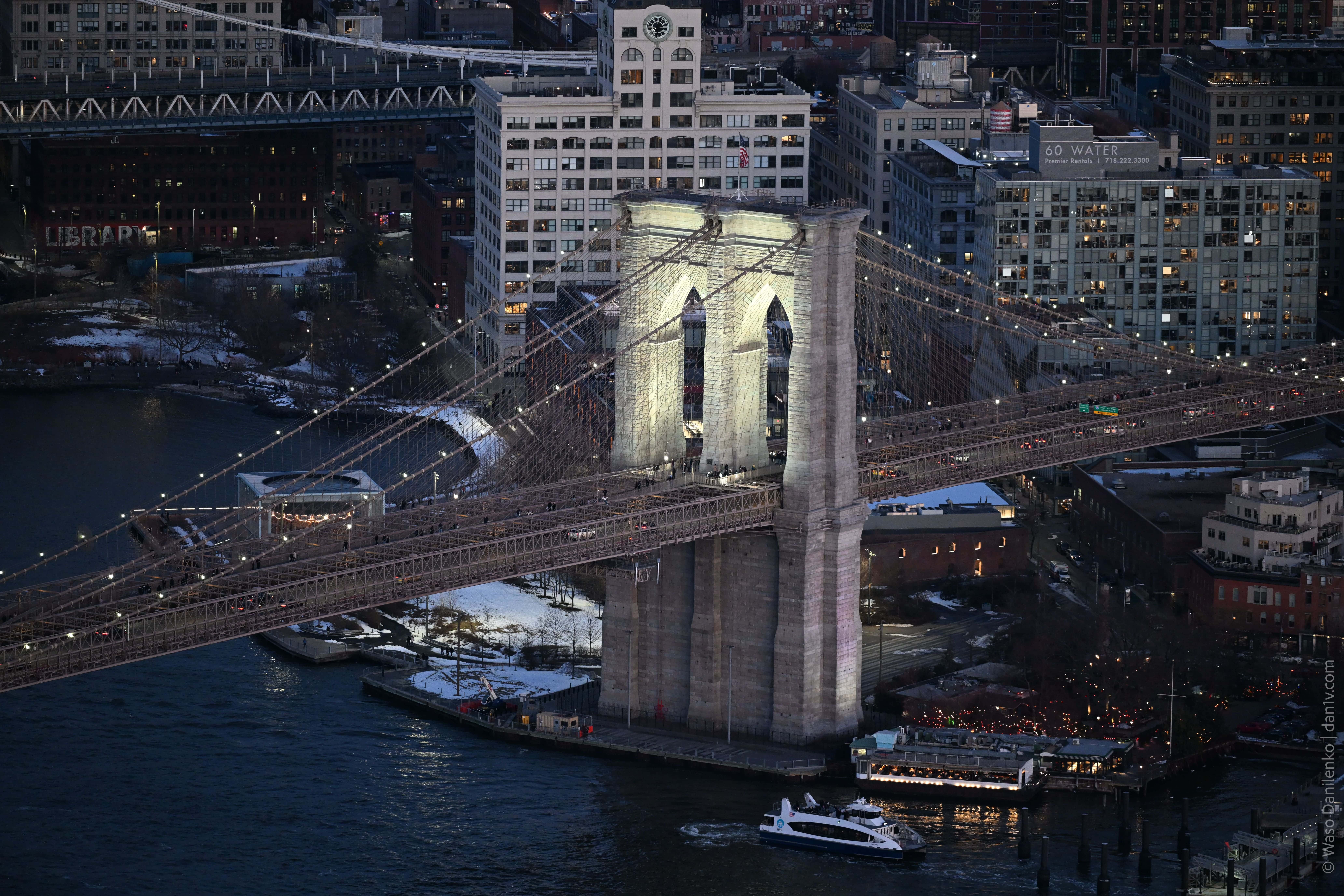
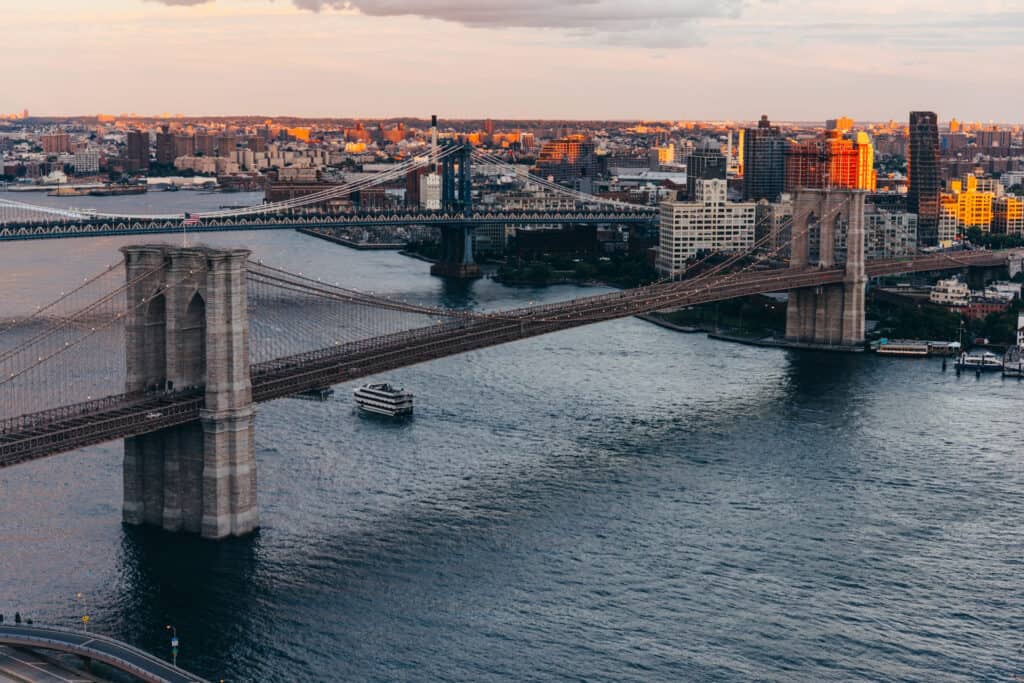
The Brooklyn Bridge is the oldest suspension bridge in the United States, one of New York City’s most iconic landmarks, an engineering marvel of the nineteenth century, and the most recognizable bridge in the world. When you see New York in films, it is usually this bridge with its Gothic arches and steel cables that appears on screen.
Interesting Facts About the Brooklyn Bridge
- It was the first suspension bridge in the world to use steel cables instead of iron chains.
- More than 150,300 people and 1,800 vehicles crossed the bridge on the opening day.
- Before the bridge was built, the only way to travel from Manhattan to Brooklyn was by ferry across the East River.
- At least 20 people died during construction, including chief engineer and designer John Roebling.
- The bridge’s strength exceeds its calculated structural requirement six times.
- Dinosaur fossils were discovered at the bottom of the river during construction.
- Because of public fears about its safety, 21 elephants were marched across the bridge to prove its strength.
- Peregrine falcons among the fastest birds in the world nest on the bridge’s towers.
- The Brooklyn Bridge has appeared in hundreds of films and has become one of the most recognizable symbols of New York in cinema.
Architecture of the Brooklyn Bridge
Revolutionary Strength of the Brooklyn Bridge
The Brooklyn Bridge is a unique hybrid of a suspension bridge and a cable-stayed bridge. At the time, bridge engineering was still rapidly developing, and engineer John Roebling decided to combine both systems in one structure to increase reliability.
On one hand, the bridge follows a classic suspension design: it has four main cables draped over the towers and anchored into massive abutments. Each cable measures approximately 40 centimeters in diameter and consists of 5,434 galvanized steel wires twisted together.
Interestingly, a major scandal erupted during construction over cable supply. Contractor Joseph Hay provided substandard wire for the bridge. By the time the fraud was discovered, some of the defective wire had already been woven into the cables and could not be replaced. Washington Roebling ordered additional wires to be added beyond the calculated requirement to compensate for the inferior material.
On the other hand, diagonal cables were added running from the towers directly to the deck. These elements function like stays: they transfer part of the load directly to the towers, increase structural rigidity, and reduce bridge movement caused by wind and traffic.
This combination of a traditional suspension system with an additional cable-stayed system gave the bridge extraordinary strength — six times greater than structurally required.
Gothic Towers of the Brooklyn Bridge
The most recognizable part of the bridge is its two monumental Neo-Gothic towers with distinctive pointed arches. John Roebling drew inspiration from the great cathedrals of Europe and insisted on Gothic architecture for the towers. He wanted the bridge not merely to serve transportation needs, but to become an architectural monument symbolizing greatness and progress.
The tower foundations extend dozens of meters into the riverbed. The submerged portions are built of limestone with caisson frameworks remaining from construction.
Wine Cellars Inside the Brooklyn Bridge
Few people know that enormous storage vaults are hidden inside the Brooklyn Bridge’s anchorages are vaulted granite chambers up to 15 meters high. These spaces were originally intended as commercial areas and shops known as the Brooklyn Bridge Anchorage, but the concept failed to gain traction. Instead, the chambers were rented out as wine cellars.
The granite walls maintained consistently cool temperatures, making the vaults ideal for aging wine and champagne. A. Smith & Co. paid 500 dollars per month to rent the Brooklyn-side vaults, while alcohol distributor Luyties Brothers paid an extraordinary 5,000 dollars per month for the Manhattan-side storage spaces.
The wine cellars remained in use until the First World War. Afterward, the chambers hosted art exhibitions, and in the 1950s a Cold War bomb shelter was discovered there containing substantial supplies of food, blankets, and warm clothing.
Since 2001, following the September 11 attacks, access to these spaces has been closed for security reasons. Today the vaults are used to store equipment for the New York City Department of Transportation.
History of the Brooklyn Bridge
Construction of the Brooklyn Bridge: A Family Feat
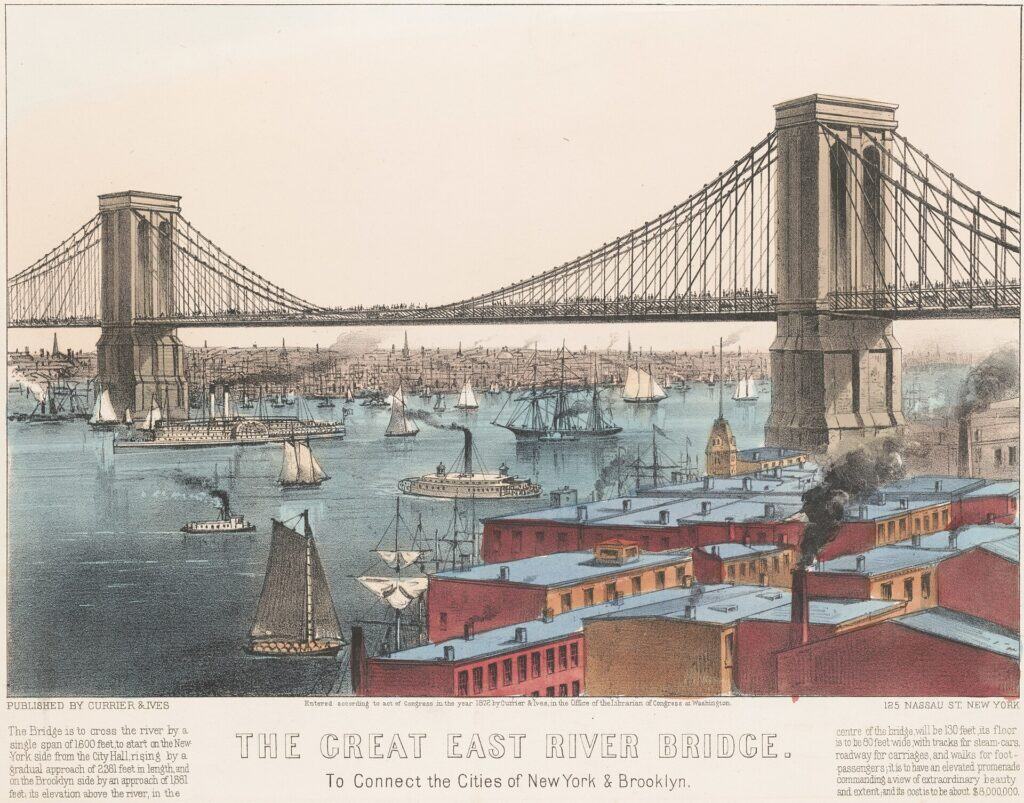
The idea for a bridge across the East River came to German immigrant engineer John Roebling in the winter of 1852. He had already built several suspension bridges, including spans over the Ohio River and near Niagara Falls. In 1867 he received the contract, but in 1869 he died of tetanus after suffering an injury at the construction site, just months before work began.
His 32-year-old son, Washington Roebling, took over the project. The tower foundations were installed in pressurized caissons on the riverbed. Workers spent four hours at a time under pressure and then ascended rapidly, unaware of decompression sickness: about 20 workers died and more than 150 were permanently disabled. In 1872, Washington himself developed a severe case and was partially paralyzed, forcing him to supervise construction from home.
His wife, Emily Roebling, became the de facto manager on site. She studied advanced mathematics, strength of materials, and stress analysis, coordinated construction for 11 years, and became the only woman allowed on the site.
In 1882, when officials attempted to remove Washington from the project, Emily addressed the trustees, thoroughly explained the finances and technical decisions, and secured his position. On May 24, 1883, she became the first person to cross the bridge in an open carriage carrying a rooster — a symbol of victory. She later earned a law degree from New York University and became an advocate for women’s rights. A memorial plaque on the bridge honors all three Roeblings.
Tragedy Immediately After Opening
The grand opening on May 24, 1883 included a parade. President Chester Arthur and future President Grover Cleveland, then Governor of New York, crossed the bridge. However, on May 30, panic in a crowd caused a deadly stampede in which 12 people were killed.
To dispel rumors that the bridge was unsafe, in 1884 twenty-one elephants and seventeen camels were marched across it in a dramatic public relations stunt that convinced residents of its strength.
An interesting historical footnote: around the turn of the century, conman George C. Parker repeatedly “sold” the bridge to gullible immigrants, inspiring the phrase: “If you believe that, I have a bridge to sell you.”
The Brooklyn Bridge in Culture
The Brooklyn Bridge has appeared in hundreds of films and has become one of the most recognizable symbols of New York in cinema. Among the most famous examples are:
- King Kong (1933) — one of the earliest iconic scenes featuring the bridge
- Annie Hall (1977) — romantic walks in Woody Allen’s New York
- Once Upon a Time in America (1984) — epic scenes in Sergio Leone’s masterpiece
- Armageddon (1998) — the bridge is destroyed by an asteroid
- I Am Legend (2007) — post-apocalyptic New York
- Spider-Man (2002) — iconic scenes featuring the Marvel superhero
Practical Tips for Visiting the Brooklyn Bridge
How to Get There
📍Brooklyn Bridge / New York, NY 10038
Subway stations High Street–Brooklyn Bridge (A, C lines) or York Street (F line) on the Brooklyn side; Brooklyn Bridge–City Hall (4, 5, 6 lines) or Chambers Street (J, Z lines) on the Manhattan side.
How Much Time to Allow
Walking across the Brooklyn Bridge takes approximately 30 to 60 minutes. The best times to visit are early morning, one hour before sunset, and after sunset. Walk toward Manhattan for the best unfolding views of Downtown and Midtown skyscrapers.
What to See Near the Brooklyn Bridge
- South Street Seaport — Historic district with restaurants, shops, and waterfront views of the bridge.
- One World Trade Center — The tallest building in the Western Hemisphere with an observation deck.
- National September 11 Memorial & Museum — Memorial and museum dedicated to the September 11 attacks.
Brooklyn Bridge Tours
- Untapped New York — secrets of the Brooklyn Bridge (40–50 dollars)
- Big Onion Walking Tours — historical tours of the bridge and DUMBO (25–30 dollars)
- NYC Ferry — affordable way to see the bridge from the water (4 dollars)
- Circle Line — cruises around Manhattan with views of all major bridges
- Bike and Roll NYC — bicycle rentals and guided tours
- Central Park Sightseeing — bicycle tours across the bridge into Brooklyn