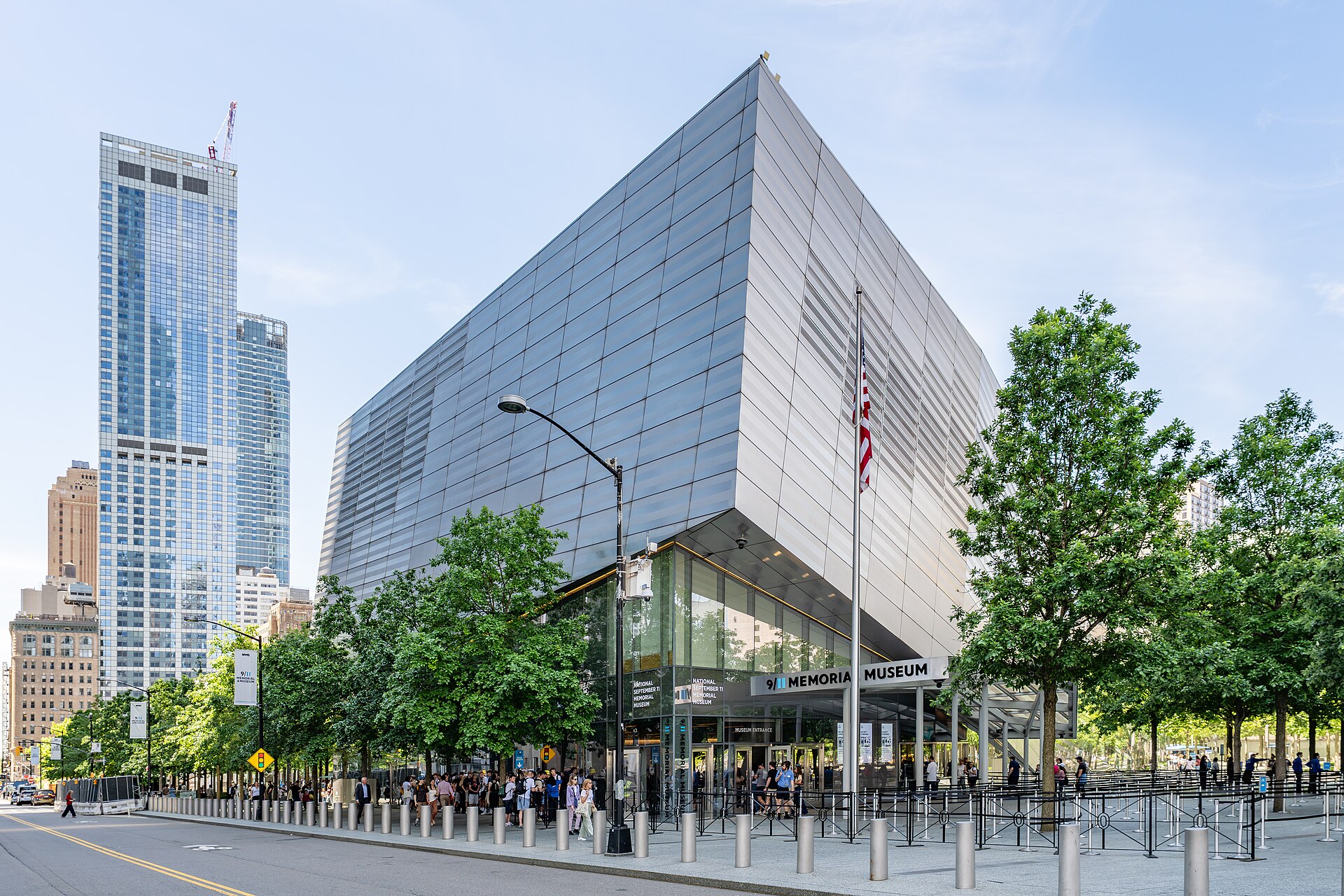
Visiting the 9/11 Museum is one of the most unusual experiences. And it is not only because the exhibition is dedicated to a horrifying tragedy. On September 11, 2001, not only New York changed. One day changed the entire country, the world, and entire industries, such as security and aviation. So the museum tells the story of events that affected everyone.
The museum is part of the 9/11 Memorial complex, whose centerpiece is two large square pools that descend deep into the ground and stand on the footprints of the Twin Towers. When visiting the museum, you can actually walk beneath these pools. The museum’s creators approached the concept of an underground gallery with remarkable skill.
When you first decide to visit this museum, you might expect something formal, archaic, and conformist — a strict mausoleum for buildings. But in reality, it is a modern and progressive museum that takes you back to 2001 and allows you to experience that day through the lives of different people, including the 2,996 people who became victims of the terrorist attacks.
Interesting Facts About the 9/11 Museum
- The museum literally sits in the basement of buildings that no longer exist — the exhibition is spread throughout the foundations of the towers, between the original severed columns.
- The museum has a wall made up of 2,983 blue watercolor squares. Artist Spencer Finch asked people who witnessed the attacks to recall the color of the sky that morning, and no two answers were the same. Behind the wall is a repository for unidentified remains — around 40% of those who died in the towers have still not been identified.
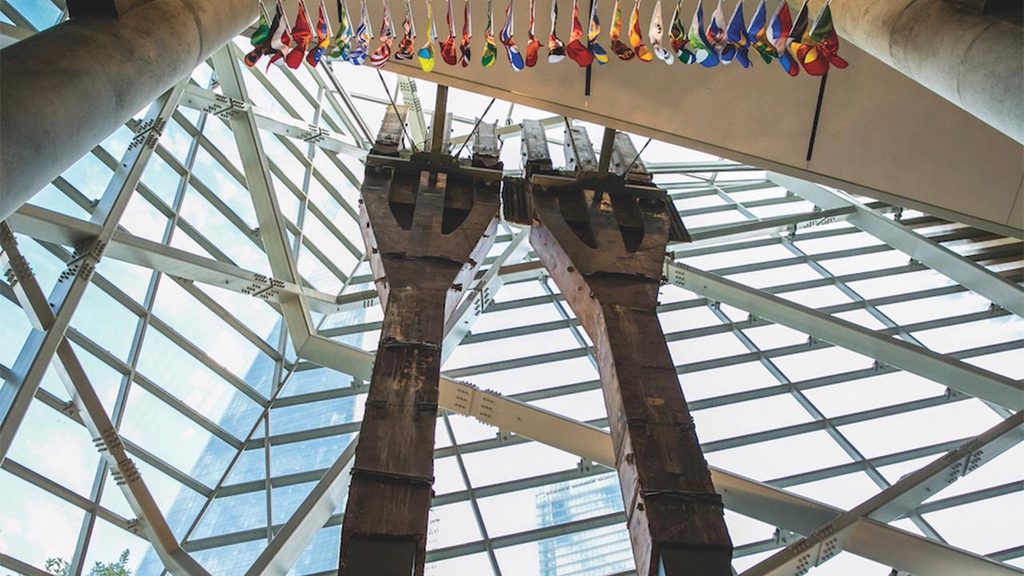
- The museum has two original facade columns from the Twin Towers, also known as the “tridents.” Interestingly, the museum pavilion was built around these columns because it would have been impossible to bring them inside otherwise: each one weighs 50 tons.
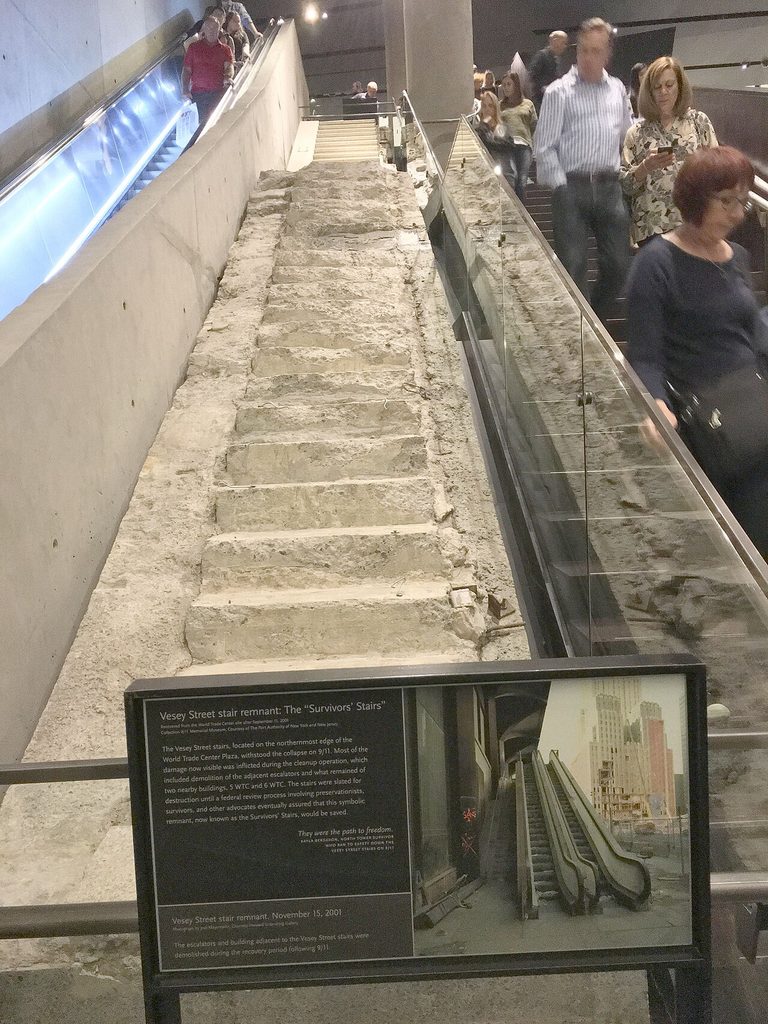
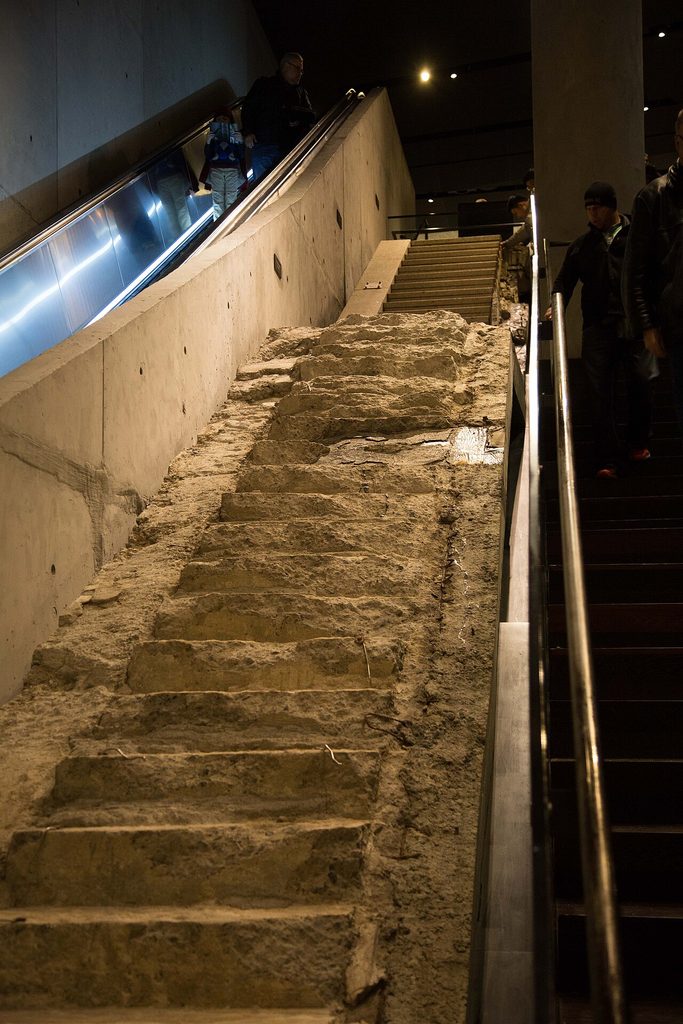
- The museum contains a 65-ton section of the staircase that helped hundreds of people descend from the WTC complex to Vesey Street, earning it the name “Survivors’ Staircase.”
- A popular myth says that one of the tower walls survived on its own. In reality, it was saved by an emergency campaign to drill new anchors into the bedrock in the fall of 2001. Without them, the subway tunnels would have flooded.
- The names on the memorial parapets are not arranged alphabetically. Instead, they are arranged according to whom the victims had connections with during their lives.
- The waterfalls on the plaza disappear into openings whose bottoms cannot be seen from any angle. They are the largest man-made waterfalls in North America.
- The Survivor Tree — a pear tree found in the rubble with broken roots and burned branches — was nursed back to health at a nursery in the Bronx and returned to the plaza only in 2010.
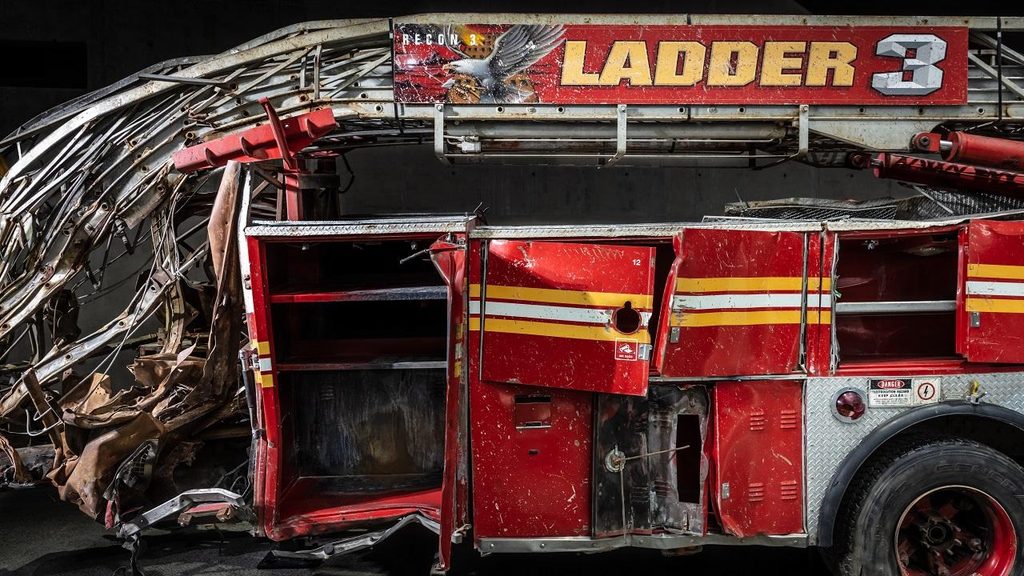
- The 30-ton Ladder Company 3 fire truck was lowered into the museum by crane while the building was still under construction, long before it opened.
- The museum’s collection contains more than 83,000 objects, and part of it is available online without a visit to New York.
History of the 9/11 Museum
The 2003 memorial design competition received 13,683 registrations from 63 countries, making it the largest architectural competition in history. The winning design, “Reflecting Absence,” was created by 34-year-old Michael Arad, a staff architect for the New York City Housing Authority.
Daniel Libeskind’s master plan for the site called for the memorial to be located 70 feet underground, in an exposed excavation. Arad’s design ignored this requirement: the plaza was eventually raised almost to street level, while only the museum was built underground. The underground memorial halls were removed from Arad’s original design. He compared the descent into them to Orpheus’s descent into the underworld. The ten-year approval process was later described by the architect as “death by a thousand paper cuts.”
Construction began in 2006 and came to a halt in December 2011, not because of a lack of funding, but because of a dispute over who would pay for the infrastructure: the memorial foundation, whose board was chaired by Bloomberg, versus the Port Authority, which was controlled by Governor Cuomo. An agreement was signed on September 10, 2012, on the eve of the next anniversary — surely not by accident.
The museum opened on May 21, 2014, with the dedication personally led by Barack Obama.
Architecture of the 9/11 Museum
The above-ground pavilion was designed by the Norwegian firm Snøhetta. It features stainless steel panels and a striped facade that echoes the aluminum mullions of the Twin Towers. The building is intentionally low and horizontal — a “bridge between two worlds.”
Inside the pavilion, behind glass, are two original “tridents”: facade columns from the North Tower, each approximately 70 feet tall and weighing 50 tons. They were installed first, in September 2010, and the pavilion was then built around them — otherwise, it would have been physically impossible to bring the columns inside.
The underground section was designed by the New York-based firm Davis Brody Bond. Its defining architectural feature is “The Ribbon”: a gently descending continuous path of ramps and stairs that echoes the ramp used to remove the debris from the site. The deeper you go, the darker the finishes become, transitioning from light ash wood to almost-black wenge.
9/11 Museum Exhibition
The 9/11 Museum’s collection contains more than 83,000 objects, some of which are available online at collection.911memorial.org. Here are the main objects on display:
- The Survivors’ Stairs — original granite steps from Vesey Street that hundreds of people used to escape the towers on the morning of September 11. They were moved by crane in 2008 to protect them during construction, making them the first original structure you encounter on the descent.
- The slurry wall — a retaining wall that protects the site from the waters of the Hudson River, built using an Italian construction technique developed in the 1940s. A popular myth claims that it “stood on its own.” In reality, the wall was saved by an emergency campaign to install new rock anchors in the fall of 2001, after the collapse destroyed the floor slabs that had been holding it in place. If the wall had failed, the subway tunnels would have flooded.
- The Last Column — a 36-foot steel beam from the core of the South Tower that was deliberately left standing for nine months. Rescuers covered it with unit numbers, photographs, and notes. It was officially removed from the site on May 30, 2002, accompanied by bagpipes and an honor guard.
- Spencer Finch’s wall — 2,983 squares of watercolor paper, each in a different shade of blue. The artist asked eyewitnesses to remember the color of the sky that morning, and no two answers were the same. Behind this wall is the sealed repository containing unidentified human remains.
- Other artifacts include the Ladder Company 3 fire truck with its completely crushed cab, weighing 30 tons and lowered 70 feet underground by crane; a fragment of an aircraft fuselage with a porthole from one of the hijacked planes; a bicycle rack with bicycles that survived beneath a layer of dust; and “composite,” a mass of concrete, paper, metal, and glass compressed into a single material.