
If you thought you knew the American Museum of Natural History from its dinosaurs, blue whale, and dioramas, the Richard Gilder Center for Science, Education, and Innovation will noticeably change that impression. It is not a separate museum, but a new western wing of the AMNH. It faces Columbus Avenue and Theodore Roosevelt Park and looks as if a river had carved it out of stone. Inside are live butterflies and insects, glass-enclosed scientific collections, an immersive 360-degree theater, and a huge canyon-like atrium that is one of the main reasons many visitors come here.
Interesting Facts About the Richard Gilder Center for Science, Education, and Innovation
- After the opening, the center’s architecture received mixed reviews. Some critics particularly praised the interior spaces but considered the exterior facing Columbus Avenue too heavy and static.
- Three older buildings in the museum complex had to be demolished to make room for the new center.
- Architects from Studio Gang designed the building to connect different parts of the museum. The center creates 33 new passageways between 10 buildings.
- The undulating facade is clad in pink granite, the same material used at the museum’s main entrance facing Central Park.
- The centerpiece of the center is a towering canyon-like atrium. Its walls are made of shotcrete, a type of concrete applied under pressure. The architects developed and tested the shape of the walls using physical models and computer programs. The design was inspired by the canyons of the American Southwest.
- The atrium serves more than a decorative purpose. It brings natural daylight into the building and also helps circulate air.
- The center is home to the Solomon Family Insectarium, the museum’s first permanent exhibition devoted entirely to insects in approximately 50 years. The vivarium houses about 1,000 free-flying butterflies representing approximately 80 species.
- The fifth and sixth floors house the Department of Ichthyology and its scientific collection of more than 2.5 million fish specimens.
History of the Richard Gilder Center
The American Museum of Natural History was founded in 1869, and one of the people involved in its creation was Theodore Roosevelt Sr., the father of the future United States president. Over the following decades, the museum continued to expand, adding new buildings, galleries, and extensions. Over time, the complex became a veritable labyrinth of 10 buildings from different eras.
In 2014, the museum announced plans for the new Richard Gilder Center for Science, Education, and Innovation (Gilder Center). It was named after financier and longtime museum trustee Richard Gilder. The architects were given several goals: to make the museum’s scientific collections more accessible to visitors, show how scientists conduct their work, create modern educational spaces, and improve connections between the different museum buildings.
The project sparked controversy because of its location next to Theodore Roosevelt Park. A local community group filed a lawsuit, concerned that the construction would reduce green space and publicly accessible areas. The legal dispute delayed the project. The final design sought to minimize the building’s impact on the park, while the landscape around the museum was redesigned by the firm Reed Hilderbrand. The paths were widened and more seating areas were added.
Construction began on June 12, 2019. During the project, its cost increased significantly. The original estimate was approximately $325–340 million, then rose to $383 million, and ultimately reached $465 million. The Gilder Center was originally scheduled to open in February 2023, but it welcomed visitors on May 4, 2023.
Architecture of the Richard Gilder Center
From the outside, the Richard Gilder Center was designed to fit naturally into the surrounding park and the museum’s existing buildings. Along Columbus Avenue, it is roughly the same height as the neighboring structures, while the flowing lines of the facade make it appear less massive. The building is clad in Milford pink granite, while large sections of glass feature a special ceramic coating designed to make them safer for birds.
The building makes its strongest impression from the inside. At its center is the five-story Kenneth C. Griffin Exploration Atrium, a vast space with curved walls and large skylights. The walls resemble rocky cliffs or a canyon: they curve smoothly, connect with one another, and form small “windows” through which visitors can see galleries on different floors. This unusual shape not only creates a distinctive interior but also helps reduce glare and improve acoustics. The curved walls are also part of the building’s structural system.
The atrium is best viewed from different levels. From the ground floor, look up to spot the bridges and small windows on the upper floors, then go higher to see the space from above. The atrium also incorporates an open scientific collections storage area directly into the space.


The Collection at the Richard Gilder Center
One of the main ideas behind the Richard Gilder Center is to show visitors what is usually hidden from view: the museum’s scientific research and discoveries. To achieve this, the center created the five-level Louis V. Gerstner, Jr. Collections Core. Three floors feature tall display cases containing more than 3,000 specimens from different museum collections. The building itself also houses approximately 4 million scientific specimens, representing about 12 percent of the entire collection of the American Museum of Natural History.
Unlike a traditional museum exhibition, there are no individual “star” specimens accompanied by lengthy descriptions. Double-sided display cases allow visitors to see not only the specimens themselves but also the scientific work behind them. Large interactive touchscreens explain what visitors are looking at and why researchers study these materials. The specimens include insects, fish, skeletons, minerals, and many other objects. The idea is to show that scientific discoveries begin with real physical specimens that researchers collect, preserve, and study.
The Richard Gilder Center also houses the Gottesman Research Library and Learning Center, new classrooms, laboratories, and workspaces for researchers. In total, 18 classrooms were created or renovated on the second, third, and fourth floors.


Exhibitions and Galleries at the Richard Gilder Center
On the first floor, there is a 460-square-meter gallery dedicated to insects. Live insects are presented alongside museum specimens, scientific tools, and digital exhibits. Some of the species on display can also be found in New York City. The leafcutter ant colonies are particularly interesting to watch.
On the second floor, there is a small tropical garden where approximately 1,000 free-flying butterflies representing about 80 species move among visitors. They sometimes land on people or their clothing. It is best to arrive at the beginning of a session, when the butterflies are most active. Before leaving, check your clothing to make sure you have not accidentally carried an insect out of the vivarium. Admission is timed and requires a separate ticket.
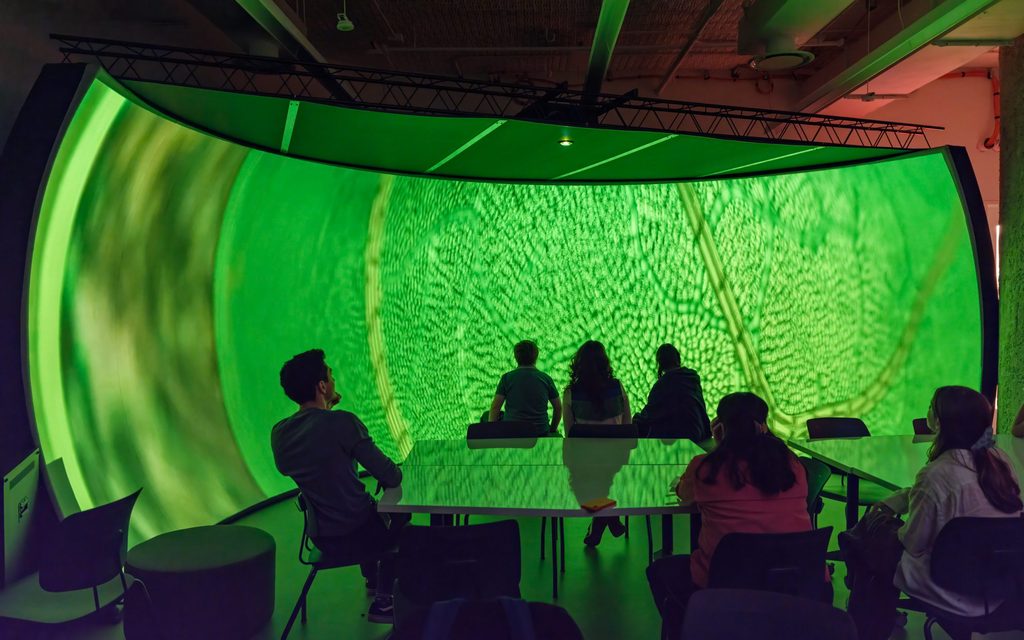
On the third floor, there is an immersive installation dedicated to the invisible connections between living organisms and their environment. In an oval hall roughly the size of a hockey rink, visitors are surrounded by light, sound, and images. The approximately 12-minute show explores connections between natural processes at different scales, from the microscopic world to entire ecosystems.
In addition to its permanent spaces, the center regularly hosts other ticketed exhibitions. These may include Encounters in the Milky Way, Goal Zone, and Impact: The End of the Age of Dinosaurs, but the selection changes, so it is best to check the museum’s website for the current exhibition list before visiting.