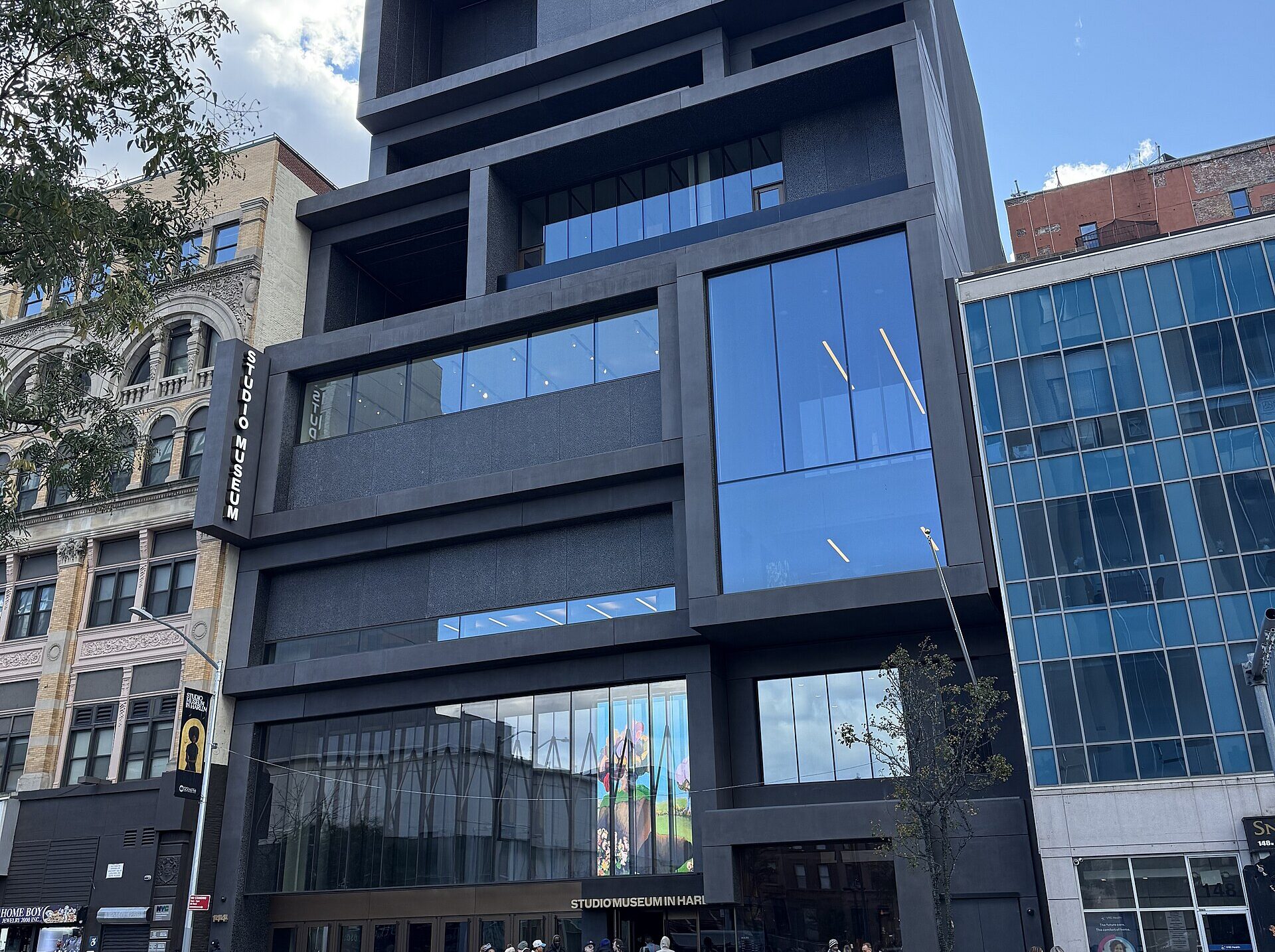
The Studio Museum in Harlem opened in 1968 above a wine shop on Fifth Avenue. At the time, major New York museums rarely exhibited the work of Black artists. So artists in Harlem decided to create their own space.
Today, the museum occupies a new $160 million building. Its collection contains about 9,000 works, and more than 150 artists have participated in its residency program, including Kehinde Wiley, Simone Leigh, Kerry James Marshall, and Julie Mehretu. Over 57 years, the Studio Museum has grown from a small space above a shop into one of the major museums dedicated to the art of African American artists.
Interesting Facts About the Studio Museum in Harlem
- In 1968, the museum did not have its own building. Its first exhibitions were held above a wine shop on Fifth Avenue.
- The museum has an Artist-in-Residence program dedicated to supporting and developing artists. It has operated since 1969 and has supported more than 150 artists.
- Residents are given a studio and almost a full year to work, without being required to create a finished exhibition in advance.
- Former residents include Kehinde Wiley, Simone Leigh, Kerry James Marshall, Julie Mehretu, and Mickalene Thomas. Many of them later became prominent figures in contemporary art.
- The museum operated without its own building for seven years. From 2018 to 2025, it was closed for construction but continued its work, with exhibitions and programs taking place at other venues.
- The new building was designed by David Adjaye, the same architect who designed the National Museum of African American History and Culture in Washington, D.C.
- The first exhibition in the new building was dedicated to the same artist who was featured in the museum’s first exhibition. In 1968, that first exhibition featured the work of Tom Lloyd, and after the new building opened in 2025, the museum presented his work again.
- The museum’s collection includes the largest archive of photographs by James Van Der Zee, one of the most important photographers of twentieth-century Harlem.
- The museum is located on one of Harlem’s main streets. In other words, this is not simply a museum that tells the story of the neighborhood. It is an institution that has developed alongside Harlem for decades.
How the Studio Museum in Harlem Was Founded
To understand why Harlem needed its own museum, we need to go back to New York in the mid-1960s.
By that time, the Metropolitan Museum of Art, Museum of Modern Art, Whitney Museum of American Art, and Solomon R. Guggenheim Museum had already spent decades shaping the idea of what American art was. But Black artists were rarely represented in their main collections and exhibition programs. At the same time, Harlem was home to many talented artists, including Romare Bearden, Norman Lewis, and Hale Woodruff.
One of them was photographer James Van Der Zee, who had been documenting life in Harlem since 1906: weddings, funerals, children, musicians, local elites, and ordinary residents. Over the decades, he created an enormous visual archive of the neighborhood, but major museums largely overlooked his work for many years.
In 1968, artist Tom Lloyd organized meetings in Harlem where artists discussed their situation. One of the main demands was an exhibition of Black artists at the Metropolitan Museum of Art. When no concrete response followed, the idea became simple: if existing museums did not provide them with space, they would create their own.
That same year, a group of artists, activists, patrons, and Harlem residents founded the Studio Museum. The museum had neither a large building nor a substantial budget. It was housed on the second floor of a building at 2033 Fifth Avenue, New York, New York 10035.
The first exhibition was Electronic Refractions II by Tom Lloyd, featuring light works made with electric lamps and equipment. It opened in November 1968.
The museum that now occupies a large modern building on 125th Street therefore began with just a few rooms above shops.
Why the Studio Museum in Harlem Has This Name
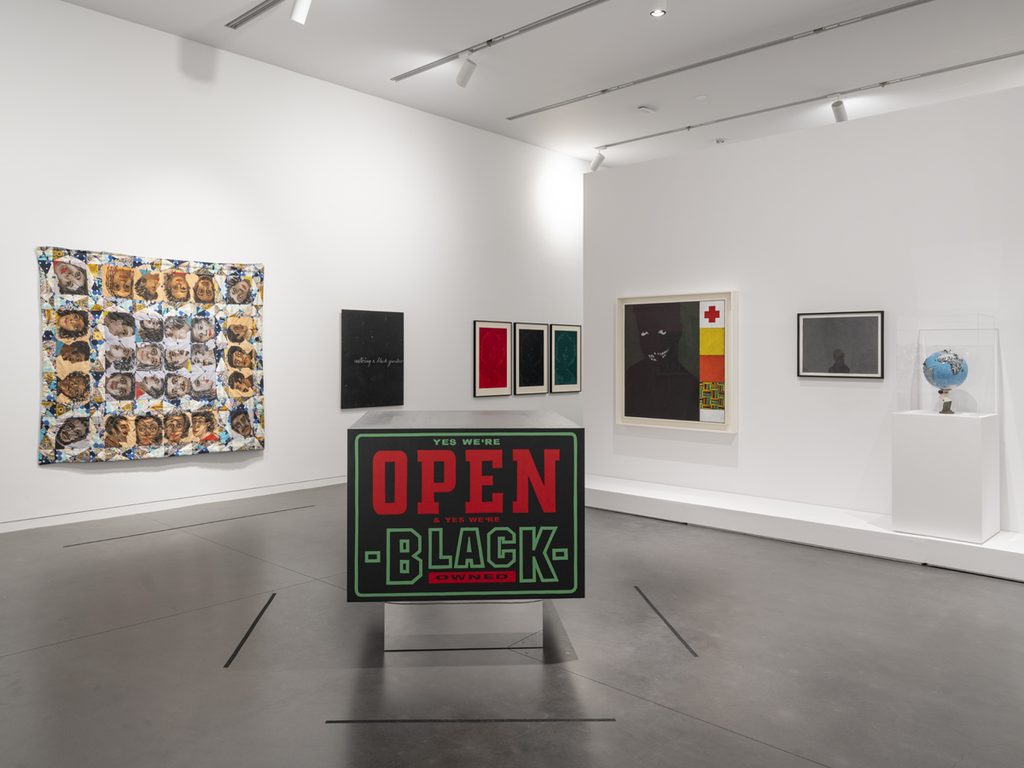
The word “Studio” in the name is not accidental. From the beginning, the museum wanted to be not only a place where finished works were preserved and exhibited, but also a place where artists could work.
That is why, in 1969, just one year after opening, the museum launched its Artist-in-Residence program. Each year, three artists receive their own studio at the museum, a stipend, and material support, as well as the opportunity to work with curators and other specialists. At the end of the 11-month program, they present their work in an exhibition.
More than 150 artists have participated in the program over the years. It is impossible to list them all, but here are a few names to give an idea of the artists involved:
- Kehinde Wiley — an artist known for portraits of Black Americans posed like figures in European Old Master paintings: hip-hop culture in gilded frames and settings inspired by Rubens and Titian. In 2018, he painted Barack Obama’s official presidential portrait, becoming the first Black artist to create one.
- Simone Leigh — a sculptor and installation artist who represented the United States at the 2022 Venice Biennale. She was the first Black woman to receive the Golden Lion, the biennale’s highest award.
- Kerry James Marshall — a painter whose works now sell at auction for $21 million or more. In 2016, his retrospective at the Museum of Contemporary Art Chicago became one of the most visited exhibitions in the museum’s history.
- Julie Mehretu — an Ethiopian American abstract painter. In 2019, the Museum of Modern Art in New York acquired her painting Dissident Score II for a record price for a living female artist.
- David Hammons — a legendary conceptual artist and one of the most influential artists in the world. He rarely exhibits his work, does not maintain social media accounts, and rarely gives interviews. His flag hangs on the facade of the new Studio Museum building.
- Njideka Akunyili Crosby — a Nigerian American artist. In 2017, one of her works sold at Sotheby’s for $3.1 million, setting a record for the artist at the time.
History of the Studio Museum in Harlem
In 1982, the museum moved into a former bank on 125th Street, which architect J. Max Bond Jr. converted into a museum. The Studio Museum remained there for the next 36 years.
Thelma Golden played an important role in the museum’s history. She joined the museum as an intern in 1987, later worked as a curator at the Whitney Museum of American Art, and returned to the Studio Museum in 2000. In 2001, Golden organized Freestyle, an exhibition featuring the work of 28 young Black artists. The exhibition became an important moment in the discussion of a new generation of artists who explored Black identity but did not want their work to be reduced solely to the subject of race. In 2005, Golden became the museum’s director and chief curator.
In 2018, the Studio Museum closed its building on 125th Street and began construction of a new one. For the next seven years, the museum continued operating without its own building, presenting exhibitions and programs at other venues.
On November 15, 2025, the Studio Museum reopened in its new building, designed by architect David Adjaye. The museum returned to 125th Street, now in a space specifically designed for its exhibitions, educational programs, and Artist-in-Residence program.
Architecture of the New Studio Museum in Harlem
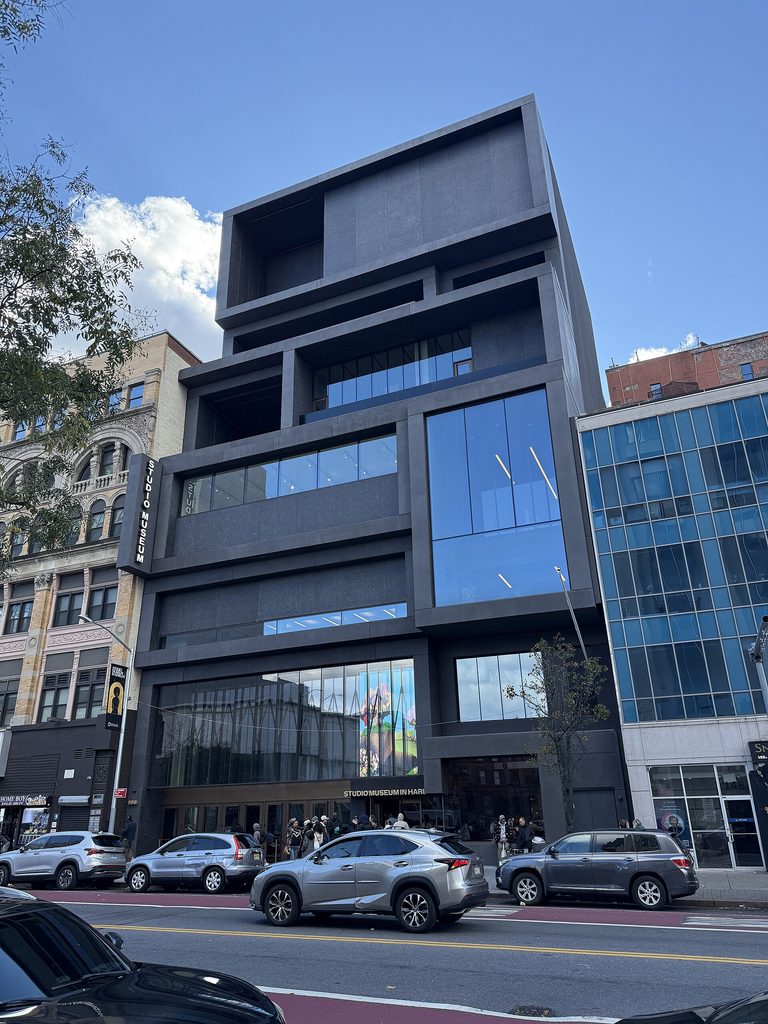
The new building immediately stands out in Harlem. Its facade is made of precast concrete in dark gray and black tones, with different surface treatments. The windows vary in size and resemble the facades of Harlem buildings, while the overall form of the building draws on local architecture, from brownstones to churches.
In front of the entrance, Adjaye created a kind of “reverse stoop” — a wide stepped platform that descends from the street toward the museum. In a typical Harlem house, a stoop rises from the sidewalk to the front door, while here the space works in the opposite direction. It serves as an entrance, a place to gather, and a small urban stage.
An Untitled flag (2004) by David Hammons hangs permanently on the facade facing 125th Street. Hammons was one of the early participants in the Artist-in-Residence program, so the work is connected not only to Harlem but also to the history of the museum itself.
Inside, seven floors are connected by a large central staircase. It serves not only as a way to move between floors but also as a public space. Lectures, screenings, performances, and other events can take place here. The building also contains galleries, studios for artists in residence, educational spaces, a library, and a landscaped rooftop terrace.
Some architectural elements are directly connected to the history of Harlem. For example, the upper galleries with natural light recall the tall interiors of local churches, while the stepped spaces inside the building echo the idea of the urban stoop.
The Studio Museum in Harlem Collection
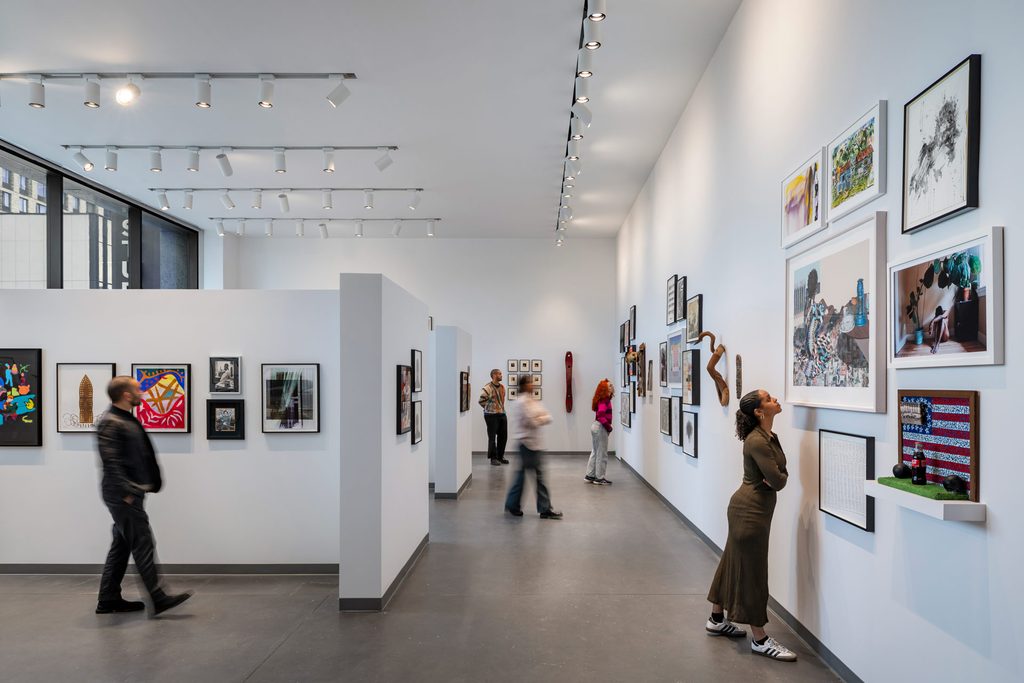
Today, the Studio Museum’s collection contains about 9,000 works by more than 700 artists. It includes painting, sculpture, photography, works on paper, video, and installation art. The collection covers roughly two centuries of art from the African diaspora, from the nineteenth century to contemporary artists.
The artists represented in the collection include Romare Bearden, known for his collages depicting life in Harlem; Jacob Lawrence, with his famous Migration Series about the Great Migration of Black Americans from the South to the North; Kara Walker, Carrie Mae Weems, Chris Ofili, and Gordon Parks.
A particularly important part of the collection is the archive of James Van Der Zee. He photographed Harlem from 1906 until his death in 1983, creating thousands of portraits and scenes of everyday life in the neighborhood. His photographs show weddings and funerals, musicians and athletes, children, families, shops, and streets.
Van Der Zee photographed extensively during the Harlem Renaissance of the 1920s and 1930s. His photographs therefore provide a rare opportunity to see this period not only through its famous writers and musicians, but also through the everyday life of the neighborhood itself.
In 1969, Van Der Zee’s work was included in an exhibition at the Metropolitan Museum of Art, after which the photographer gained wider recognition outside Harlem. Today, the Studio Museum preserves his archive, including photographs, negatives, and other materials related to his work. It is one of the most important parts of the museum’s collection and an important resource for studying the history of twentieth-century Harlem.
Visitors’ Information
📍 Studio Museum in Harlem / 144 West 125th Street, New York, NY 10027
Subway:
- 2/3 trains to 125th Street — right next to the entrance
- A/B/C/D trains to 125th Street — a 5-minute walk
Hours:
- Thursday–Friday: 12:00–18:00
- Saturday–Sunday: 10:00–18:00
- Monday–Tuesday: closed
Admission: Suggested donation; admission is technically free.
Website: www.studiomuseum.org