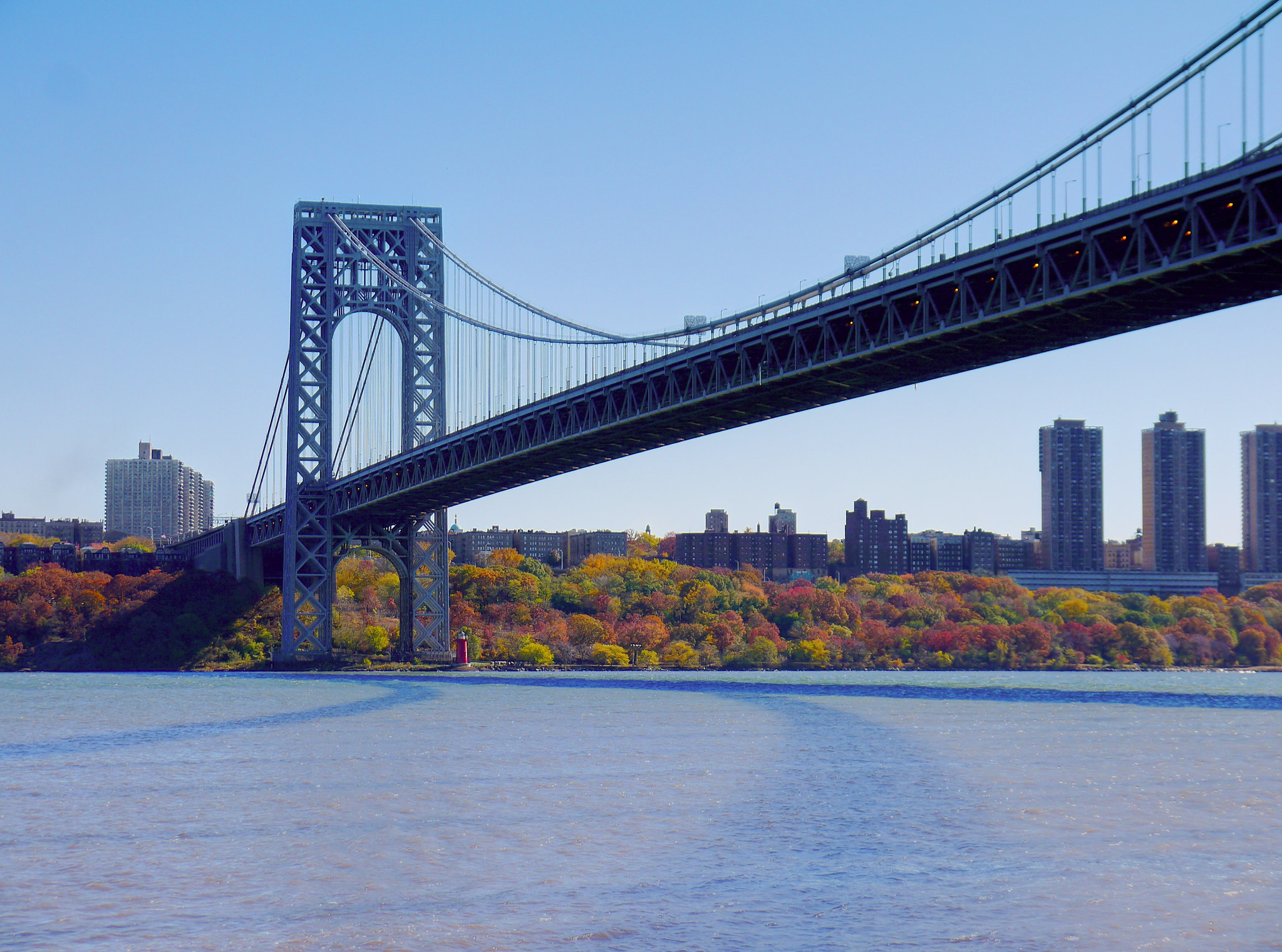
The George Washington Bridge, known to New Yorkers simply as the GWB or “George,” connects Manhattan with New Jersey and is considered the busiest automobile bridge in the world. About 100 million vehicles cross it each year. Unlike the bridges from our previous articles, it does not cross the East River. It stands over the Hudson River, at the northern tip of Manhattan in Washington Heights.
Tourists rarely make it here, which is a shame. When it opened in 1931, it was the longest suspension bridge in the world, almost twice as long as the previous record holder. The towers were supposed to be clad in granite, but the Great Depression put an end to that plan. The architect Le Corbusier later called the finished bridge the most beautiful bridge in the world. There is also a small red lighthouse beneath its Manhattan tower that was saved from demolition by American children.
Interesting Facts About the George Washington Bridge
- The bridge’s name is connected to the American Revolutionary War. In 1776, Fort Washington and Fort Lee stood on opposite sides of the Hudson River. From the New Jersey side, George Washington watched as the British captured the Manhattan fort.
- The lower level is nicknamed “Martha,” after Martha Washington, George Washington’s wife.
- In 1931, it became the longest suspension bridge in the world. The record lasted until the Golden Gate Bridge opened in 1937.
- The bridge was built in just four years, eight months ahead of schedule and for less than the planned budget.
- The towers were originally supposed to be clad in granite, but the Great Depression forced the project to abandon the idea. The exposed steel structure remained. The architect Le Corbusier was delighted with it and called the bridge the most beautiful in the world.
- The bridge was originally so strong that it did not need the usual stiffening structure beneath the roadway. It was added only in 1962, when the lower level was built.
- The red Jeffrey’s Hook Lighthouse stands next to the Manhattan tower. It is the only surviving lighthouse in Manhattan. It was built in New Jersey in 1880 and moved to its current location in 1921. After the bridge was built, the lighthouse was no longer needed, but it was saved thanks to letters from children who had read the book The Little Red Lighthouse and the Great Gray Bridge.
- Nearby Fort Lee was one of the centers of early American filmmaking. In the 1910s, some of the first film studios in the United States operated here, before the film industry eventually moved to California.
- Since 1947, an American flag measuring 27 by 18 meters and weighing more than 200 kilograms has been displayed on the New Jersey tower on holidays. According to the Port Authority, it is the largest American flag in the world.
- In 2013, the bridge became the center of the political scandal known as Bridgegate. Two of the three local lanes leading to the bridge from Fort Lee were closed without warning. The city was hit by a massive traffic jam, and the scandal seriously damaged the political career of New Jersey Governor Chris Christie.
- Today, it is one of the busiest automobile bridges in the world. Approximately 270,000 to 290,000 vehicles cross it every day, or about 100 million vehicles a year.
- You can walk across the bridge for free from New York to New Jersey. It is the only bridge that directly connects Manhattan with New Jersey and has a pedestrian walkway.
History of the George Washington Bridge
At the beginning of the 20th century, there was no bridge across the Hudson River between Manhattan and New Jersey. The river is much wider here than the East River, and ocean liners traveled along it, so people crossed between the two shores by ferry. Railroad tunnels opened in 1908, followed by the Holland Tunnel for automobiles in 1927.
The idea of building a bridge across the Hudson was promoted for decades by Gustav Lindenthal, one of New York’s best-known bridge engineers. He envisioned a giant bridge near 57th Street that would carry both trains and automobiles. The project proved too expensive, and the railroad companies refused to finance it.
Othmar Ammann, a Swiss engineer, worked for Lindenthal. He believed a bridge in central Manhattan would not be feasible and proposed a simpler location near 179th Street, where the two shores are closer together. Lindenthal saw this as a betrayal, and Ammann left. In the 1920s, his project gained the support of the Port Authority of New York and New Jersey.
Construction began in 1927. On the New Jersey side, one of the towers was built directly on the Palisades rock, with the cables anchored into the rock itself. The bridge opened on October 25, 1931, eight months ahead of schedule. Its 1,067-meter main span was the longest in the world and held the record until the Golden Gate Bridge opened in 1937.
The towers were originally supposed to be clad in granite, but the Great Depression forced the project to abandon the plan. The exposed steel structure impressed the architect Le Corbusier, who called the bridge the most beautiful in the world.
Ammann designed the bridge from the beginning with the possibility of adding a second level. By the 1950s, the eight lanes were no longer enough, so a lower level was built between 1958 and 1962 under Ammann’s direction. The bridge then had 14 lanes: eight on the upper level and six on the lower level. The lower level was nicknamed “Martha” after Martha Washington. Today, trucks use only the lower level.
Architecture and Engineering of the George Washington Bridge
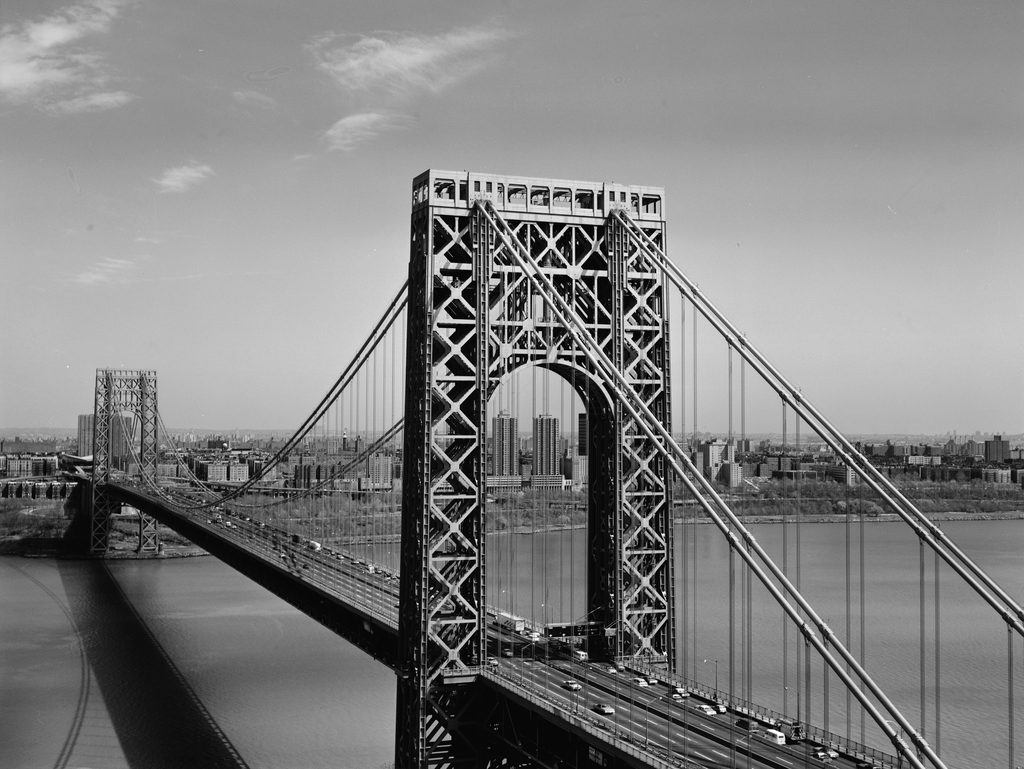
The main engineering feature of the George Washington Bridge is its unusually light roadway. Othmar Ammann used what is known as the “deflection theory”: the heavier and longer a bridge is, the more stiffness the cables themselves provide. Because of this, the bridge did not need the usual stiffening structure beneath the roadway when it opened in 1931. The roadway was supported by simple crossbeams. The stiffening structure was added only in 1962, when the lower level was built.
The steel towers were also supposed to look very different. According to the design by architect Cass Gilbert, they were going to be covered with concrete and granite to resemble two enormous stone monuments. But construction took place during the Great Depression, so the expensive cladding was abandoned. The towers were left exposed, with steel latticework and diagonal braces.
Unexpectedly, this version turned out to be much more striking than the original design. In 1935, architect Le Corbusier visited New York and called the George Washington Bridge the most beautiful bridge in the world. For modernist architects, it became an example of how the structure itself could serve as architecture without additional decoration.
The Little Red Lighthouse Beneath the George Washington Bridge
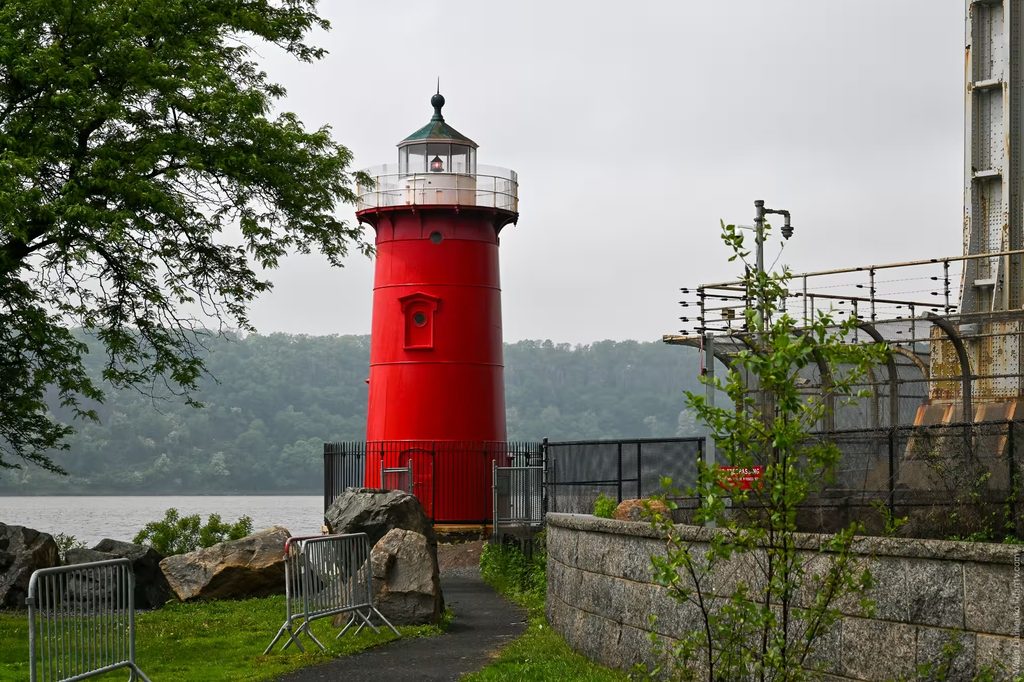
Beneath the Manhattan tower, right by the water, stands a red cast-iron lighthouse about 12 meters tall. It is called Jeffrey’s Hook Light, named after Jeffrey’s Hook, and it is the only surviving lighthouse in Manhattan.
The lighthouse was built in 1880, but it originally stood in a completely different location, at Sandy Hook in New Jersey. In 1921, it was moved here because Jeffrey’s Hook was a dangerous spot for ships. It operated for ten years before ending up beneath the bridge. The bridge lights were brighter than any lighthouse, so it was decommissioned in 1948. The Coast Guard planned to put it up for auction.
In 1942, a children’s book by Hildegarde Swift, illustrated by Lynd Ward, was published under the title The Little Red Lighthouse and the Great Gray Bridge. The little lighthouse is upset that a huge bridge has been built next to it and that it is no longer needed. Then, on a foggy night, it becomes clear that the lighthouse still has an important job: the bridge watches over the airplanes, while the lighthouse is responsible for watching over the boats.
The book became a classic. When the lighthouse was put up for sale in 1951, the Coast Guard received letters from children across the country, and the lighthouse was transferred to the city. In 1979, it was added to the National Register of Historic Places, and in 1991, it was designated a New York City landmark.
The lighthouse is rarely open to the public. Visitors can enter during organized tours run by the city’s Parks Department and during the annual Little Red Lighthouse Festival, held in Fort Washington Park in early fall. You can walk up to the lighthouse from the outside on any day.
Bridgegate: The Most Famous Traffic Jam in the History of the George Washington Bridge
On the morning of September 9, 2013, two of the three local lanes leading onto the bridge from Fort Lee were closed without explanation. As a result, the town was stuck in a massive traffic jam for four days. School buses, ambulances, and fire trucks were caught in the gridlock.
It later emerged that the closures had been organized by people in the administration of New Jersey Governor Chris Christie. The scandal became known as Bridgegate and dealt a serious blow to Christie’s political career. Two of his associates were convicted, but the United States Supreme Court overturned their convictions in 2020.
How to Walk Across the George Washington Bridge
You can walk across the George Washington Bridge for free from New York to New Jersey. It is the only bridge in New York City where you can take such a walk: the roadway is almost 65 meters above the Hudson River, with views of Manhattan, the river, and the Palisades on either side. It is noisy and windy, but unlike the Williamsburg Bridge, there are no trains running along the route.
The walk from Manhattan to Fort Lee takes about 30 to 40 minutes. It is another 10 to 15 minutes on foot to the nearest park in New Jersey. The pedestrian walkways are closed at night.
The walk is especially nice at sunset, when Manhattan is bathed in warm light. On national holidays, you may see the enormous American flag on the New Jersey tower, although it is not displayed when the wind is too strong.
The bridge is also part of a popular cycling route into New Jersey.
What to See Near the George Washington Bridge
Manhattan, Washington Heights
- Jeffrey’s Hook Lighthouse and Fort Washington Park. There is a path down to the waterfront from 181st Street, crossing a pedestrian bridge over the Henry Hudson Parkway.
- The Cloisters. The medieval branch of The Metropolitan Museum of Art (The Met), located in Fort Tryon Park about a 30-minute walk north. The bridge can be seen from above.
- Nervi Bus Terminal.
- Morris-Jumel Mansion. The oldest surviving house in Manhattan, built in 1765. It served as George Washington’s headquarters in the fall of 1776. About a 20 to 30-minute walk south.
- High Bridge. The oldest surviving bridge in New York City, built in 1848 as an aqueduct across the Harlem River. It is now open to pedestrians. About a 25 to 30-minute walk east.
- Audubon Terrace. Home to the Hispanic Society of America, with paintings by Goya and Velázquez. About a 20-minute walk south.
New Jersey, Fort Lee
- Fort Lee Historic Park. The site of the original fort, with reconstructed batteries and an observation area. The most famous view of the bridge is from here, looking toward its southern side.
- Palisades Interstate Park. A natural area along the Palisades with trails along the waterfront and the ridge, as well as views of the bridge and Manhattan.
- Fort Lee, the predecessor to Hollywood. In the 1910s, the town was one of the centers of American filmmaking. Some of the first film studios operated here before the industry moved to California. The town is home to a small film museum, the Barrymore Film Center.
Visitors’ Information
📍 Washington Bridge / New York, USA