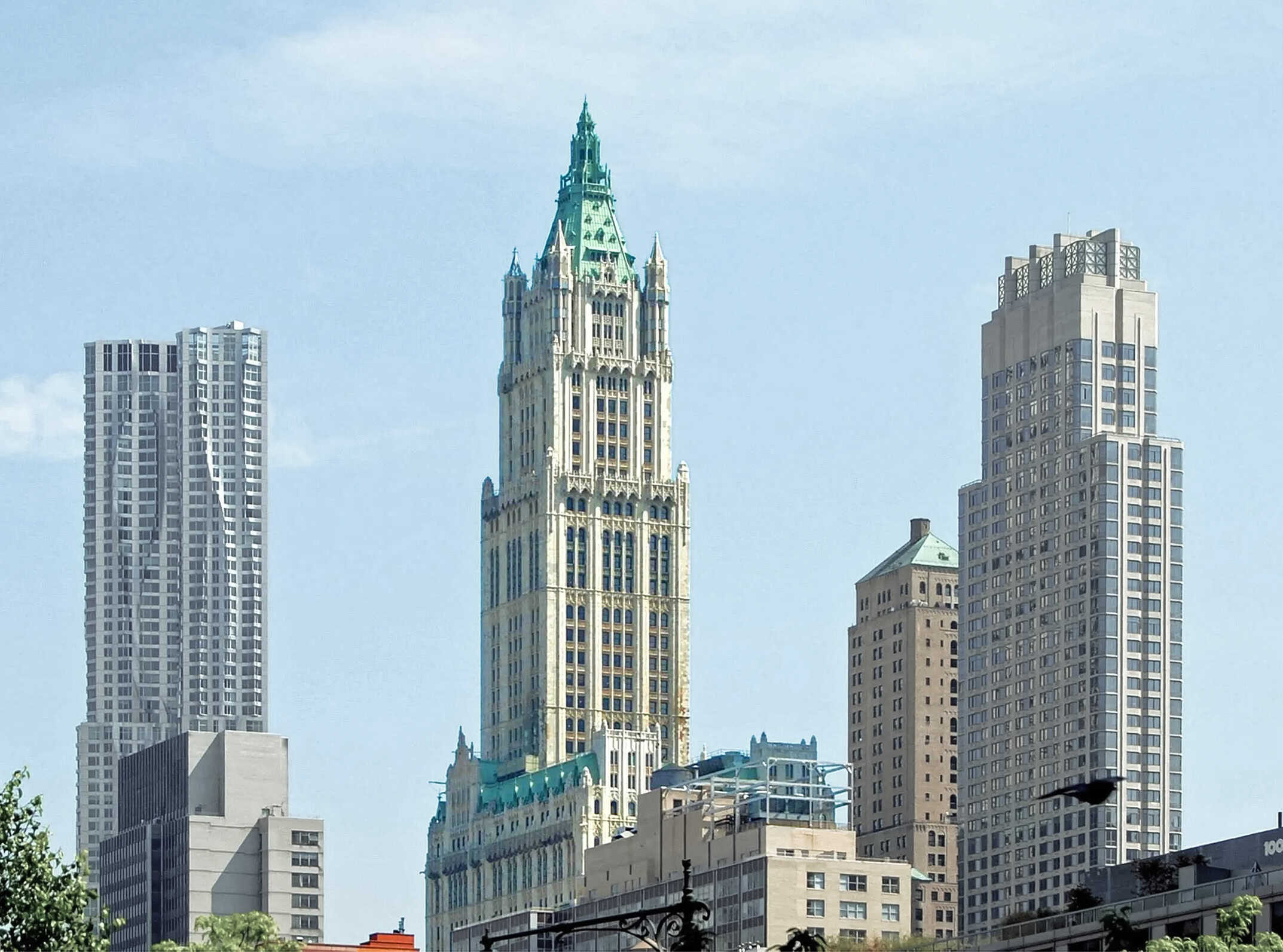
Imagine this: it is 1913, and United States President Woodrow Wilson presses a button, causing 80,000 electric light bulbs to illuminate New York City all at once. That is how the world learned about its new record holder — The Woolworth Building. The structure that amazed the planet still stands in Lower Manhattan today, watching over the city with its Gothic spire.
The History of The Woolworth Building
Frank Woolworth, the son of a farmer from New York State, came up with a brilliantly simple idea: a store where everything cost five or ten cents. In 1879, he opened his first shop in Utica, New York. Business was slow at first, but Woolworth persisted, opening store after store. By the 1910s, the Woolworth chain had grown to more than one thousand stores across America, and Frank had become a multimillionaire.
In 1910, Woolworth hired architect Cass Gilbert and gave him a task: build a tower that would be visible from every part of the city. He paid 13.5 million dollars in cash for the project — without taking out a single loan. Construction lasted three years, and on April 24, 1913, the building officially opened with that famous signal from the White House, thousands of lights, champagne, and ecstatic newspaper headlines.
The Cathedral of Commerce
The building’s nickname, “The Cathedral of Commerce,” is not merely a metaphor. Cass Gilbert deliberately designed the skyscraper as a modern cathedral, using the language of medieval Gothic architecture. It reflected a deeper cultural meaning of the era: early twentieth-century capitalism needed its own temples — symbols of faith in progress and private enterprise.
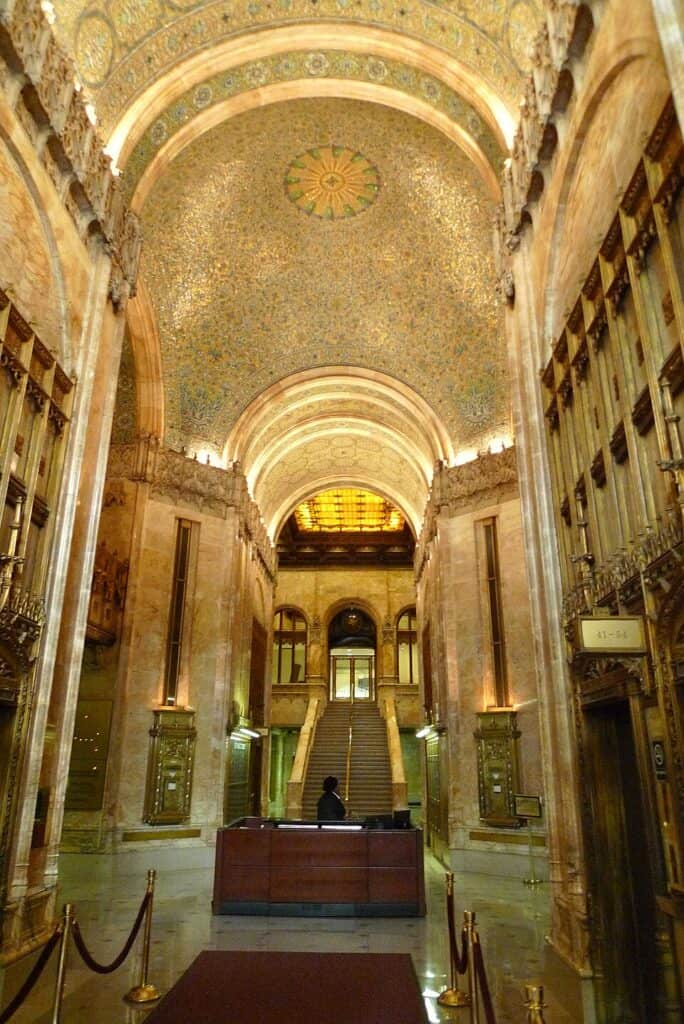
The lobby truly resembles a church nave, with soaring vaulted ceilings, light filtering through stained glass windows, mosaics, and gilded details.
Architecture of The Woolworth Building
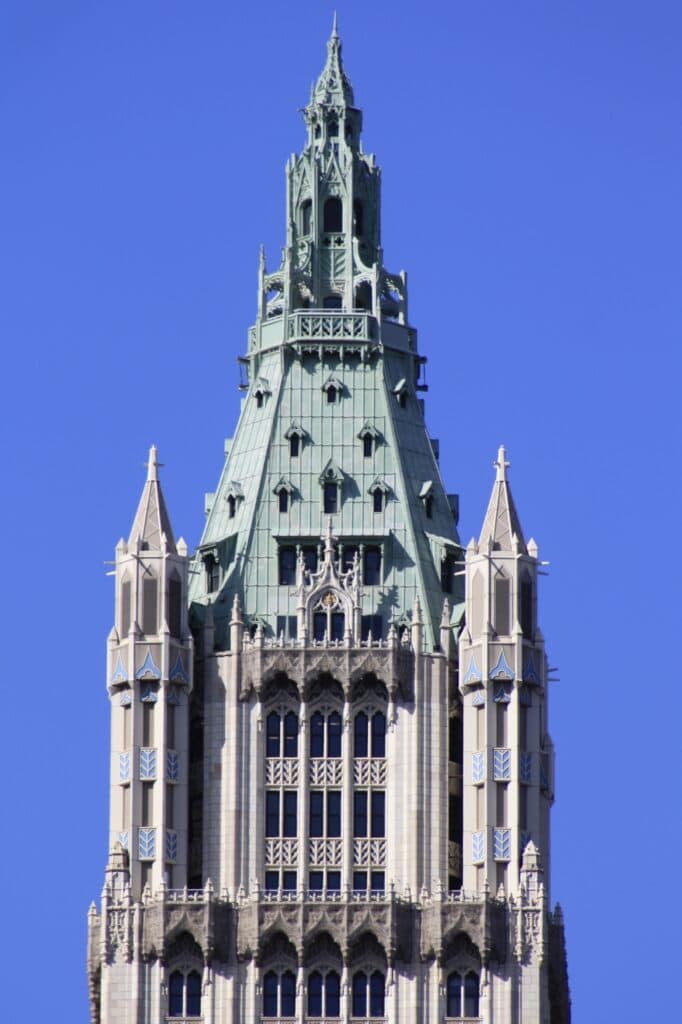
Cass Gilbert believed that a skyscraper should be a functional work of art. He drew inspiration from the great Gothic cathedrals of Europe, particularly the Houses of Parliament in London. As a result, the façade is clad in cream-white terracotta adorned with elaborate Gothic ornamentation: pointed arches, gargoyles, pinnacles, finials, and buttresses at every corner of the tower, just like a true medieval cathedral.
The main entrance and lobby deserve special attention. It is one of the most luxurious interiors in New York City, featuring marble walls, vaulted ceilings with gold and turquoise mosaics, and decorative bas-reliefs.
At the time of its completion, The Woolworth Building was the tallest building in the world — 241 meters tall with 57 floors. It held the record for 17 years, until the completion of the Chrysler Building in 1930. The building contains 80,000 square meters of office space, approximately 30 elevators, its own power plant, a post office, and even a swimming pool.
The Woolworth Building Today
In 2012, developers at Alchemy Properties purchased the upper 30 floors and converted them into luxury residential apartments. The project was named Woolworth Tower Residences. There are only 34 residences, ranging from studios on the lower residential levels to duplexes and a penthouse at the very top of the tower. The three-level penthouse, with panoramic views of Manhattan, Brooklyn, and Staten Island, was originally listed for 110 million dollars.
The lower floors remain office space. The lobby is open to visitors during business hours.
What Is Near The Woolworth Building
Directly in front of the building is City Hall Park, home to New York City Hall, built in 1812 and one of Manhattan’s most beautiful public spaces. Behind the building lies the Brooklyn Bridge, about a fifteen-minute walk along the river. Approximately ten minutes away is National September 11 Memorial & Museum.
This is one of the best walking routes in Lower Manhattan: in a single day, you can walk from The Woolworth Building to the 9/11 Memorial, continue to Wall Street, and finish your day on the Brooklyn Bridge.
Visitor’s Information
📍 The Woolworth Building / 233 Broadway, New York, NY 10007, opposite City Hall Park
Subway: City Hall Station (Trains 4, 5, 6), Park Place Station (Trains 2, 3), Fulton Street Station (Trains A, C, J, Z, 2, 3, 4, 5)
Lobby Hours: Open to visitors on weekdays from 8:00 AM to 6:00 PM
Admission: Free