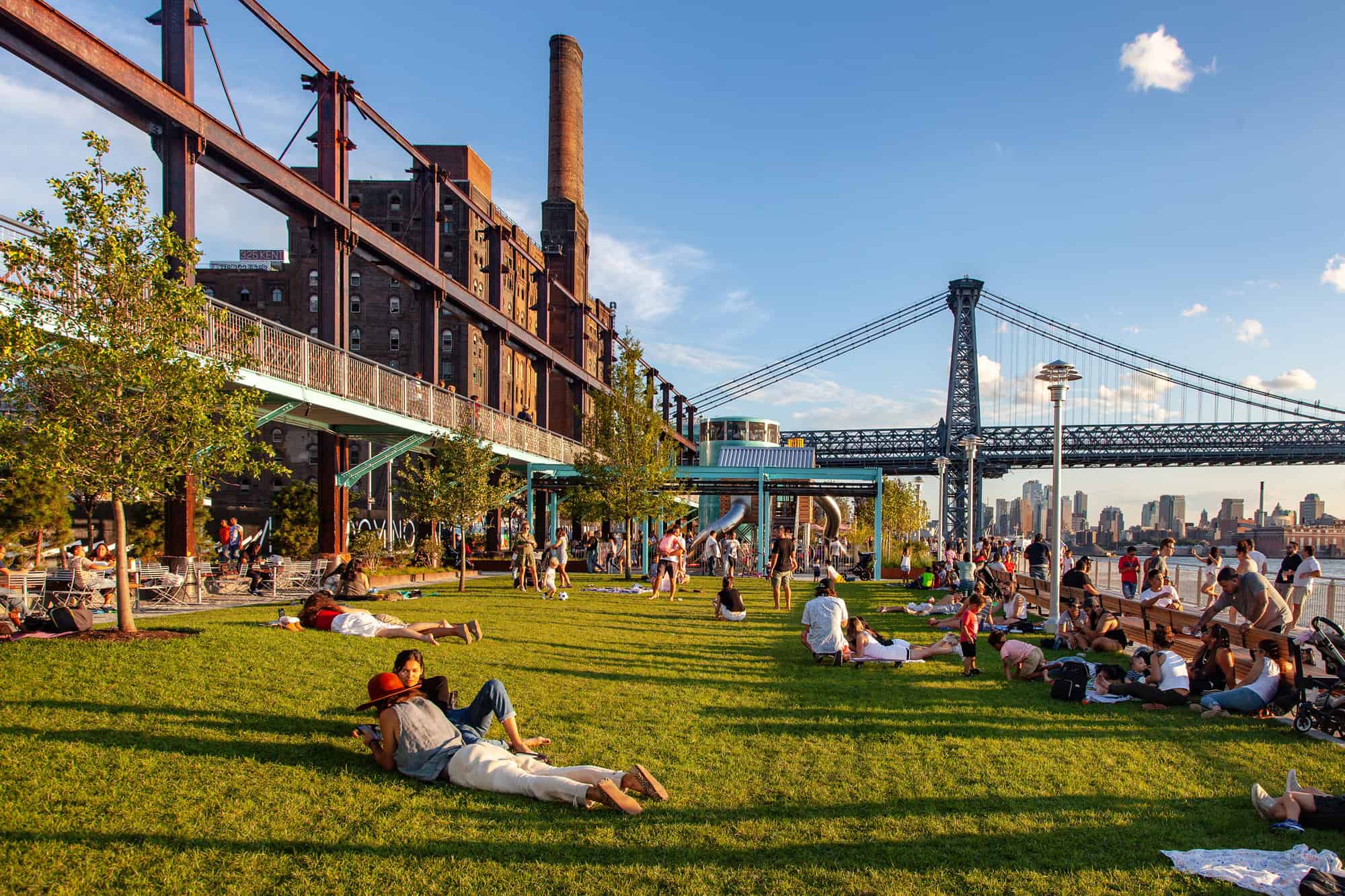
Domino Park is an 11-acre waterfront park on the East River in Williamsburg, Brooklyn. Rusty industrial structures more than a century old stand here, hipsters stroll, children play, and artists work. On the horizon, Manhattan is visible as if in the palm of your hand. Admission is free, and this is one of the best places in New York that tourists do not know about.
Interesting facts about Domino Park
- This site was once home to the largest sugar factory in the world, the Domino Sugar Refinery. At its peak, it produced half of all the sugar in the United States.
- The factory operated from 1856 to 2004, almost 150 years without interruption.
- During the redevelopment, more than 6,000 tons of contaminated soil were removed from the ground.
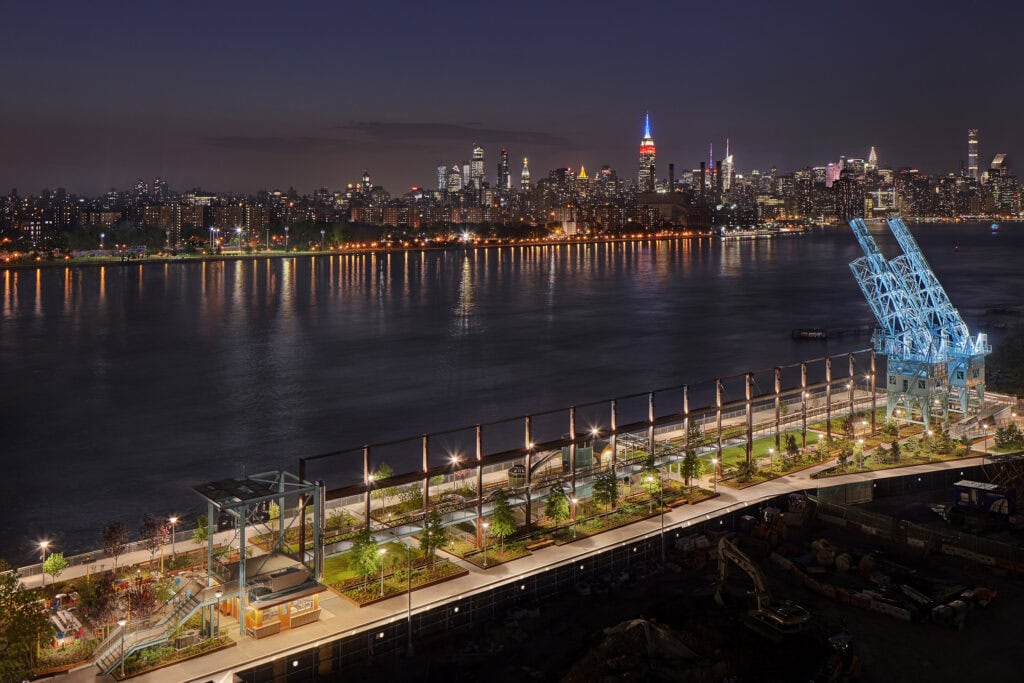
- The park preserves original gantry cranes, which now serve as children’s slides and art objects.
- The art installation by artist Kara Walker, “A Subtlety” (2014), was created inside the abandoned factory and became a cultural sensation.
- The park was designed by the firm James Corner Field Operations, the same team that created the High Line.
- The opening of the park in 2018 was met with mixed reactions: local residents feared it would accelerate the gentrification of Williamsburg.
The history of Domino Park
In 1856, the Havemeyer & Elder sugar factory was built on the banks of the East River. The location was not chosen by chance: sugarcane was delivered via the river from the Caribbean, and finished products were shipped out from the same place. By the 1870s, the enterprise had become the largest sugar refinery in the world. By the mid-twentieth century, the factory produced 40 to 50 percent of all refined sugar in the United States.
In 1900, the factory was renamed the American Sugar Refining Company. Its retail sugar brand was called Domino and featured a logo with a blue cube and red lettering. Thousands of workers were employed at the plant, many of whom lived in nearby neighborhoods. Residents recall that the smell of caramel could be sensed several blocks away.
By the late 1990s, however, sugar faced competition from corn syrup. The factory entered a crisis and ultimately closed in 2004. Seven of its ten buildings were demolished, leaving only the most historically valuable structures.
The battle for the waterfront
Two Trees Management acquired the site in 2012, but Williamsburg residents opposed the redevelopment. They feared that the waterfront would disappear under new construction. Activists demanded the preservation of the industrial character of the area and accessibility for all city residents, not just the new occupants of expensive condominiums.
After years of negotiations with the city administration, a plan was adopted that allocated 11 acres along the river for a public park. In 2018, Domino Park opened to the public.
Architecture and design of Domino Park
Designers from James Corner Field Operations, the creators of the High Line, chose an approach that is rare for American parks: not to conceal the industrial past, but to make it the main exhibit. As a result, Domino Park resembles an open-air museum.
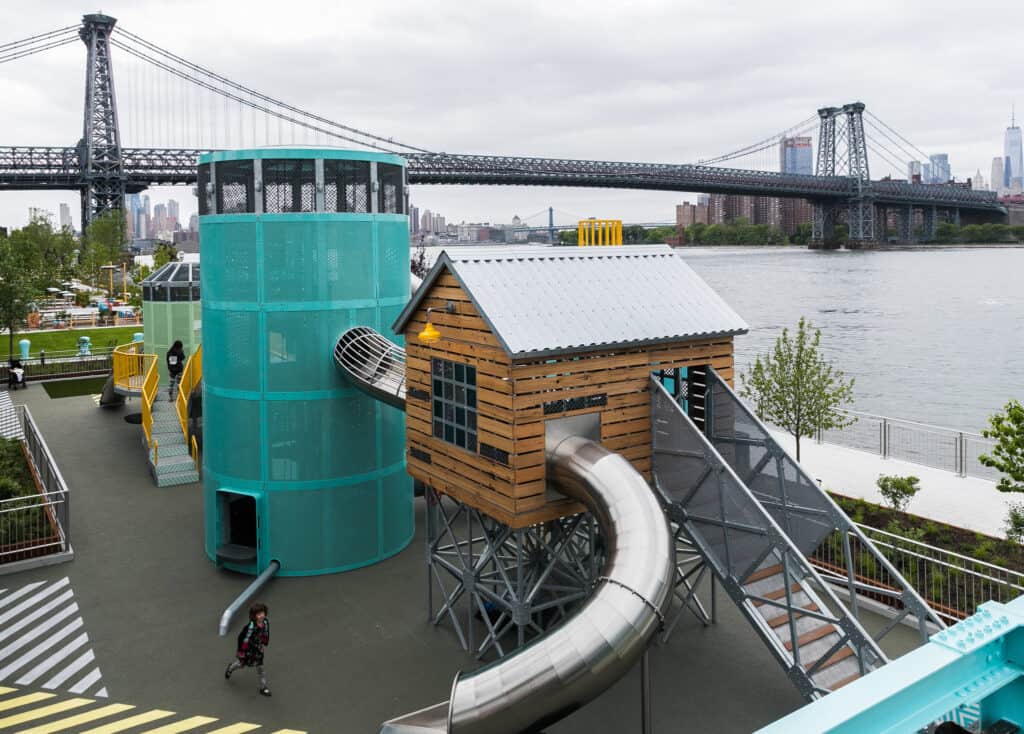
Along the waterfront, four enormous metal tanks that once stored molasses have been preserved. They now house a playground, seating areas, and art spaces. Multi-story gantry cranes remain in place, standing like rusty sculptures that visitors can touch. Elements of the former industrial site — pipes, rails, and cast-iron grates — are found throughout the grounds.
Particular attention should be given to the signature bench stretching more than 600 meters along the entire waterfront. It is a carefully designed landscape element that unifies the park into a single cohesive space.
What to see in Domino Park
Domino Sugar Refinery — the factory building
The main factory building, constructed in 1882, is currently being redeveloped into a residential and office complex, but its scale is astonishing. The brick giant stands right behind the park and is best photographed from the waterfront. It is a rare example of nineteenth-century industrial architecture preserved in New York.
Old industrial cranes and tanks
Four steel molasses storage tanks form the park’s main visual landmark. They were intentionally preserved and now function as pavilions and children’s play areas. Original lifting mechanisms stand nearby.
The waterfront and the view of Manhattan
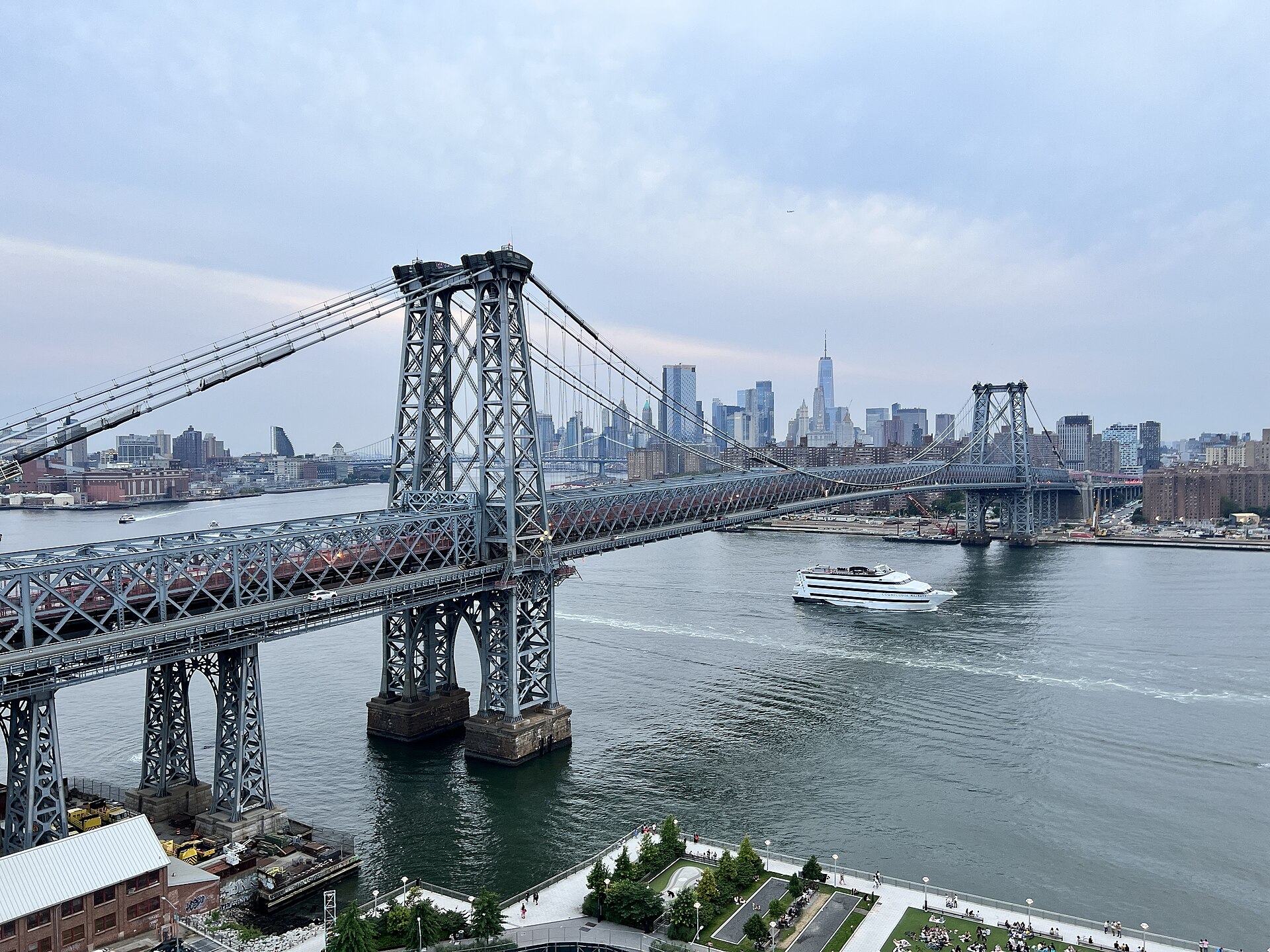
From here, visitors can enjoy views of Lower Manhattan, the Williamsburg Bridge, and the movement of ships along the East River. At sunset, the skyscrapers glow with golden light.
Installations
The park actively collaborates with artists, regularly featuring temporary and permanent art objects. The most famous is Kara Walker’s monumental installation “A Subtlety” (2014), created inside the still-abandoned factory. The work, reflecting the history of sugar production through the lens of slavery, attracted more than 130,000 visitors in three months.
Landscape areas
In addition to its industrial aesthetic, the park offers green lawns, shady trees, and flower beds. This is important, as summers in Williamsburg can be hot. The greenest and quietest section of the park is located near the northern entrance and is ideal for reading or having a picnic.
Culture and context of Domino Park in New York
Domino Park is one of the clearest embodiments of the contradictions of modern New York. On one hand, it is a model public space: open, free, beautiful, and historically rich. On the other hand, its emergence coincided with a sharp rise in real estate prices in Williamsburg.
Williamsburg used to be a working-class neighborhood with strong Puerto Rican and Hasidic communities. From the late 1990s, artists and young professionals began moving in, attracted by low rents. By the 2010s, the area had become one of the most fashionable addresses in New York, and rents increased dramatically. The opening of Domino Park and the construction of luxury residential towers around it marked the final stage of this transformation.
Some researchers and activists describe this process as “gentrification through public art and urban improvement”: the park is created for everyone, but indirectly makes the area unaffordable for those who lived there before. It is a complex and uncomfortable story, and Domino Park stands at its very center.
How to get to Domino Park
📍 Domino Park, 300 Kent Ave, Brooklyn, NY 11249
- Subway: Lines J, M, Z to Marcy Avenue station (8 minutes on foot). Line L to Bedford Avenue station (15 minutes on foot across Williamsburg).
- Bus: The B62 runs along Kent Avenue and stops near the park entrance. From Manhattan, the B39 crosses the Williamsburg Bridge and stops a few blocks from the park.
- NYC Ferry: The East River route stops at North Williamsburg, right by the park entrance. From Manhattan, the trip takes about 10 to 15 minutes. Fare: 4 US dollars (the same as a subway ride).
- Citi Bike: Stations are located near each park entrance.
- Taxi: There is no through traffic along the waterfront; ask to be dropped off at the entrance on Kent Avenue.