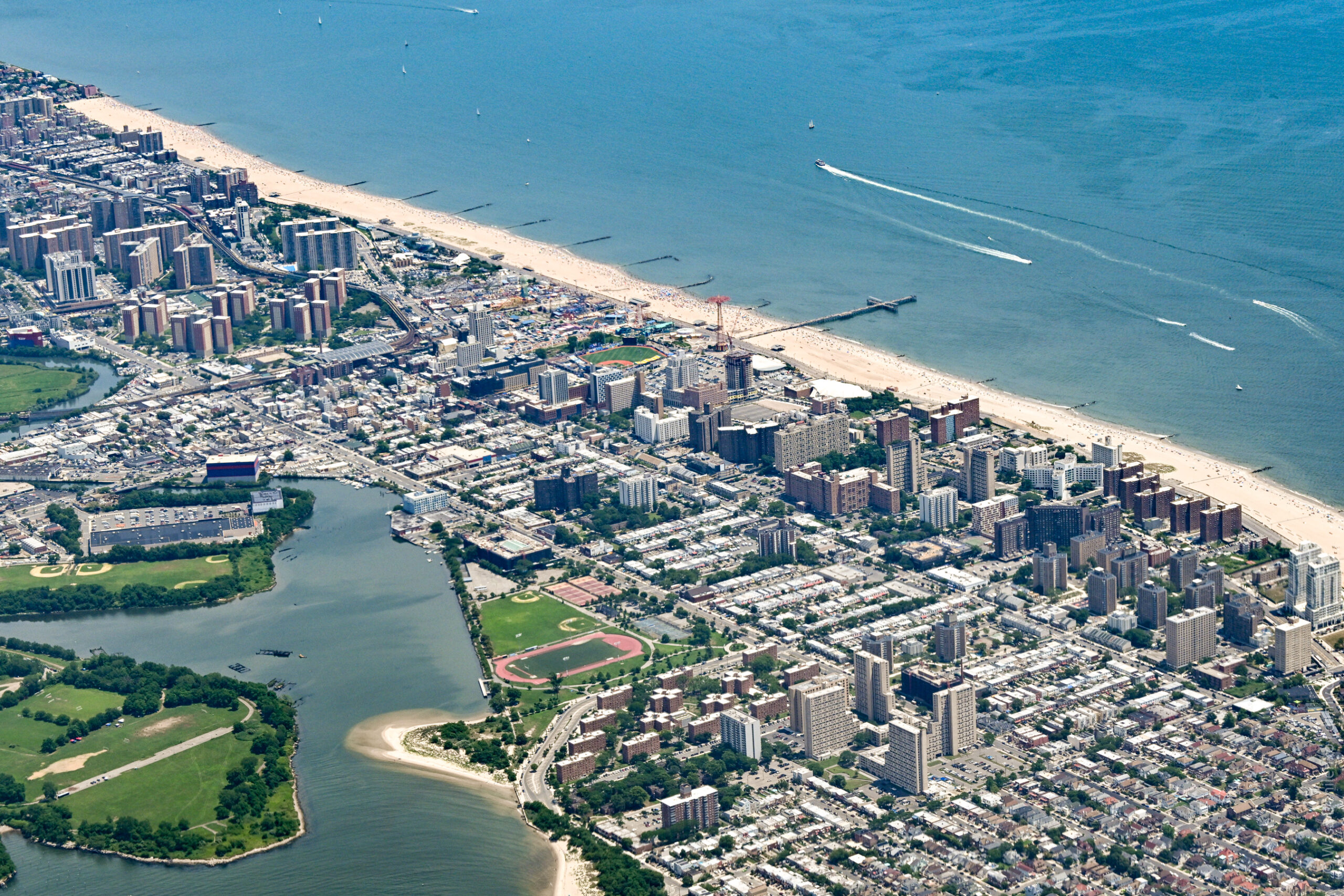
Brighton Beach is a completely different New York, where Cyrillic letters cover storefront signs, Russian and Ukranian speech fills the streets. The area has long been nicknamed “Little Odessa,” as it historically became a hub for Soviet immigrants and a center of the Russian-speaking community.
It is located on the southern shore of Brooklyn, right along the edge of the Atlantic Ocean. It is at the same time a beach resort, a historic urban neighborhood, and a living time machine that transports you somewhere between 1980s Odessa and present-day New York.
The phenomenon of Brighton Beach is unique: nowhere else in the world do Soviet nostalgia, American freedom, and the Atlantic breeze blend into such a distinctive mix.
Interesting facts about Brighton Beach in New York
- The railroad built in 1878 turned Brighton Beach into a popular resort destination. Today, an elevated subway line still runs above the neighborhood’s main street, Brighton Beach Avenue.
- In the late nineteenth century, Brighton Beach was famous for the Brighton Beach Race Track, where enormous bets were placed. It was here in the 1890s that legendary jockey Tod Sloan began his career.
- On maps and in official documents, the area is called Brighton Beach, but in everyday speech and the media it has long been referred to as “Little Odessa” because of the large number of immigrants from the Black Sea region.
- Russian-language media has existed here since the 1980s. Brighton Beach became a center of Russian-language journalism in the United States: newspapers such as “Novoe Russkoe Slovo” and “Russkiy Bazar” developed here, and local television broadcast in Russian to the diaspora across the country.
- Several episodes of the television series The Sopranos were filmed here. The creators used Brighton Beach as a setting for scenes involving Russian characters because the neighborhood’s atmosphere is difficult to recreate in a studio.
- The area has experienced three distinct waves of Russian-speaking immigration: the late 1970s with Jewish emigrants from the Soviet Union, the early 1990s following the collapse of the Soviet Union, and 2022 after Russia’s invasion of Ukraine. Each wave added new cultural layers.
- Brighton Beach Avenue is the main commercial street, much of it located beneath the elevated subway line.
- Many restaurants operate in the style of Soviet banquet halls, with live music, dance floors, and an abundance of dishes. Dinner here can last up to five hours.
- There is also a free public beach at Brighton Beach.
Culture and atmosphere of Brighton Beach
Brighton Beach is, on the one hand, a twenty-first century New York neighborhood with its diversity and fast pace, and on the other, a preserved Soviet way of life with its collectivism and social norms. Longtime residents who arrived in the late 1970s often say that Brighton Beach is neither Russia nor Ukraine, but a third country that never existed: a nostalgic vision of the Soviet past layered onto the American present.
After 2022, a new cultural layer emerged with the arrival of Ukrainian refugees and immigrants. This has created some tension: certain stores removed Russian symbols, while Ukrainian flags and Ukrainian-language signs appeared. The neighborhood, long defined as “Soviet,” is now undergoing a rethinking of its identity.
What to see in Brighton Beach
Brighton Beach
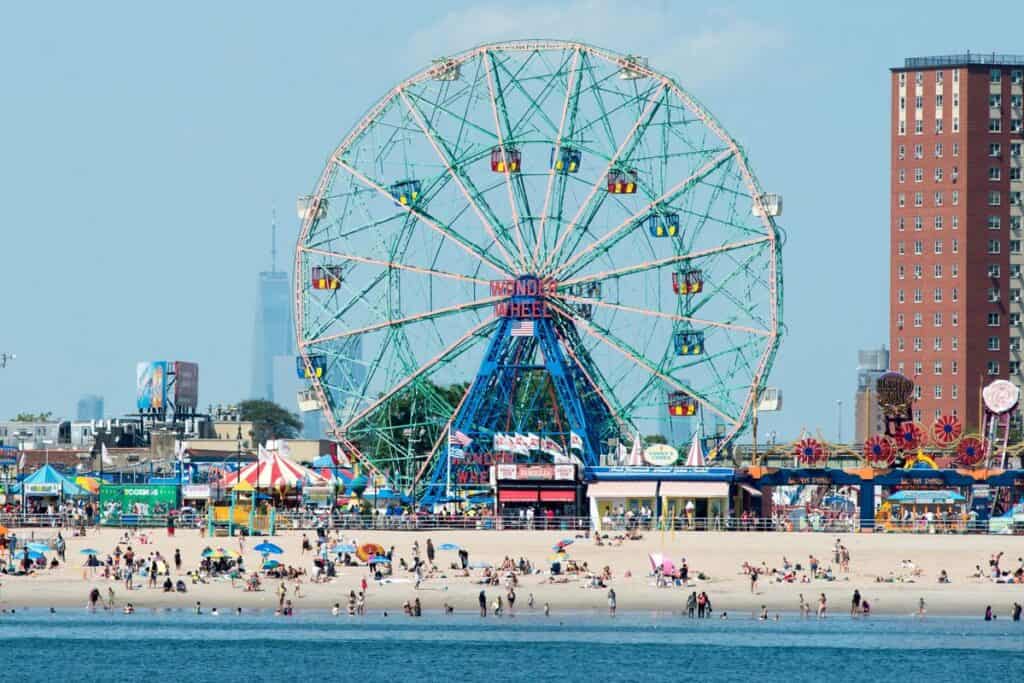
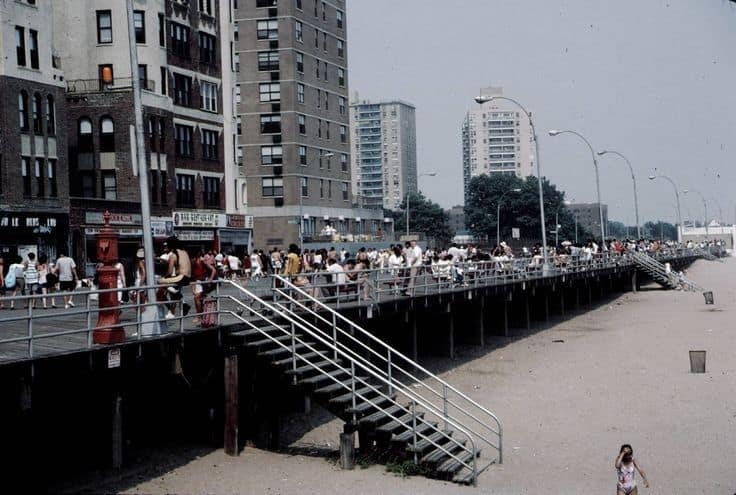
The main attraction of Brighton Beach in the warmer months is, of course, the beach itself and the famous Riegelmann Boardwalk, built in 1923. The boardwalk stretches for 4.3 kilometers and connects Brighton Beach with Coney Island.
Unlike the noisy and carnival-like Coney Island, the Brighton section of the beach is calmer and more family-oriented. The beach is free and open to everyone. In summer it can get crowded, but that is part of its atmosphere.
📍 601 Riegelmann Boardwalk, Brooklyn, NY 11235
Brighton Beach Boardwalk
The wooden Brighton Beach Boardwalk is the main promenade of the neighborhood. You can easily spend an entire day here: in the morning, runners exercise and elderly couples walk their small dogs; during the day, grandmothers sit on benches having endless conversations; in the evening, groups of young people gather.
Along the boardwalk, there are seasonal cafes with ocean views where you can drink tea served in a glass with a metal holder or eat ice cream — the classic “plombir” style made “the old way.”
Brighton Beach Avenue
The main shopping street runs under the elevated Brighton Line subway, creating a distinctive industrial landscape with the constant rumble of trains overhead. Today, it is known for its shops, grocery stores, and Eastern European restaurants, as well as the abundance of signs written in Cyrillic.
Coney Island
Coney Island is a historic entertainment district of New York that has existed since the late nineteenth century. It features a wide public beach, an amusement park with iconic attractions such as the wooden Cyclone roller coaster and the Ferris wheel, as well as numerous street развлечения and food stands.
This place combines the nostalgic atmosphere of old America with modern festivals, including the famous Mermaid Parade, and remains one of the most recognizable symbols of summer in New York.
📍 1000 Surf Ave, Brooklyn, NY 11224
New York Aquarium
The New York Aquarium is the oldest operating aquarium in the United States, founded in 1896 and relocated to Coney Island in the mid-twentieth century. It is home to hundreds of species, from sharks to sea lions, and its exhibits combine indoor pavilions with outdoor spaces overlooking the Atlantic Ocean, making the visit especially atmospheric.
📍 602 Surf Ave, Brooklyn, NY 11224
Manhattan Beach
Manhattan Beach is a quieter and more prestigious neighborhood on the eastern edge of Coney Island. Unlike the busier nearby areas, it offers a slower pace of life, green parks, and expensive residential properties.
Brighton Beach Library
One of the most popular branches of the Brooklyn Public Library system. It opened in 1949 and moved to a new building in 1964. It contains an extensive collection of books and materials in the Russian language.
📍 16 Brighton First Road, Brooklyn
What to eat in Brighton Beach: restaurants, cafes, and markets
Brighton Beach is arguably the best place in New York, and possibly in the entire United States, to try the cuisine of the former Soviet Union in all its diversity — from classic Russian dumplings to Uzbek plov, Uyghur lagman, and Georgian khachapuri.
Tatiana restaurant and nightclub
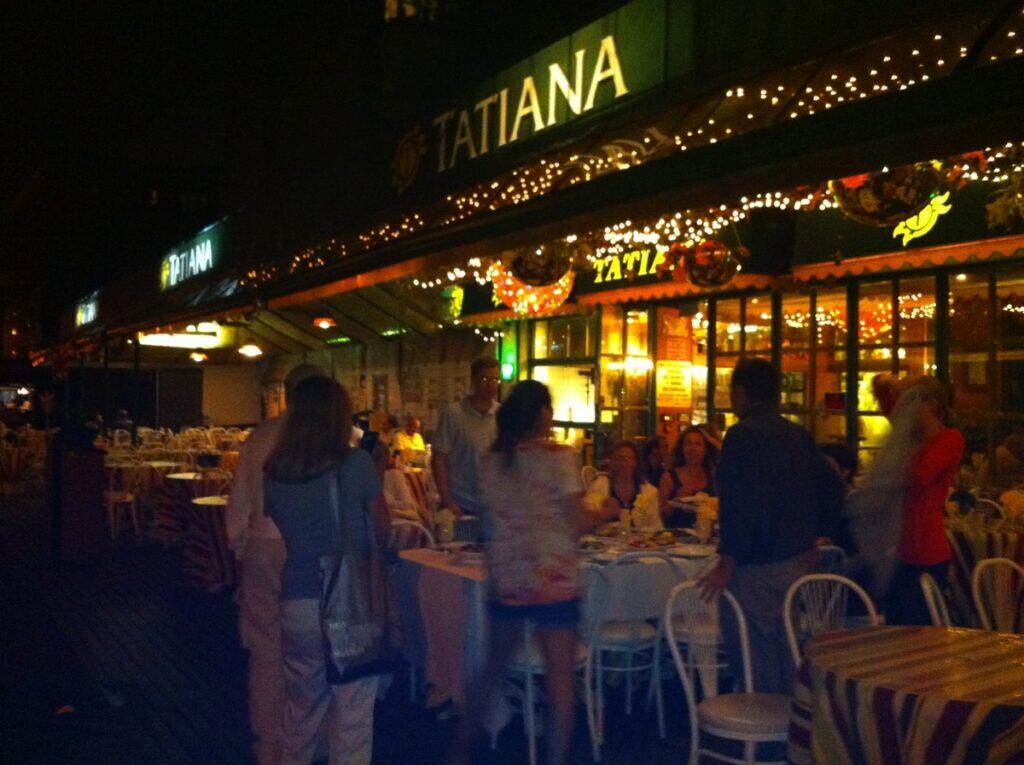
If you ask a New Yorker who does not live in Brighton Beach to name at least one place in “Little Odessa,” you will most likely hear “Tatiana.” It is a classic Russian restaurant on the boardwalk with an ocean view.
On Saturdays, it hosts a full dinner show with live music, magicians, and dancing — all included in a fixed menu costing around 125 dollars per person. It feels as if you have accidentally walked into someone’s wedding: endless salads, meat, and desserts.
📍 3152 Brighton 6th St, Brooklyn, NY 11235
Skovorodka
There are many good restaurants in Brighton Beach, but only one has a life-sized bear statue at the entrance. Inside, there is dark wood decor, a style reminiscent of a medieval castle, and excellent Russian and Ukrainian cuisine. Blue glasses on every table suggest that you should come here with a reason to make a toast.
📍 615 Brighton Beach Ave, Brooklyn, NY 11235
Cafe Kashkar
A Uyghur and Uzbek restaurant that The Infatuation included in its list of the top twenty-five restaurants in all of New York. Lagman, lamb manti, plov, and spicy meat pies are served in very large portions, and the prices are low by New York standards.
📍 1141 Brighton Beach Ave, Brooklyn, NY 11235
Azure lounge
A restaurant located directly on the boardwalk with an ocean view, yellow and blue tablecloths, and the feeling of a Black Sea resort.
📍 3145 Brighton 4th St, Brooklyn
Tashkent supermarket
Not a restaurant in the traditional sense, but an entire gastronomic world. Inside, there are two fifteen-meter double-sided buffets with more than two hundred trays of prepared food. You can choose samsa, chebureki, manti, pelmeni, borscht, salads, and dozens of other dishes. There is also halal meat, fresh fruits, and a wide variety of Eastern sweets.
📍 713 Brighton Beach Ave, Brooklyn
Vanilla Gourmet
A sweets shop where you will feel like a child in a candy store. The shelves are filled with dried fruits, nuts, baklava, halva, and Turkish delight in every imaginable color, as well as a large selection of Russian chocolates wrapped in foil.
📍 287 Brighton Beach Ave, Brooklyn, NY 11235
History of Brighton Beach
How it all began
The land where Brighton Beach now stands was purchased from Native Americans as early as 1645. Until the 1860s, the area consisted mostly of farms on sandy soil — not the most obvious place for what would later become a major center of Russian-speaking immigrants.
In 1868, German-American railroad magnate William Engeman decided to build a seaside resort here. He purchased all thirty-nine plots of land with the help of surveyor William Stillwell for 20,000 dollars.
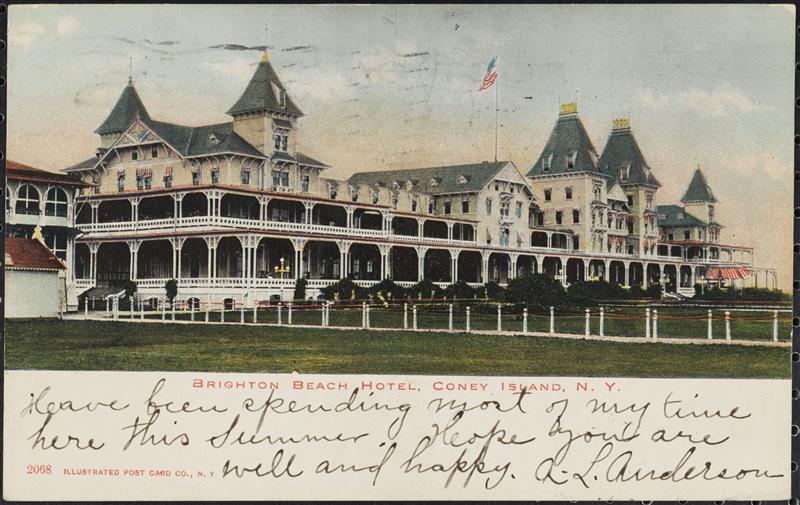
The centerpiece of the resort was the grand Hotel Brighton, a wooden structure that could accommodate five thousand guests and serve up to twenty thousand visitors daily. Nearby stood a two-story bathing pavilion, one hundred twenty meters long, designed for one thousand two hundred bathers.
How a 5,000-Ton hotel was moved
One of the most remarkable engineering stories of the nineteenth century took place here. Due to coastal erosion, the Brighton Beach Hotel was in danger of collapsing into the ocean.
In 1888, engineers decided to move the entire building instead of dismantling it:
- The structure was lifted using thirteen hydraulic jacks
- Twenty-four railroad tracks were laid underneath
- The building was placed on one hundred twelve flatcars
- Six locomotives slowly moved it 150 to 180 meters inland over ten days
The hotel continued operating for more than thirty years afterward.

The era of Jewish immigrants
In the 1920s, after the railway became a full subway line, Brighton Beach transformed into a year-round residential neighborhood. In the 1930s, many Jewish immigrants from Eastern Europe settled here.
By the 1950s, the area was predominantly Jewish, including second-generation residents and Holocaust survivors. However, by the 1960s, the neighborhood began to decline as younger generations moved to the suburbs.
The Soviet wave: “Little Odessa”
In the 1970s, the Soviet Union relaxed emigration policies, and thousands of Soviet Jews moved to New York. Many were settled in Brighton Beach, where housing was affordable and a community already existed.
Between 1975 and 1980, about 40,000 Soviet immigrants arrived, forming the largest Russian-speaking community in the city. The area became known as “Little Odessa” and “Little Russia.”
Since the 1990s, new waves of immigrants from Georgia, Armenia, Azerbaijan, and Central Asia have continued to shape the neighborhood.
Russian organized crime
In the 1970s, the so-called “Potato Bag Gang” operated in the area, robbing victims using crude but effective methods. In the 1990s, the notorious crime figure Vyacheslav Ivankov, known as “Yaponchik,” became a dominant figure until his arrest in 1995.
Today, this period is more a part of history and popular culture than reality, and Brighton Beach is considered safe.
Brighton Beach in film and popular culture
The neighborhood frequently appears in films and media, including:
- Russian Dolls (2011)
- Requiem for a Dream (2000)
- Little Odessa (1994)
- Maximum Risk (1996)
- Brother 2 (2000)
- Good Weather on Deribasovskaya (1992)
- Grand Theft Auto IV
Famous residents of Brighton Beach
Brighton Beach has produced many notable figures, including:
- Alexander Vindman — political figure and witness in the 2019 impeachment proceedingsWhat to see in Brighton Beach
- Jack Kirby — comic book artist and co-creator of Captain America
- Neil Diamond — singer and songwriter
- Neil Sedaka — pop musician
- Harvey Keitel — actor
- Willie Tokarev — Russian-American singer
Brighton Beach in Film and Popular Culture
Brighton Beach has long held a special place in cinema as a symbol of Russian-speaking immigration in New York.
One of the most notable films that established a dark and insular image of the neighborhood is Little Odessa by James Gray. In this film, the area is portrayed as closely tied to crime and internal conflicts within immigrant families.
In recent years, however, this image has begun to change, and a key role in that shift has been played by Anora by Sean Baker. Unlike earlier portrayals, the film presents Brighton Beach as a vibrant, dynamic, and multilayered environment rather than a closed and stereotypical enclave.
How to Get to Brighton Beach
- Subway (most convenient option): Take the B or Q lines to Brighton Beach station. From Manhattan, the journey takes approximately 45 to 50 minutes; from Delancey Street, about 35 minutes. The subway exits directly onto Brighton Beach Avenue.
- Bus: Routes B68, B1, and B49 connect Brighton Beach with other parts of Brooklyn.
- By car: From Manhattan, drive through the Battery Tunnel (Brooklyn–Battery Tunnel) and continue along Ocean Parkway. Parking in the area is paid, but spaces can usually be found.
- Uber or Lyft: From central Manhattan, the ride typically costs between 35 and 50 US dollars depending on traffic. From Brooklyn, it is significantly cheaper.