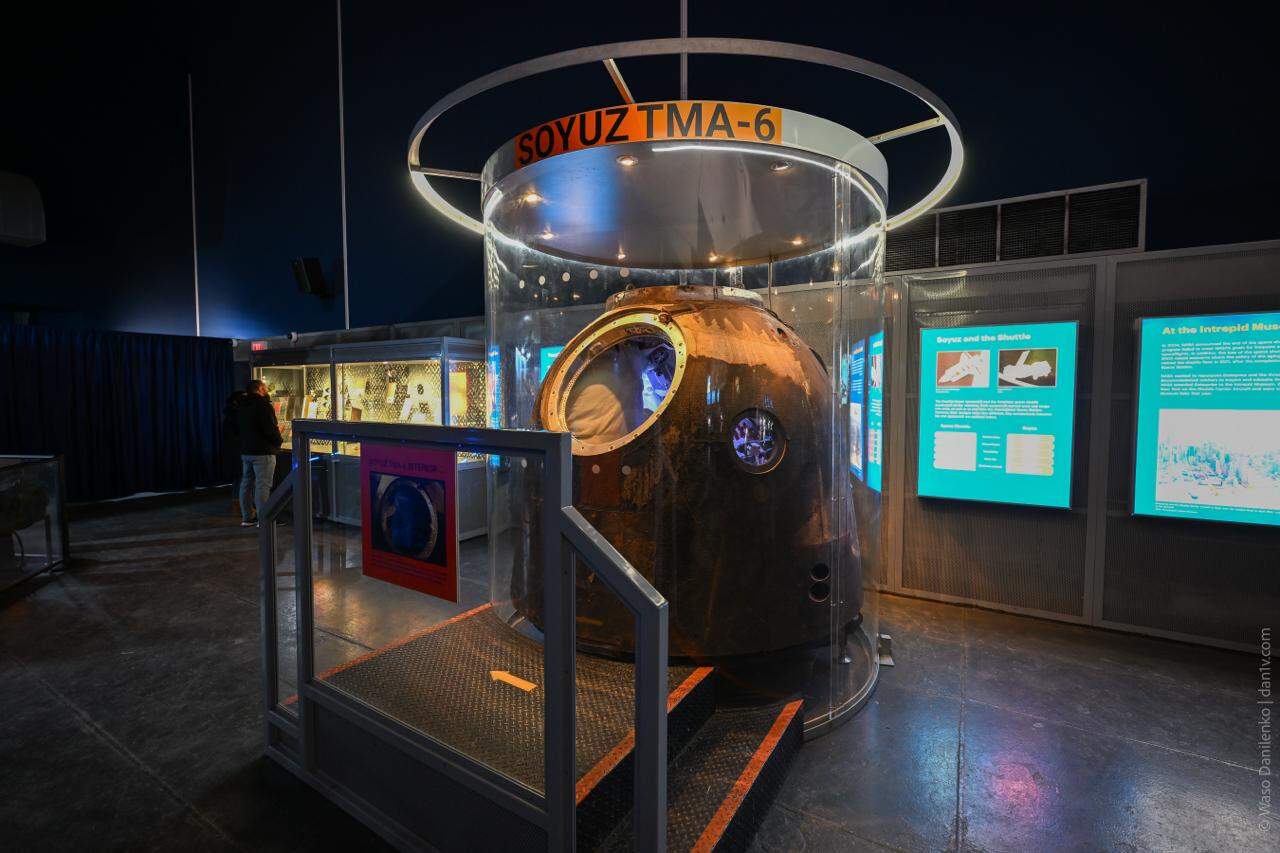
I was recently on a submarine… (who would have thought I’d ever write those words) …at the Intrepid Sea, Air & Space Museum. In addition to the submarine itself, there’s a small exhibition about the broader context: the Cold War and nuclear weapons.
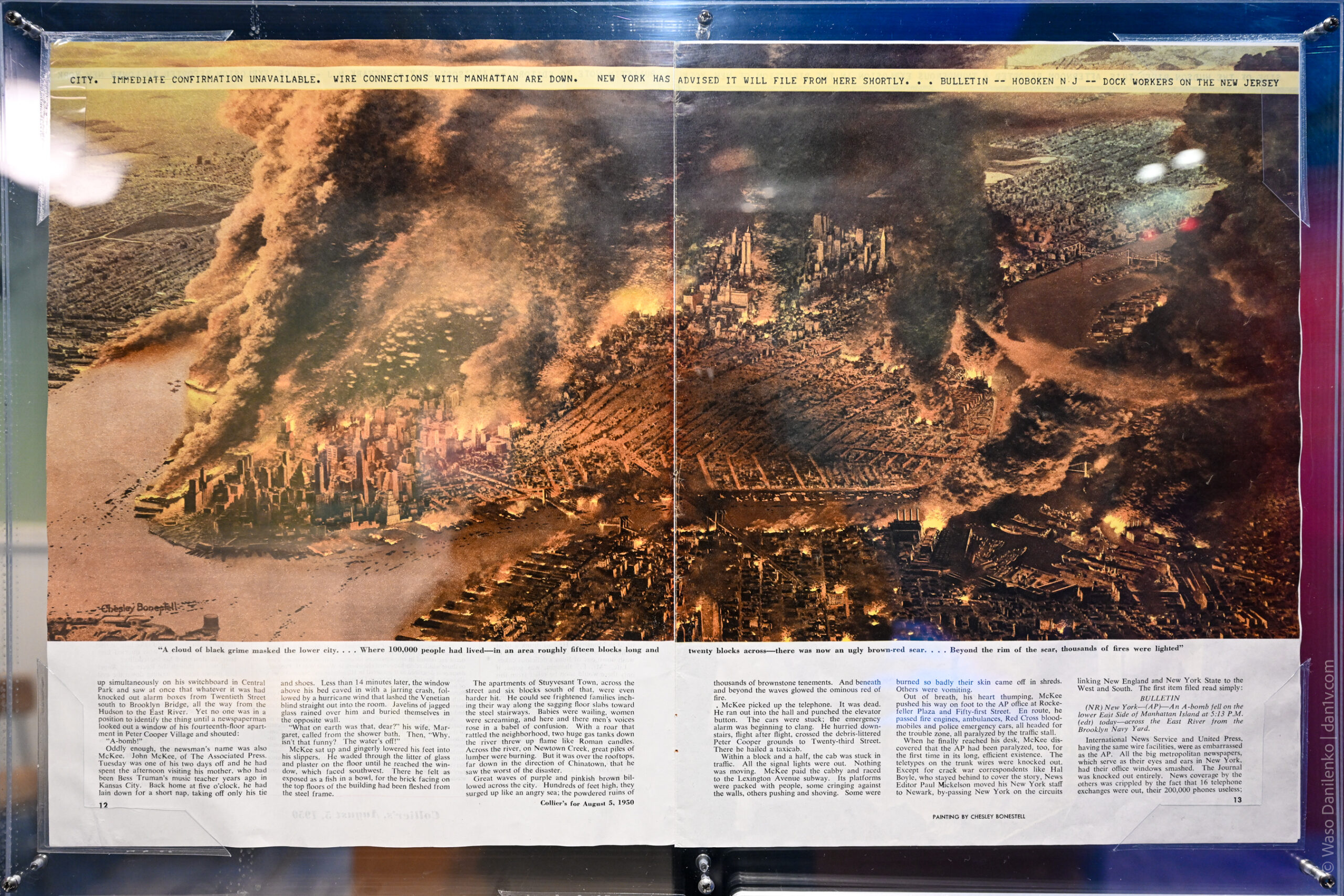
On the wall hung this drawing — so strikingly realistic it looked like an archival photograph. It honestly gave me chills.
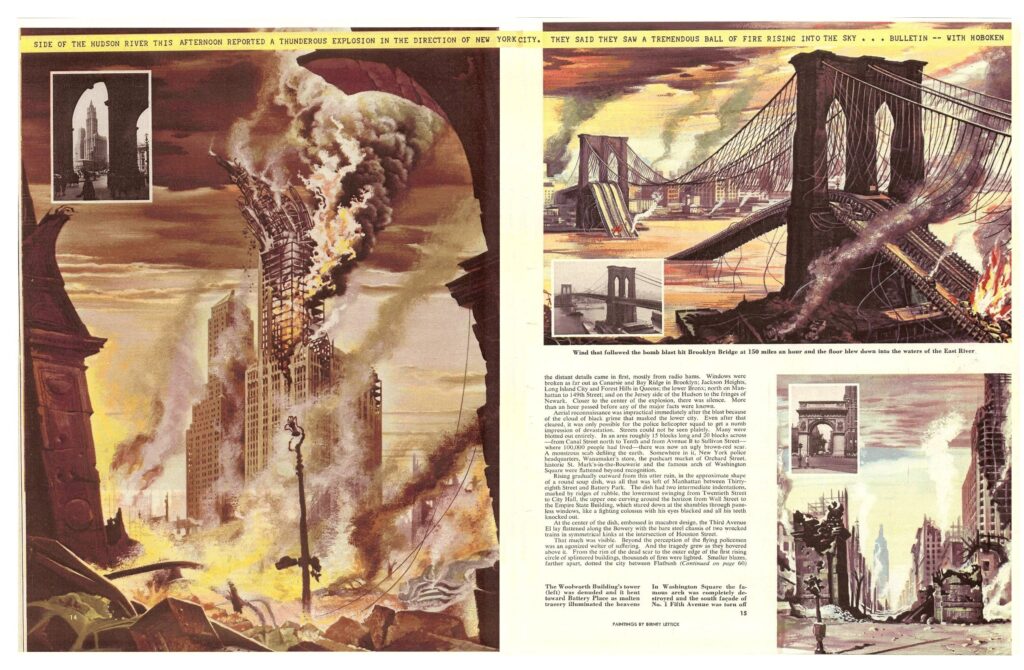
It turns out that in 1950, the popular magazine Collier’s published a detailed account of what an atomic bomb would do to New York — in horrifying detail — complete with illustrations by Chesley Bonestell (1888–1986).
Without a doubt, it was one of the most terrifying images ever to appear on the cover of a major American magazine. Opening the spread, readers were confronted with a city in flames. Across the interior illustrations ran a news-ticker headline: “…WIRE COMMUNICATION WITH MANHATTAN ARE DOWN…”
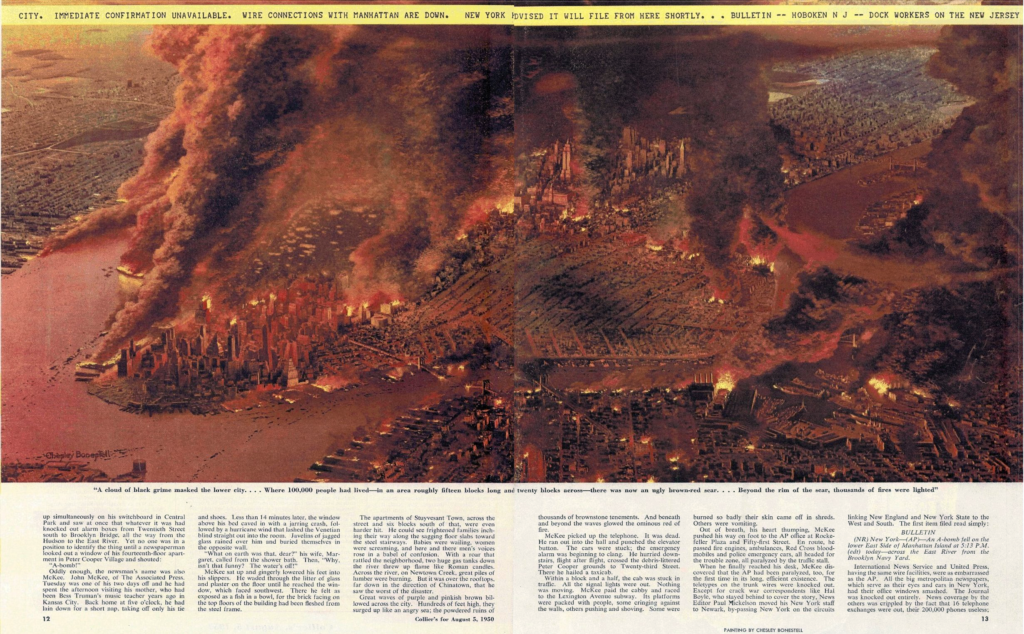
The opening pages describe an ordinary Tuesday in New York:
People are going about their daily routines. Suddenly, a blinding heat is felt, and a flash engulfs the city. On Coney Island, it’s mistaken for a lightning strike. A housewife in the Bronx approaches her kitchen window to see where the light is coming from — and the glass explodes in front of her, sending thousands of “cutting shards” flying her way. As the article notes, soon “millions of people scattered across thousands of miles” learn what has happened.
It’s striking that no other city in the world has been imagined destroyed as often as New York.
Throughout the 19th, 20th, and 21st centuries, New York has been blown up, ruined, and attacked across every possible medium — from films to novels to newspapers. In the American collective imagination, there is something apocalyptic that repeatedly returns to the destruction of the nation’s most populous city.
Before World War II, visions of a ruined New York took the form of giant waves, fires, or attacks by a giant ape. But after the United States dropped two atomic bombs on Japan, the atom became the new universal destroyer of cities — especially amid escalating Cold War tensions and the news that on August 29, 1949, the Soviet Union had tested its first atomic bomb.
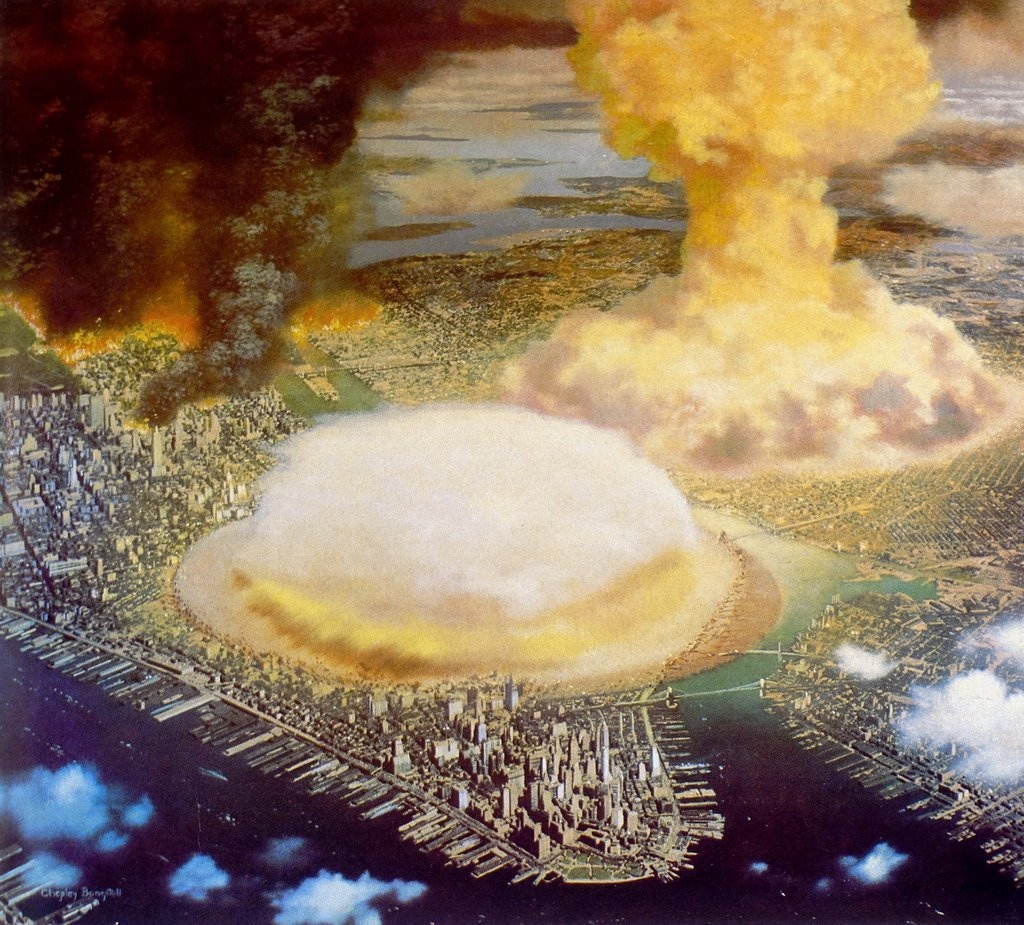
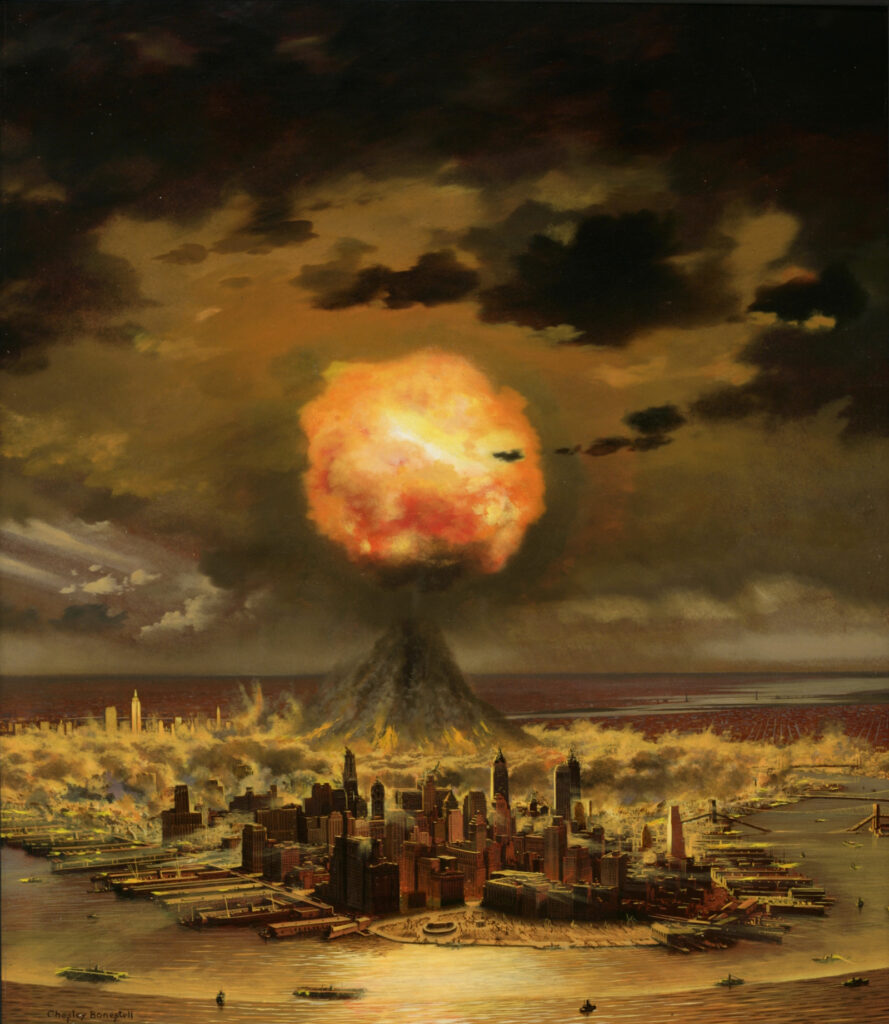
I also can’t help mentioning that Bonestell contributed to one of New York’s most beautiful visual icons: he participated in the creation of the Chrysler Building. The famous eagles and gargoyles crowning the building were his personal contribution to its design.
He also created architectural illustrations for the Golden Gate Bridge project. As the press wrote at the time, “Bonestell’s beautiful illustrations delighted both city officials and the public, and he is credited with helping ensure that the bridge was actually built.”
Beyond architecture, Chesley was a true space enthusiast — so much so that he is considered one of the founders of the genre of space art for scientific illustration.
His style had a profound influence on science fiction art, book illustration, and cinema; Bonestell was highly sought after in Hollywood.
📍 Intrepid Sea, Air & Space Museum / Pier 86, W 46th St, New York, NY 10036, United States