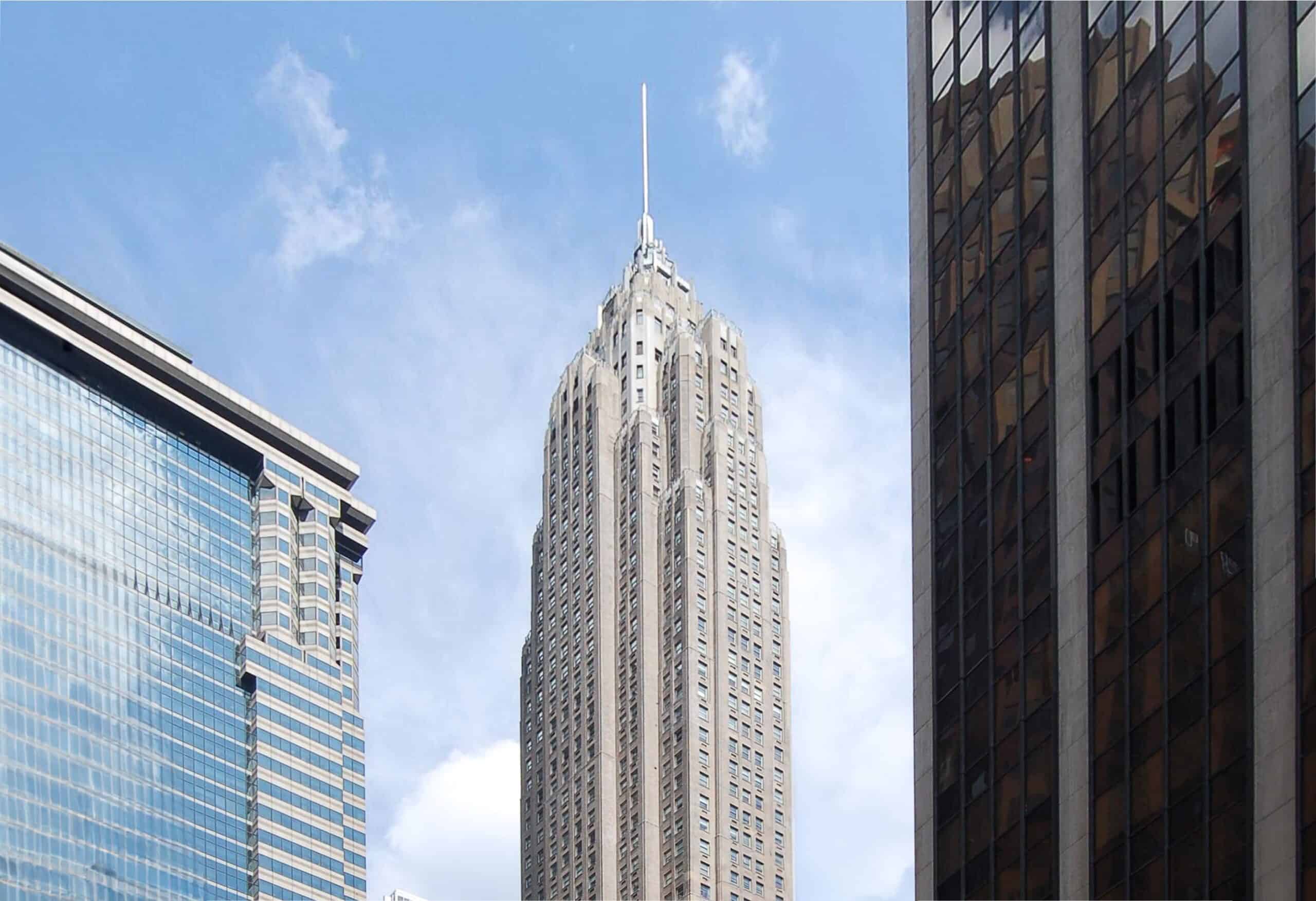
70 Pine Street, also known as the Cities Service Building or the American International Building, is one of the most beautiful skyscrapers in New York. It also happens to be the last of the great pre-war skyscrapers built in Lower Manhattan.
Interesting Facts About 70 Pine Street
- When construction was completed, the building was the third tallest in the world — only the Empire State Building and the Chrysler Building were taller.
- The building is 290 meters (952 ft) tall and has 67 floors. It was the tallest skyscraper in Downtown Manhattan for more than 40 years, until the World Trade Center was built in the early 1970s.
- 150 of the 612 apartments in the building have private outdoor terraces.
- The building was constructed for the Cities Service Company, an energy firm owned by magnate Henry Latham Doherty.
- It was built on the eve of the Great Depression and World War II, after which high-rise construction in the area almost completely stopped. No new skyscraper appeared in Downtown for nearly 30 years.
- Despite being built during the Great Depression, the building became profitable by 1936, and by 1941 it was 90% occupied.
- The steel frame rose at an average pace of three floors per week. Construction required 10 million bricks, 23.5 million pounds of cement, and 24,000 tons of steel.
- In 1932, the Downtown League awarded the building Best Building in the Financial District completed in the previous 12 months.
- The skyscraper is hard to see up close because of the narrow streets, but it is highly visible on the skyline from afar — from the Brooklyn Bridge, Brooklyn, or the water.
- 70 Pine Street is a favorite subject for photographers. In 1946, photographer Weegee called the skyscraper a “city within a city.”
- During renovation, several elevators in the lobby were converted into mailboxes for residents, an example of creative adaptive reuse.
Henry Doherty — Creator of 70 Pine Street
Henry Latham Doherty (1870–1939) was one of the most eccentric American entrepreneurs of the early 20th century. At age 12, he dropped out of school and started working as a messenger for Columbus Gas Company in Ohio. As he later recalled:
“I couldn’t get along in school and spent most of my time under threat of expulsion.”
Despite this, he quickly impressed company leadership with his work ethic and engineering ingenuity. By the age of 20, he had already become the company’s chief engineer. In 1910, Doherty founded Cities Service Company, an energy holding company that quickly grew to control 150 subsidiaries across 38 states, including oil and utility companies.
By 1932, Doherty was a multimillionaire, and his companies served 9,000 communities and had 600,000 shareholders. Doherty personally participated in designing the building. Early commentators noted that:
“He insisted on dignity and beauty, completely avoiding anything loud, pompous, or overly flashy.”
He wanted the building to look “exclusive, rich, yet simple and even slightly austere.” Interestingly, Doherty lived on the roof of another building he owned on State Street, where he had an apartment with a gym, squash court, and a motorized bed that rolled out onto a terrace. In city records, however, he was listed as a janitor, allowing him to bypass restrictions on private use of commercial space.
The top three floors of 70 Pine Street were originally designed as Doherty’s personal penthouse — with a gym, squash court, and that same motorized terrace bed. But worsening arthritis prevented him from moving in. Instead, the penthouse was converted into a public observation deck (admission 50 cents), which became one of the highest viewing platforms in Lower Manhattan.
Architecture of 70 Pine Street
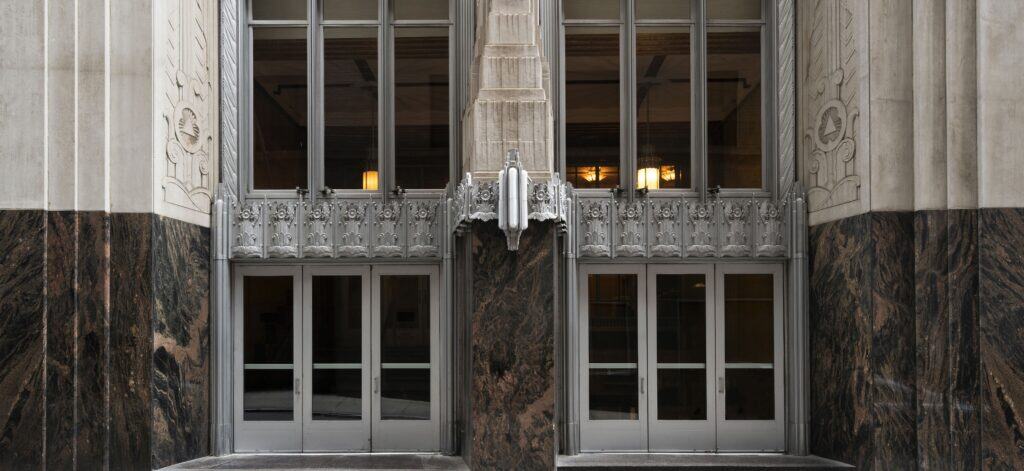
The building was designed by the architectural firm Clinton & Russell, Holton & George, with Thomas J. George considered the lead architect.
The firm Clinton & Russell, founded in 1894, became one of New York’s leading architectural practices in the early 20th century. Charles Clinton and William Russell specialized in commercial buildings and hotels; Holton and George later joined and expanded the firm’s work into large office towers. 70 Pine Street became their masterpiece and final major project.
The building is designed in Art Deco style with Gothic influences, particularly visible in its setbacks and spire. For nighttime illumination, the façade uses numerous 400-watt lamps — fitting for a building commissioned by an energy company.
The structure is decorated with the triangular Cities Service logo, sunflowers, sun rays and stepped pyramids directing the eye upward toward the spire. Above the entrance is a miniature model of the skyscraper. Inside that model is another microscopic model of the building — a literal architectural recursion carved in stone.
Innovations of 70 Pine Street
Double-Deck Elevators
Because the tower’s footprint was narrow, engineers introduced a revolutionary solution: double-deck elevators. The upper cabin served odd-numbered floors and loaded from the main lobby. The lower cabin served even-numbered floors and loaded from a basement lobby.
This innovation saved $200,000 in construction costs and freed up 3,700 m² of rentable space. The elevators remained in service until 1972, when they were replaced with conventional single-deck elevators, partly because the basement entrance was never properly completed.
Escalators
70 Pine Street became the first office building in New York designed like a department store. Instead of elevators, escalators served the first six floors. In the morning, they ran up only. In the evening, they ran down only. They allowed complete evacuation of those floors in 10 minutes. The escalators were hidden behind a false marble wall.
A City Within a City
The building once contained a full internal infrastructure, including:
- a bank with the most advanced security system of its time
- the 400-seat Tower Restaurant
- a barbershop
- a beauty salon
- a hat cleaning service
- a sandwich shop
- a florist
- a photo laboratory
On the 4th floor there was a medical clinic for employees. On the 7th floor, legendary boxer Artie McGovern opened a sports club with handball and squash courts, ping-pong tables, and golf practice areas. And on the 29th floor, a legal library with 16,000 volumes served tenants and was staffed by a licensed attorney-librarian.
Observation Deck on the 66th Floor
The former Doherty penthouse was converted into a public observation deck. Until the construction of the World Trade Center in 1973, it was the highest observation deck in Downtown Manhattan. The glass observation gallery on the 66th floor was designed as a “snow cap” on the limestone mountain — the top of the tower crowned with glass and an aluminum spire.
The deck closed during World War II because it overlooked the Brooklyn Navy Yard, an active military base. After the war it briefly reopened but was finally closed until 1975.
Interiors of 70 Pine Street
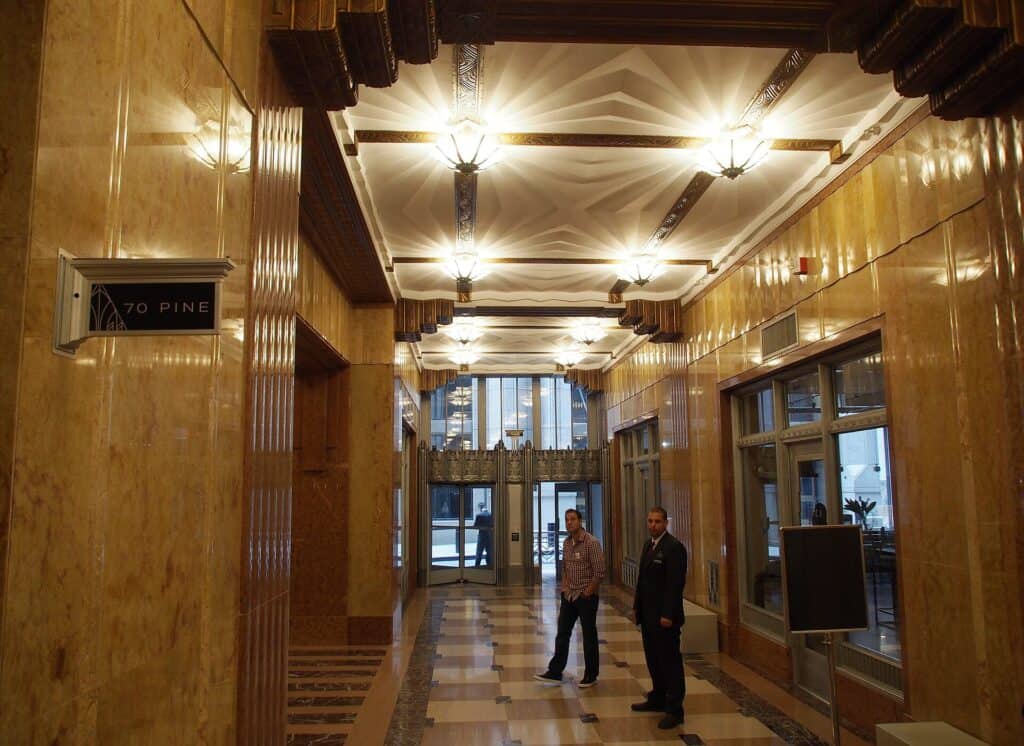
The lobby of 70 Pine Street is one of the most richly decorated Art Deco interiors in New York. Its walls feature multicolored European marbles, including Roman and golden travertine. Elevator doors feature motifs inspired by Native American art, including zigzags, sun rays, and the Cities Service logo. Elevator frames contain stepped arches, another Art Deco hallmark.
In 2011, the lobby was officially designated a New York City landmark. Today the lobby is open to the public — visitors can walk in, admire the interior, and explore the retail spaces.
The Second Life of 70 Pine Street
In 1976, the building was purchased by insurance giant American International Group (AIG) for $7 million. AIG renamed it the American International Building and made it its global headquarters, occupying it for more than 30 years.
But in 2008, the global financial crisis hit and AIG was on the brink of collapse. The U.S. government provided a record $180 billion bailout. Under pressure to repay taxpayers, AIG sold the building in 2009 for $150 million to Kumho Investment Bank and a New York developer.
After several ownership changes, the building was acquired in 2012 by DTH Capital and Rose Associates, who converted it into a residential complex.
Today the building contains:
- 612 apartments
- 164 hotel rooms
- a fitness center
- bowling alley
- golf simulator
- cinema
- a game room in the former bank vault
- restaurants, bars, and shops
Restaurants and Bars at 70 Pine Street
70 Pine Street has become one of the most exciting culinary destinations in Lower Manhattan, with several venues operated by Kent Hospitality Group.
Crown Shy
Crown Shy is located on the ground floor inside the Art Deco lobby. It is the first solo project of chef James Kent (formerly of Eleven Madison Park and The Nomad) and his partner Jeff Katz.
The European-inspired restaurant opened in 2019 and quickly became one of the best new restaurants in New York. The dining room features 5-meter-tall floor-to-ceiling windows and an open kitchen, creating an atmosphere that is both relaxed and ceremonial. The restaurant holds one Michelin star.
SAGA
SAGA is a fine-dining restaurant on the 63rd floor with two Michelin stars. The name is an acronym formed from the founders’ children: Seylah, Ayla, Gavin, and Avery.
The tasting menu starts at $245 per person. There are no printed menus — servers simply describe the evening’s dishes. SAGA occupies Henry Doherty’s former apartment, the same one that once contained the motorized bed.
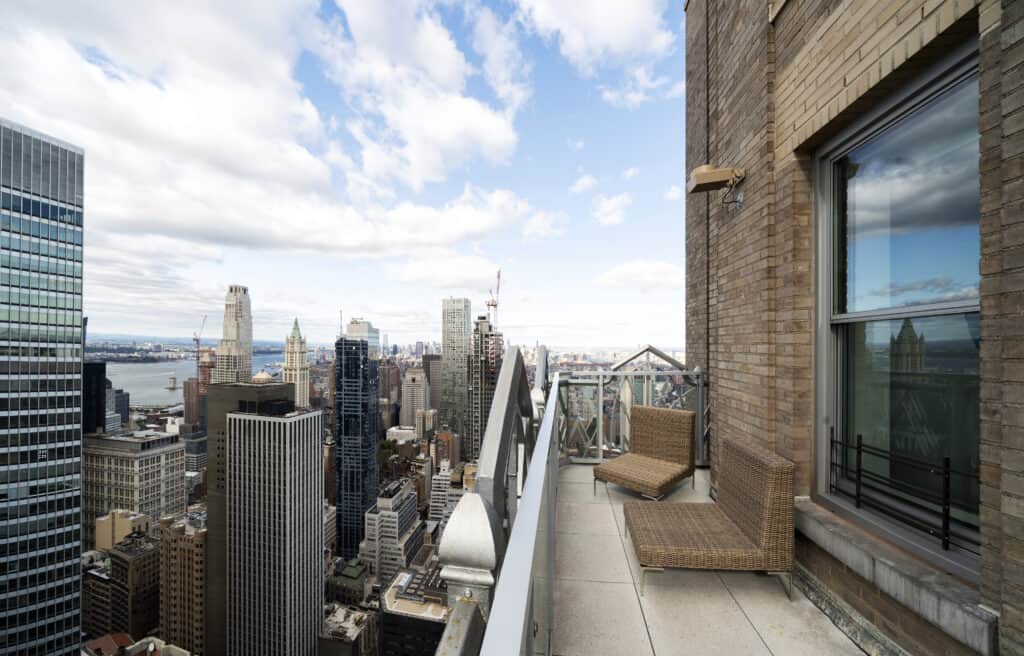
Three open terraces on the 63rd floor offer some of the best views in the city. Guests enter through the lobby, take a dedicated elevator, and the host explains the history of the building along the way.
Overstory
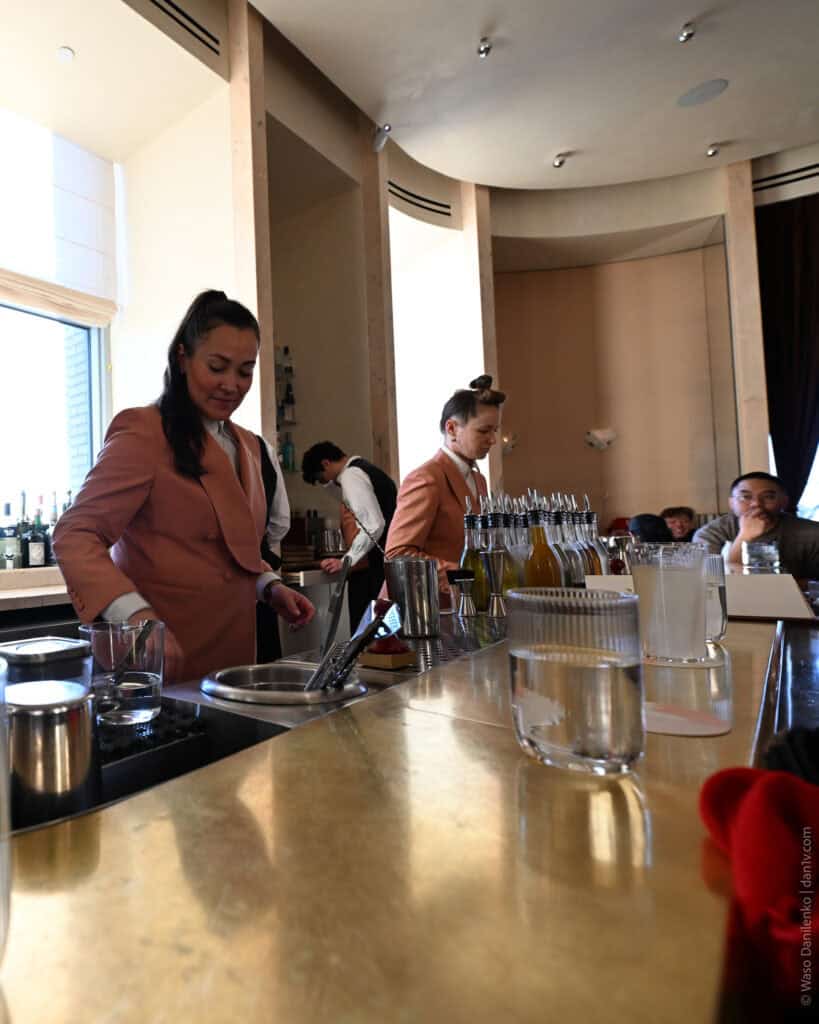
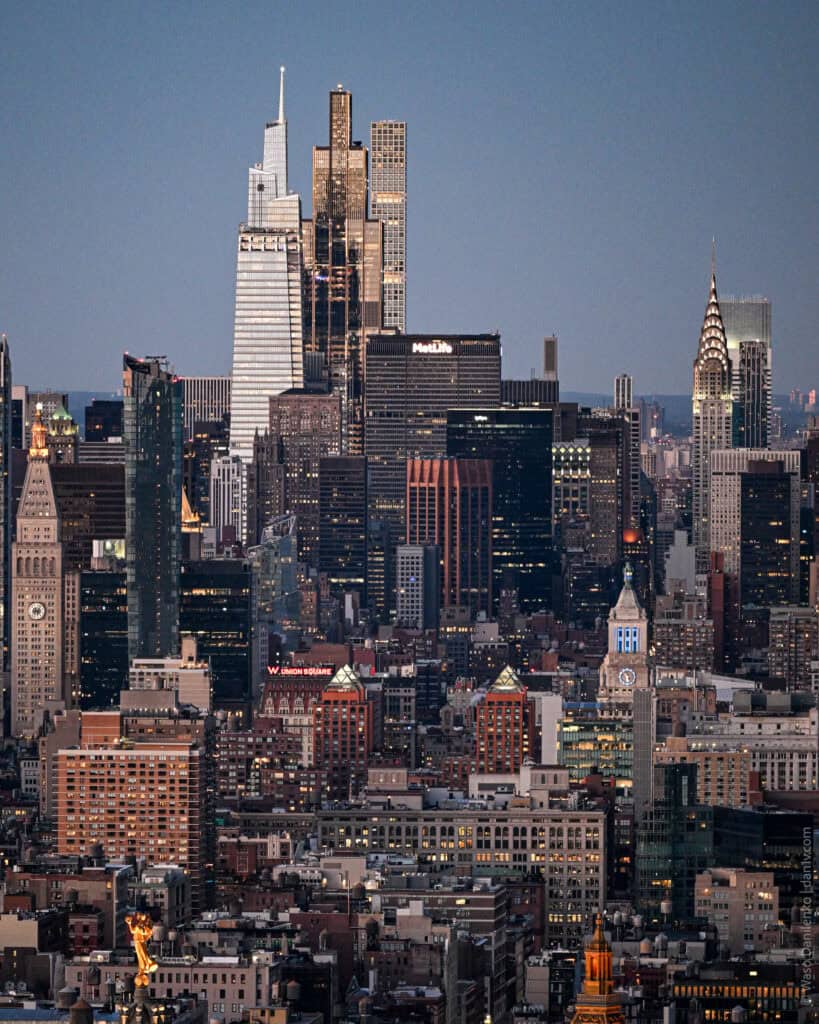
Overstory is a cocktail bar on the 64th floor, one level above SAGA. In 2023, it was named the third best bar in the world by The World’s 50 Best Bars. The bar is surrounded by a circular terrace with 360-degree views of New York. Cocktails start at $24.
How to Get There
📍 70 Pine Street, New York, NY 10005 Financial District, Lower Manhattan
Nearest subway stations:
- Wall Street — lines 2, 3
- Fulton Street — lines 2, 3, 4, 5, A, C, J, Z
- Broad Street — lines J, Z
The lobby is open to the public, so visitors can walk in and admire the Art Deco interior. Reservations are required for Overstory and SAGA.