Everyone knows New York’s Oculus, designed by Santiago Calatrava… But few know that this project would not have been possible without one museum, the Spanish architect’s first project in the United States — the Milwaukee Art Museum.
The Milwaukee Art Museum (MAM) is a museum blessed with architects. The first building was designed by Eero Saarinen himself in 1957, in the form of a soaring cross over the lake. The second pavilion was designed by David Kahler in the Brutalist style in 1975, and the third and most famous building was built in 2001 by Calatrava.
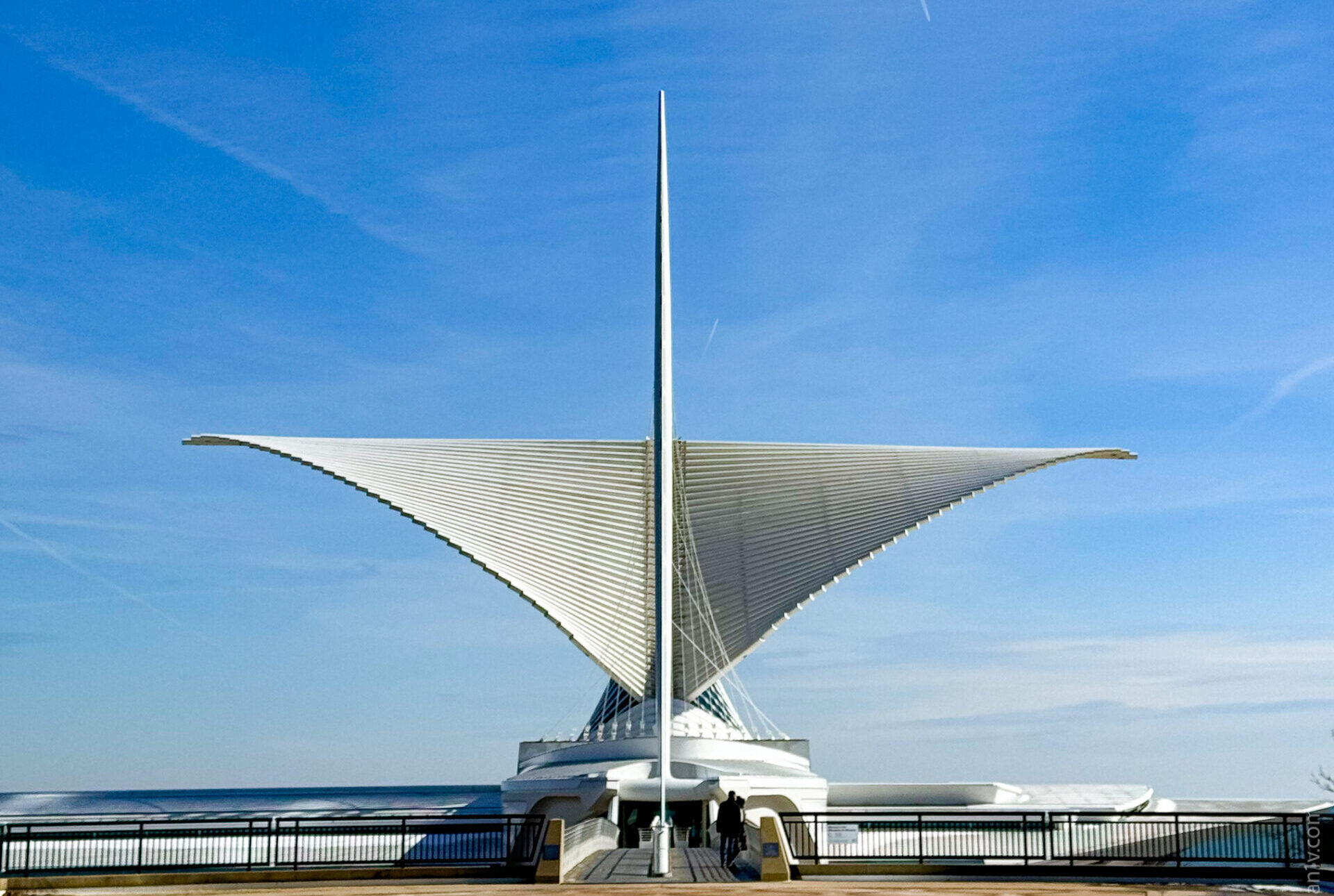
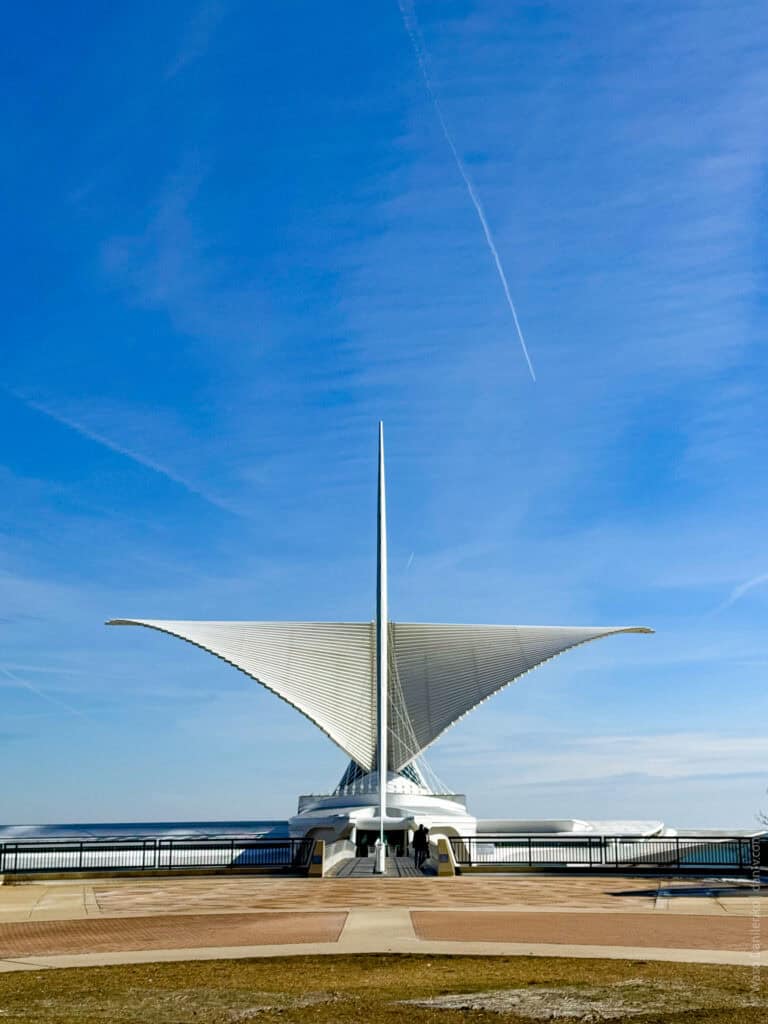
A white structure on the shore that opens its wings twice a day — literally, mechanically, with the creaking of hydraulics — to a width of 66 meters. The wings weigh 45 tons. That’s Calatrava. This is what the locals call Pavilion Quadracci, named after the architect who created it.
Key facts about the Milwaukee Art Museum
- The museum was founded in 1888 as a merger of two private galleries.
- Located on the shores of Lake Michigan, at 700 N. Art Museum Drive, it’s right on the water.
- The campus occupies nearly 10 acres along the waterfront.
- The museum’s total area is 31,700 square meters, divided into three buildings from different eras.
- The museum’s collection contains more than 35,000 works from antiquity to the present day.
- It is the largest art museum in Wisconsin.
- Three buildings, three architects: Eero Saarinen (1957), David Kahler (1975), and Santiago Calatrava (2001).
- Construction of the Pavilion Quadracci cost $121 million and took four years (1997–2001). Wings (Burke Brise Soleil): 72 steel fins, span 66 meters, weigh 45 tons, open and close in 3.5 minutes.
- Attendance: approximately 400,000 people per year.
- Admission on Thursday evenings is pay-what-you-wish.
- Children under 12 are always free.
The History of the Milwaukee Art Museum
How It All Began
In 1888, Milwaukee was one of America’s most vibrant industrial cities. German immigrants transformed it into the country’s beer capital, with Pabst, Schlitz, and Miller all operating here. There were also slaughterhouses, tanneries, and shipyards. And yet, a genuine thirst for culture, characteristic of the German diaspora, was evident.
That same year, 1888, two men independently decided to give the city an art institution.
Frederic Layton, a businessman who had made his fortune in the cattle trade, built a private gallery near Cathedral Square and opened it to the public. It was the Layton Art Gallery: a stately Victorian mansion housing a permanent collection of European paintings.
Around the same time, a group of city activists created the Milwaukee Art Association (later renamed the Milwaukee Art Institute) — an organization without a permanent building but with ambitions.
The two organizations existed side by side for nearly 70 years, with their own collections, directors, and sponsors. It wasn’t until 1957 that they merged. The new building served as the catalyst.

Eero Saarinen
In 1954, Milwaukee officials conceived the idea of building a memorial to World War II veterans. They also wanted to construct a worthy building for the combined collections of two art institutions. The architect chosen was Eero Saarinen, a Finnish-American genius who, during the same period, designed JFK Airport in New York, Dulles Airport in Washington, D.C., and the famous Gateway Arch in St. Louis.
The Milwaukee County War Memorial Center, completed in 1957, is one of Saarinen’s finest works. The building takes the form of a floating cross: four wings from a central base hover above the ground. The ground floor is completely open — the building literally hovers. Horizontal lines, austere concrete, and enormous glass facades overlooking the lake — classic international style at its finest.
Saarinen often worked with the image of a “bird in flight” — just look at the TWA terminal at JFK Airport (1962). The Milwaukee War Memorial is a more restrained version of the same idea: the cross doesn’t fly, but hovers above the ground. It was this feeling that led Calatrava to say forty years later that Saarinen’s building was “both an inspiration and a challenge.”
The new building opened in 1957, uniting the collections of the Layton Art Gallery and the Milwaukee Art Institute under one roof. The combined organization was named the Milwaukee Arts Center (renamed the Milwaukee Art Museum in 1980).
David Kahler
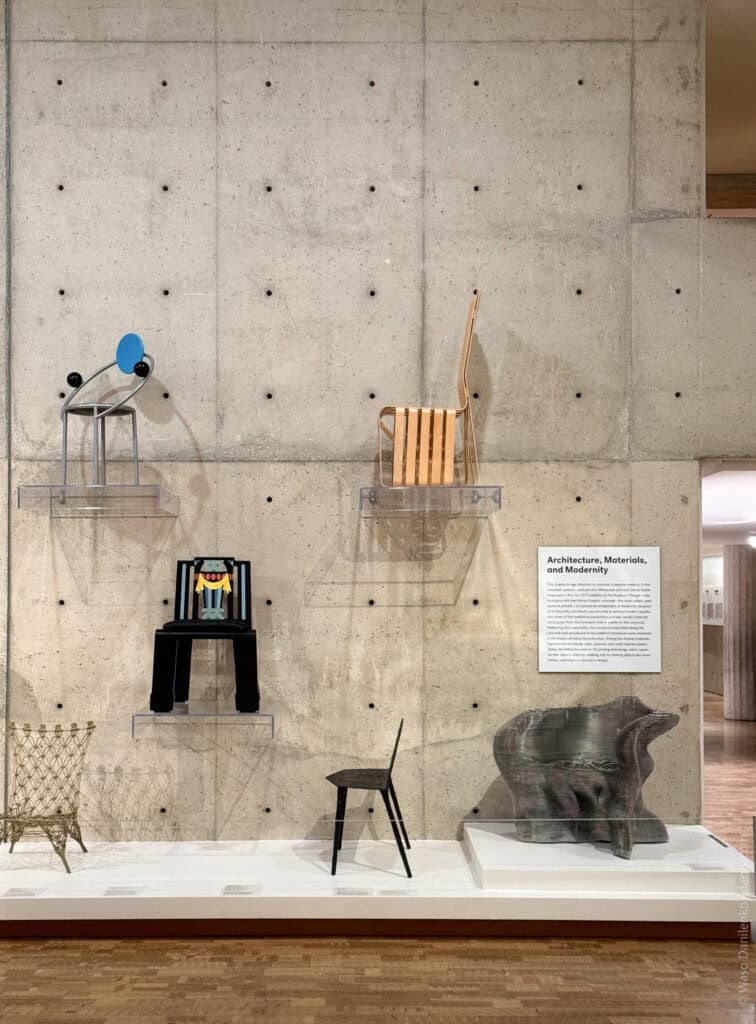
By 1975, the museum’s collection had grown so large that Saarinen’s building could no longer accommodate it. Architect David Kahler constructed the Kahler Building — a massive, brutalist concrete structure adjacent to the memorial on the west. It was the right architectural solution for its time: 1970s-style brutalism, unadorned, a functional concrete form.
Critics disliked it, and the museum wasn’t particularly proud of it. However, the building did accommodate a new wing, which was immediately filled with one of the most important private collections in the museum’s history.
Also in 1975, Peg Bradley, widow of industrialist Harry Lind Bradley, donated over 600 works of European and American modernism to the museum. The works she collected from 1950 to 1975 included German Expressionists, Georgia O’Keeffe, Barbara Hepworth, Mark Rothko, Andy Warhol, and Pablo Picasso. It was one of the largest art donations in the history of American regional museums. And it was then that MAM acquired real artistic clout.
Santiago Calatrava
By the late 1980s, the museum was once again in need of expansion. Saarinen had designed a magnificent building, but it was too compact. The brutalist Kahler Building added space but failed to address the public space problem: it lacked a proper lobby, parking, and space for temporary exhibitions.
In 1988, celebrating the museum’s centennial, the management announced a campaign to build a new building. An international competition was announced, and numerous proposals were received. Spanish architect Santiago Calatrava presented a concept that took the commission’s breath away.
But then something unexpected happened. Calatrava withdrew his candidacy in 1994. He was worried about working in the United States — an unfamiliar market, unfamiliar building codes, unfamiliar contractors. The commission, which included Donald Baumgartner (a major donor and a man with architectural taste), persisted. Baumgartner personally persuaded Calatrava to return to the project. And he did.
Construction of the Quadracci Pavilion (named after Betty and Harry Quadracci, who donated $10 million in matching funds) began on December 10, 1997, and was completed in 2001.
The Quadracci Pavilion Architecture at the Milwaukee Art Museum
The pavilion stands on the shore of Lake Michigan: the construction site was an abandoned coastal landfill. Beneath it was fill soil, and beyond that, only the lake bed. To support the 37,700-ton (!) building on this site, a special concrete foundation slab was required to evenly distribute the load.
The project consists of several elements:
Reiman Bridge
A pedestrian cable-stayed bridge spanning Lincoln Memorial Drive and connecting the museum to the city center. 61 meters long, with a 60-meter inclined mast and 1,000 meters of steel cable stays. The bridge is intentionally asymmetrical: the inclined mast creates a sense of movement, directing the eye toward the building.
Windhover Hall
The main lobby and the heart of the complex. The name is a reference to Gerard Manley Hopkins’s poem “The Kestrel” (Windhover is a soaring bird).
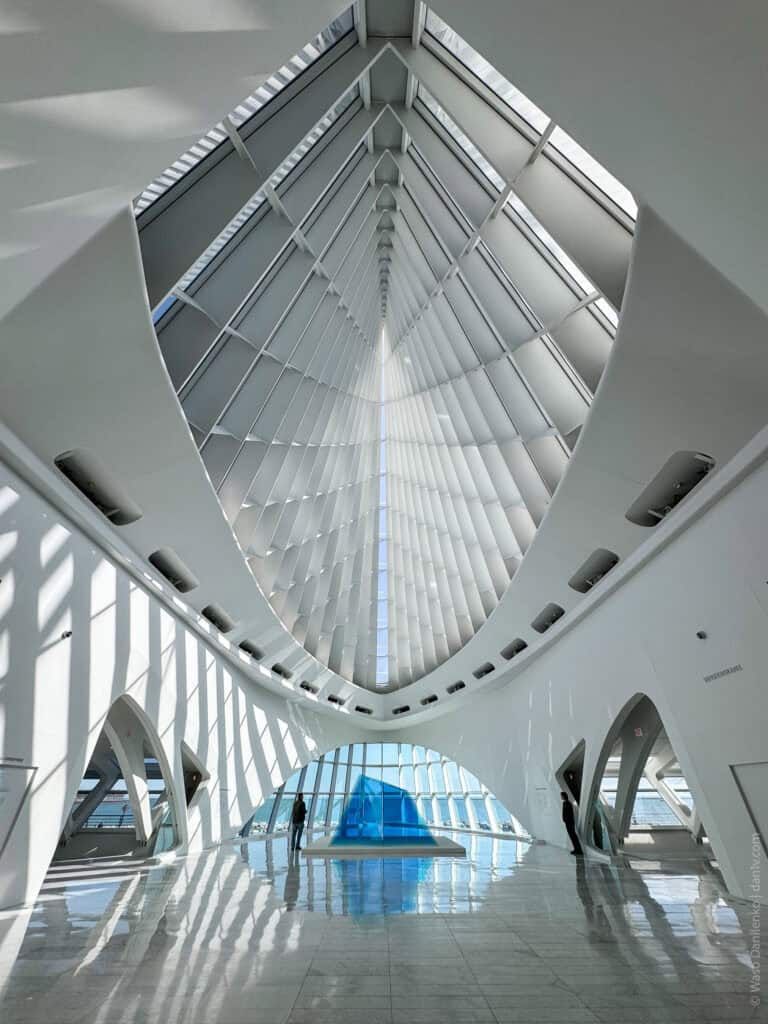
This 27-meter-high space under a glass vault is Calatrava’s interpretation of a Gothic cathedral. Flying buttresses, pointed arches, ribbed vaults, a central nave. All made of white concrete. This is Gothic architecture translated into the language of 21st-century engineering: the same principles of load transfer, the same vertical thrust, but no ornamentation. Only form.
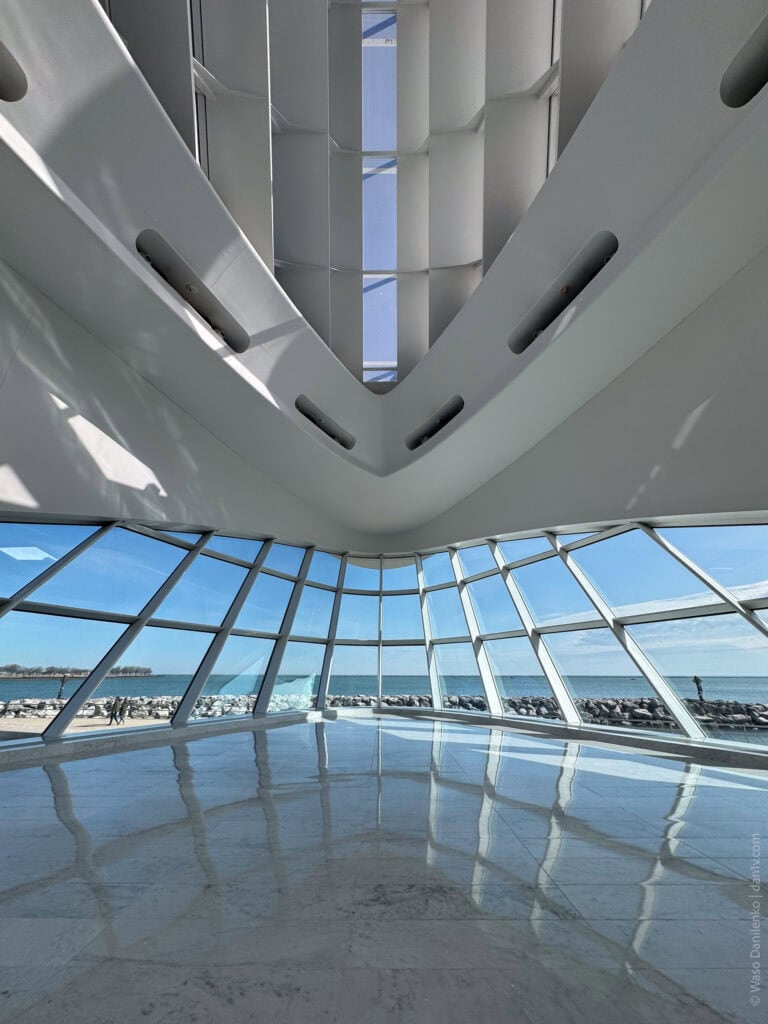
At the east end of the hall is an apse (a projecting part of the building adjacent to the main structure and covered by a semi-dome) shaped like a ship’s prow, with floor-to-ceiling windows looking directly onto Lake Michigan.
The concrete for Windhover Hall was created like this: first, carpenters laser-cut each wooden formwork according to computer-generated drawings—each form is unique, like the parts of a ship. The inner surface of the formwork was coated with a special compound to ensure a perfectly smooth concrete finish. Only then was the concrete poured.
The entire project required 2,100 tons of rebar. Workers bent most of it by hand according to unique drawings, as standard shapes did not fit any of the structural elements.
Burke Brise Soleil – Wings
This is the building’s main attraction. The Burke Brise Soleil (French for “Burke sunscreen”) is a movable sunscreen atop the glass dome of Windhover Hall. At the time of its construction, it was an engineering and architecturally unprecedented piece of American architecture.
- 72 steel fins arranged in a fan-shaped configuration
- Fin length: 8 to 32 meters
- Flying span: 66 meters—approximately the same as a Boeing 747
- Gross weight: 45 tons
- Powered by 22 hydraulic cylinders
- Opening/closing time: 3.5 minutes
- Each fin has an ultrasonic wind sensor
- At wind speeds exceeding 37 km/h (23 mph) for 3 seconds, the wings close automatically
The wings open twice a day: in the morning when the museum opens, and at noon, closing for lunch and then opening again, closing when the museum closes. This schedule is more than just a decorative gesture: the open wings allow diffused light through the glass dome, while the closed ones protect against overheating.
By the way, the wing sections were transported to Milwaukee on an An-225 Mriya, the world's largest cargo aircraft, which belonged to the Ukrainian Air Force. The sections were too large for any other aircraft.
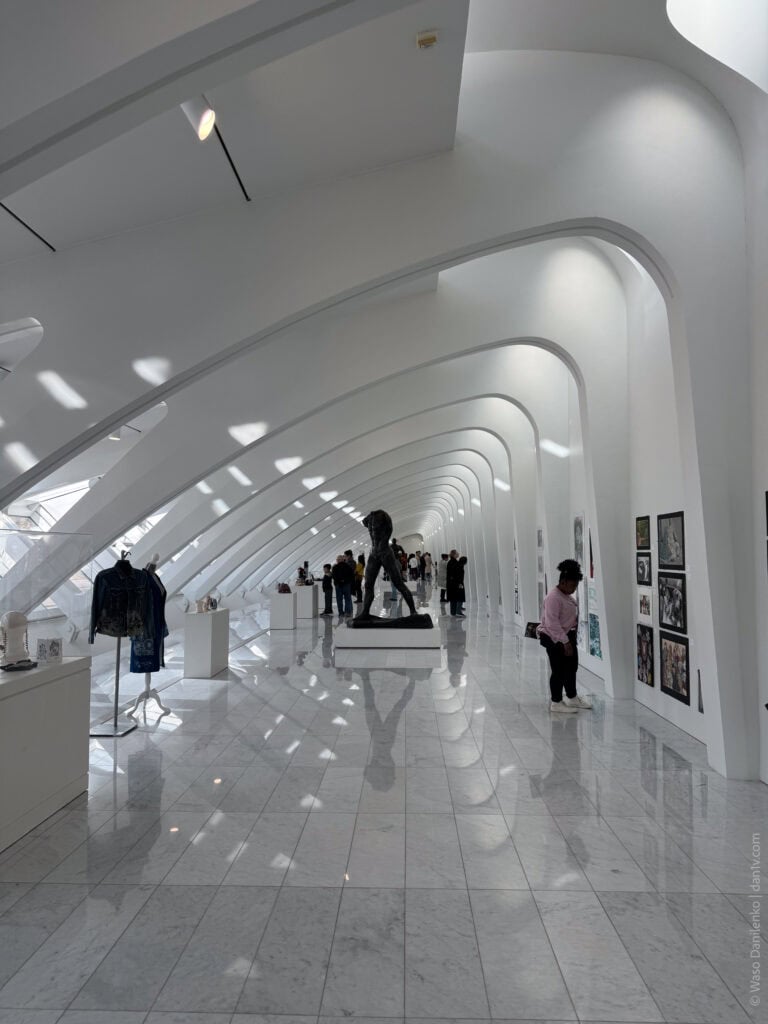
Who is Santiago Calatrava?
Santiago Calatrava was born in 1951 in Valencia, Spain. He is one of the few practicing architects in the world to hold two degrees: one in architecture (1974) and one in civil engineering (1979).
Most architects draw beautiful designs and hand them over to engineers, who then decide what will work. Calatrava does the thinking himself. Therefore, his buildings achieve what others fail to do: they literally move, bend, and balance on the edge of possibility. His designs are inspired by natural forms—birds, fish, the human skeleton — and yet they are built like bridges.
Calatrava began his career as a bridge builder. His first major success was the Stadelhofen Railway Station in Zurich (1983). Then came a series of bridges for the Barcelona Olympics. By the mid-1990s, he was one of the most renowned architects in Europe, but he was virtually unknown in America.
The Milwaukee project changed that. Milwaukee was followed by the Oculus in New York (a transportation hub near the World Trade Center, 2016), the Ciudad de las Artes y las Ciencias in Valencia, the Assut de l’Or Bridge, and the Ponte della Costituzione in Venice.
Calatrava’s life in the United States was complicated. The Oculus in New York, planned for $2 billion, ended up costing $4 billion — the largest budget overrun in the history of American public buildings. Calatrava sued several clients who accused him of cost overruns. Nevertheless, he became an architect whose name is recognizable to city residents by the building’s silhouette — a rare occurrence in architecture.
Milwaukee Art Museum Collection
German Expressionism
The museum houses over 32,000 works, including a well-presented collection of German Expressionism (due to the significant German immigrant population in Wisconsin), including 11 paintings by Gabriele Münter, a longtime friend of Wassily Kandinsky and a member of the Blue Rider group.
Georgia O’Keeffe
The 11 works by O’Keeffe represent one of the largest collections in any museum. A native of Wisconsin, she spent most of her life in New Mexico. The collection features large floral paintings, New Mexican landscapes, and abstract art. The personal friendship between O’Keeffe and Peg Bradley explains the depth of this section of the collection.
Haitian Art
One of the largest public collections of Haitian art outside of Haiti. Vibrant, expressive, and utterly unique paintings in the spirit of voodoo and folk Catholicism. Artists like Hector Hyppolite and Philomé Obin are key names. This is the part of the museum you’d least expect to find in a Wisconsin town.
American Art
And, of course, a lot of American art, including the Ashcan School (New York realists of the early 20th century who painted clotheslines between houses, immigrants in basements, bars, and back alleys — all the things salon painting studiously ignored), the Hudson River School (American Romantics of the mid-19th century who painted wild landscapes — rivers, mountains, and forests), Winslow Homer with his seascapes and rural America, Grant Wood — the same one who painted “American Gothic” — and Georgia O’Keeffe with her exaggerated flowers and New Mexico landscapes, despite being a Wisconsin native.
Folk Art
A rarity for a major American museum: a comprehensive collection of outsider and amateur art. Works by people without academic training, created out of an excess of something internal, not for career reasons. One of the main sections, it often lingers longer than Rothko.
Contemporary Art
Minimalism, conceptualism, neo-expressionism. Andy Warhol’s “Campbell’s Soup” (1965), works by Barbara Hepworth, Mark Rothko, and Helen Frankenthaler.
European Art
From the Renaissance to the 19th century. A strong section on European Baroque, French engravings from the 1600s to 1900s are among the collection’s greatest strengths.
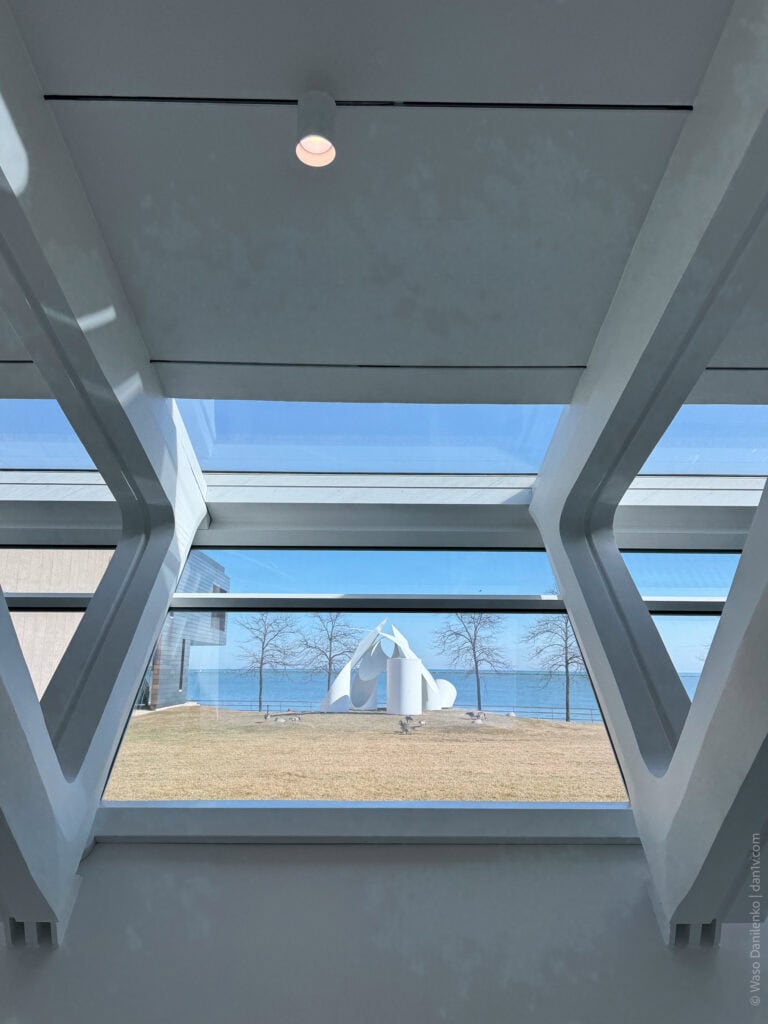
And one of the most beautiful and noticeable sculptures in the museum courtyard is Argo (1975, you can see it in my photo) by the artist Alexander Liberman, born in Kyiv, who, after emigrating to the United States, continued to work at New York’s Conde Nast, holding the position of editor-in-chief there in the mid-60s.
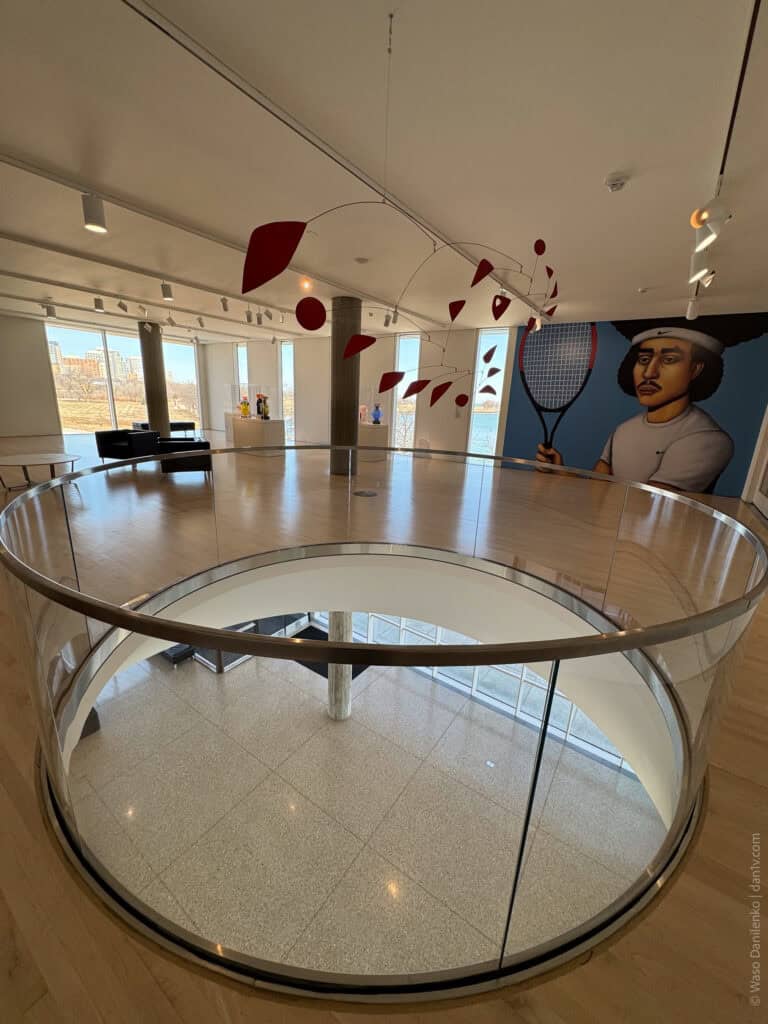
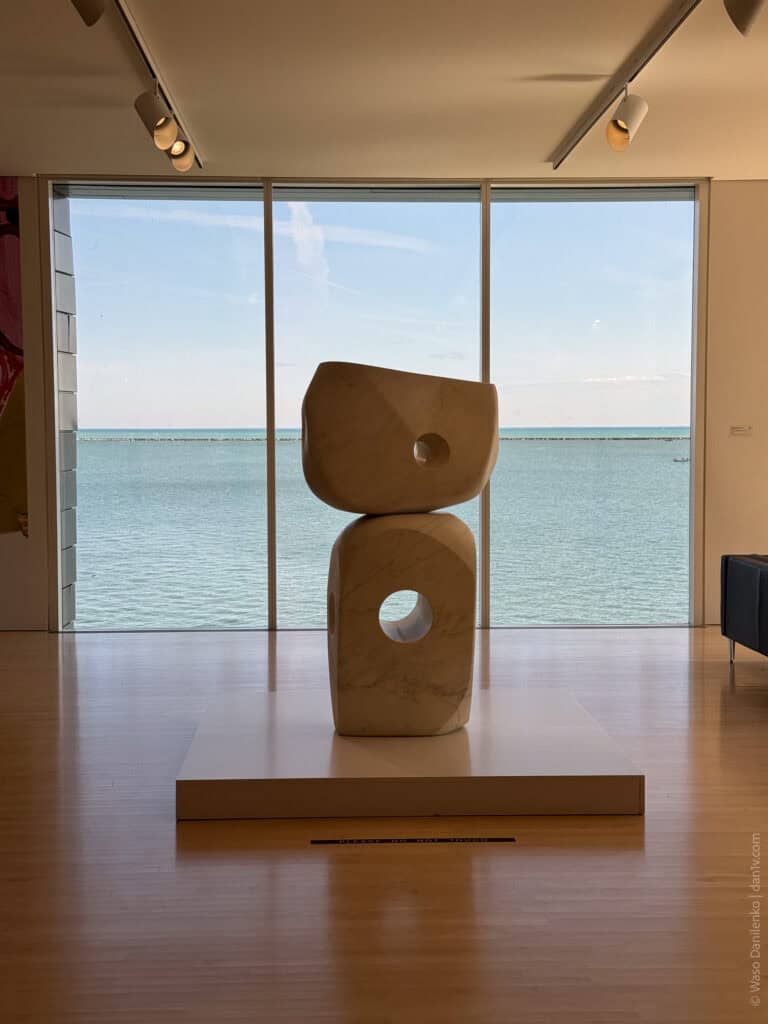
How Peg Bradley’s Gift Transformed the Milwaukee Art Museum
Margaret Peg Bradley, widow of industrialist Harry Lind Bradley, began collecting contemporary art in 1950. Not based on expert advice or market trends, but on her personal taste. She trusted her eye more than consultants.
Over 25 years — from 1950 to 1975 — she collected approximately 600 works. Vibrant, expressive, and not always convenient. Münter and O’Keeffe weren’t as famous then as they are now. Rothko was alive and selling. Warhol was just coming into fashion.
In 1975, Peg Bradley donated her entire collection to the museum — around 400 works in a single gift. The remaining works arrived later. This changed everything: without the Bradley collection, the Milwaukee Art Museum would have been a strong regional museum. With it, it rose to the forefront.
The Bradley Wing, which opened in 1975 in the Kahler Building, was created in honor of this collection. In March 2026, the wing underwent a major renovation and reopened with a new display.
The amount of Peg Bradley's gift has never been officially disclosed. According to art market estimates, the Rothko, O'Keeffe, and Warhol works in this collection alone are worth hundreds of millions of dollars today. At the time of the gift in 1975, Bradley's entire collection cost her far less — she purchased the works before they became icons.
What was happening in the Milwaukee Art Museum building besides art?
From the very beginning, the Quadracci Pavilion was conceived not only as a museum building but also as a public space for the city. Windhover Hall hosts weddings, corporate events, and charity balls. Renting out the main hall is a perfectly New York approach, but in Milwaukee, it seemed especially appropriate for a city desperately in need of a symbolic space.
And the symbolism worked. Quadracci Pavilion opened in October 2001, a month after September 11. Calatrava attended the ceremony and said, “The opening of this museum was for me a sign of respect and even love for Milwaukee and the United States of America.”
The building has also appeared in films:
- Transformers: Dark of the Moon (2011) — the soundstage plays the headquarters of villain Dylan Gold (Patrick Dempsey)
- Bridesmaids (2011) — opening aerial shots of Milwaukee
- Need for Speed: Undercover (2008)
- American Idol
Visitors information
📍Milwaukee Art Museum / 700 N Art Museum Dr, Milwaukee, WI 53202
Admission:
- Adults — $25
- Students and seniors — $20
- Children under 12 — always free
- Thursday 4:00 PM–8:00 PM — Pay-What-You-Wish
- Bank of America/Merrill Lynch cardholders — free the first weekend of each month (Museums on Us program)
Hours: Tuesday–Sunday 10:00 AM–5:00 PM, Thursday 10:00 AM–8:00 PM
The wings open and close twice daily: in the morning when the museum opens (10:00 AM), close at noon and then reopen, close in the evening when the museum closes, and close at 8:00 PM on Thursday (when the museum is open until 8:00 PM).
If wind speeds exceed 37 km/h (23 mph) for more than 3 seconds, the wings automatically close and remain closed. This happens frequently along the shores of Lake Michigan, especially in the fall and winter. Check the forecast before your visit.
The best place to watch from the outside is the Reiman Bridge: you stand directly on the axis, the wings opening up before you. The best place inside is Windhover Hall: look up through the glass dome as the wings slowly unfurl, casting shadows from the fins across the floor.