Eldridge Street Synagogue is located on Manhattan’s Lower East Side. It was built in 1887 by Jewish immigrants from Russia and Eastern Europe. The Eldridge Street Synagogue was one of the first synagogues of its kind in the United States and remained an important center of community life for many years.
Today, the building serves as both a museum and an active synagogue. Visitors can explore its restored interior, with soaring painted ceilings, stained-glass windows, and decorative details, learn about the history of Jewish immigration to New York, and attend guided tours, concerts, and lectures. After years of neglect, the synagogue was restored and reopened in 2007. It is now designated a National Historic Landmark.
Interesting Facts About the Museum at Eldridge Street
- It was the first major synagogue in the United States built by Jewish immigrants from Eastern Europe.
- The building was designed by two German Catholic architects. Although they did not practice Judaism, they created one of the most recognizable Jewish places of worship in the country.
- The synagogue’s main sanctuary can accommodate approximately 700 people.
- During the restoration, the original stained-glass window was not recreated because no photographs of it had survived. Instead, a new design was created for the window.
- The restoration of the building took more than 20 years.
- The museum is closed on Saturdays and major Jewish holidays in observance of Jewish religious traditions.
History of the Museum at Eldridge Street
In the late 19th century, Manhattan’s Lower East Side became home to thousands of Jewish immigrants from the Russian Empire and other parts of Eastern Europe. Many had fled pogroms, poverty, and persecution. Several synagogues were already operating in the neighborhood, but the Kahal Adath Jeshurun congregation (Hebrew for “Community of Israel” or “Community of Jeshurun”) decided to build a large synagogue that would become an important center of Orthodox Judaism in New York.
Construction was completed in 1887. The new synagogue was intended to serve the many Jewish families who spoke Yiddish and maintained the traditions of their homeland. The project was entrusted to brothers Peter and Francis Herter, German Catholic architects. They had designed only a few buildings before, but the synagogue became a major success and helped establish their reputation.
For its first few decades, the synagogue was an important gathering place for the local community. Over time, however, the neighborhood began to change. After immigration restrictions were introduced, fewer new arrivals came from Eastern Europe, and many wealthier families moved to other parts of the city. Maintaining such a large building became increasingly difficult. In the 1940s, the congregation moved to a smaller basement chapel, and the main sanctuary was closed. By the 1950s, members could barely afford heating and essential repairs.
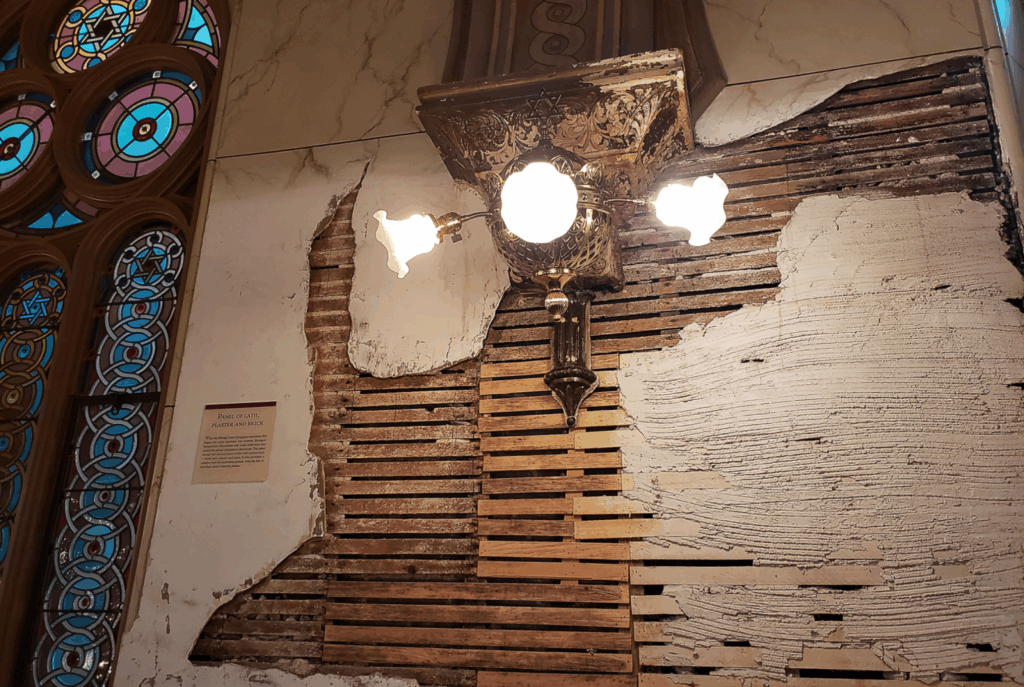
Without regular maintenance, the building gradually fell into disrepair. Dust accumulated inside, pigeons settled on the balconies, and the stained-glass windows and other interior features deteriorated. It seemed that the synagogue might never be restored.
Everything changed in the 1980s, when journalist and historic preservation advocate Roberta Brandes Gratz noticed the abandoned building. Determined to save it, she founded the Eldridge Street Project in 1986 together with attorney William Josephson. An extensive restoration began, lasting more than twenty years and costing approximately $20 million.
In December 2007, the synagogue’s main sanctuary finally reopened after restoration. The building once again became a place of worship, as well as a museum dedicated to the history of New York’s Jewish community. A new stained-glass window was installed in 2010, and a permanent museum exhibition opened in 2014.
Architecture of the Eldridge Street Synagogue
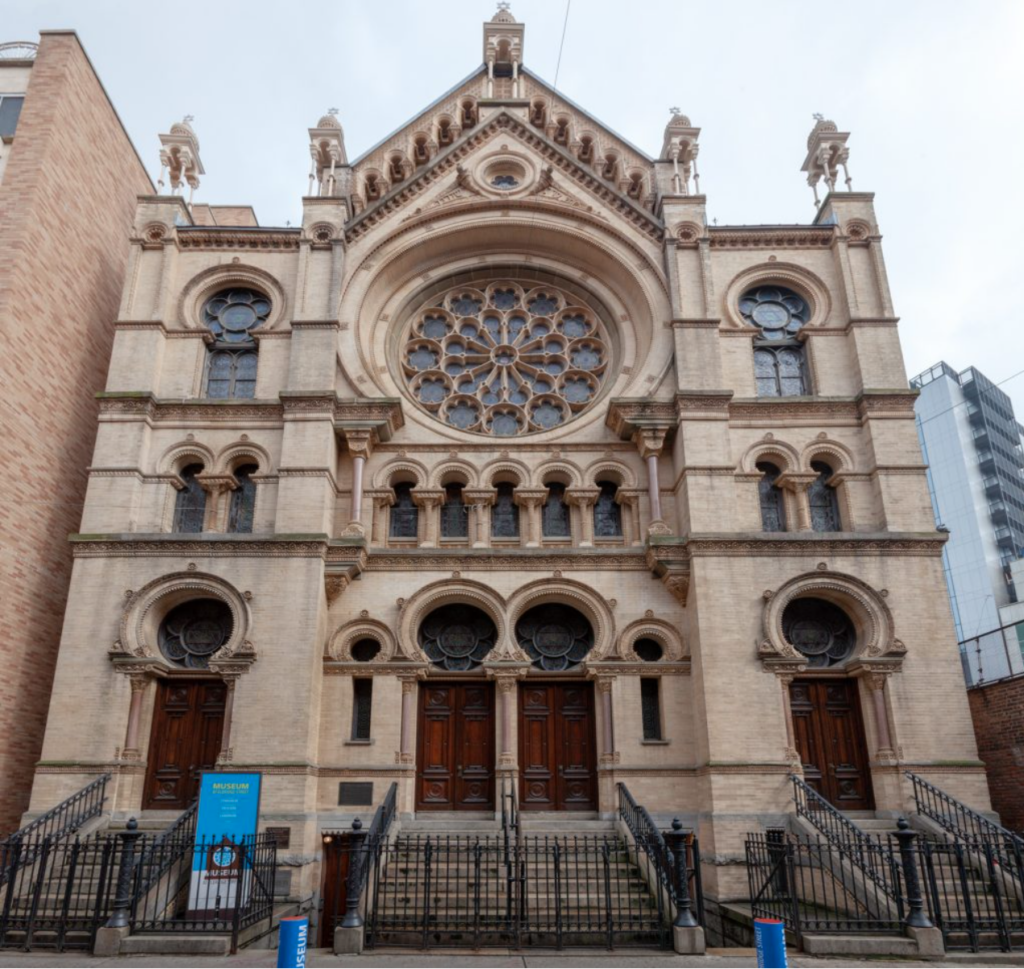
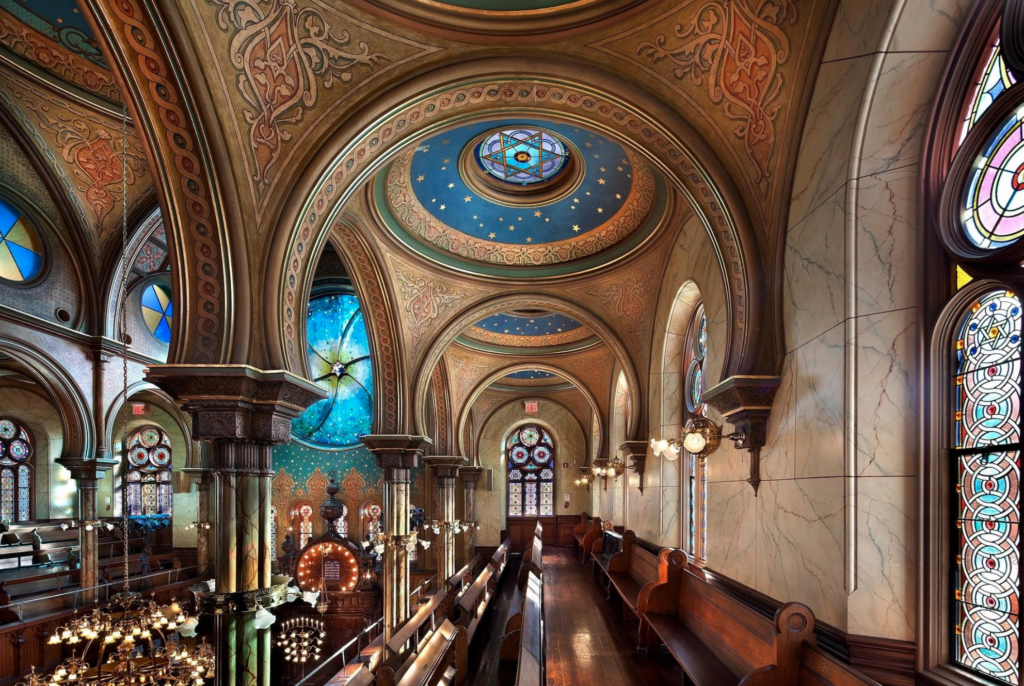
The Eldridge Street Synagogue stands out for its unusual architecture, which combines Moorish, Gothic, and Romanesque styles.
The building’s façade is made of cream-colored brick. It is decorated with Moorish-style horseshoe arches and a large round window that resembles a Gothic design. Thanks to this architectural style, the synagogue looks more like a palace than a religious building.
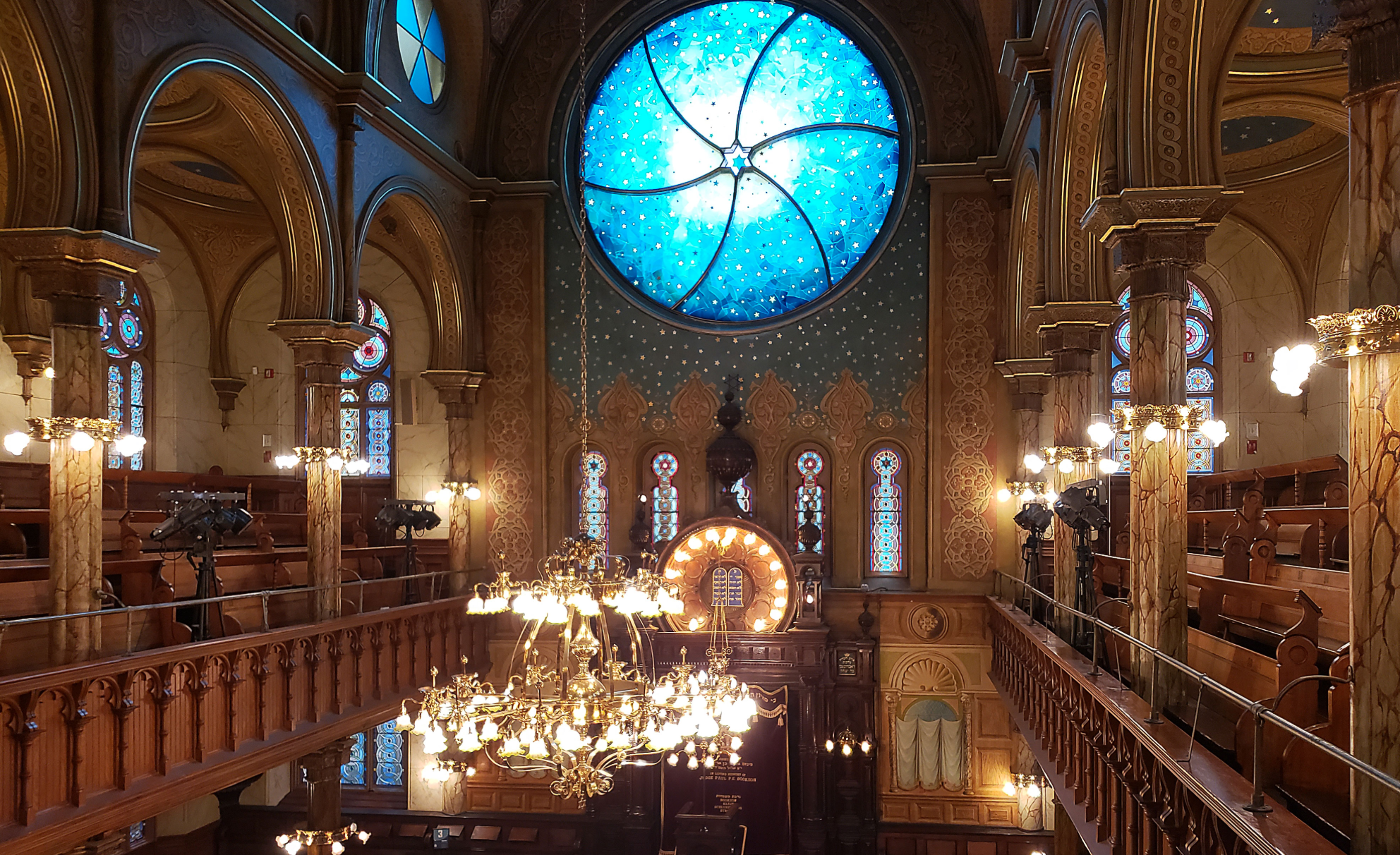
Inside, there is a spacious prayer hall that can accommodate 700 people. It is surrounded by tall balconies, while the ceiling is decorated with blue vaults and star patterns.
Two important features of the interior are the Ark of the Covenant — an ornate cabinet against the eastern wall where the Torah scrolls are kept — and the bimah, a small raised platform with a reading desk from which sacred texts are read during services. Both elements are made of walnut wood.
Nearby, visitors can see wall paintings that imitate real fabric curtains. During the restoration, craftsmen painstakingly recreated the original patterns and decorative details by hand, trying to preserve the interior’s original appearance.
One of the most striking features of the hall is the large circular stained-glass window on the eastern wall. It was created by artist Kiki Smith and architect Deborah Gans in 2010.
The window is five meters in diameter and consists of 1,200 pieces of glass. Hundreds of golden stars are arranged in a spiral against a blue background. The artists drew inspiration from the traditional star patterns found on the synagogue’s walls and ceiling.
The previous window had been damaged beyond restoration, so instead of creating an exact replica, the decision was made to commission a contemporary work of art.
Exhibitions at the Museum at Eldridge Street
The Museum at Eldridge Street does not have a traditional collection of paintings or historical artifacts. Its main exhibit is the building itself, with its restored interior. Visitors can explore the main sanctuary and see the historic wall paintings, the wooden Ark of the Covenant, the balconies, and the chandeliers. One of the most striking features is the large circular stained-glass window created by artist Kiki Smith and architect Deborah Gans.
The museum also features a permanent exhibition dedicated to the lives of Jewish immigrants on the Lower East Side and the history of the synagogue itself. It tells the story of how the building was constructed, how it became the center of the local community, why it eventually fell into disrepair, and how it was restored. The exhibits include historical objects connected to the building’s past, including a 19th-century prayer book.
Some details serve as reminders of the synagogue’s past and its many years of neglect. For example, the glass blocks that were once used to seal a damaged window are now incorporated into the design of a wall in the lower prayer room. An old sign discovered during the restoration in 2005 has also been preserved inside the building and now decorates the staircase.
In addition to its permanent exhibition, the museum hosts temporary exhibitions dedicated to the history of the Jewish community and life on the Lower East Side. It also organizes concerts, lectures, and cultural events. One of its annual highlights is the outdoor festival Egg Rolls, Egg Creams, and Empanadas, which introduces visitors to the traditions of New York’s diverse communities.