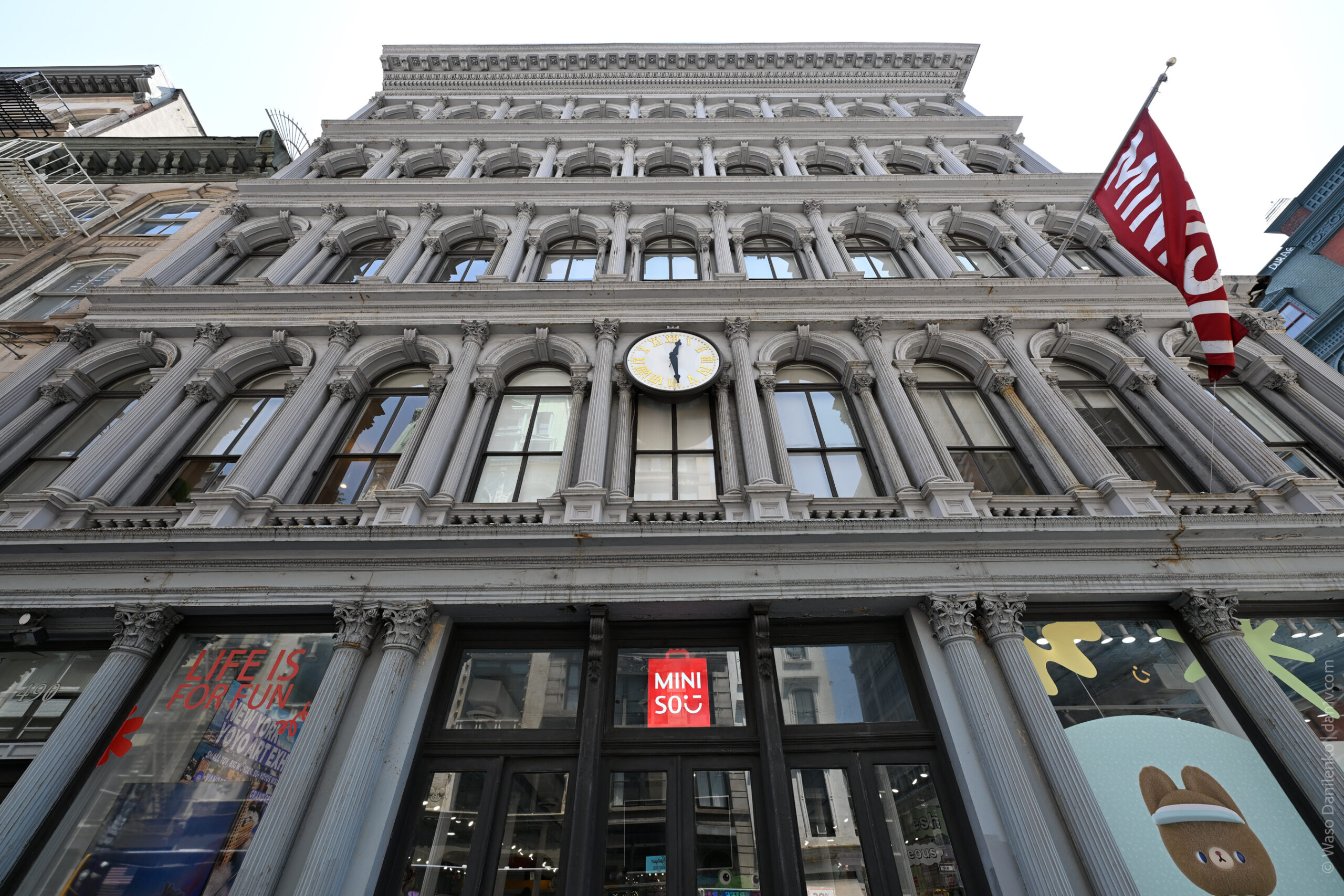
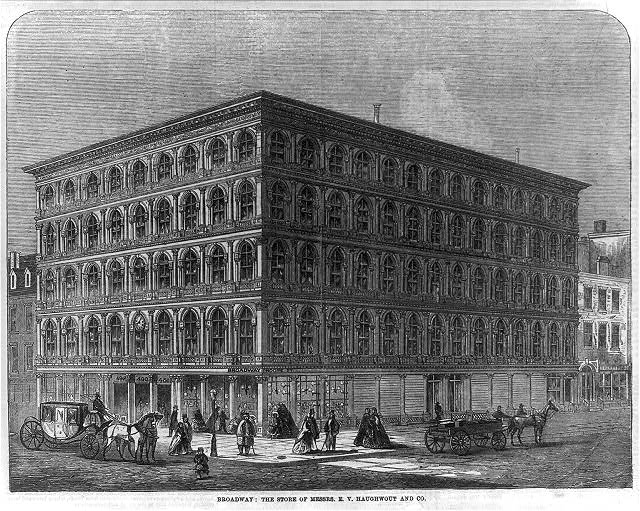
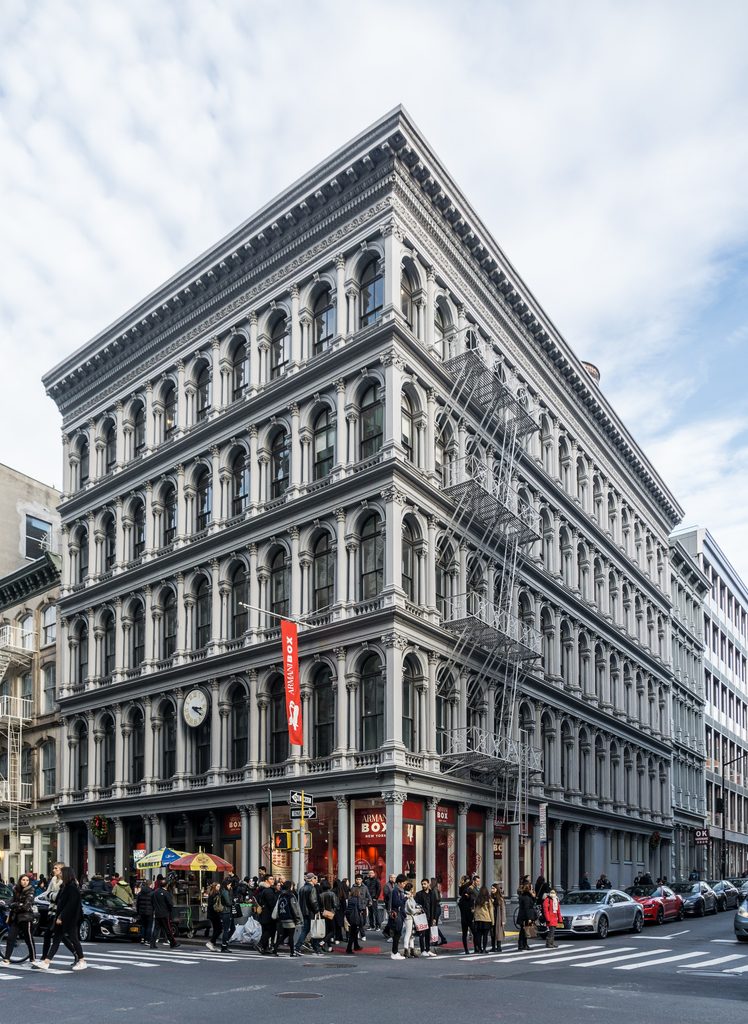
It’s amusing (though perhaps not all that surprising) that if you search for the “world’s first elevator,” you’ll quickly come across a building in New York. The Haughwout Building at 488 Broadway is still standing today and features one of the finest cast-iron facades in the city. It has been nicknamed the “Parthenon of Cast-Iron Architecture.”
How Did the World’s First Elevator Come to New York?
The first elevator — more precisely, the first safe passenger elevator — was installed on March 23, 1857, in Eder Haughwout’s china and glassware store at 488 Broadway.
Interestingly, the building didn’t actually need one. Five stories was considered an ordinary height for New York at the time, and climbing the stairs was perfectly manageable. But Haughwout installed the elevator for an entirely different reason: he hoped people would come to see this mechanical novelty and stay to buy porcelain.
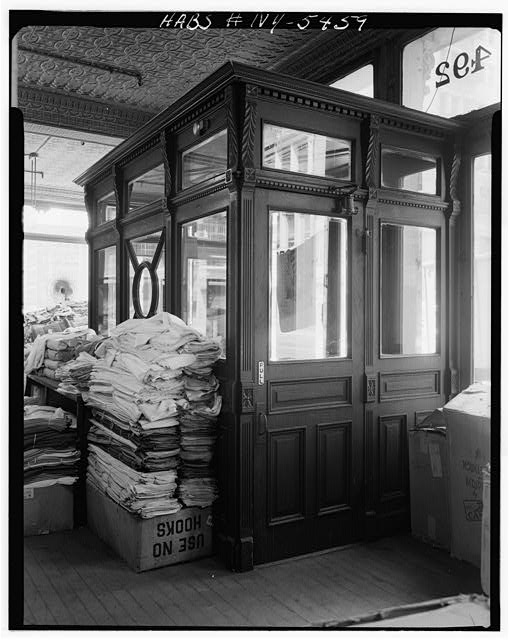
The plan didn’t work. The elevator was noisy and moved jerkily, so most visitors preferred to use the stairs. By 1860, it had been abandoned. It operated for about three years. The Library of Congress archives contain a photograph of an elevator on the building’s ground floor, taken in 1970, but it is clearly not the original elevator from 1857.
The Haughwout Building: Home of the World’s First Elevator in New York
The Haughwout Building, designed by architect John P. Gaynor and constructed in 1856–1857, is still standing in New York today. On November 23, 1965, it was designated a New York City landmark, making it one of the earliest buildings to receive this status.
The cast iron used for its famous facade was a relatively new building material at the time. It made it possible to create lightweight facades with large windows and repeating decorative elements, which explains why SoHo has so many cast-iron buildings. The Haughwout Building is one of the finest examples.
Perhaps the most important thing about this building isn’t its facade. It helped pave the way for New York to become a vertical city: after 1857, it became clear that people didn’t have to rely on stairs to move between floors.
Today, the building houses shops and residential lofts, while its ground floor is occupied by a MINISO flagship store. So, in the very same building where porcelain and crystal were once sold, you can still do a little shopping. Only now, you’ll probably want to take the elevator.
Who Invented the Elevator?
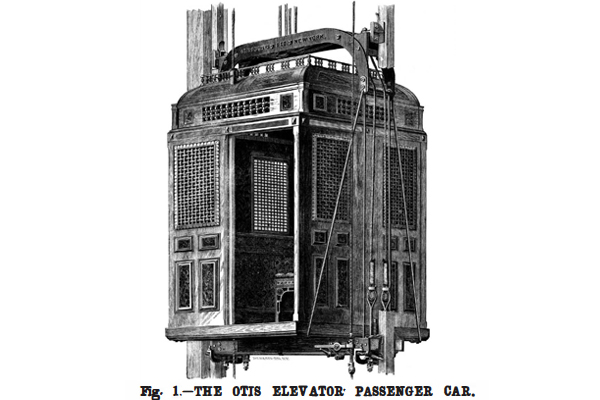
The man behind the first elevator was Elisha Graves Otis (1811–1861), a mechanic from Yonkers. He did not invent the elevator itself: lifting platforms had existed long before his time. Otis’s real achievement was inventing the first reliable, affordable safety brake that would stop the elevator car if its cable broke. Fear of falling was what kept people from using elevators, and Otis found a way to overcome it.
He did not receive a patent for his invention until January 1861. Just three months later, he died in Yonkers at the age of 49, leaving his company in debt. His sons, Charles and Norton, took over the business and transformed a small workshop into the global Otis empire.
As early as 1859, New York got the first hotel elevator in the United States, installed at the Fifth Avenue Hotel on Madison Square. It worked in a completely different way: a passenger car furnished with sofas was mounted on an enormous iron screw that ran from the basement to the attic. It moved up and down like a nut turning along a bolt. The invention was called a “vertical screw railway,” and its creator was Boston engineer Otis Tufts.
This is where the confusion that has lasted for a century and a half begins. Otis was Tufts’s first name, not his last, and the coincidence has led to the two inventors being mixed up ever since. The hotel itself was demolished in 1908, so not a trace of its screw railway remains.
📍Haughwout Building / 488 Broadway, New York, NY 10012