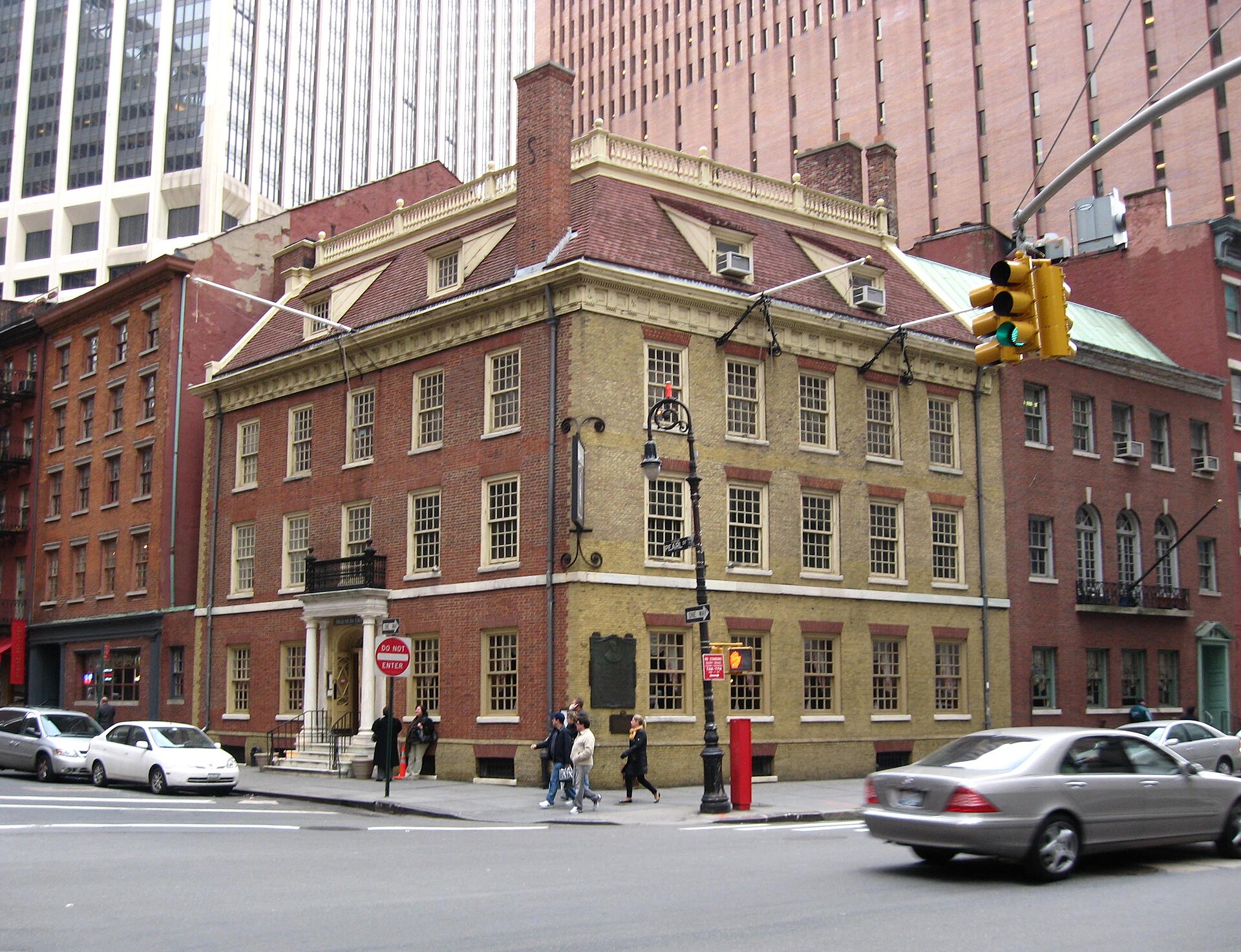
It’s hard to believe, but Fraunces Tavern in New York still operates for its original purpose. You can share a meal in the very same place where New Yorkers dined back in the 17th century. According to its owners, it’s the oldest surviving building in Manhattan — and once served as George Washington’s headquarters. Fraunces Tavern is located in one of New York City’s historic landmark districts.
Interesting Facts About Fraunces Tavern
- The Fraunces Tavern building was constructed around 1719 as a private residence for merchant Stephanus DeLancey. In 1762, Samuel Fraunces purchased the building and opened a tavern called the Queen’s Head.
- Before the American Revolutionary War, American patriots gathered at the tavern to discuss how to resist British rule.
- After the war ended in 1783, George Washington met with his officers here to bid them farewell. This became one of the most famous events in the tavern’s history.
- After the war, the building housed government offices of the newly formed United States, including departments responsible for foreign affairs and finance.
- In the early 20th century, the building was saved from demolition and restored at the initiative of the Sons of the Revolution. Some architectural details were reconstructed based on assumptions about what the tavern had looked like in the 18th century.
- In January 1975, a bomb planted by members of the Puerto Rican organization FALN exploded at the tavern, killing four people.
- Today, Fraunces Tavern is considered an important historic landmark in Lower Manhattan. The building houses a museum dedicated to the history of the American Revolution, as well as a restaurant and bar where visitors can dine in the atmosphere of an 18th-century tavern.
History of Fraunces Tavern
Fraunces Tavern is a living witness to American history — from the colonial era through the Revolution and the founding of the United States, right up to the present day. Revolutionaries and diplomats gathered here, and George Washington bid farewell to his army within these walls.
In 1674, Manhattan finally came under British control. The plot of land on Pearl Street where Fraunces Tavern now stands was created through landfill in 1691. Stephanus Van Cortlandt acquired the lot, and in 1700 his son-in-law, Stephen De Lancey — a French Huguenot — became its new owner. He built a three-story brick house on the site.
From the 1740s to 1759, the building was used for trade and residential purposes. In 1762, Samuel Fraunces — an entrepreneur and tavern keeper — purchased the property. He opened the Queen’s Head Tavern here, which quickly became a hub of New York social life.

On November 25, 1783, the British left New York — a day now known as Evacuation Day. On December 4, George Washington gave his famous farewell to the officers of the Continental Army in the Tavern’s “Long Room,” leaving an indelible mark on U.S. history.
From 1785 to 1788, the building housed federal offices including the Department of Foreign Affairs, the War Department, and the Treasury. Important international negotiations were conducted here and key documents of the young nation were drafted.
In the 19th century, the building became a boarding house with a tavern on the ground floor. It was rebuilt several times after fires in 1832, 1837, and 1852. Despite the changes, it remained known as Fraunces Tavern. In 1883, the Sons of the Revolution organization was founded within its walls.
By 1900, the building faced demolition, but was saved thanks to efforts by the Daughters of the American Revolution and other groups. This helped launch the historic preservation movement in the United States.

Collection and Exhibitions at Fraunces Tavern
The Fraunces Tavern Museum’s collection focuses on the culture and history of Colonial America, the War for Independence, and the early years of the United States. The collection holds about 8,000 items divided into six main categories: furniture, documents and communications, personal belongings, artworks, household items, and military artifacts. Visitors can find tables, teacups, paintings, letters, and much more.
About 400 objects from the collection are regularly displayed in eight galleries open to the public. Visitors can also explore additional items from past exhibitions in the museum’s online archive.
- Furniture
Furnishings typical of colonial New York homes and taverns, including original tables, chairs, cabinets, and sideboards from the 18th century. Some pieces are believed to have been used in the tavern during George Washington’s time. - Documents
Historically significant letters, newspapers, official records, announcements, and even signed directives. The collection includes letters from George Washington, Alexander Hamilton, and other Founding Fathers. - Personal Belongings
Personal items that belonged to soldiers, political figures, and civilians. These include weapons, uniforms, rings, watches, diaries, household goods, and religious artifacts. - Artworks
Paintings, engravings, busts, sculptures, and portraits. Among these are portraits of George Washington, battle scenes, and depictions of historic events connected to the tavern. - Household Items
Tea and coffee sets, pitchers, bottles, cutlery — all helping to recreate the atmosphere of everyday life in an 18th-century tavern. - Military Artifacts
Sabers, muskets, bullets, soldiers’ letters, army journals, and more — offering insight into how Revolutionary soldiers lived and fought.