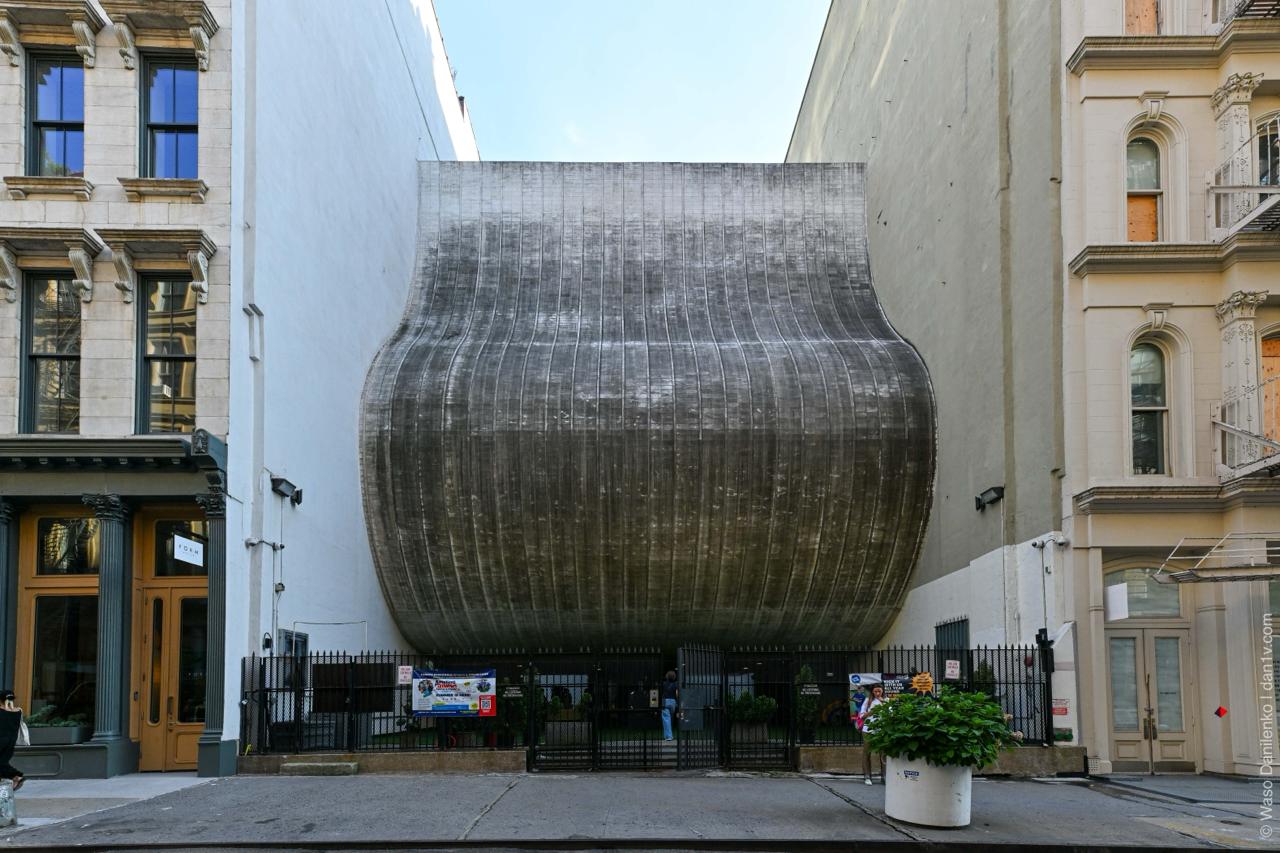
On White Street, in the heart of trendy Tribeca, stands a building that immediately stands out among the red brick lofts of the 19th century. From the street, you can see the white, asymmetrical structure in the spirit of 1960s futurism, but it is not a theater or art center, as might initially appear, but a religious building.
The Tribeca Synagogue is one of New York City’s most unconventional religious buildings, an architectural masterpiece built in 1967 and a vibrant Jewish community that has been in existence for nearly 90 years.
Interesting facts about the Tribeca Synagogue
- The synagogue’s architect, William Breger, studied under Walter Gropius, the founder of the Bauhaus. The influence of the modernist philosophy of “form follows function” is felt in every detail of the building.
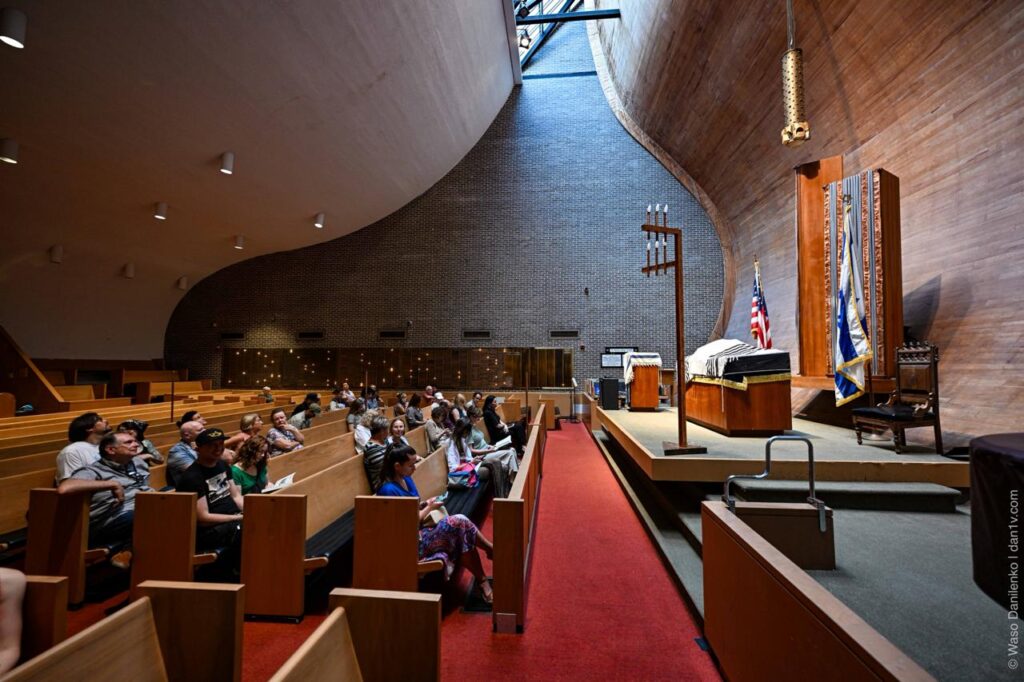
- The auditorium is designed so that voices are heard throughout the auditorium thanks to its acoustics. This is crucial, as the use of microphones on Saturday is prohibited by Sabbath laws.
- The New York Times described the building this way: “Its facade curves like a piano deck, hovering over a small plaza.”
- The synagogue was founded in 1938 as a modest minyan on the top floor above a grocery store. It was created by Jacob Rosenbloom, an assistant to U.S. Attorney Thomas Dewey, for Jewish lawyers and civil servants who had no place to say Kaddish on weekdays.
- In the 1960s and 1970s, up to 2,000 people attended weekday services.
- The synagogue has changed names three times in its history: the Civic Center Synagogue, then the Synagogue for the Arts, and finally, in 2013, the Tribeca Synagogue.
- Musician Moby publicly called it one of his favorite “strange” buildings in New York, comparing its originality only to the Guggenheim Museum.
- Architect William Breger conceived the building as a “floating architecture” — a symbol of Judaism’s unboundedness, its ability to travel through centuries and civilizations.
The Architecture of the Tribeca Synagogue
William N. Breger built numerous retirement homes throughout New York City, but it is the Tribeca Synagogue that truly makes his mark on architectural history.
From the outside, the building stands out against the backdrop of cast-iron facades and brick warehouses of the 19th century, like a smooth concrete wave, devoid of windows and decoration. The curved facade literally hangs over the open entryway, creating the illusion of weightlessness. Breger called this concept “floating architecture,” imbuing it with a theological significance: the Jewish people never completely settled in one land; their culture was always in flux.
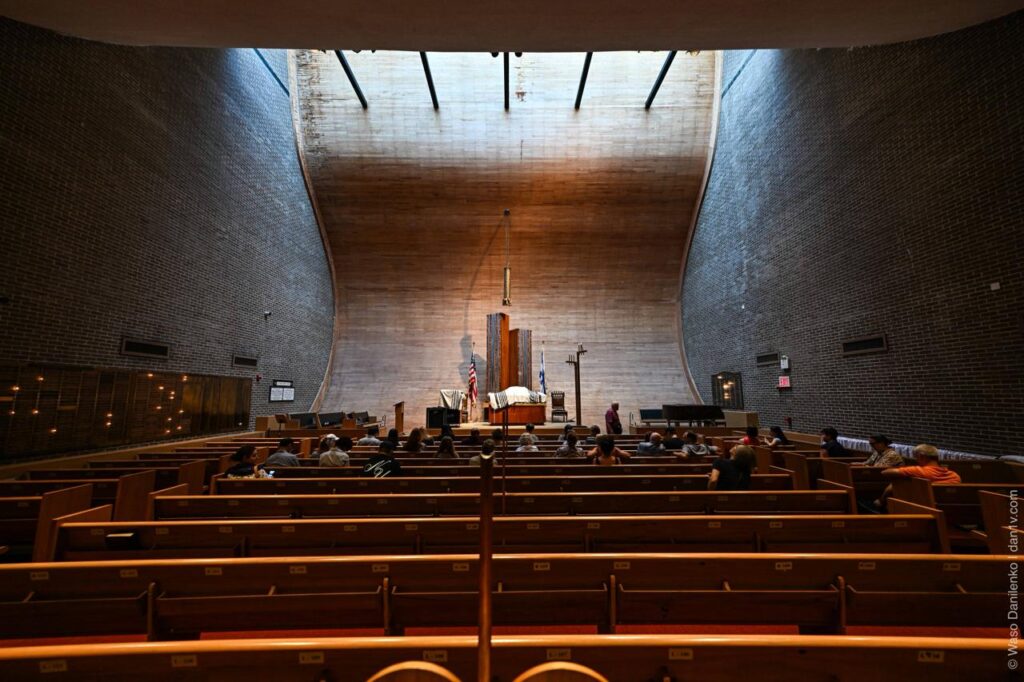
The curves visible from the street are repeated inside the building. It’s as if you’re inside a vase or a seashell. Daylight pours softly from above, creating a unique meditative atmosphere. It’s this geometry that is responsible for the unique acoustics. The curved walls collect and evenly distribute sound, much like the soundboard of a musical instrument. The building’s acoustics allow for services to be held according to all the rules of Orthodox Judaism on Shabbat, without the use of electronics.
A small plaza with sculptures surrounds the building, where visitors can pause before entering. During the period when the synagogue was known as the “Synagogue for the Arts,” a gallery operated inside, and the hall itself was actively used for cultural events. This tradition continues today.
History of the Tribeca Synagogue
In 1938, Jacob J. Rosenbloom, then an assistant to District Attorney Thomas E. Dewey, noticed that thousands of Jews in downtown Manhattan had no place to pray on weekdays. The first services were held in a rented loft above a store and were only open Monday through Friday.
In 1957, the congregation finally acquired its own address — 80 Duane Street. However, just three years later, city officials seized the property for the construction of the Jacob Javits Federal Office Building. As compensation, the synagogue received land at 49 White Street, in what was then an industrial, sparsely populated Tribeca. The project was commissioned to William Bruegger, and the new building opened in 1967.
Attendance peaked in the late 1960s. But the financial crisis of the 1970s hit downtown Manhattan hard: businesses closed, Jewish professionals left for other areas. The synagogue lost a significant portion of its traditional congregation and struggled to make ends meet.
A revival came in 1989 with the arrival of Rabbi Jonathan Glass, a Boston native with a Columbia University degree and ordained at New York’s Mirer Yeshiboth. He founded a Sunday school at the synagogue, expanded its adult education programs, and reimagined the community’s place in the new Tribeca neighborhood, which was by then becoming one of the world’s most fashionable art districts. Under Glass’s leadership, the synagogue was renamed “Synagogue for the Arts,” opened a gallery, and began hosting concerts, exhibitions, and cultural events.
In 2013, the congregation adopted its current name, Tribeca Synagogue, cementing its connection to the neighborhood. Today, it is a fully functioning Orthodox synagogue with daily and holiday services, an active school, a Latin American department, youth programs, and an open door to anyone interested in learning about Jewish culture and traditions.
Tribeca Synagogue Events
The synagogue enjoys a vibrant life far beyond the prayer schedule. Regular events include Shabbat and holiday meals, chamber music concerts, exhibition openings, and lectures on Jewish history and philosophy. The monthly “Meet Me at Tribeca” gathering brings together young Jewish professionals from Lower Manhattan for informal networking.
The synagogue space is available for rent. It hosts mitzvahs (any act of piety or selfless kindness that benefits others and the world), weddings, corporate meetings, concerts, and gala dinners. The social hall seats up to 245 guests, and a professional kosher kitchen can accommodate a full banquet.
Visitors Information
📍Tribeca Synagogue / 49 White Street, Tribeca, Manhattan, NY 10013
Metro: lines A/C/E/J/Z/N/Q/R/W/6, Canal St or Chambers St stations
Website: tribecasynagogue.org
Admission: Free to services
Services: Tue, Wed, Fri — Shacharit (morning prayer). Shabbat and holidays as scheduled