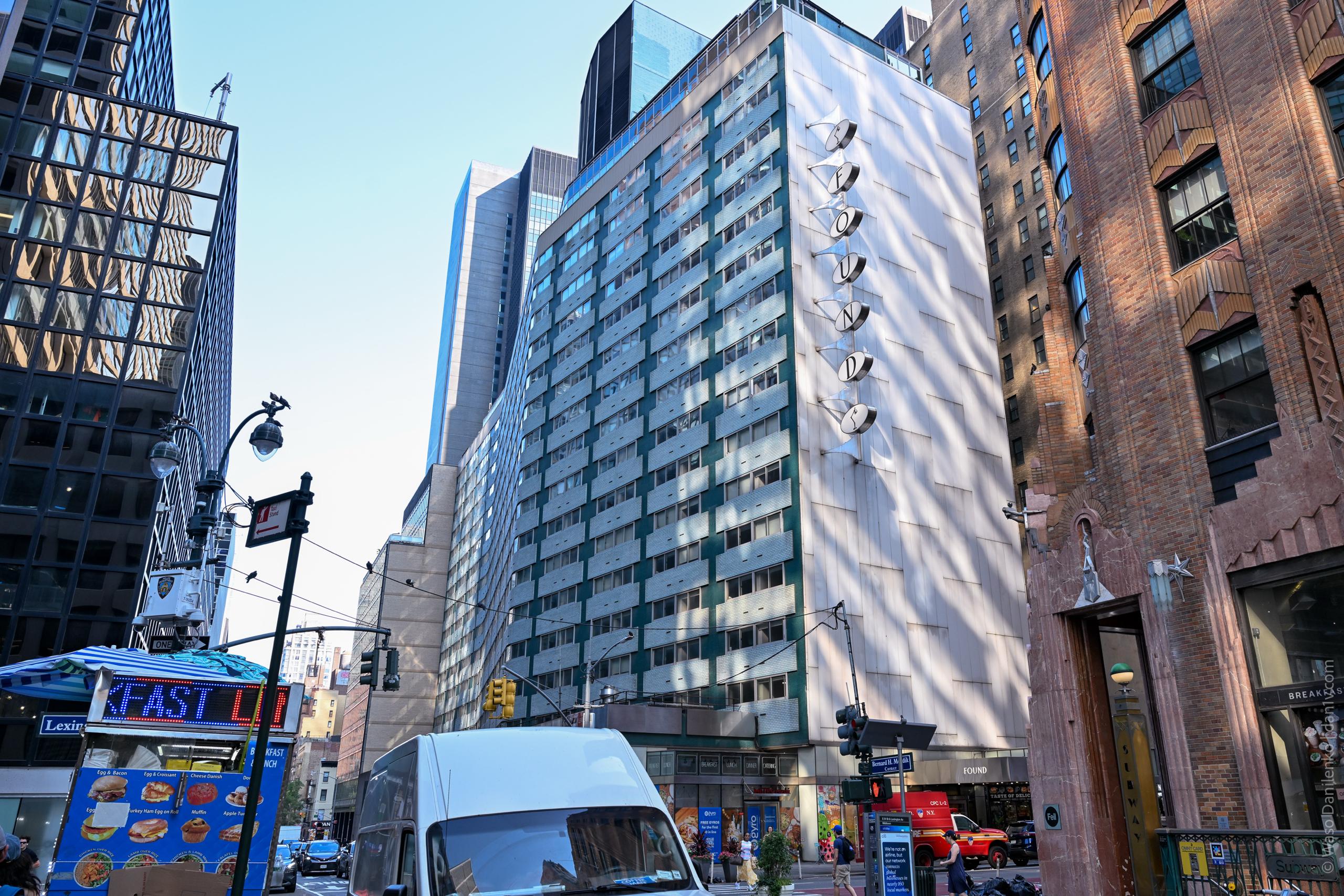
The first time I noticed the FOUND sign in New York, I could not figure out why it looked so familiar.
Then it hit me: I had seen the exact same style in Miami. The sign stayed in the back of my mind for a long time, and about a year later I finally decided to find out the story behind it.
It turns out that the building was originally the Summit Hotel, which opened in 1961. It was the first luxury hotel built in New York since the opening of the Waldorf-Astoria in 1931.

The architect was Morris Lapidus, who was born in Odesa in 1902 into an Orthodox Jewish family. His family emigrated to the United States, he graduated from Columbia University in New York, but it was in Florida that he built his remarkable career.
Lapidus is widely regarded as the king of the Miami Modern (MiMo) style, the postwar architectural movement that gave South Florida its distinctive look. Curved façades, playful forms, and tropical design elements have become inseparable from the image of Miami and Miami Beach. Two of his most famous works are the Fontainebleau Hotel (1954) and the Eden Roc Hotel (1955), both in Miami Beach.
The Summit Hotel became Lapidus’s first major project in New York. Interestingly, he assured reporters that the hotel would not resemble a beach resort. As he put it, “That would be as ridiculous as a girl walking down Fifth Avenue in a bikini.”
Looking at the building today, even from a couple of blocks away, it still feels like a little piece of Miami Beach transported to Midtown Manhattan.
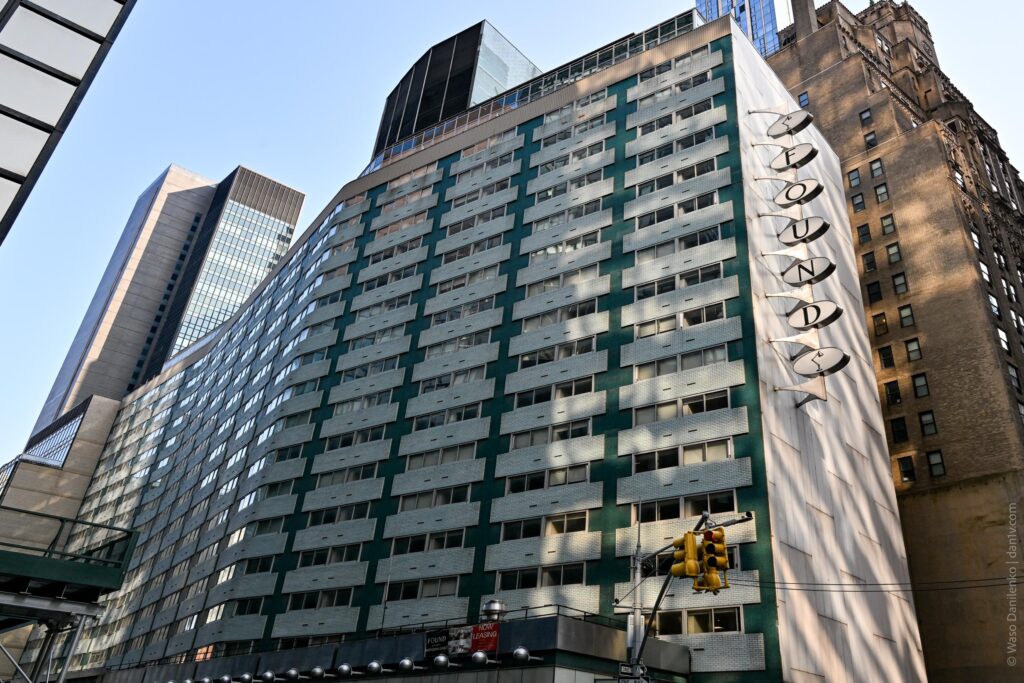
Now imagine New York in the early 1960s. The city was celebrating the clean geometry of Manhattan’s street grid while embracing the restrained elegance of the International Style for its new skyscrapers. Then, right in the middle of all that, appeared a hotel with a wavy façade, playful colors, and unconventional materials. It was a bold statement.
Critics joked that the hotel had been built far too far from the beach, and Lapidus himself later admitted that his creation had become “the most hated hotel in New York.”
Although recognition eventually came — when the building was designated a New York City landmark in 2005—Lapidus’s life could easily be summed up as that of a man with a remarkably complicated fate.
His entire career swung between rejection and triumph, with both arriving decades later than they should have.
He designed some of the most popular hotels in the United States, yet remained an outsider within the architectural profession. One of his fiercest critics was Paul Rudolph, whose own house in New York can now be visited on guided tours.
Interestingly, one of Lapidus’s projects was Trump Village, a residential complex in Coney Island. The “Trump” in its name refers not to Donald Trump but to his father, Fred Trump. The seven-building development is often credited with marking the point at which the Trump family’s real estate business truly took off.
The architect’s turbulent career was mirrored by the fate of the building itself. The Summit Hotel became the Loews New York Hotel in 1991, the Metropolitan Hotel in 2000, and the DoubleTree Metropolitan in 2005, before finally closing during the pandemic in 2020.
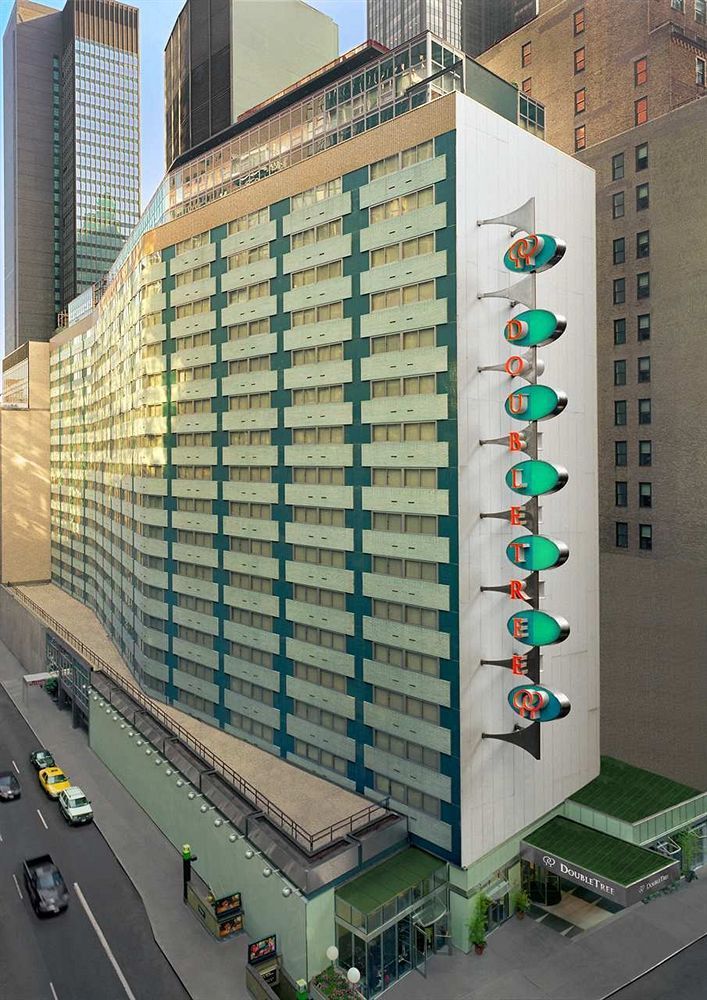
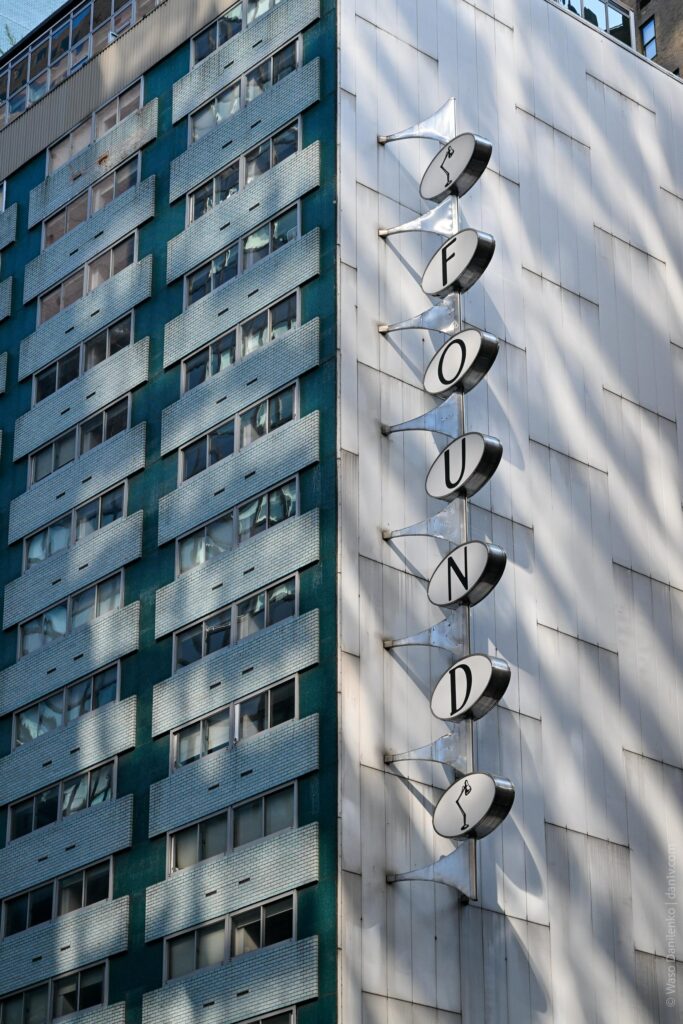
In 2022, the property was purchased and converted into Found Study, a student residence. That is why the old circular sign now carries new letters: (THE) (S) (U) (M) (M) (I) (T) became (F) (O) (U) (N) (D).
📍 Found Study / FOUND Study Midtown East, 569 Lexington Ave, New York, NY 10022