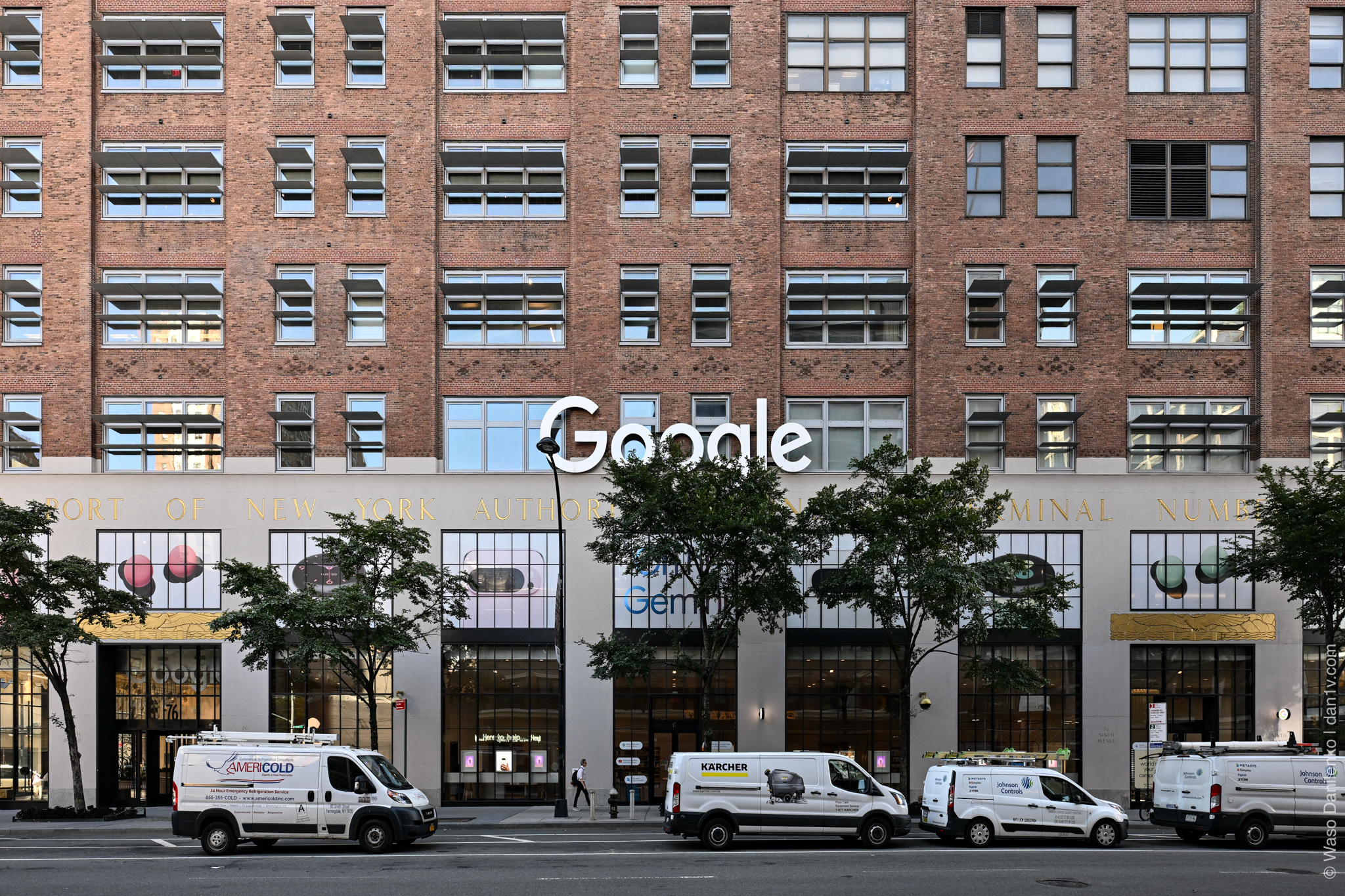
There are buildings in New York that millions of people walk past without even looking at them. Google’s New York headquarters, the Port Authority Building at 111 Eighth Avenue, is a good example. It looks like a giant Art Deco brick. Inside, however, is one of the main physical internet hubs on the East Coast.
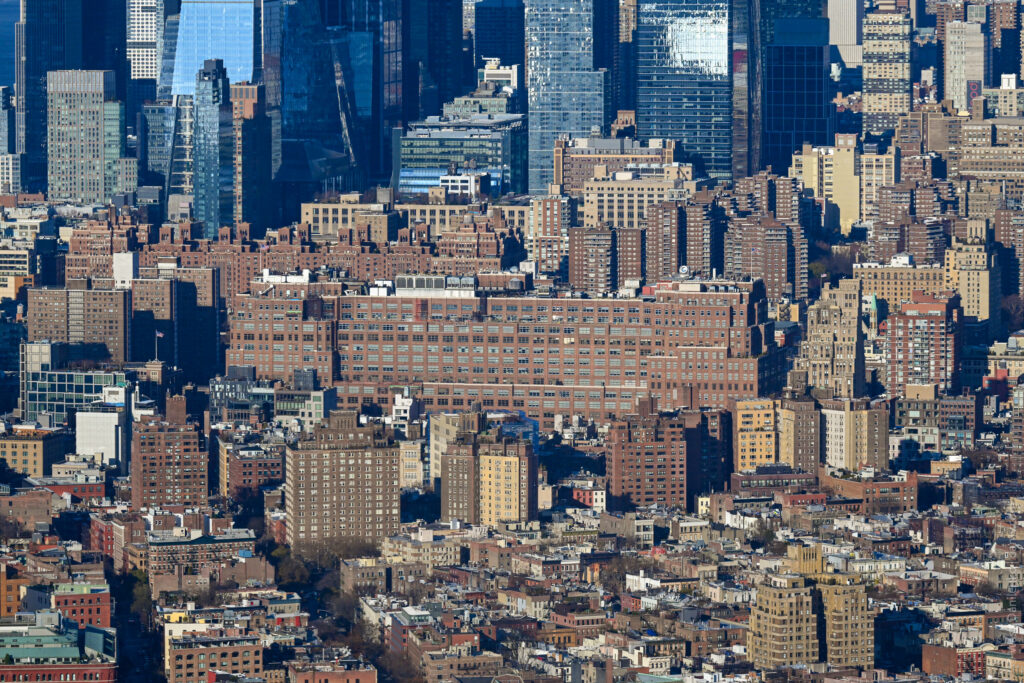
111 Eighth Avenue was built in 1932 by the Port Authority of New York and New Jersey as Union Inland Terminal No. 1, an inland freight terminal. It occupies an entire city block and measures 63 × 244 meters. When it opened, it was the largest building in New York City by floor area, larger than the Empire State Building. Since the late 1990s, it has been one of the world’s major carrier hotels, and since 2010, it has been entirely owned by Google.
Interesting Facts About Google’s Building at 111 Eighth Avenue
- Google bought the building, one of the largest in all of New York City, in 2010 for nearly $2 billion, making it one of the most expensive real estate deals for a single building in United States history at the time.
- The building occupies an entire city block, stretching from Eighth Avenue to Ninth Avenue and from 15th Street to 16th Street. According to the city’s property records, the lot measures 63 × 244 meters.
- The building has its own private entrance to the subway.
- The roof offers beautiful views of both Downtown and Midtown Manhattan, not to mention the Meatpacking District.
- There are free scooters inside the building, making it easier and faster to get around the floors.
- Equinix, Digital Realty, DataBank, Lumen, Telia, and four internet exchange points, including DE-CIX New York, are located inside the building.
- The office has a food court with many different cuisines and dining options.
- You cannot enter the building. It is a private office and data center, and there are no tours.
- The building has had several names over the years, and the confusion itself tells part of its history: Union Inland Freight Station No. 1 / Union Inland Terminal No. 1 was its official name when it opened in 1932; Port Authority Commerce Building was the name used in 1933; Port Authority Building has been used since the 1940s, when the Port Authority established its headquarters there; 111 Eighth Avenue is the neutral address-based name; and “Google Building” is what people in Chelsea have called it for the past fifteen years.
Freight Post Office at 111 Eighth Avenue
To understand why this enormous building was built in the first place, you have to picture Manhattan in the 1920s. All the port’s freight traffic moved through the piers along the Hudson, and each railroad had its own warehouses and trucks driving through the narrow streets of the West Side. The Port Authority proposed a solution: one central building farther inland where all the railroads could bring small shipments, sort them under one roof, and then send them out in fully loaded trucks.
The people behind the idea called it a “freight post office.” Roosevelt put it even more precisely in his welcoming message for the opening in September 1932, calling it a “postal service for merchandise.”
Trucks entered from 15th Street. The freight was lifted to the appropriate floor, sorted, lowered, and then sent out from the 16th Street side. The system worked remarkably well. A record from May 25, 1936, has survived: 250 trucks entered the building, while only 37 left. Eighty-five percent of the trucks simply disappeared from the city streets.
Freight was moved between floors not by ramps, but by four freight elevators large enough for an entire truck to drive inside. Each had a 17 × 34-foot platform and a lifting capacity of 18 tons.
On January 6, 1933, the Port Authority invited 50 people to dinner — right inside one of the freight elevators, simply to demonstrate how enormous they were. The headline in The New York Times literally read: “50 Invited to Dinner in Elevator.”
Incidentally, this was “Terminal No. 1,” the first in a planned series of three. The other two were never built: first the Great Depression intervened, and later the concept itself became outdated. As a result, the building is the only physical reminder of an entire urban planning concept that never came to fruition.
The most common mistake in articles about this building is to assume that because Chelsea Market is nearby and the High Line physically runs through it, trains must have entered 111 Eighth Avenue as well. They did not. There were never any railroad tracks inside this building.
The High Line runs several blocks to the west, around Tenth and Eleventh Avenues, while the whole point of an “inland terminal” was that it was not located on a railroad. Freight was brought there from the piers by trucks. The building where railroad tracks actually entered the structure was the Starrett-Lehigh Building, ten blocks to the north. It had its own famous freight elevators, which were known as “vertical streets.”
Architecture of the Port Authority Building at 111 Eighth Avenue
The building was designed by architect Lusby Simpson, who also worked on Bryant Park, at the firm Abbott, Merkt & Co., which specialized in industrial buildings. A fun fact: immediately after this building was completed in 1933, he won a competition to redesign Bryant Park — the same lawn and plane trees you see today were designed by the same person who created Manhattan’s most brutalist-looking warehouse.
All Manhattan skyscrapers built in the 1920s and 1930s taper upward in a series of setbacks. This was required by the 1916 Zoning Resolution, which mandated setbacks so that sunlight could reach the streets. But 111 Eighth Avenue was legally classified as a warehouse and therefore avoided most of these requirements. That is why it stands as a massive monolithic block, filling the entire site.
A recurring seagull motif is scattered across the facade, and above one of the entrances, a seagull holds a fasces in its claws — a bundle of rods with an axe from ancient Rome. In American architecture of the early 1930s, this was a symbol of civic unity. A similar motif can be found on the United States Supreme Court Building.
History of Google’s Building at 111 Eighth Avenue: How a Warehouse Became a Major Internet Hub
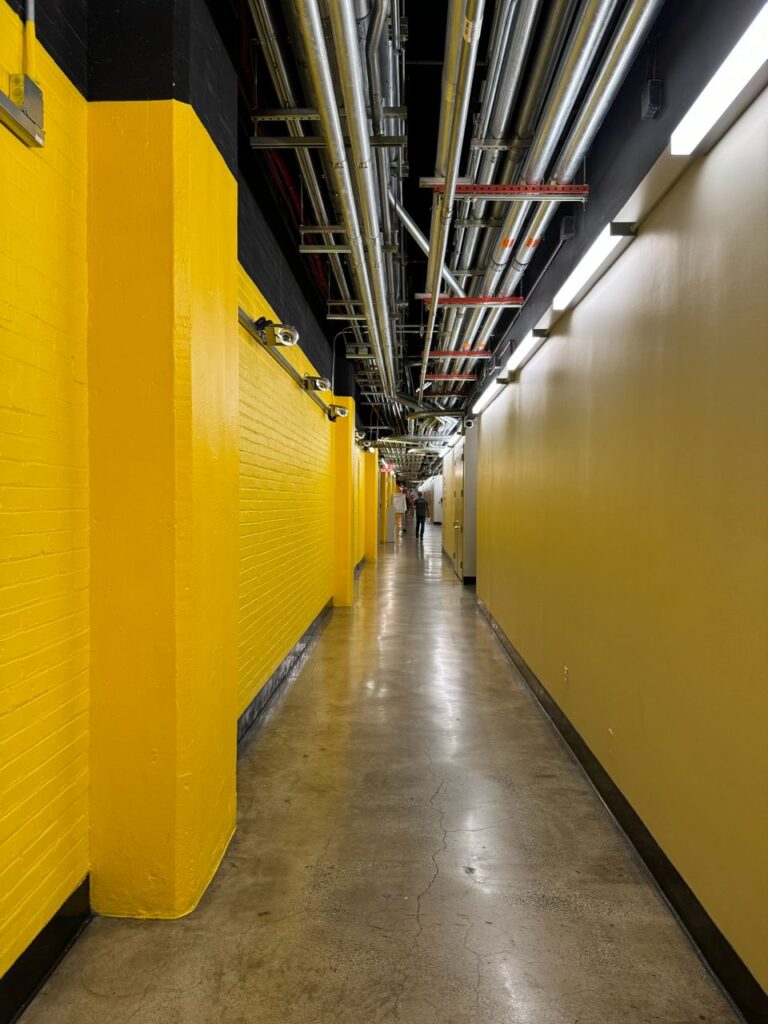
In 1998, the building was purchased by Taconic Investment Partners, and from day one, the company was targeting telecommunications rather than traditional office space. It turned out that a building designed to move tons of steel vertically was an ideal data center: the floors were engineered for industrial loads, the ceilings are 4.4 meters high, the floors are open spaces of 15,300 square meters without a single partition, and the freight elevators can lift a 15-ton generator to the twelfth floor — something that would be physically impossible in an ordinary office skyscraper.
A “carrier hotel” is a building where the networks of different telecommunications operators physically meet, in dedicated rooms known as meet-me rooms. The more operators already located in a building, the more attractive it becomes for the next one to move in — a classic network effect. Today, 111 Eighth Avenue is home to Equinix, Digital Realty, DataBank, Lumen, Telia, and four internet exchange points. In September 2025, the building’s data center even deployed a quantum computer in collaboration with Nvidia.
On August 14, 2003, during the famous blackout that affected the northeastern United States, the building stayed operational thanks to an underground fuel tank and 37 generators. This story is repeated in virtually every article about the building, and it is perhaps the best illustration of what Taconic invested its $50 million modernization budget in.
Google first appeared here in the mid-2000s as an ordinary tenant, and by the end of 2010, it occupied approximately 500,000 square feet. Instead of continuing to lease space, the company decided to buy the entire building. The deal was announced on December 22, 2010, and the figures still vary: contemporary press reports put the price at $1.8–1.9 billion, while industry publications later settled on $1.77 billion, or approximately $610 per square foot. Google itself never confirmed the amount.
Everyone immediately assumed that Google had bought itself an internet hub. Larry Page personally denied this: the main reason was office space, not telecommunications infrastructure. The logic is actually quite simple — Google needed enormous, uninterrupted floor plates because a typical Manhattan skyscraper was too cramped for its working model.
You cannot, of course, go inside — it is a private office and data center with no public tours. But inside there are five cafés with free food, the Google Commons atrium with green walls over exposed concrete, meeting rooms themed around Broadway musicals and subway stations, and employees ride scooters between floors.
Visitor’s Information
📍Port Authority Building / 111 Eighth Avenue, New York, NY 10011
You cannot enter the building. The best way to see it is to walk around the entire block: the main facade is on Eighth Avenue, while the 15th and 16th Street sides still have the original loading dock openings and service entrances. Look for the granite base, the limestone cladding on the lower floors, and, of course, the seagulls.
The 14th Street / Eighth Avenue subway station is located directly beneath the building. It is home to one of the best examples of public art in the New York City subway: Tom Otterness’s Life Underground, with more than one hundred bronze figures scattered throughout the station.
Across the street, at 76 Ninth Avenue, is Google Store Chelsea. Nearby are Chelsea Market, the High Line, and Pier 57, which has one of the best rooftop spots in the neighborhood for watching the sunset. Together with the building, they make an excellent half-day itinerary through West Chelsea.