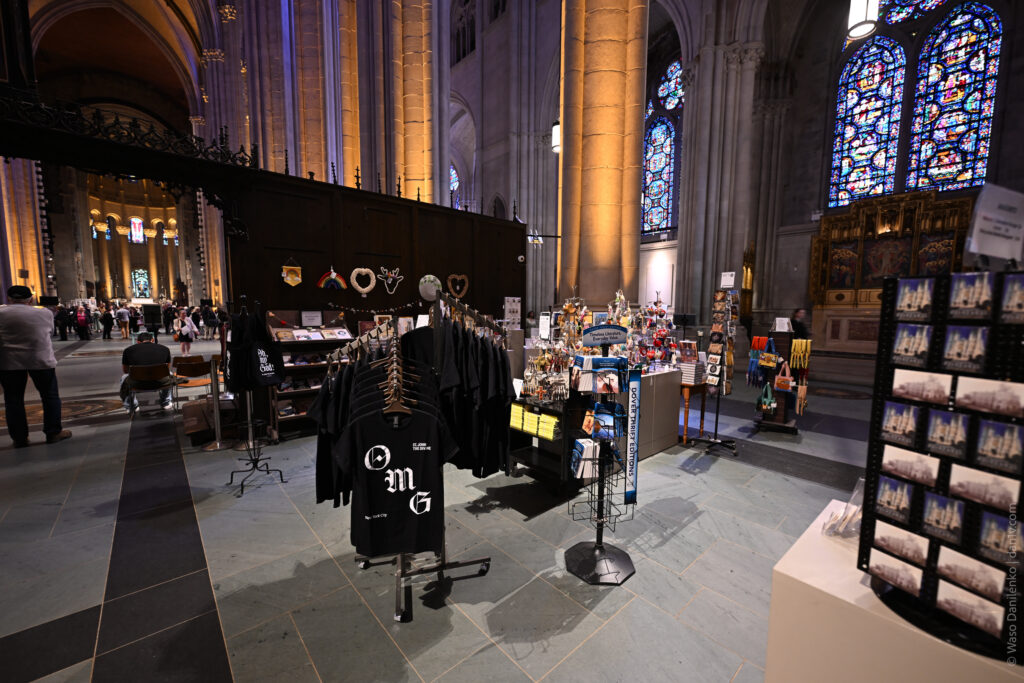
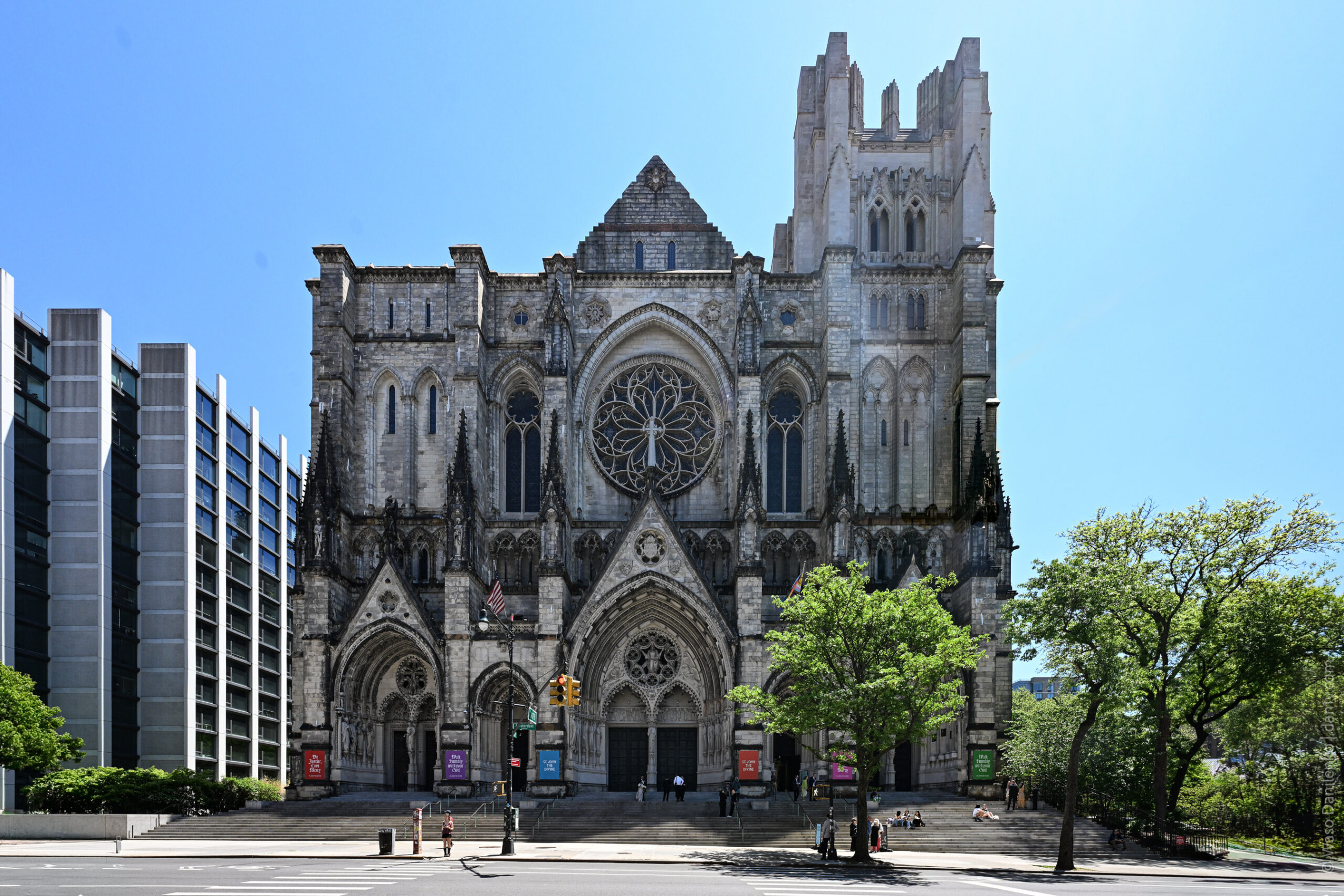
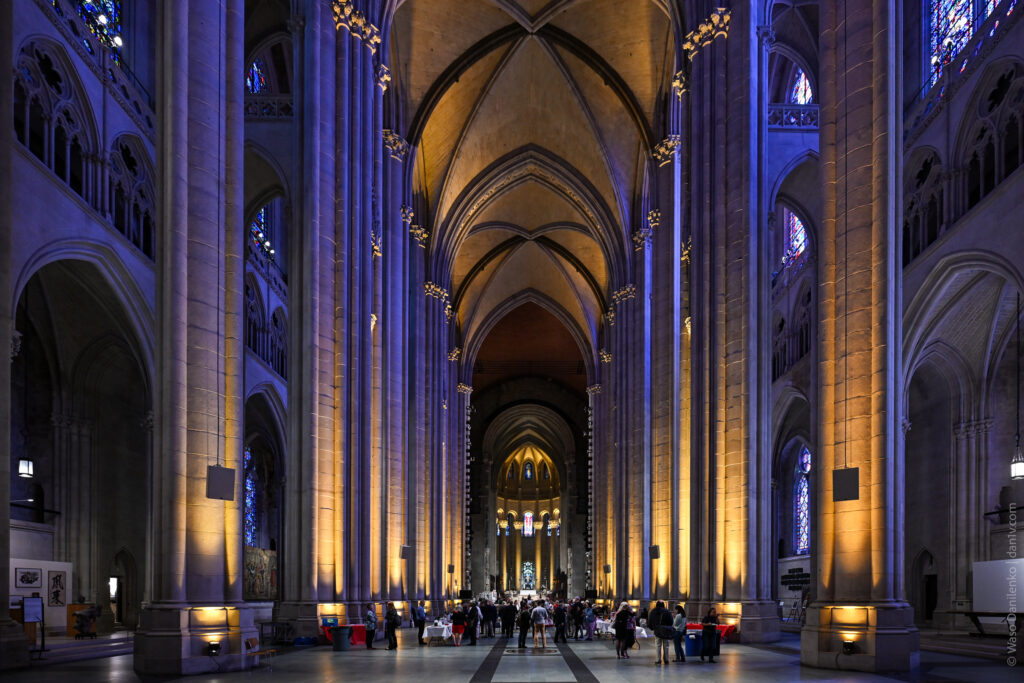
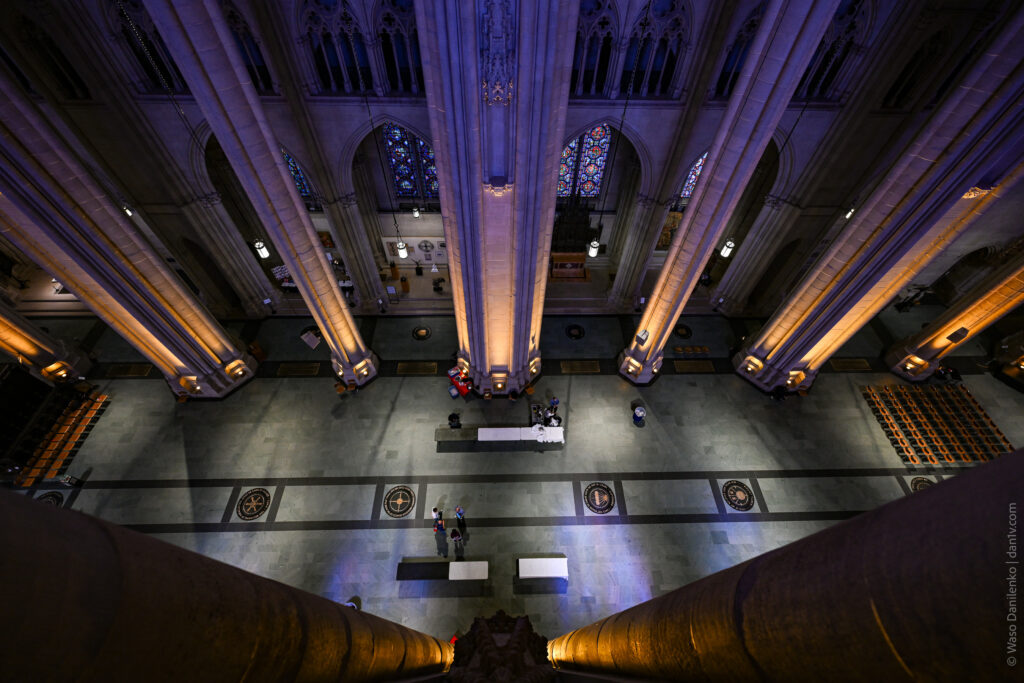
The Cathedral of St. John the Divine on Amsterdam Avenue is the largest church in North America and the sixth largest in the world. It is 183 meters long, the central nave is 38 meters high, and its floor area is over 11,000 square meters. It has stood in Morningside Heights since 1892, yet it remains unfinished, earning it’s nickname “St. John the Unfinished.” Construction began 133 years ago, and by some estimates, it will take just as long.
On the exterior, the main façade depicts New York City’s sinking: the Brooklyn Bridge snapped in two, the Twin Towers falling, the Statue of Liberty sinking. Above it all, a mushroom cloud. Inside, the cathedral contains 8,035 organ pipes, Keith Haring’s white gold vice, and a 17-meter-tall temporary dome large enough to accommodate a full-size Statue of Liberty. And two peacocks walking in the courtyard.
Key Facts About the Cathedral of St. John the Divine
- The Cathedral of St. John the Divine is the largest Gothic cathedral in the world (a church that serves as the seat of a bishop). By both length and interior volume, it ranks among the six largest church buildings in the world.
- Length: 600 feet (183 m) from the main entrance to the eastern apse.
- Floor Area: Approximately 121,000 square feet (11,240 sq m).
- Height of the Central Nave: 125 feet (38 m).
- Construction began on December 27, 1892 (the Feast of St. John) and continues to this day. The two tower spires remain unfinished.
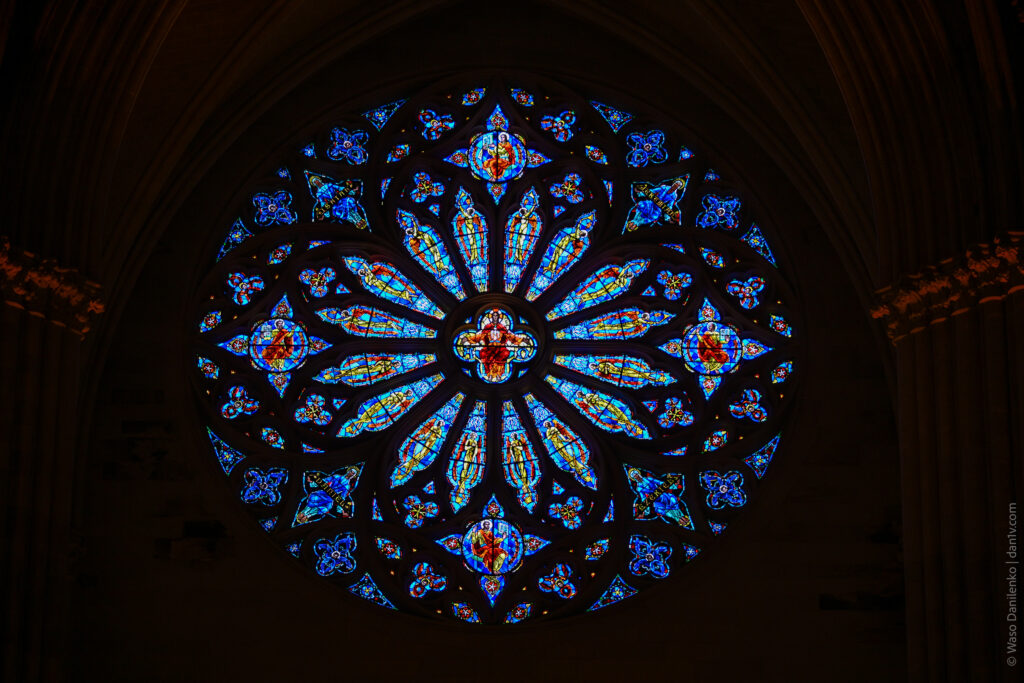
- The cathedral features a 40-foot-diameter rose window, the third largest in the world, composed of approximately 10,000 pieces of stained glass.
- The Great Organ, with 8,035 pipes and 141 stops, is one of the most powerful church organs in the world.
- The Cathedral of St. John the Divine occupies an 11-acre site — an extraordinary amount of space in Manhattan.
- The campus includes its own school, community kitchen and dining hall, several chapels, gardens, a sculpture park, and residential buildings for clergy.
- More than 25,000 free meals are served annually to people in need on the cathedral grounds.
Why is the Cathedral of St. John the Divine the largest, not St. Peter’s?
This is the first question that arises for anyone who hears about the “largest cathedral in the world.” What about Rome?
St. Peter’s Basilica in the Vatican is a basilica, not a cathedral. A cathedral is a church that houses the seat of a bishop. St. Peter’s Basilica does not have a permanent bishop’s see, so it is not officially a cathedral. The cathedral church in Rome is San Giovanni in Laterano, which is considerably smaller.
St. John the Evangelist is indeed a cathedral: the bishop’s chair stands in the sanctuary. Therefore, according to classification rules, it is the largest cathedral of its type in the world. In terms of total interior volume, it ranks in the top five or six in any classification, including basilicas.
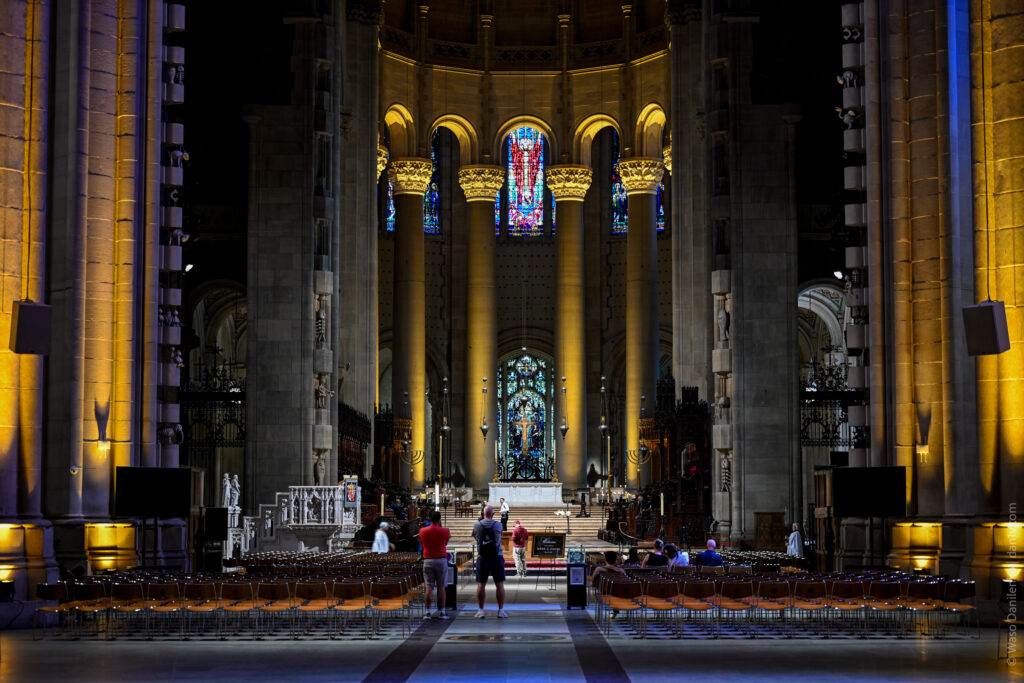
The Architecture of the Cathedral of St. John the Divine
The Cathedral of St. John the Divine’s main architectural feature is that it is two distinct buildings in one. The western and eastern ends of the cathedral were built in fundamentally different styles by different architects, several decades apart. The seam between them is visible to the naked eye.
Romano-Byzantine Apse in the East
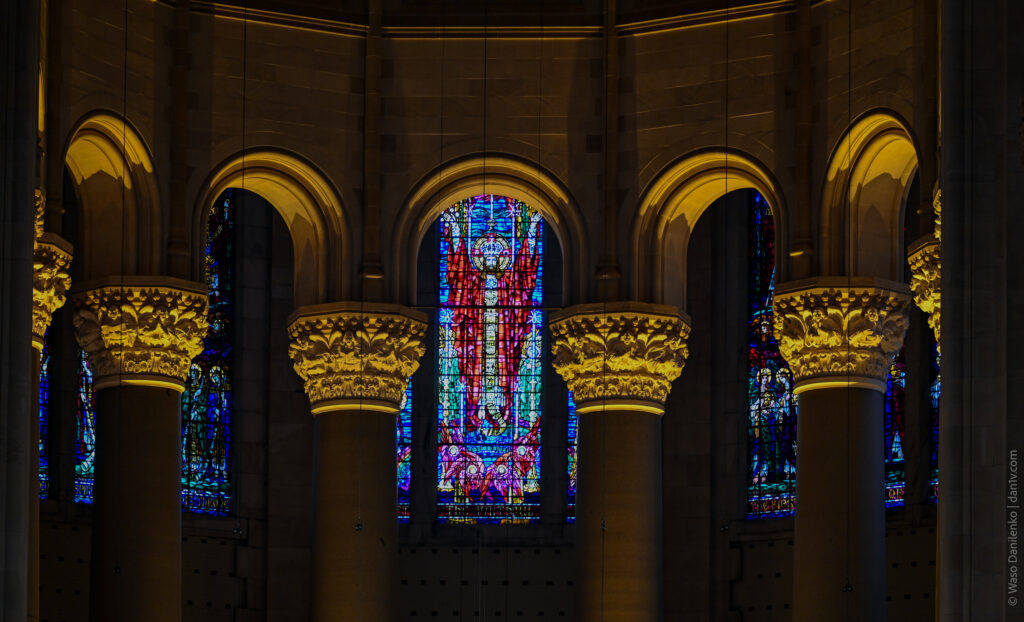
Architects Hines and LaFarge designed the eastern section: the apse with seven chapels, the choir, the transept, and the supporting drums of the main dome. These features include thick walls, rounded arches, and heavy granite columns brought from Maine on a specially equipped barge. Each column was so heavy that transporting one took about a year.
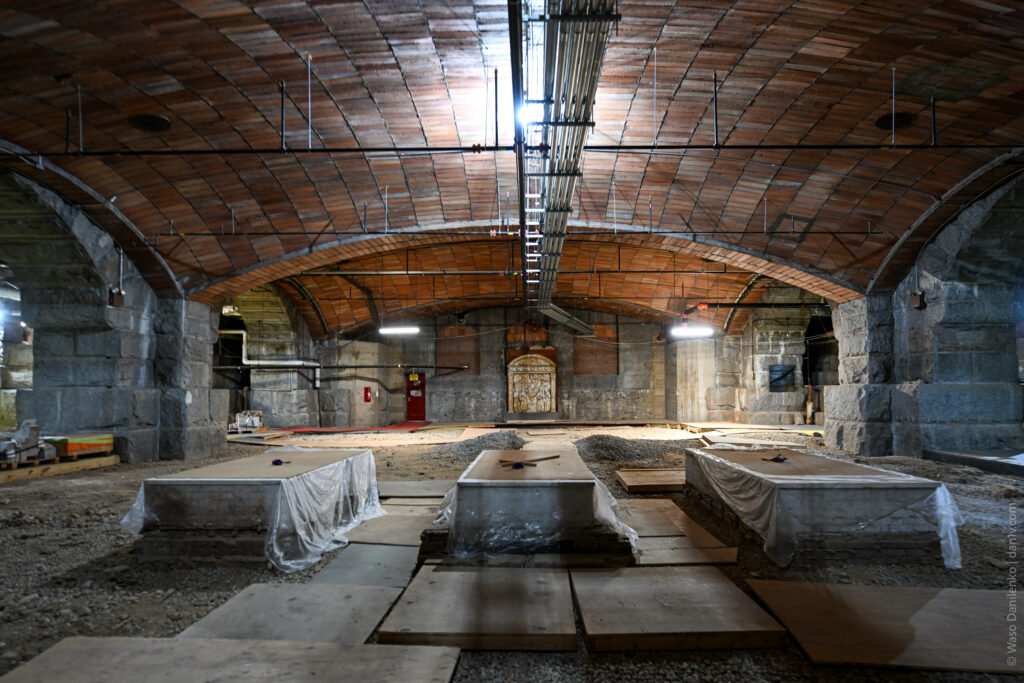
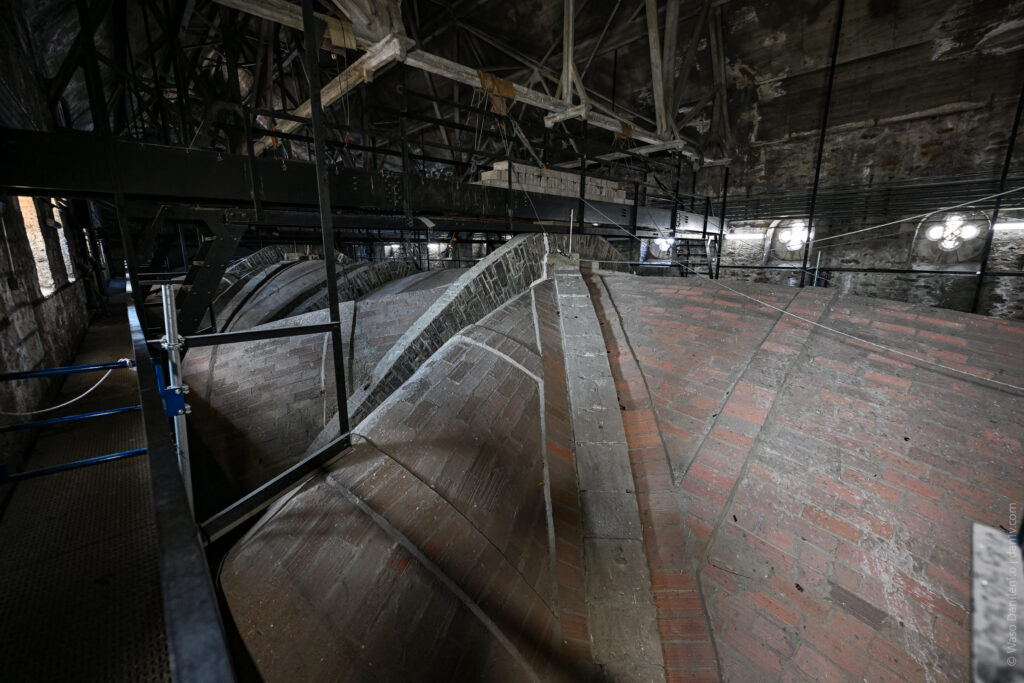
Also visible are the vaults of Guastavino, a Spanish architect who worked in New York in the late 19th century and left his mark on many of the city’s buildings, including Grand Central. The Guastavino dome over the nave and transept has been “temporary” for over a hundred years — it was installed as an interim solution until a permanent structure was built, but the permanent structure was never completed.
Seven chapels radiate from the apse, each dedicated to a saint in its own architectural style. Hines and LaFarge conceived them in 1892, the same year Ellis Island opened, ushering in a wave of European immigrants to America. The seven chapels were intended to be architectural tributes to each of New York City’s seven largest immigrant groups. They are arranged geographically from south to north:
- St. James Chapel — Spanish style. Stained glass features works by Cervantes, Saint Teresa of Avila, and El Greco.
- St. Ambrose Chapel — Italian style.
- St. Martin of Tours Chapel — French style. Designated for private prayer.
- St. Savior’s Chapel — Eastern Mediterranean style, dedicated to Eastern Christians. The first to be built, 1904. It houses a triptych by Keith Haring and the sculpture “Christa.”
- St. Columba’s Chapel — British style.
- St. Boniface’s Chapel — German style. Used for temporary art exhibitions.
- St. Ansgar’s Chapel — Scandinavian style. Nearby is a baptistery donated by the descendants of Pieter Stuyvesant, the last Dutch governor of New Amsterdam.
The cathedral's Mission Chapel houses a memorial to three genocides: the Armenian (1915–1923), the Jewish Holocaust (1939–1945), and the Bosnian genocide (since 1992).
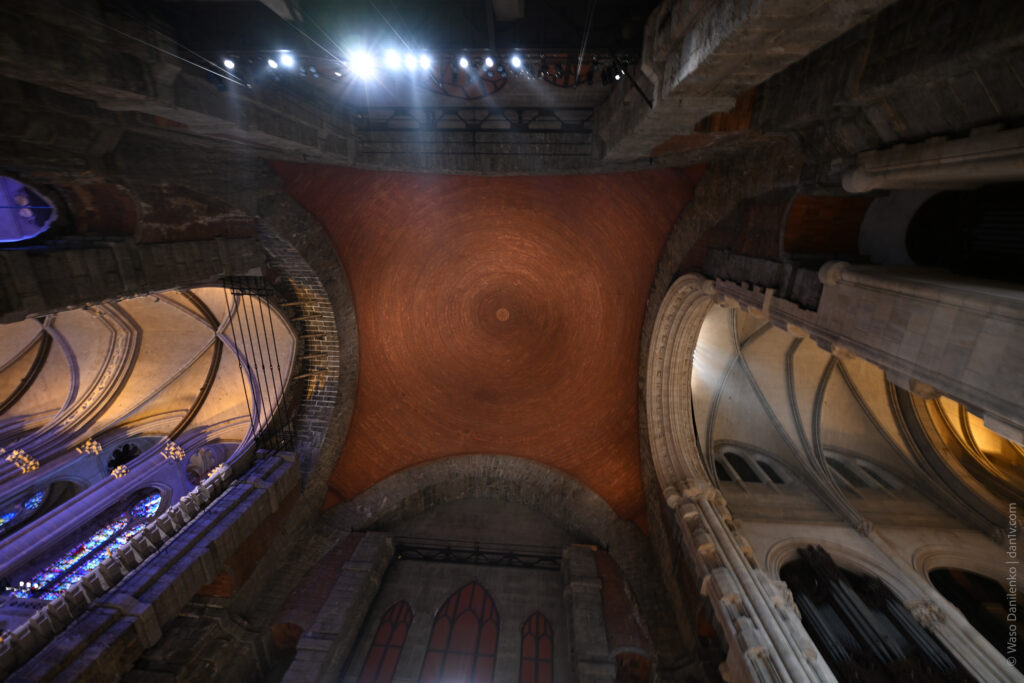
Gothic and Apocalypse in the West
Architect Ralph Adams Cram of the Boston firm Cram, Goodhue & Ferguson was a proponent of the Gothic style and considered the Romano-Byzantine style incompatible with the cathedral’s concept. He redesigned the western portion — the nave, west facade, and towers — in a pure Gothic style: pointed arches, vertical aspiration, and lacy stone carvings.
Construction of the Gothic nave proceeded intermittently: funds ran out, and world wars began. On November 30, 1941, the full length of the nave was completed and dedicated. A week later, the Japanese attacked Pearl Harbor, and construction was halted again, this time for the remainder of the war.
The cathedral’s west facade features two towers, which were intended to rise to a height of approximately 70 meters. One of them, the southern one, was begun in 1982 and reached approximately two-thirds of its planned height, after which the funds ran out. The south tower literally breaks off mid-sentence. The north tower is unstarted. If you stand in front of the main façade and look up, the difference in the age of the stone is visible to the naked eye: the lower part, built in the early 20th century, has darkened and developed a patina. The upper part of the south tower, completed in the 1980s, is light, almost white.
The main portal of the western façade is called the Portal of Paradise. It is the youngest part of the cathedral’s entire sculptural program: it was carved by the British master Simon Verity together with Jean-Claude Marchionni from 1988 to 1997.
The center of the tympanum above the doors is Christ. Below him is St. John the Evangelist himself, holding a quill and a scroll. On the sides are eight-foot-tall figures of prophets and apostles, executed in the Gothic style. On the plinths beneath the prophets’ feet are a series of reliefs depicting the Apocalypse in New York City in the 1990s:
- New York City skyscrapers collapse under a nuclear mushroom cloud.
- The Brooklyn Bridge breaks in half; buses and cars fall into the water.
- The Twin Towers and the Chrysler Building lean over.
- The Statue of Liberty sinks into the sea.
- Against the backdrop of the New York Stock Exchange are skeletons, snakes, and scorpions.
- Huge waves wash over the city.
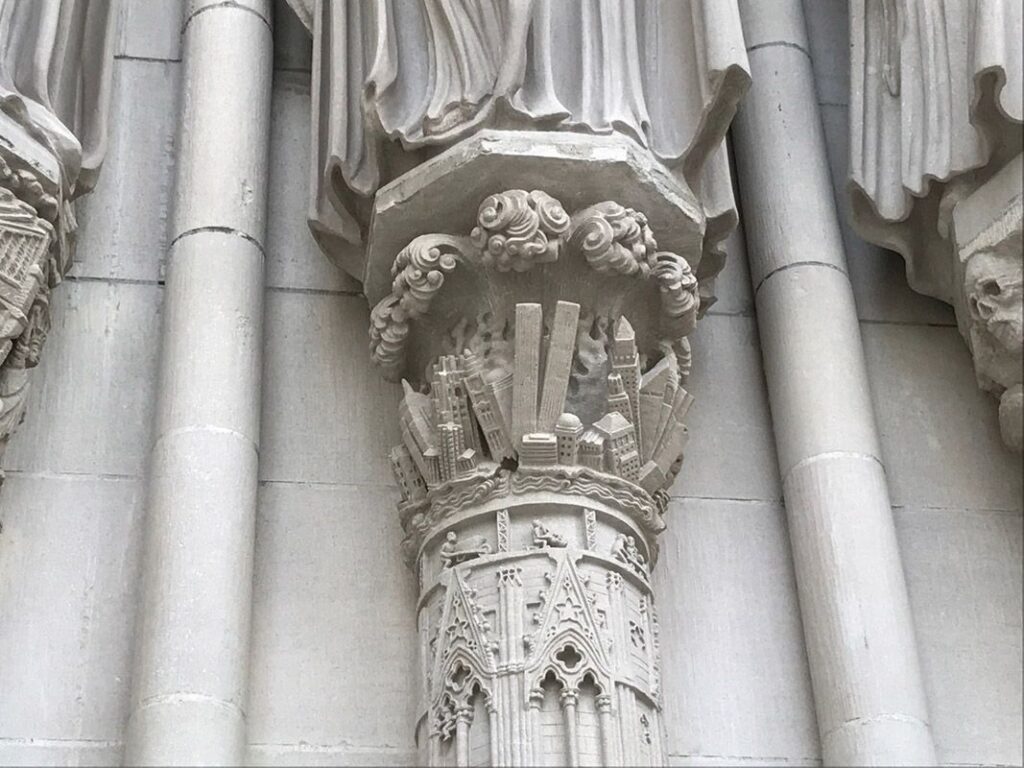
Beneath this scene of destruction lies another scene: resurrection and construction. Masons are erecting a new cathedral on the ruins, just as Nehemiah built the Second Temple on the site of the destroyed Temple of Solomon.
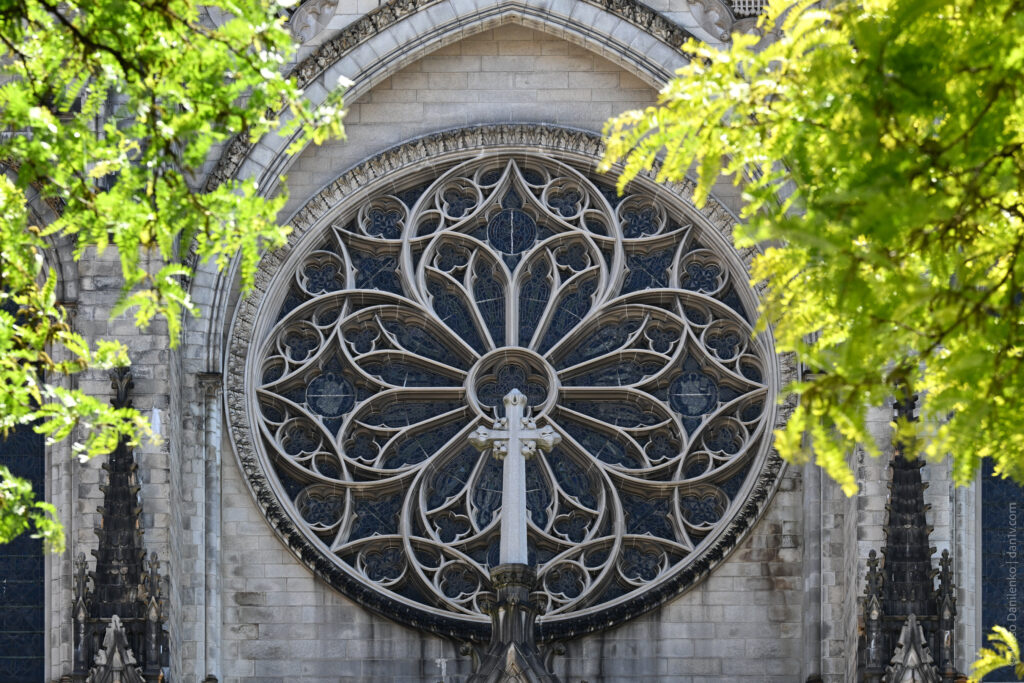
On the western wall above the main entrance is the Great Rose Window, created by master stained glass artist Charles Connick. It contains over 10,000 glass fragments assembled using a medieval technique — each fragment is hand-set into a lead frame.
In the center is Christ, surrounded by prophets of the Old and New Testaments and sixteen angels. Below the main rose window is the Small Rose Window, shaped like a seven-pointed star with a Christogram at its center.
The Great Organ
The Great Organ of the Cathedral of St. John the Divine is one of the most powerful instruments in the world. The first organ was installed in 1911 by the Ernest M. Skinner Company. In 1954, it was expanded to its current 8,035 pipes in 141 stops.
When the organ is playing at full volume during Sunday services, its sound literally vibrates in your ribs, meaning the physical pressure of the sound is felt by your body.
Art in the Cathedral of St. John the Divine
Keith Haring’s Triptych
In the Chapel of the Savior (St. Savior) is a triptych of bronze covered in white gold, titled “The Life of Christ.” It was completed in 1990 by Keith Haring, one of the leading artists of New York street culture in the 1980s. It was Haring’s final work: he completed it just weeks before his death from AIDS on February 16, 1990. A memorial service for Haring was held in the cathedral.
The triptych is executed in Haring’s signature style: angular figures in motion, outstretched hands, and angels. At the center is his famous “Luminous Child,” held in hands as a metaphor for the Christ Child.
Christa
Since 2016, the same Chapel of the Savior has housed the bronze sculpture “Christa.” It is a female figure of Christ on a cross made of Lucite, a work by artist Edwina Sandys, created in 1974.
The sculpture first appeared in the cathedral in 1984 during Holy Week. It was removed early due to protests from some parishioners. In 2016, “Christa” returned to its permanent location. The cathedral describes it as “an exploration of the symbolism of the image of Christ and God manifested in each person.”
Memorial to September 11
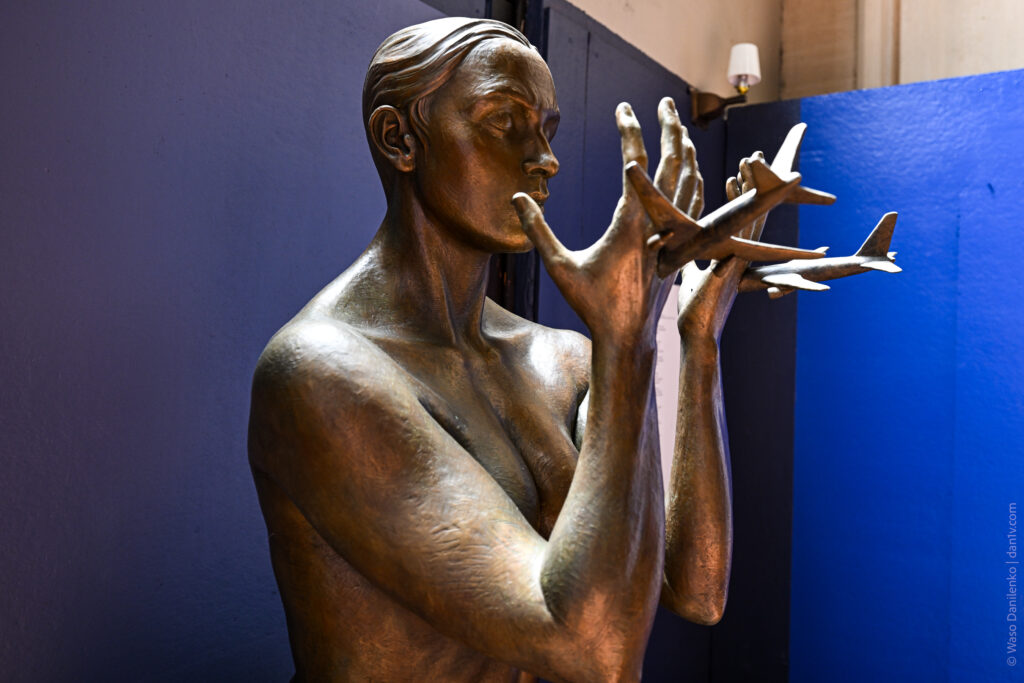
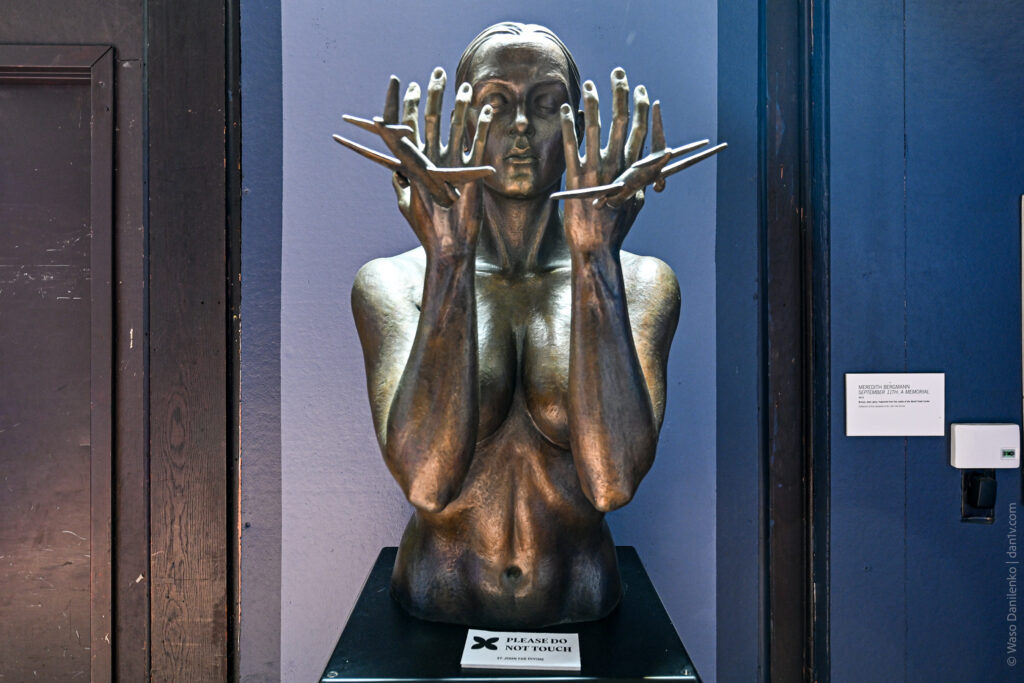
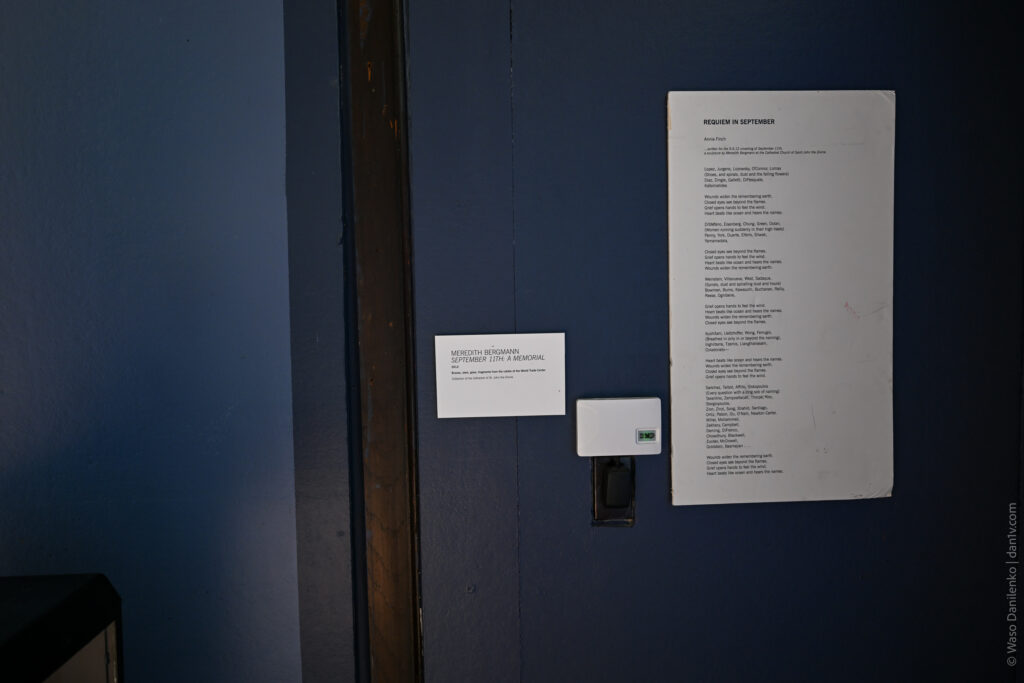
The Cathedral of St. John the Divine houses one of the lesser-known memorials dedicated to the tragedy of September 11, 2001. It is a monumental bronze sculpture, “Memorial to September 11,” created by American sculptor Meredith Bergmann. It was installed in the cathedral in 2012 and remains there permanently.
The sculpture depicts a young naked woman with closed eyes. Her hands are raised in front of her face in a gesture that simultaneously suggests protection and prayer. According to the artist, the female figure symbolizes New York City itself — a strong, vulnerable, and at the same time resilient city that survived the catastrophe.
The creation of the monument began just days after the terrorist attacks. Bergmann, who was in New York and witnessing the aftermath of the tragedy, created a small model of the future composition. The cathedral later commissioned a larger version. Fragments of the World Trade Center debris, stored on the cathedral grounds after the attacks, were placed at the base of the monument. Thus, the pedestal became a kind of reliquary, containing the actual remains of the destroyed towers.
The artist noted that while working on the image, she was inspired by Christian themes, particularly images of Saint Sebastian and Saint Francis. She sought to convey not only the pain and destruction, but also the spiritual awakening that many Americans experienced after the events of September 11th.
17th-Century Barberini Tapestries
Tapestries from the Barberini workshop, one of Rome’s most important weaving workshops in the 17th century, which worked for the Vatican, are hung throughout the cathedral. Two tapestries were damaged in a fire in 2001; their multi-year restoration became one of the most labor-intensive conservation projects in the cathedral’s history.
Japanese Vases
Two large Japanese vases in the nave were a gift from the Japanese ambassador, Tsuneo Matsudaira, in 1926. They depict hibiscus flowers and Japanese birds.
Sculptures by Tom Otterness
Since 2015, the cathedral has housed works by American sculptor Tom Otterness. Dozens of small bronze figures — playful, sometimes satirical — are hidden in column niches throughout the nave. They must be found, making it feel like an interactive quest that no one advertises.
American Poets’ Corner
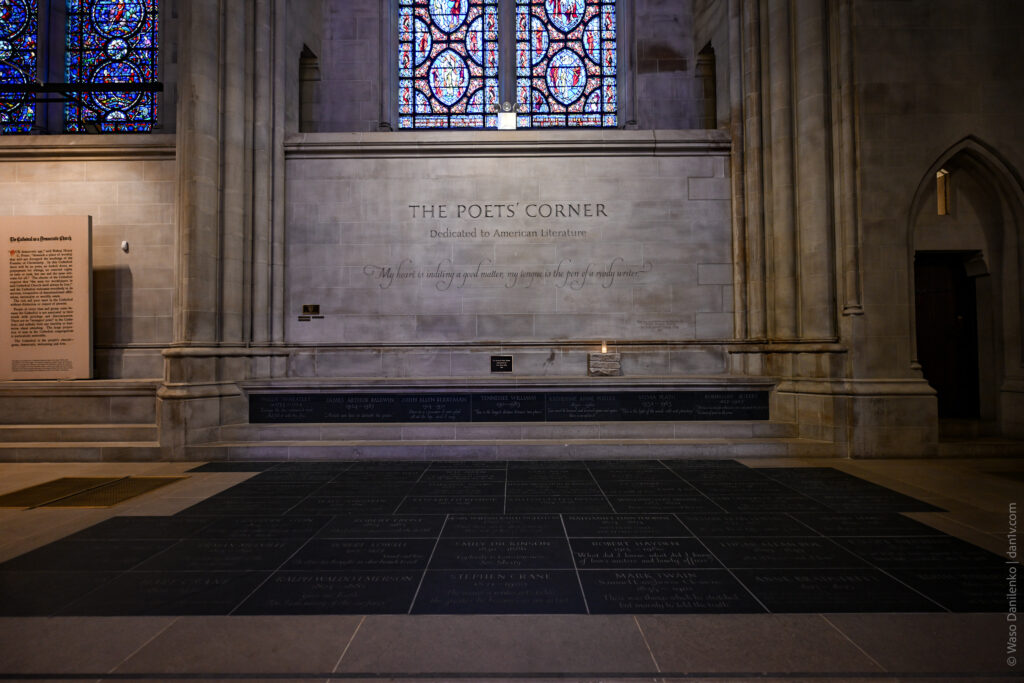
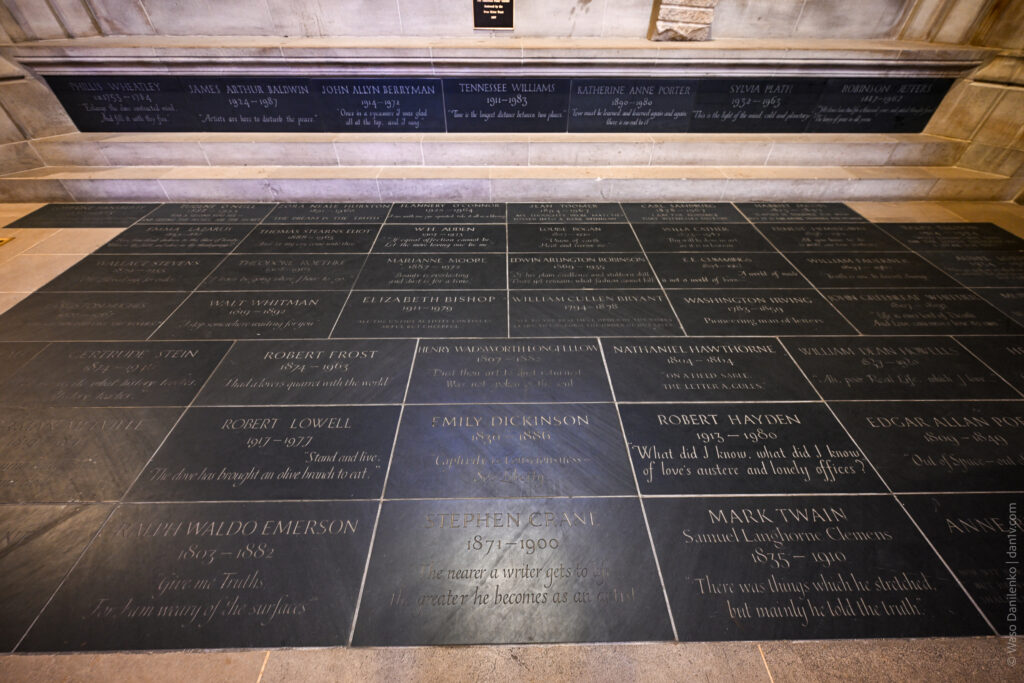
One of the side aisles contains memorial plaques honoring great American writers. These are not burials, but rather commemorative plaques. Edgar Allan Poe, Henry James, Walt Whitman, Mark Twain, Willa Cather, and Edith Wharton are among them.
Joseph Brodsky was among those who selected poets for the cathedral’s literary pantheon, along with Eudora Welty, William Jay Smith, Richard Wilbur, John Hollander, and Robert Penn Warren. A month after Brodsky’s death, hundreds of people came to the cathedral to pay their respects. A memorial service was held at the cathedral on March 8, 1996. Brodsky died of a heart attack on January 28, 1996, at the age of 55.
The Peace Fountain
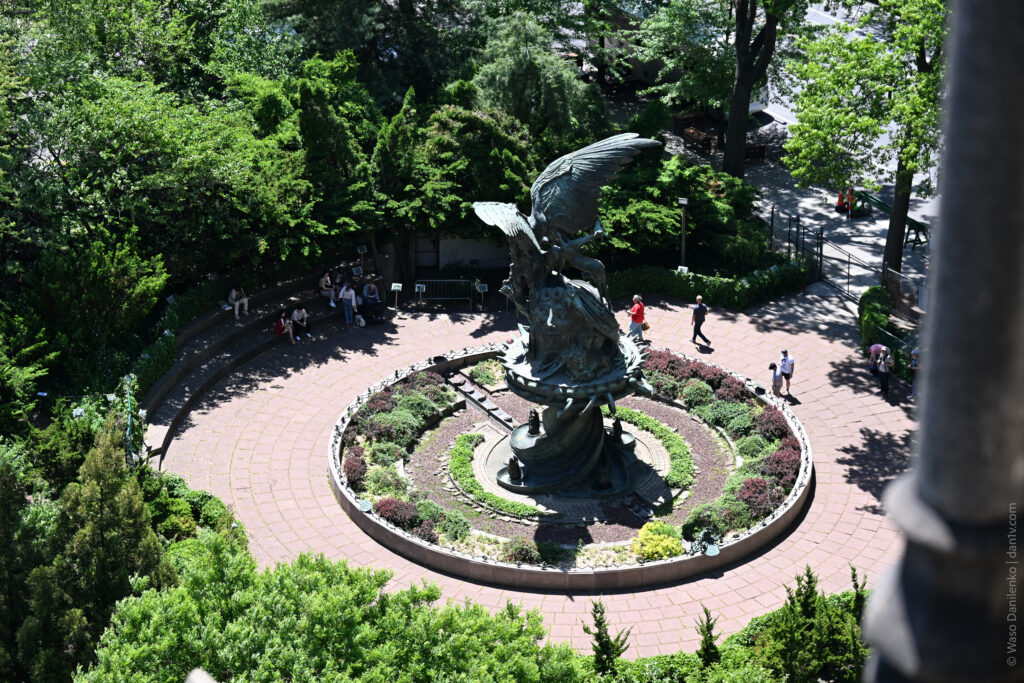
In the cathedral’s south courtyard stands the Peace Fountain, a work by sculptor Greg Wyatt, installed in 1985 to commemorate the 200th anniversary of the New York Episcopal Diocese.
The central figure is the Archangel Michael, standing on a DNA helix above a crab (symbolic of the moon and water). In his hand is the severed head of Satan. Around the central pillar are nine giraffes. Why giraffes is a question to which different tour guides have different answers. The entire sculpture is surrounded by bronze animal figurines sculpted by children from local schools, whose works were then converted into metal and installed around the fountain.
The Peace Fountain is regularly included on lists of "New York's strangest sculptures." Next to it grows the Biblical Plant Garden, a collection of herbs and perennials mentioned in the Bible. There is also a rose garden and two live peacocks that simply stroll around, sometimes stopping at the main entrance.
The History and Events of the Cathedral of St. John the Divine
The cathedral’s history begins with rivalry. In the 1850s and 1860s, New York Catholics began building St. Patrick’s Cathedral on Fifth Avenue — a grand Gothic cathedral that opened in 1879 and immediately became a symbol of the Catholic Church’s power and influence in the city.
The Episcopal Church — the oldest Protestant denomination, historically tied to Anglicanism and considering itself the “elite” denomination of New York — viewed this with increasing discomfort. Bishop Horatio Potter of the New York Diocese decided that the Episcopalians also needed a cathedral worthy of a world city. In 1887, he launched a fundraising campaign.
The main sponsor was J.P. Morgan, one of the richest men in America. In 1892 alone, the year construction began, he donated the equivalent of $13 million in today’s money. Morgan continued to finance the construction for many years afterward, making it one of the major philanthropic projects of his life.
In 1888, a three-year architectural competition was announced — unprecedented in the United States in its length and scale. The firm of Heins & LaFarge won: architects George Lewis Heins and Christopher Grant LaFarge proposed a design in the Romanesque-Byzantine style with Gothic elements — eclectic, ambitious, and unusual.
The cathedral’s cornerstone was laid on December 27, 1892, the feast day of St. John, after whom the cathedral is named. Approximately 10,000 people attended the ceremony. Before construction began, engineers had to dig 21 meters deep until they reached bedrock. This process took several years.
Which celebrities have visited the cathedral?
- Duke Ellington premiered his “Second Sacred Concert” here in 1968. His funeral in 1974 drew 12,500 people — New York’s jazz, cultural, and political elite.
- Martin Luther King Jr. preached in the cathedral during an ecumenical service in support of civil rights legislation in the 1960s.
- Desmond Tutu, Archbishop of Cape Town and anti-apartheid activist, spoke here on numerous occasions.
- The Dalai Lama visited the cathedral as a guest of honor.
- Sting recorded a live concert here for his album “If on a Winter’s Night.”
- Eta Hawke and Uma Thurman married here in 1998. Godspell, a musical based on the Gospel of Matthew, was written in 1970 by the cathedral’s playwright, John-Michael Tebelak, together with Stephen Schwartz. The musical became a hit on Broadway and continues to be regularly performed worldwide.
- In 1990, Diamonda Galás performed “Plague Mass” here — a requiem for the victims of AIDS, one of the most radical performances in American musical history.
- In 1994, Mariah Carey gave a benefit concert for a children’s fund. Philippe Petit, the tightrope walker famous for his walk between the towers of the World Trade Center in 1974, walked a tightrope over Amsterdam Avenue in 1982.
Blessing of the Animals
Every year on the first Sunday in October — the Feast of St. Francis — the cathedral holds a service for the blessing of the animals. Over the decades, dogs and cats, rabbits and hamsters, pythons and boa constrictors, peacocks (native to the cathedral), Cameroon pygmy goats, horses, and, once, a camel have passed through these gates.
This is one of the cathedral’s most attended services of the year. The second most popular event is the Blessing of the Bicycles, which takes place on the first Saturday in May.
Visitors infornation
📍Cathedral of St. John the Divine / 1047 Amsterdam Ave, New York, NY 10025
Subway: B/C trains to Cathedral Pkwy–110th Street, 1 train to 110th Street–Cathedral Pkwy
Hours:
- Mon–Sat: 7:30 AM–6:00 PM
- Sun: 7:30 AM–7:00 PM
- Gardens and courtyard open until sunset
Admission: Suggested donation $5–10, technically free
Tours:
- Regular (architecture, history, major works of art) — $18, usually Mon, Wed, Fri, and Sat at 1:00 PM
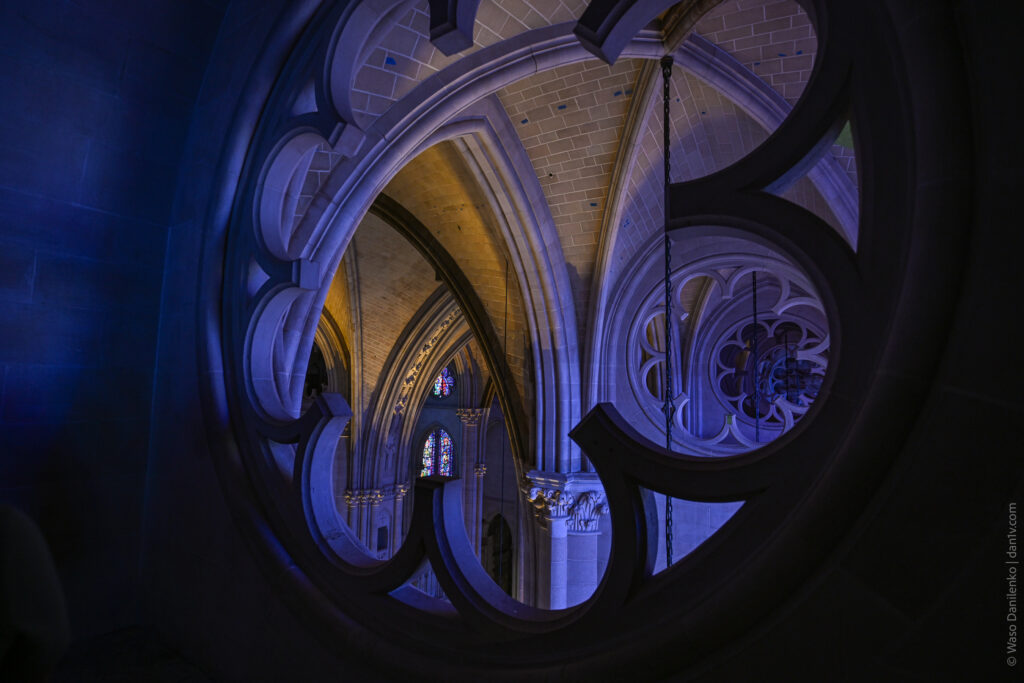
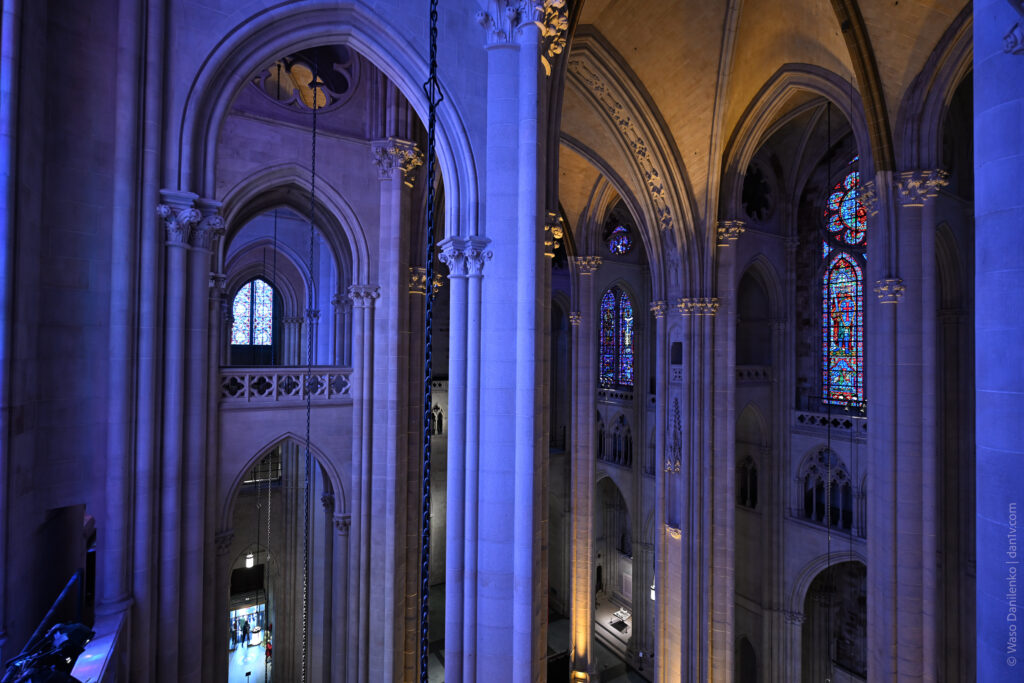
- Vertical (climb a spiral staircase over 125 feet, offering a bird’s-eye view of the entire nave) — $25, Fri and some Sat at 2:00 PM
Website: stjohndivine.org