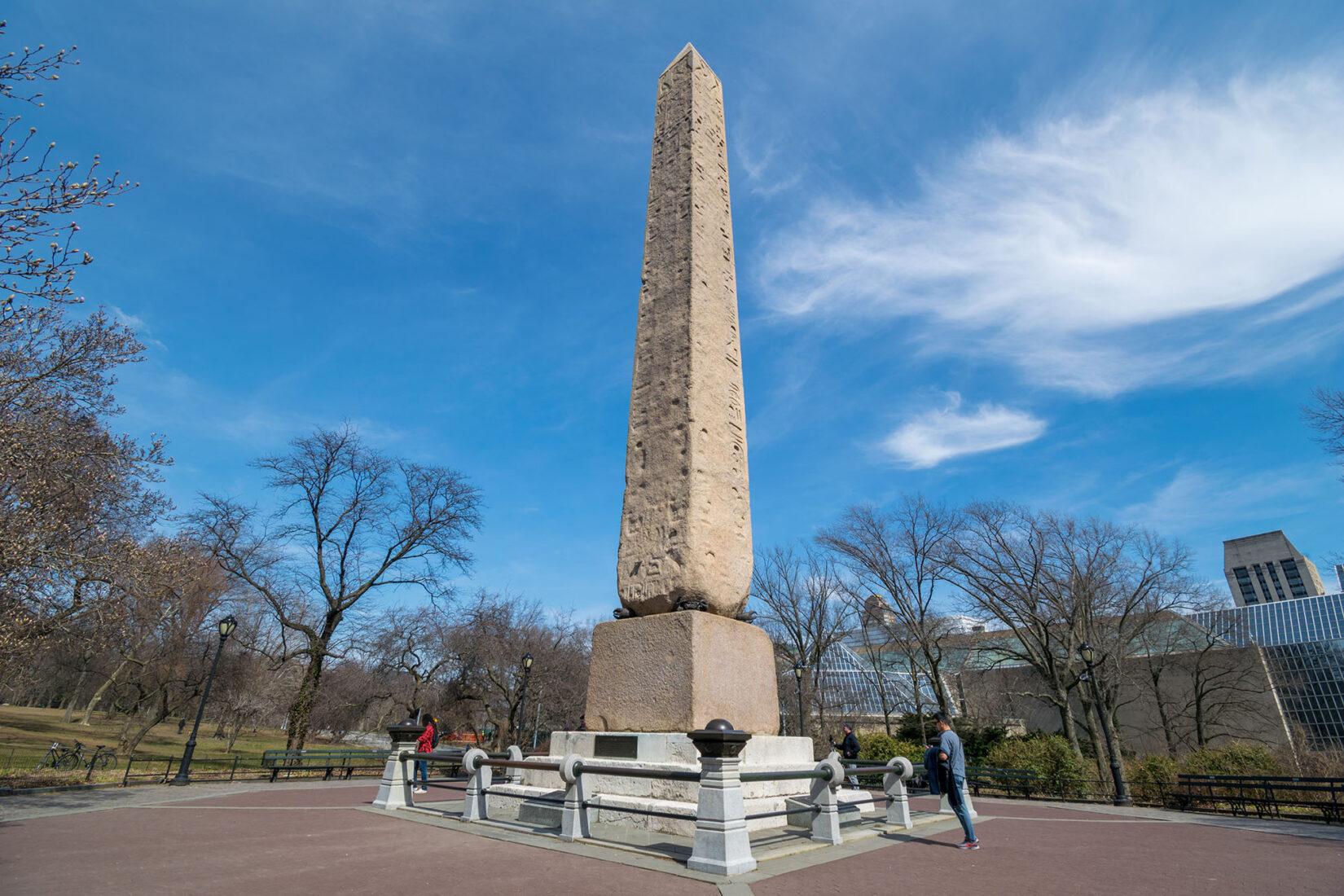
What is the oldest structure in New York City? Contrary to what its appearance might suggest, it is not the Port Authority Bus Terminal.
The oldest man-made monument standing outdoors in New York is Cleopatra’s Needle, the ancient Egyptian obelisk in Central Park. It is approximately 3,500 years old, having been carved around the 15th century BCE. The obelisk arrived in New York in 1880 and was erected the following year.
Here is a fun fact: crossing the Atlantic took the obelisk 38 days, but moving it the final 2 miles (3 kilometers) across Manhattan required 112 days. Anyone who has tried to get across the city during rush hour will probably appreciate the irony — some things never change.
The single granite monolith weighs more than 220 tons and stands about 69 feet (21 meters) tall. And, as is often the case with historical names, Cleopatra had about as much to do with this obelisk as Julius Caesar had with the Caesar salad. It earned its nickname because it once stood near the Caesareum, a temple whose construction was begun by Cleopatra. By the time the obelisk was moved there, however, she had already been dead for about 18 years.
Cleopatra’s Needle did not end up in the United States by accident. By the nineteenth century, Europe was in the grip of Egyptomania. Paris had received the Luxor Obelisk, which was installed at Place de la Concorde in 1836. London acquired another Alexandrian “Needle” and erected it along the Victoria Embankment in 1878. New York, meanwhile, had no obelisk at all, and newspapers complained about it almost as though it were a personal insult. Rome had thirteen — why should New York be any different?
During the celebrations surrounding the opening of the Suez Canal, Egyptian officials announced that they would be willing to present one of their standing obelisks to the United States. Their generosity had a practical motive: Egypt was rapidly heading toward bankruptcy, and it had far more ancient monuments than available funds.
One final detail makes the story even better. The captain who transported the obelisk across the Atlantic later admitted that the chosen site in Central Park was “possibly the worst place within the city limits to deliver an obelisk.” The location was selected not because it was easy to reach, but because the underlying bedrock provided a solid foundation and the isolated setting ensured that no future skyscraper would overshadow it.
📍Greywacke Knoll in Central Park, west of The Metropolitan Museum of Art, near 81st Street. The easiest way to reach it is by walking around the museum on the park side.