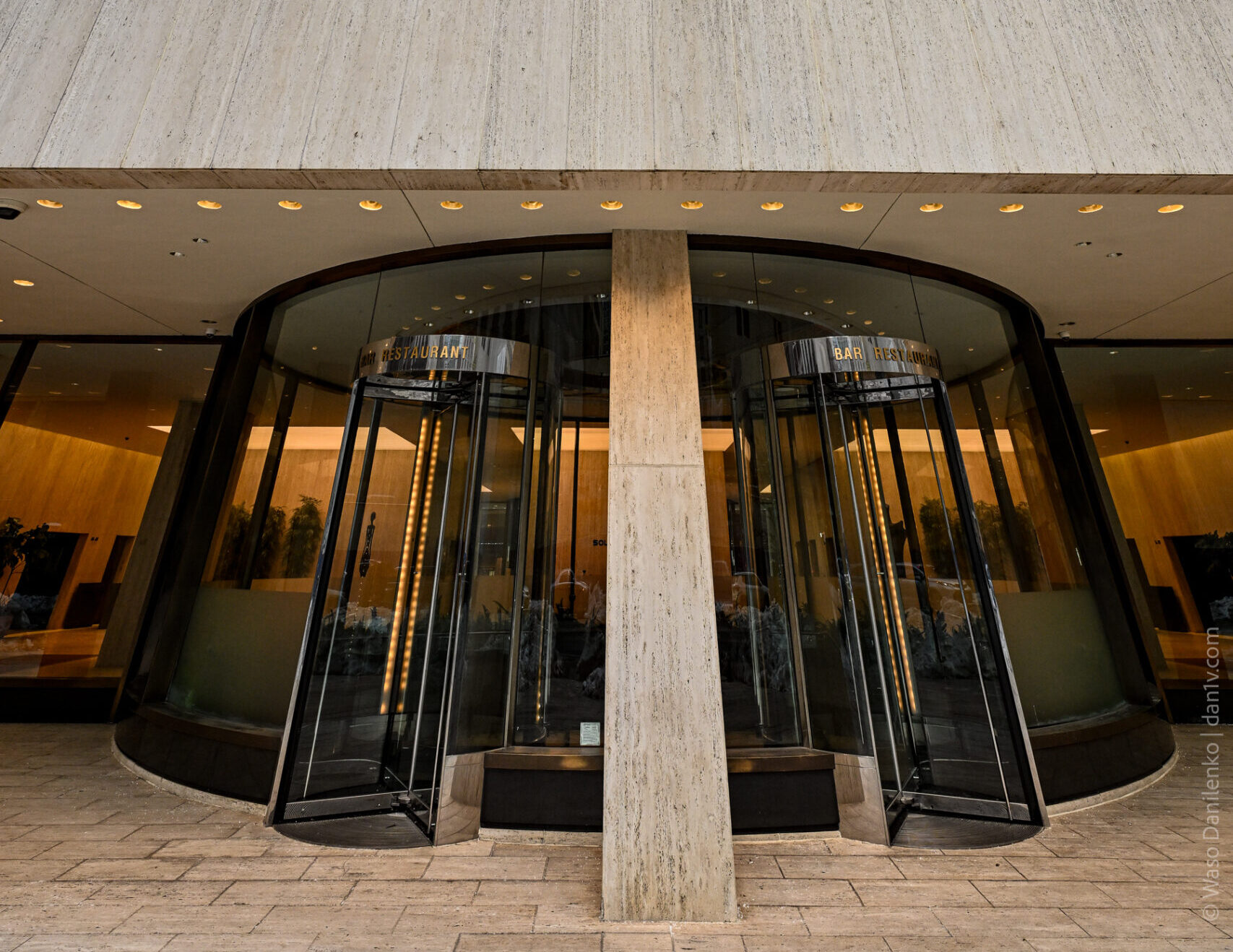
The Solow Building, located at 9 West 57th Street, is one of those New York City skyscrapers that almost everyone recognizes, even if few people remember its name. Its black glass façade curves gracefully down toward 57th Street, and the enormous red 9 embedded in the sidewalk has been seen by nearly everyone who has walked through the area around the Plaza Hotel.
For decades, however, the building was almost impossible to enter. For more than half a century, it has been regarded as the most expensive office building in the United States. Today, visitors finally have a reason to step inside: the building is home to the Soloviev Foundation Gallery, where you can explore the exhibition Made in Tension, featuring historic textiles and works of art.
Key Facts About the Solow Building
- The Solow Building was constructed between 1969 and 1974 and designed by Gordon Bunshaft of Skidmore, Owings & Merrill — the same architect behind Lever House, one of the defining masterpieces of glass modernism.
- The tower stands 689 feet (210 meters) tall, has 50 stories, and offers approximately 1.5 million square feet (140,000 square meters) of office space.
- The building was commissioned by developer Sheldon Solow, who named the tower after himself and remained its sole owner until his death in 2020. The surname Solow is an Americanized version of Soloviev, adopted by the family upon arrival at Ellis Island after emigrating from the Russian Empire.
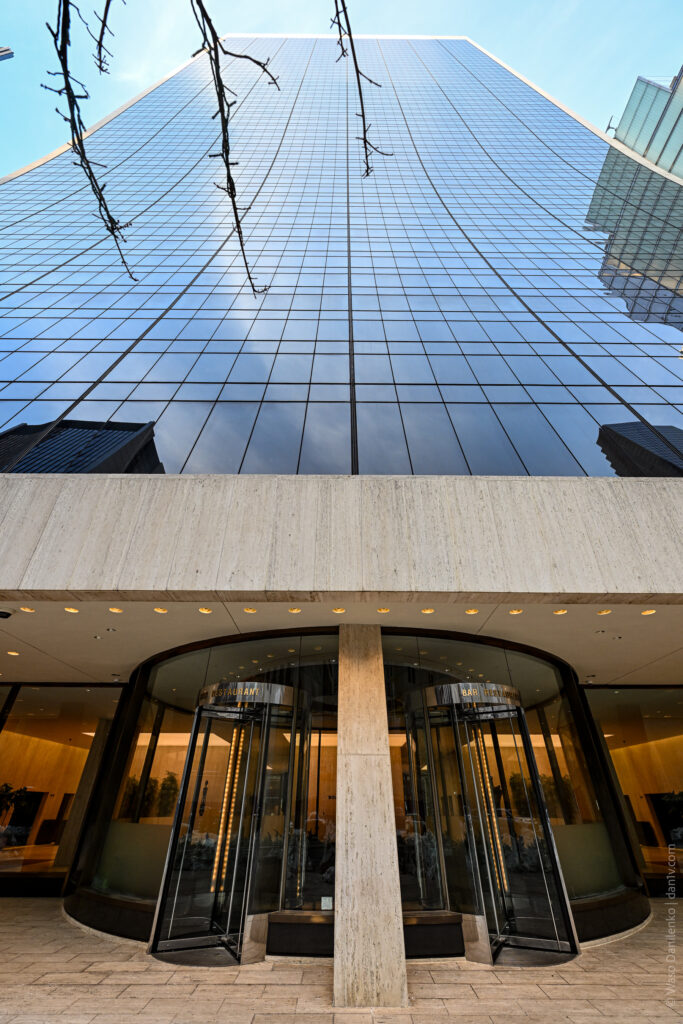
- It was the first major building in New York City with a sloping façade. The north and south walls curve inward from street level to the 18th floor, making the tower nearly 65 feet (20 meters) narrower at the top than at its base.
- In front of the entrance stands the iconic red “9” sculpture, weighing more than five tons and created by designer Ivan Chermayeff. It has become one of New York City’s best-known pieces of public art. The footwear brand Nine West takes its name from the building’s address.
- Architecture critics in the 1970s largely disliked the design, but the public embraced it — and tenants even more so. By 2016, the tower was valued at more than $3.4 billion, making it one of the most valuable office buildings in the United States.
- For decades, the ground floor housed what was arguably the world’s most exclusive art gallery. Although it qualified for the tax benefits granted to public museums, it was effectively closed to visitors. Among its treasures was a Botticelli painting that was later sold for $92 million.
- In April 2026, the family office of a Mexican billionaire leased 5,060 square feet (470 square meters) on the 50th floor at $327.50 per square foot per year, setting the highest office rental rate ever recorded in the history of New York City’s commercial real estate market.
Sheldon Solow: The Developer Behind the Solow Building
Sheldon Henry Solow was born in Brooklyn in 1928 to Isaac Solow, a bricklayer who had emigrated from the Russian Empire, and his wife, Jennie, a homemaker. Before the Great Depression, Isaac had briefly worked as a small-scale real estate developer, but after losing his properties during the economic collapse, he returned to laying brick.
Solow studied engineering and architecture at New York University, but left school in 1949 without completing his degree. Just one year later, he and his father secured a government-backed loan and built a 72-unit apartment building in Far Rockaway, Queens. Isaac named the development Sheldon Gardens in honor of his son.
The family went on to develop additional residential projects on Long Island, followed by a shopping center. In 1962, at the age of 34, Solow opened his own office on Park Avenue and shifted his focus to luxury residential development in Manhattan.
The idea of assembling a large development site on 57th Street came from a broker friend in the mid-1960s. Solow initially planned to build a residential tower, but after seeing the newly completed General Motors Building nearby, clad in white marble, he decided to aim much higher. Instead of apartments, he set out to create an office tower that would be even more prestigious—and even more expensive.
Assembling the Site for the Solow Building
Acquiring land for a skyscraper in Midtown Manhattan is often a bit like a spy operation. As soon as property owners realize that a developer is trying to assemble an entire block, prices can soar overnight. To avoid this, Sheldon Solow quietly purchased properties between 57th and 58th Streets through several independent brokers beginning in 1965, making sure no one realized a single buyer was behind the acquisitions. In total, he assembled 17 separate parcels.
The largest piece of the site came from The Church of Jesus Christ of Latter-day Saints. In 1962, the Church had purchased land on 58th Street, across from the Plaza Hotel, with plans to construct its own 30- to 40-story tower. Instead, it agreed to transfer the property to Solow in exchange for the promise of four floors in the future building. The Church later withdrew from the arrangement after a dispute over mortgage financing.
Not every neighbor was willing to sell. Andrew Goodman, president of Bergdorf Goodman, refused to part with either his building or its valuable air rights. Solow was also unable to purchase 4 West 58th Street, home to the famous Paris Theatre. Instead, he secured a long-term ground lease and the property’s air rights, allowing him to increase the size of the future tower. The Paris Theatre remains open today as Manhattan’s last single-screen movie theater.
Redevelopment came at a cultural cost. Demolition erased part of old 57th Street, once known as one of New York’s leading gallery districts. From 1963 to 1968, the southern portion of the site housed the renowned Pace Gallery, while a loft on 58th Street served as the office of modernist architect Paul Rudolph.
In August 1968, Solow announced that Gordon Bunshaft of Skidmore, Owings & Merrill would design a 45-story office tower for the site. By early 1970, the plans had expanded to 50 stories and approximately 1.5 million square feet of office space.
Construction was not without tragedy. In November 1970, two electricians were killed after falling down an elevator shaft, and a collapsing crane injured five workers. By June 1971, the structural frame had reached its full height. To mark the milestone, the building was decorated with two seven-story arrowhead sculptures created by artist Ann Healy.
The Architecture of the Solow Building: Why Does the Skyscraper Look Like a Ski Jump?
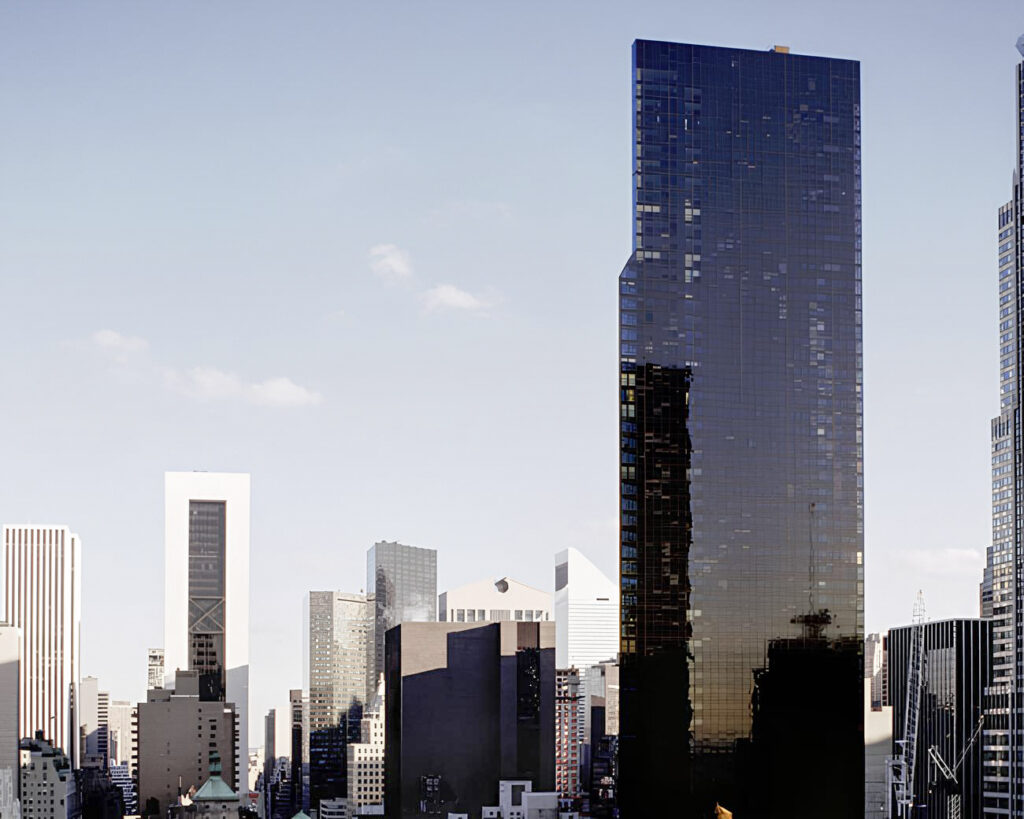
By the time he designed the Solow Building, Gordon Bunshaft was already considered one of the masters of modern architecture. His Lever House, completed in 1952, established the model for the glass office tower that would shape skylines around the world for decades. For Sheldon Solow, however, Bunshaft created something New York had never seen before: a skyscraper whose north and south façades do not rise vertically from the street. Instead, they curve gently inward from the sidewalk to the 18th floor, before continuing straight upward for the rest of the tower. As a result, the building is considerably wider at street level than at the top, narrowing by about 64 feet (19.5 meters).
The distinctive shape was not created purely for artistic effect. Under New York City’s 1961 Zoning Resolution, tall buildings were required to step back from the street as they rose, typically through a series of terraces known as setbacks. An early version of the project placed the elevator shafts outside the building’s central core, but the idea proved technically impractical. Bunshaft’s solution was to replace the traditional stepped profile with one continuous curve. The design fully complied with zoning regulations while producing a clean, sculptural silhouette rather than a stack of setbacks. As a result, 9 West 57th Street became the first major building in New York City with a sloping façade.
The north and south elevations are clad in black-tinted glass, while the east and west sides are almost entirely solid. They are faced with horizontal bands of travertine, interrupted only by narrow vertical window slits along the edges. Through those openings, visitors can glimpse the building’s black diagonal steel bracing, allowing part of the structural system to remain visible from the outside. Hidden at the base of the sloping glass façade is a massive drainage system designed to collect rainwater as it runs down the inclined surface.
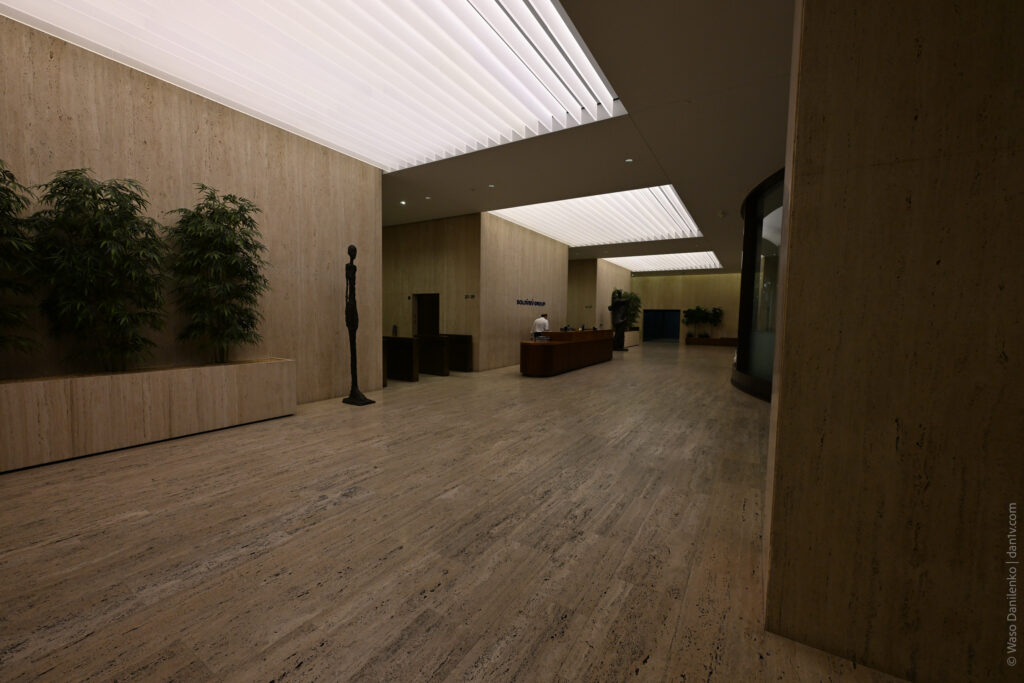
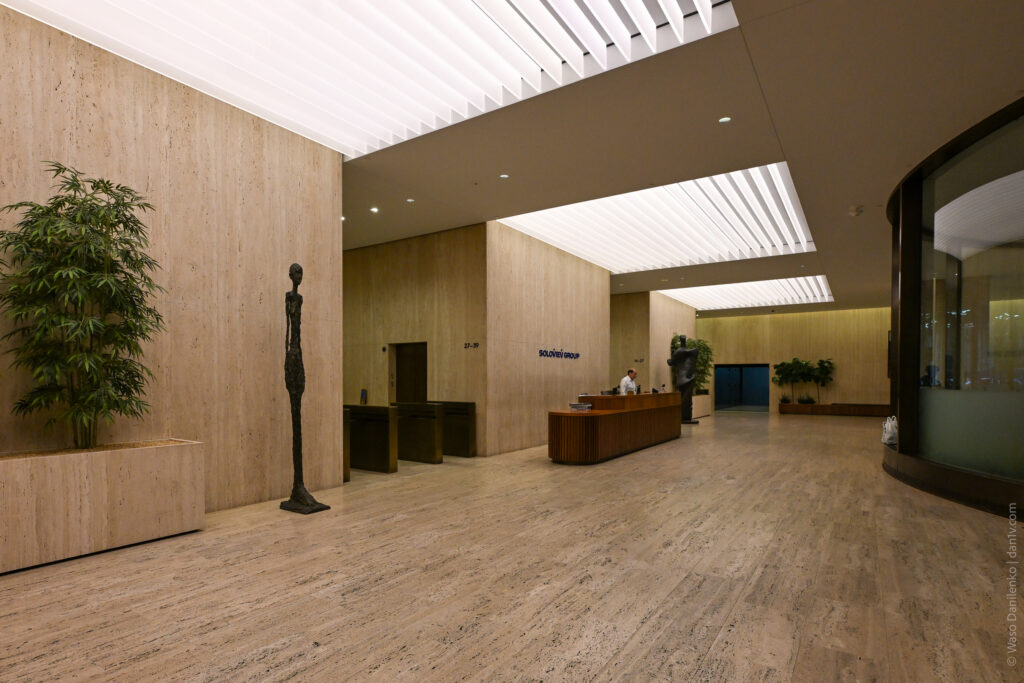
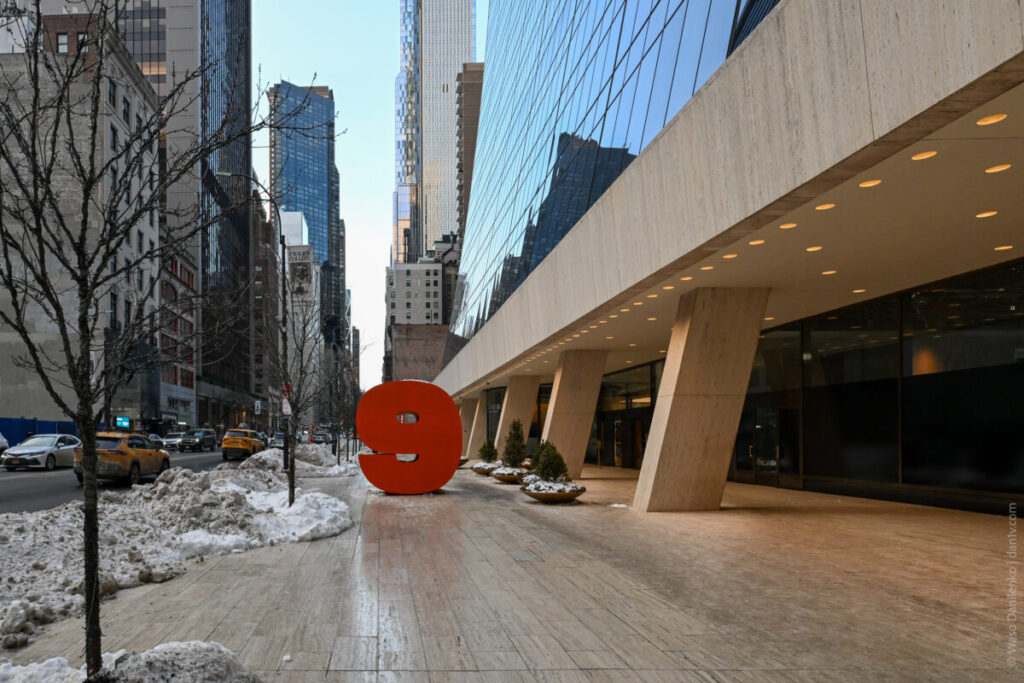
The tower is set back 36 feet (11 meters) from 57th Street and 49 feet (15 meters) from 58th Street, creating a spacious public plaza paved in the same travertine used on the building’s side walls. Inside, a marble-clad lobby runs the full depth of the block, allowing pedestrians to enter from 57th Street and exit onto 58th Street.
The Solow Building also has an architectural sibling: the W. R. Grace Building on 42nd Street, overlooking Bryant Park, with its similarly sweeping, curved façade. This was not plagiarism. Bunshaft’s original, unbuilt design concept for the Solow project was ultimately adapted for W. R. Grace, and the two towers were completed at almost the same time. As a result, New York gained two of its most distinctive “ski jump” skyscrapers, both designed by the same architect.

How New York Criticized the Solow Building
Few skyscrapers of its era received such unanimous criticism from architectural reviewers as the Solow Building. Even before construction began, Progressive Architecture dismissed the project as a “blockbuster” that would inevitably destroy the scale and street life of the gallery-lined 57th Street.
Ada Louise Huxtable, the first architecture critic for The New York Times and the first critic ever to receive a Pulitzer Prize, published a review titled “Anti-Street, Anti-People.” She went so far as to express sympathy for “half the guests at the Plaza Hotel whose windows now face the black glass wall on 58th Street.”
Criticism extended beyond newspaper columns. In 1974, the Fifth Avenue Association condemned the tower as an example of “urban bad manners.” Ironically, the same organization honored designer Ivan Chermayeff for the giant red 9 sculpture standing in front of the very building it had criticized. The head of Midtown’s planning office publicly argued against sloping buildings within the city grid, while architect Henry Cobb described their visual impact as “very strong, hostile, and aggressive.”
The public, however, felt differently. New Yorkers quickly gave the tower affectionate nicknames such as the “ski slope” and the “bell-bottom building,” a fitting comparison in the fashion-conscious 1970s. Arthur Drexler, the founding curator of architecture at The Museum of Modern Art (MoMA), perhaps explained the controversy better than anyone else. In his view, the uproar existed simply because the building did not rise vertically from the street, as architects had conditioned people to expect. Its immense curved glass façade, he argued, was “a thrilling spectacle — not as architecture, but as urban theater, as mesmerizing as a fountain.”
Time ultimately proved kinder to Bunshaft than his early critics. Today, the sweeping silhouette of 9 West 57th Street is one of Midtown Manhattan’s most recognizable landmarks. And the strongest argument in its favor has always been found on its upper floors. From the beginning, Sheldon Solow insisted that he was building the tower to maximize extraordinary views, believing that companies would be willing to pay premium rents for them.
The Red Number 9 Outside the Solow Building
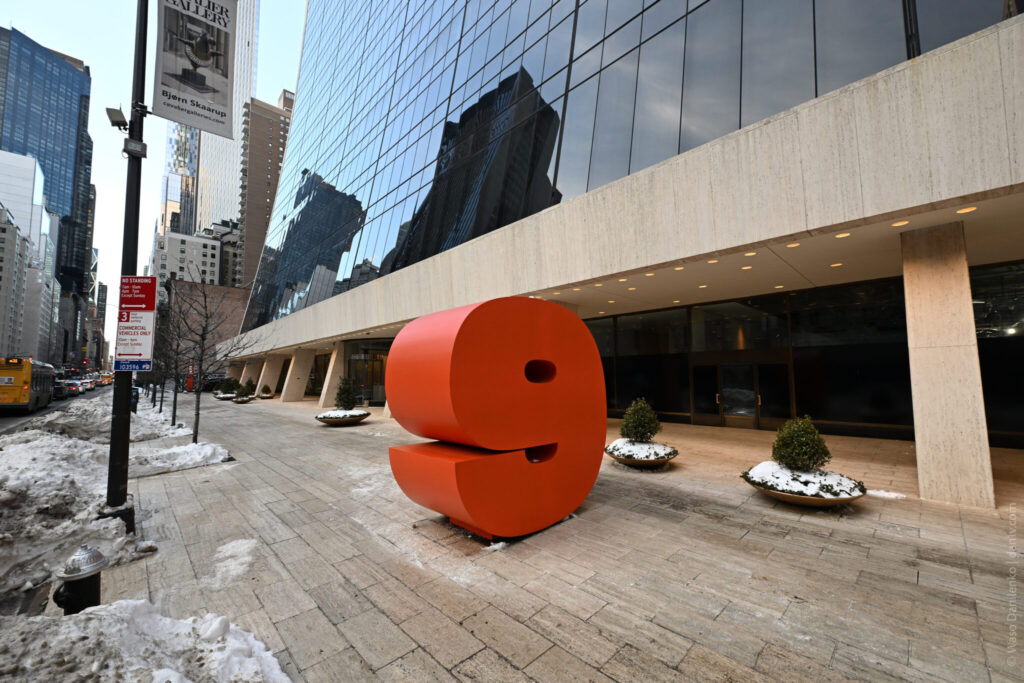
Standing at the entrance on 57th Street is what may be the most photographed street address in the world: a bright red number 9, nearly 10 feet (3 meters) tall and weighing more than five tons.
The sculpture was designed by graphic designer Ivan Chermayeff, co-founder of the legendary firm Chermayeff & Geismar, the studio behind iconic logos for Chase, Mobil, and NBC. An interesting side note: Ivan’s father, architect Serge Chermayeff, was born in Grozny.
According to Ivan Chermayeff, the idea began as a joke. The building’s sloping façade reminded him of a launch ramp, making it look as though the giant number 9 was about to slide down onto the street. Sheldon Solow appreciated the sculpture for more practical reasons. He felt that the plaza in front of the building looked too empty, and the oversized numeral also helped draw attention away from the blank walls of neighboring buildings.
The sculpture’s history has not been entirely smooth. After it was installed in 1972, Solow became involved in a dispute with the city over its placement and removed it for an entire year. Eventually, the two sides reached a compromise, allowing the sculpture to stand on the sidewalk, for which Solow initially paid the city an annual rent of $1,000. What many people do not realize is that the number is not simply resting on the pavement. Hidden beneath it is a structural support column that extends three stories below ground.
In the late 1970s, a young footwear company opened its first office in the building. The founders liked the address so much that they named the brand Nine West after it. The company eventually grew into an international retailer with hundreds of stores, and for years millions of customers carried shopping bags bearing the skyscraper’s address without ever realizing its origin.
The plaza on the 58th Street side features another notable work of art: Moonbird, a 13-foot (4-meter) bronze sculpture by Joan Miró. Solow installed it in 1994, explaining simply that it was “one of my favorite sculptures.” Before Moonbird arrived, the site was occupied by a mobile created by Alexander Calder, but Solow had it removed after realizing that strong winds could potentially cause the structure to collapse onto pedestrians.
Tenants of the Solow Building: New York’s Record-Breaking Office Rents
Sheldon Solow secured his first anchor tenant before construction had even begun. In 1969, cosmetics giant Avon abandoned plans to relocate to Rockefeller Center and instead leased space in the future tower — initially 20 floors, later expanding to 25. The company agreed to pay higher rents than those offered elsewhere. There was, however, one thing Avon could not negotiate: naming rights. Solow had built the tower to carry his own name and had no intention of sharing the façade.
The building opened in phases between 1972 and 1974, at what seemed like the worst possible moment. New York City was entering a severe fiscal crisis, and many corporations were moving elsewhere. Solow remained confident, and his gamble paid off. After Avon came Morgan Guaranty (later part of JPMorgan Chase), Sony, Deutsche Bank, and Chanel. The French fashion house signed a lease for the 44th floor as early as 1972 and has remained in the building for more than half a century.
By the 1980s, the Solow Building, together with the General Motors Building and the Seagram Building, commanded the highest office rents in New York City. The secret was not only the architecture but also the geometry. Beginning on the 24th floor, the north-facing windows rise above neighboring rooftops, offering unobstructed views of Central Park — a panorama that financial firms have long been willing to pay a premium for.
Over time, the tower evolved into an unofficial headquarters for the global hedge fund and private equity industries. At various times, it has housed firms including KKR, Silver Lake, Providence Equity, Tiger Global, Apollo Global Management, and Sculptor Capital. On Wall Street, the address became so well known that people simply referred to it as “Nine West,” and everyone understood which building they meant.
In 2007, office space on the upper floors was offered at $175 per square foot per year, while the average rent for a premier Midtown office was approximately $85 per square foot. By 2016, the building had been valued at more than $3.4 billion, and JPMorgan provided a $1.2 billion mortgage secured by the property.
The record, however, was broken in April 2026. HBeyond, a family office, leased 5,060 square feet (470 square meters) in the northwest corner of the 50th and top floor, with some of the finest views of Central Park, at $327.50 per square foot per year. It became the highest office rent ever recorded in New York City, surpassing the previous record of $320 per square foot, set at One Vanderbilt.
The building’s owner, Stefan Soloviev, summed it up in a single sentence: “The price speaks for itself.”
The record-setting tenant turned out to be Gonzalo Evia Ballères, a 28-year-old Mexican entrepreneur, grandson of mining magnate Alberto Baillères, one of Mexico’s wealthiest businessmen, and founder of the artificial intelligence startup Lok. The business press focused on the lease, while the tabloids were more interested in another detail: the young billionaire was reportedly dating actress Emma Watson.
The Story of the Soloviev Foundation Gallery at the Solow Building
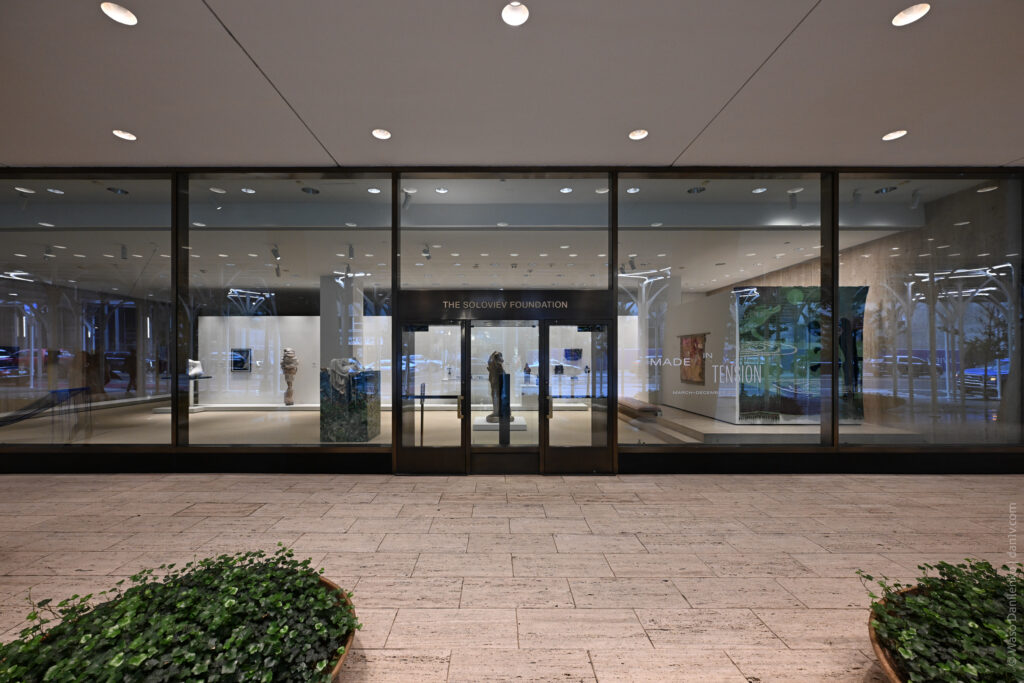
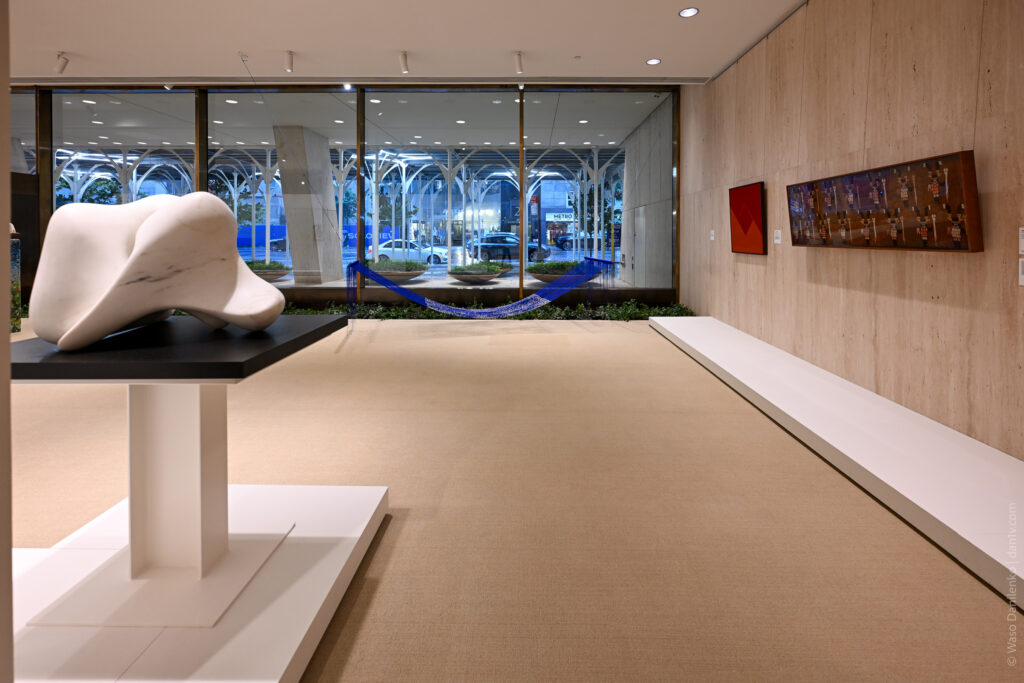
The Soloviev Foundation Gallery is home to a collection of paintings and sculptures worth more than half a billion dollars. For nearly half a century, these works were hidden from public view on the ground floor of 9 West 57th Street. Since May 2023, however, the collection has finally been accessible to visitors through free guided tours, available by advance reservation.
While building his real estate empire, Sheldon Solow also spent decades assembling one of New York’s most remarkable private art collections. His eye for art was widely admired. The collection includes works by Alberto Giacometti, Henri Matisse, Pablo Picasso, Joan Miró, Balthus, Jean Dubuffet, postwar American artists ranging from Franz Kline to Jean-Michel Basquiat, monumental sculptures by Henry Moore and Isamu Noguchi, nineteenth-century African art, and, for good measure, a Renaissance portrait by Sandro Botticelli, purchased in 1982 for what would now be considered a remarkably modest price.
In 1991, Solow established the nonprofit Solow Art and Architecture Foundation, transferring a significant portion of his collection to the organization. The arrangement followed a familiar model: a wealthy collector donates artwork to a charitable foundation, receives a federal tax deduction on part of its value, and the foundation itself qualifies for tax-exempt status because it is formally organized for the public benefit.
In practice, however, the public was never allowed inside.
The masterpieces were displayed behind glass on the building’s ground floor, but the only way to see them was by standing on the sidewalk along 57th Street and peering through reflective windows, competing with the glare of sunlight and the reflections of passing taxis.
Beginning in 2017, activist and collector Ethan Arnheim launched the satirical website solowfoundation.org, an unofficial “museum website.” Instead of announcing exhibitions, it featured photographs of the collection taken through the building’s reflective glass, along with explanations of how the foundation’s tax benefits worked. The project attracted widespread attention. In 2018, it was covered by the press, and Manhattan Borough President Gale Brewer wrote on social media that “a private collection closed to the public while receiving tax benefits is outrageous.”
In May 2023, the gallery finally opened its doors for public tours under the name Soloviev Foundation, giving visitors access to a collection that had remained largely hidden for decades.
Inside the Soloviev Foundation Gallery Today
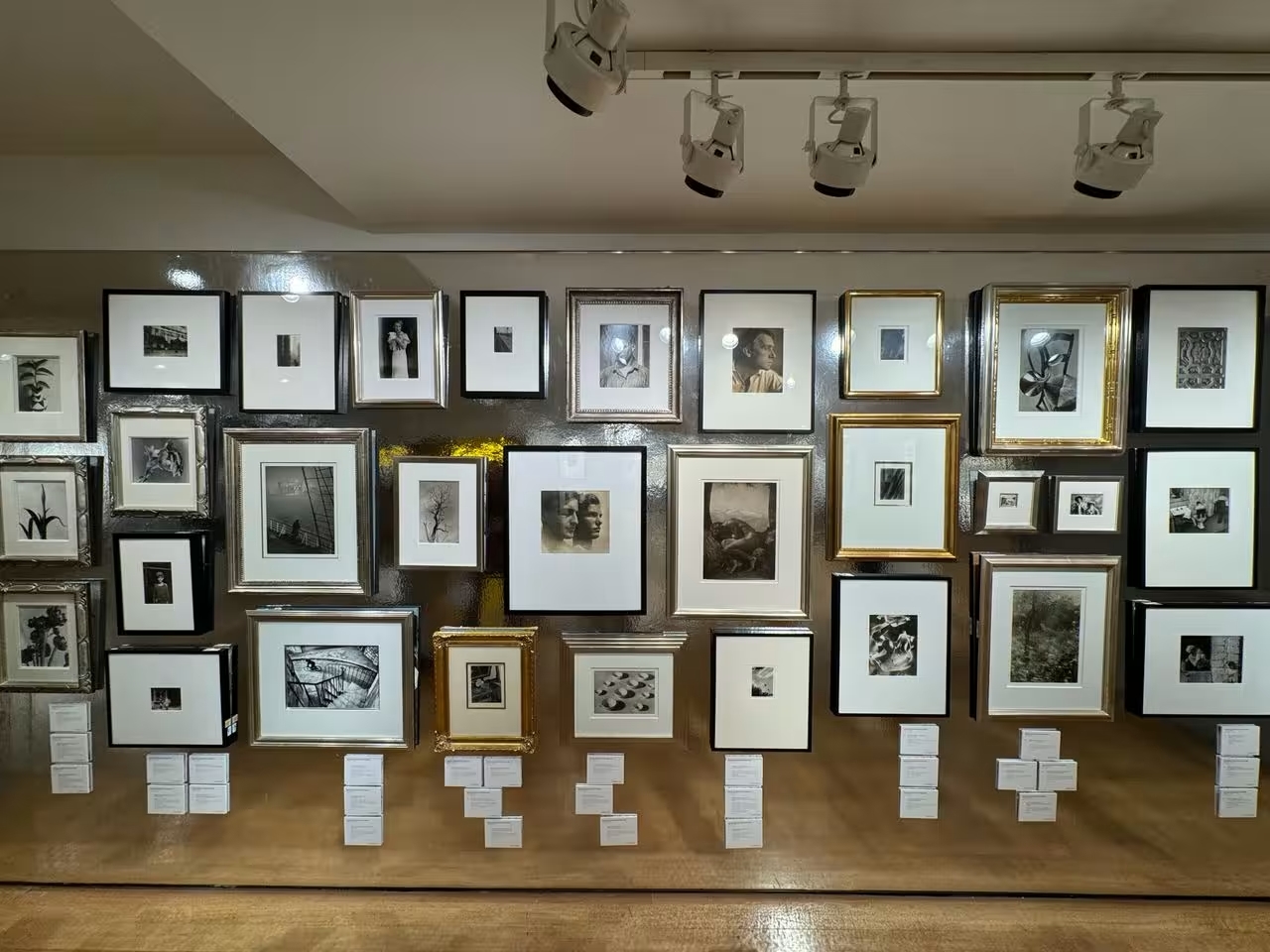
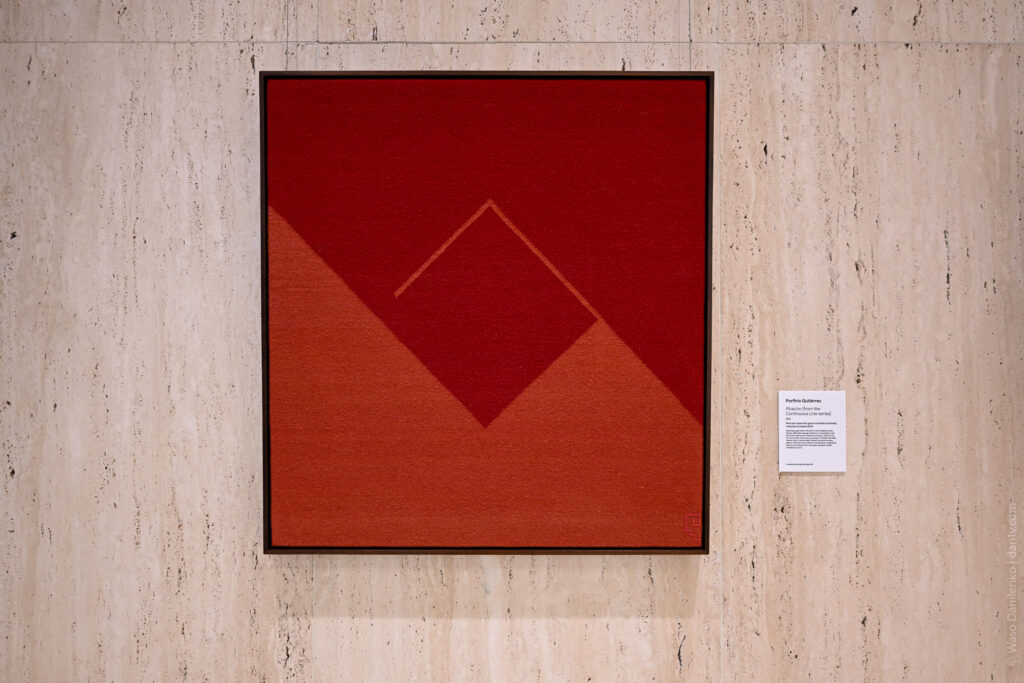
The Soloviev Foundation Gallery opened on May 24, 2023, on the ground floor of 9 West 57th Street—the very space where the collection had remained hidden from public view for decades. The renovation and exhibition design were created by the New York-based architecture studio New Affiliates, which transformed the galleries into a continuous visitor route and opened the experience toward the street.
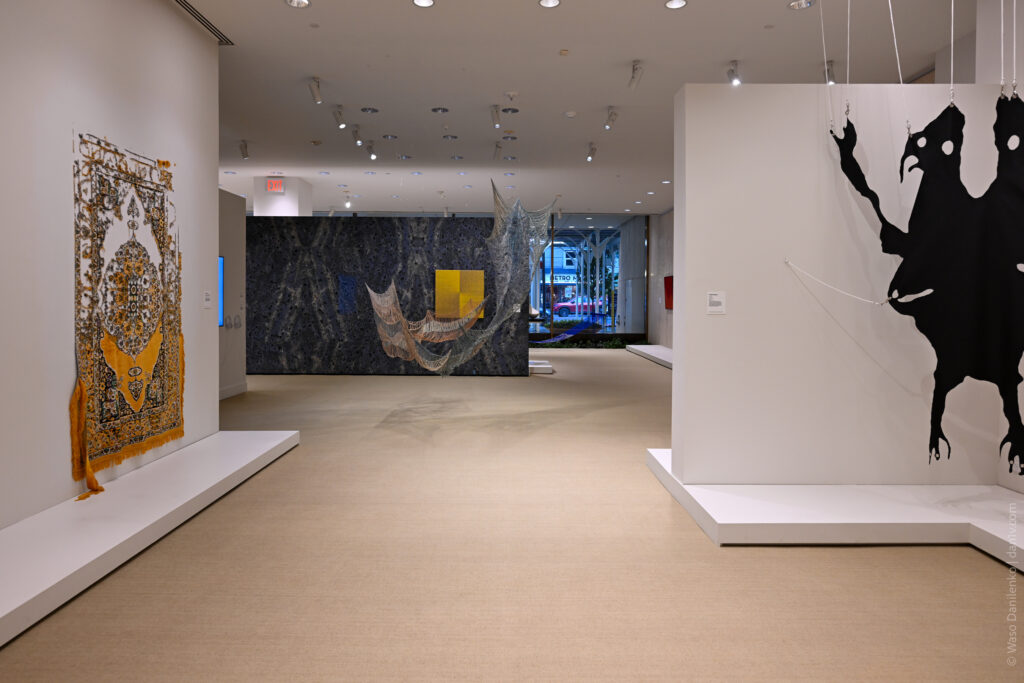
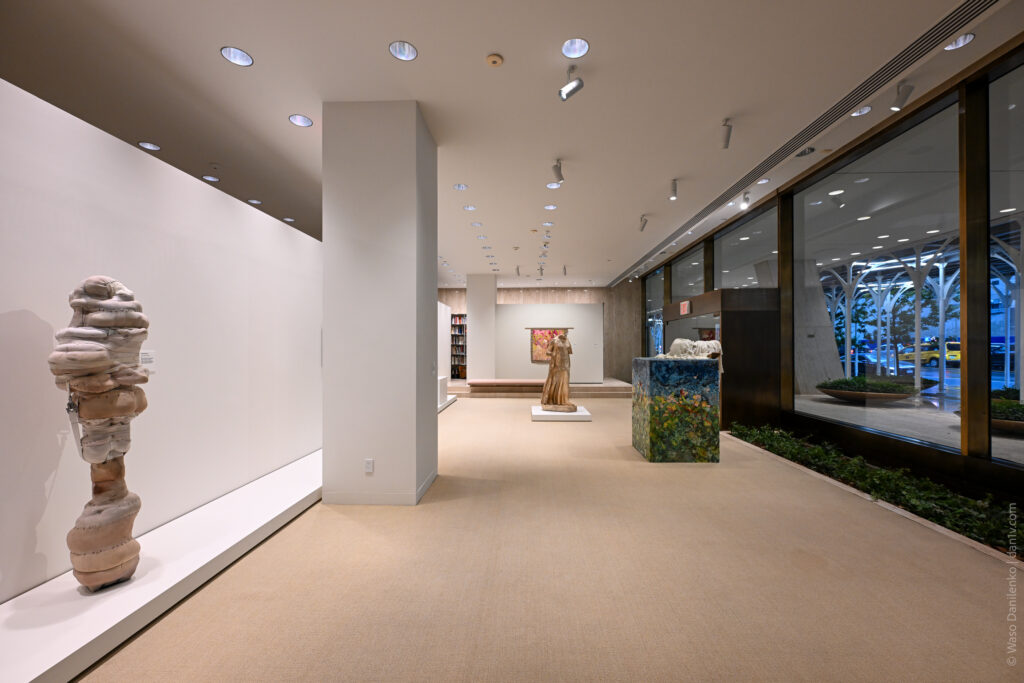
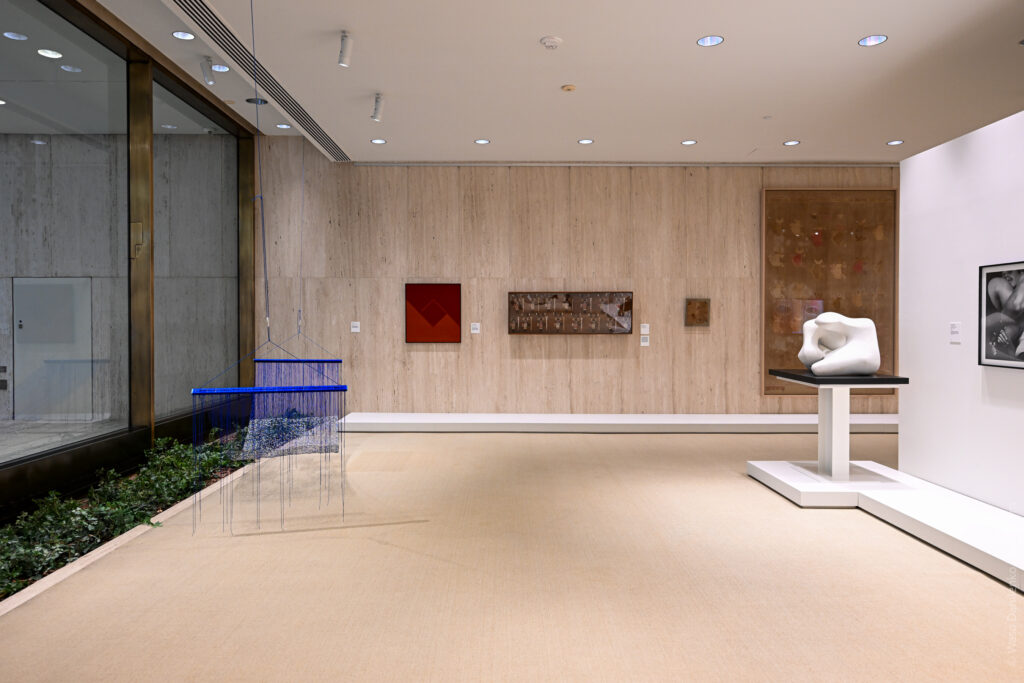
Highlights of the Soloviev Foundation Collection
- Alberto Giacometti is the central figure of the collection. The gallery owns both paintings and sculptures by the Swiss artist, including Portrait of Yanaihara (1961), depicting the Japanese philosopher Isaku Yanaihara, who posed for Giacometti through dozens of exhausting sessions that rarely resulted in a finished work. Art historians now refer to this period as the “Yanaihara crisis.” Other notable works include Caroline in a Red Dress (1965) and the bronze sculpture Large Figure (1947). Giacometti famously said that he was not seeking a person’s exact likeness, but rather how that person survives in memory.
- Henri Matisse is represented by several important late works, including Self-Portrait (1945), Portrait of Paul Matisse X (1946), and Interior with Figure (1947). The centerpiece, however, is the monumental The Acrobats (1952), one of the largest works created using Matisse’s celebrated late cut-out technique. Confined to bed, the artist described the process as “drawing with scissors.” In The Acrobats, he constructs the same figure in two different ways — once as a complete silhouette and once as a fragmented composition — pushing his decorative style toward something remarkably close to conceptual art. The current exhibition also includes another masterpiece from this period, Oceania, the Sky (1946).
- The gallery presents European Modernism almost as if it were an illustrated textbook. Visitors encounter Paul Cézanne’s luminous late watercolors, Pablo Picasso’s Cubist still life Torero (1911) and Portrait of a Poet (1941), and Fernand Léger’s Musical Instruments (1926), a celebration of the machine age. Joan Miró is represented by both his early, nearly academic Portrait of Ramon Sunyer (The Jeweler) (1918) and the dreamlike paintings of the 1920s and 1930s, where mysterious symbols float across neutral backgrounds, appearing somewhere between living creatures and microscopic organisms, including Painting (1926), Painting (1927), and Animated Landscape (1935).
- The collection’s Balthus is represented by a portrait of the Cassandre-Mouron family. The father is A. M. Cassandre (Adolphe Mouron), the legendary Art Deco poster designer and creator of the Yves Saint Laurent logo. Although painted with the precision of a nineteenth-century academic portrait, the image becomes increasingly unsettling the longer one looks: the daughter appears too large to be sitting comfortably on her mother’s lap, while the youngest son is dressed like a small child yet reads a newspaper with the concentration of a financial analyst. By contrast, Jean Dubuffet deliberately rejects traditional artistic refinement. His works The Juggler (1944) and The Editor (1951) embody the principles of Art Brut, the term Dubuffet coined to describe art created outside conventional academic traditions by children, self-taught artists, and psychiatric patients.
- The street-facing gallery overlooking 57th Street is devoted to large-scale American postwar art. Franz Kline’s Untitled (1954) is a classic example of Abstract Expressionism, defined by its bold black brushstrokes. Nearby hangs Al Held’s monumental black-and-white abstraction (1972), whose geometric forms seem to press outward toward the viewer. Morris Louis’s Gamma Kappa (1960) demonstrates his signature technique of staining pure color directly into the canvas. Cy Twombly is represented by Untitled (Empire of Flora) (1961), painted shortly after his move to Rome. Isamu Noguchi appears through two sculptures from 1979, including Idi Amin, in which stacked basalt stones depict the Ugandan dictator without any hidden supports — a deliberately unstable arrangement suggesting that every dictatorship is ultimately precarious. The sequence concludes with Jean-Michel Basquiat’s Parts (1984), a richly layered composition incorporating photocopies and graffiti-like text, whose structure subtly echoes Matisse’s The Red Studio. Also on view is Henry Moore’s Working Model for Draped Reclining Figure (1976–1979).
- A lesser-known but equally significant part of the collection is its nineteenth-century African sculpture, featuring works from the Ashanti, Fang, Kongo, Chokwe, Ekoi, Luba, Sapi, Yoruba, and various artistic traditions of Cameroon. A Fang reliquary head was included in the gallery’s inaugural exhibition. In February 2025, the Foundation paired African sculpture with photographs by James Van Der Zee, the leading photographer of the Harlem Renaissance, including his iconic Garvey Parade on Seventh Avenue (1924).
Auction Dramas from the Solow Collection
Botticelli: Bought for $1 Million, Sold for $92 Million
In 1982, Sheldon Solow purchased Sandro Botticelli’s Portrait of a Young Man Holding a Medallion (c. 1480) at Christie’s in London for £810,000 — about $1.1 million at the time.
The painting is one of only three Botticelli portraits still in private hands. Over the years, it was exhibited at The Metropolitan Museum of Art, The National Gallery in London, The National Gallery of Art in Washington, D.C., and the Städel Museum in Frankfurt.
Shortly before his death, Solow consigned the work to Sotheby’s. On January 28, 2021, it sold for $92.2 million ($80 million plus buyer’s premium), setting a new auction record for Botticelli at more than nine times the artist’s previous high. Among Old Master paintings, only Leonardo da Vinci’s Salvator Mundi, which sold for $450.3 million in 2017, has achieved a higher auction price. According to The Wall Street Journal, the buyer was a Russian-speaking collector.
The Most Expensive Sculpture Ever Sold at Auction
In May 2015, Solow sold Alberto Giacometti’s bronze sculpture L’Homme au doigt (Pointing Man) (1947) at Christie’s New York for $141.3 million.
According to press reports, the buyer was hedge fund billionaire Steve Cohen. The result remains the highest price ever paid for a sculpture at auction, and it also reflects Solow’s distinctive negotiating style: once again, he completed the sale without relying on a third-party guarantee, despite the enormous value involved.
The 2025 Auction That Fell Short
In November 2022, Stefan Soloviev said in an interview that his father had assembled a “phenomenal collection” and that he had no intention of selling any of it.
Nevertheless, in May 2025, the Foundation consigned Grande tête mince (Large Thin Head) (1955) by Alberto Giacometti to Sotheby’s. The painted bronze portrait of the artist’s brother Diego Giacometti is the only painted example among the six casts produced and was exhibited at the 1956 Venice Biennale. Sheldon Solow had acquired it in 1980, and the Foundation announced that any proceeds would support charitable causes.
What happened next followed a familiar Solow pattern. There was no third-party guarantee, the estimate was listed as “in excess of $70 million,” and bidding opened at $59 million.
For nearly four minutes, auctioneer Oliver Barker attempted to draw additional bids from the room. The bidding eventually reached $64.25 million, still below the confidential reserve price. With an audible sense of disappointment in the room, Barker declared the lot unsold.
The sculpture — displayed only shortly before in the Foundation’s own exhibition, something you cannot hold — returned to the collection.
Visitors’ Information
📍 Solow Building / East River Realty Company, LLC, 9 W 57th St, New York, NY 10019
Subway: Take the F train to 57 Street, or the N, Q, R, or W trains to 57 Street–7 Avenue or Fifth Avenue/59 Street.
Admission is free, but advance reservations are required through solovievfoundation.org. Visitors can choose between guided tours and self-guided exhibition time slots.
If no available times appear on the booking page, all reservations have been claimed. Check back later, as additional slots may become available.