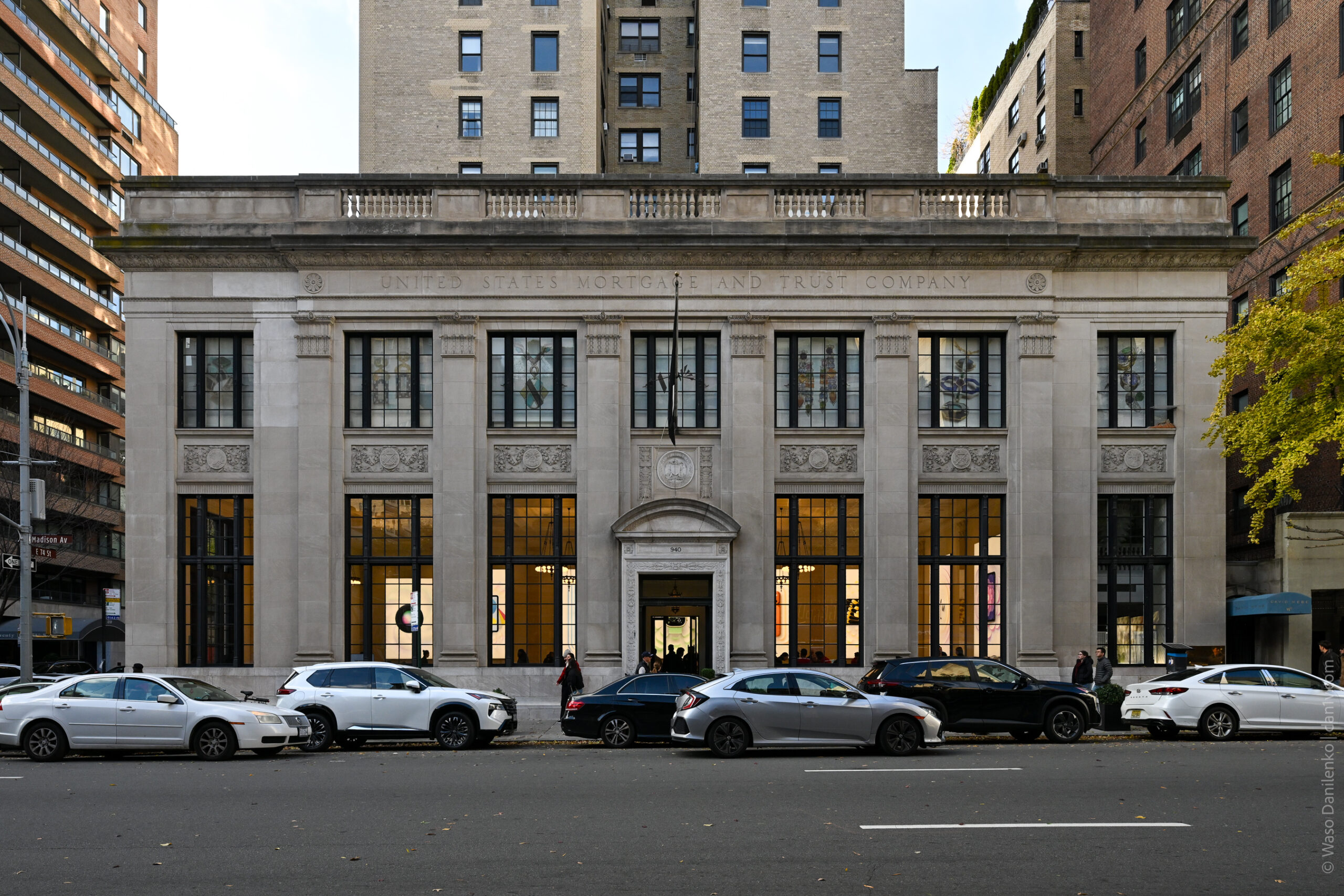
In New York City, people often visit stores not to shop, but to admire the buildings they occupy, including their interiors. One example is the seemingly ordinary Apple Store on the Upper East Side, located inside 940 Madison Avenue, the former home of United States Mortgage & Trust Company, a bank building completed in 1922.
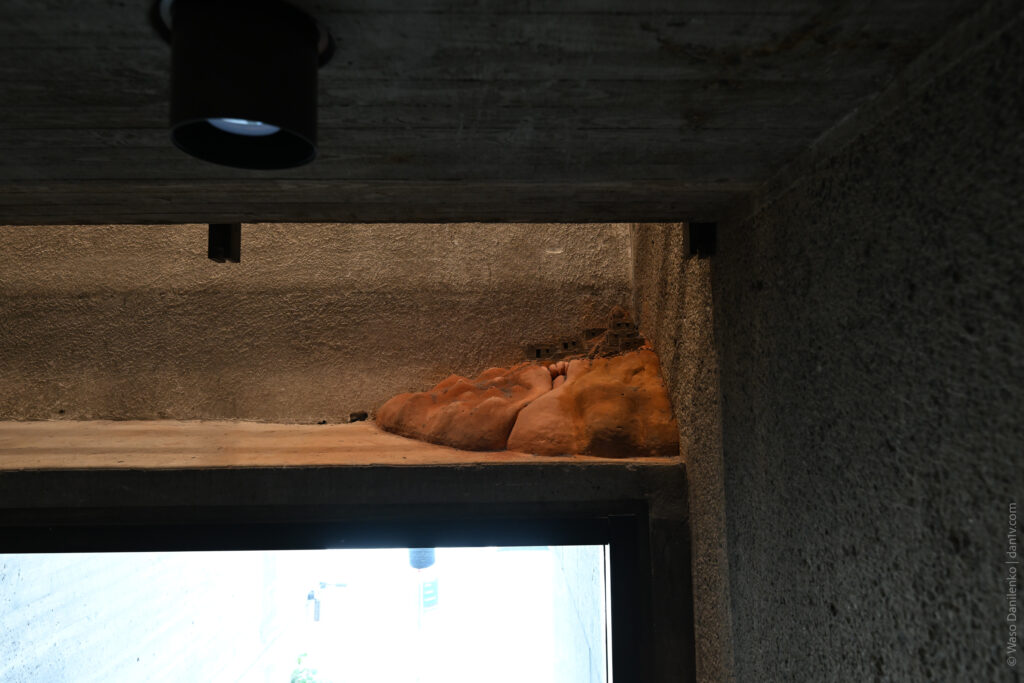
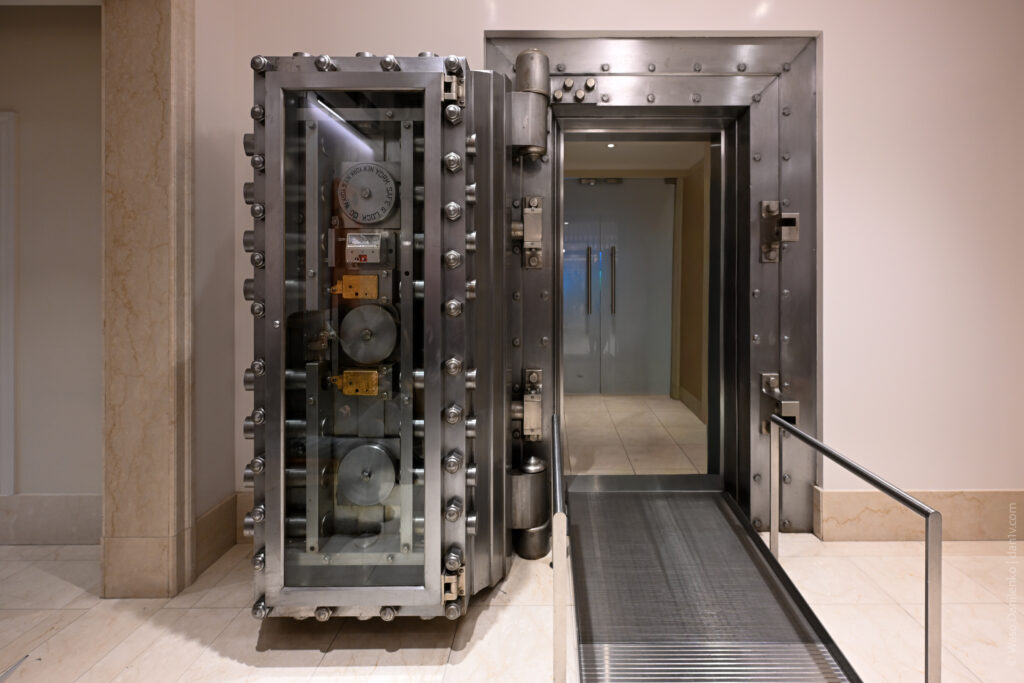
In the basement, the original bank vault still remains, complete with a steel door more than a meter thick. Today, instead of protecting cash and securities, it displays iPhones. On one of the windowsills, visitors can also find a tiny civilization made of sand and clay, created by artist Charles Simonds.
Key Facts About Apple Store on the Upper East Side
- The building was constructed between 1921 and 1922 for the New York bank United States Mortgage & Trust Company as its Madison Avenue branch.
- It was designed by Henry Otis Chapman of the architectural firm Barney & Chapman. The reported construction cost was approximately $600,000, equivalent to about $10–11 million today.
- In November 1922, the building received the First Prize from the Fifth Avenue Association for the best new architectural project of the year. Newspapers covering the award somehow forgot to print the architect’s name.
- The building is part of the Upper East Side Historic District, a landmark district designated by New York City in 1981. This means that any changes to the exterior must be approved by the Landmarks Preservation Commission (LPC). That is why, instead of installing an illuminated Apple logo, the store flies an Apple flag outside the building.
- Beginning in the mid-twentieth century, the building housed a Chemical Bank branch for nearly forty years, followed later by Chase Manhattan. In 1998, the branch was robbed at gunpoint, an almost unimaginable event for this neighborhood.
- Since 1981, two sections of Charles Simonds’ artwork Dwellings have been installed on the building’s façade. These miniature clay settlements represent an imaginary civilization. A third section is located across the street in the stairwell of the Breuer Building.
- Between 2002 and 2013, the building was home to the VBH boutique and gallery. The interiors were redesigned by architect Peter Marino.
- Apple opened its store here on June 13, 2015. The renovation was designed by Bohlin Cywinski Jackson, the same architectural firm responsible for the famous glass cube Apple Store on Fifth Avenue.
- The opening was preceded by a public dispute, as the East 74th Street Association attempted to prevent Apple from moving into the neighborhood.
- Directly across the street, at 945 Madison Avenue, stands the building designed by Marcel Breuer. It has served as the home of the Whitney Museum of American Art, later The Met Breuer and Frick Madison, and since November 2025 it has become the global headquarters of Sotheby’s.
The Architecture of Apple Store on the Upper East Side
In the spring of 1921, the United States Mortgage & Trust Company branch on Madison Avenue could no longer handle the growing number of customers. The building the bank occupied had simply become too small for its expanding business.
The bank purchased the neighboring properties and then sold its original building. The commission for the new headquarters went to Henry Otis Chapman, a partner at the architectural firm Barney & Chapman. The project was described at the time as being in the Late English Renaissance style, with a limestone façade, an entrance and base clad in Knoxville marble (a Tennessee marble known for its distinctive pinkish hue), and a floor plan designed to maximize natural light and ventilation.
The building’s architectural style is worth a closer look because sources still cannot agree on how to classify it. Newspapers in 1921 described it as Late English Renaissance. Modern architectural guides typically identify it as a restrained example of Beaux-Arts architecture. Manhattan historian Tom Miller calls it Neoclassical, while Architect Magazine describes it as an interpretation of late eighteenth-century French Neoclassicism, reimagined through the architectural language of the 1920s.
Despite these differing labels, the decorative details are remarkably restrained and precise: carved stone panels, flat stylized capitals above two-story pilasters, and a heavy balustrade parapet crowning the cornice.
The History of 940 Madison Avenue Before Apple Store
By the middle of the twentieth century, the building was occupied by a Chemical Bank branch, which remained there for more than forty years. By the end of the century, however, the bank required only a small portion of the property. The rest was occupied by the British antiques dealer Stair & Company, a respected name in the international fine furniture market.
In 1996, Stair & Co. subleased approximately 6,000 square feet to Alexander Gallery. The ten-year lease was valued at around $10 million and included part of the ground floor, the mezzanine, and the entire second and third floors.
By then, the gallery had spent two decades as a prominent figure in New York City’s art world. It was known not only for its exhibitions but also for its legendary Barterer’s Ball parties. Tickets could not be purchased. Instead, guests had to exchange property worth more than $10,000 during the evening to gain entry. Trades reportedly included houses in the Hamptons, chairs salvaged from the Titanic, and breeding rights for thoroughbred racehorses.
In 1996, Chemical Banking Corporation was renamed Chase Manhattan. On March 12, 1998, two armed men robbed the branch in broad daylight, shooting one customer in the leg before escaping with an undisclosed amount of money. The New York Times described the incident as a shocking disruption in a neighborhood known for its quiet shops, thick carpets, doorbells, and decorative iron grilles.
In 2002, the building became home to W. Bruce Hoeksema, owner of the Roman luxury brand VBH, known for its handbags and jewelry. Architects Peter Marino and Steven Lerner redesigned approximately 10,000 square feet of interior space. The former banking hall was transformed into an intimate, residential-style environment where $14,000 handbags were displayed alongside contemporary art and ethnographic objects, all of which were also available for purchase.
VBH deliberately preserved the gallery-like atmosphere established by its previous tenants. From its opening, the boutique maintained its own exhibition program under the direction of art dealer Mark Fletcher. In 2006, the space presented an exhibition featuring 160 photographs by Man Ray.
Over the course of a century, 940 Madison Avenue has served as a bank, an antiques showroom, an art gallery, an ultra-luxury boutique, and once again, a gallery before ultimately becoming one of the most distinctive Apple Stores in the world.
A Tiny Civilization on the Windowsill of Apple Store on the Upper East Side
Beginning in the early 1970s, artist Charles Simonds created homes for an imaginary civilization he called the Little People. He built miniature settlements from unfired clay, complete with towers, battlements, and crumbling walls, and placed them in cracks between bricks, on windowsills, inside gutters, and on vacant lots throughout SoHo and the Lower East Side.
These works were intentionally temporary. Rain washed them away, children dismantled them, and entire buildings containing them were eventually demolished. Over the following decades, Simonds created more than 300 of these miniature settlements in over 30 cities around the world, including Paris, Berlin, Shanghai, and Dublin.
In 1977, the Whitney Museum of American Art invited Simonds to create a work for its Biennial exhibition. He installed one of his tiny settlements on the windowsill of one of the distinctive trapezoidal windows of the Breuer Building.
Four years later, in 1981, the museum commissioned him to create a permanent installation. This time, Simonds did something particularly clever.
Always somewhat skeptical of cultural institutions, he declined to place the artwork inside a gallery. Instead, he selected the staircase between the first and second floors—a dim, transitional space that architects nevertheless consider one of the most beautiful parts of the building.
But that was only part of the idea. Simonds divided the installation into three separate sections. One remained inside the museum, while the other two were placed on the building directly across the street: one on a second-floor windowsill at 940 Madison Avenue, and another on a chimney cap on the roof.
The meaning of the gesture becomes immediately clear. The artwork physically breaks through the boundary of the museum itself. To experience it in its entirety, visitors must stand in the museum staircase, look upward toward the clay settlement above the window, and then look downward through the glass toward the continuation of the same civilization living across the street on the former bank building. No single viewpoint reveals the complete work at once.
Today, this is Charles Simonds’ longest-surviving installation anywhere in the world. It outlasted the Whitney Museum’s move to the Meatpacking District in 2015, with its preservation specifically required in the museum’s lease agreement with The Metropolitan Museum of Art. It survived the Met Breuer era, the Frick Madison years, and when Sotheby’s purchased the Breuer Building in 2023, the auction house publicly committed to preserving the entire installation, including the portions located on 940 Madison Avenue across the street.
How Apple Store Came to 940 Madison Avenue on the Upper East Side
By 2013, it had become public that the owners of 940 Madison Avenue had signed a lease with Apple. The neighborhood’s reaction was swift and overwhelmingly negative.
The East 74th Street Association, led in part by property owner Herbert Feinberg, hired legal counsel and published an open letter in June 2014 arguing that the proposed Apple Store would undermine both the building’s landmark status and the character of the neighborhood. Their argument was straightforward: Madison Avenue was known for its luxury boutiques, antique dealers, and quiet atmosphere, while Apple stores attracted large crowds.
Residents also raised procedural objections, claiming that the construction permit had been issued based solely on the contractor’s self-certification, without a formal inspection by either the New York City Department of Buildings or the Landmarks Preservation Commission (LPC).
Architectural Record observed that the neighborhood had certainly not welcomed its new tenant with open arms. At the same time, the magazine noted that the finished store was intentionally understated. There is no dramatic glass cube like the Apple Store on Fifth Avenue at 59th Street, and there is no illuminated Apple logo like the one inside Grand Central Terminal.
The Apple flag flying outside the building is not simply an aesthetic choice. It is the result of preservation regulations. Because the building is located within a designated historic district, all exterior signage must be approved by the Landmarks Preservation Commission. Madison Avenue is also subject to additional city regulations governing projecting signs. The flag became a practical compromise that satisfies preservation rules while still making the store instantly recognizable.
The Apple Upper East Side store officially opened on June 13, 2015, and continues to operate today.
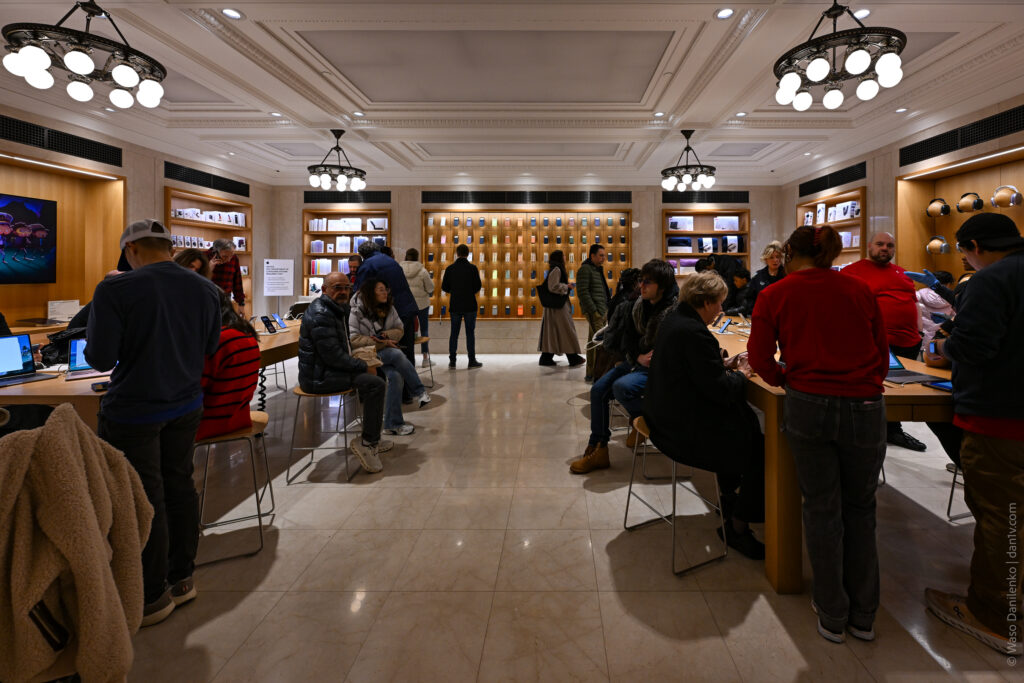
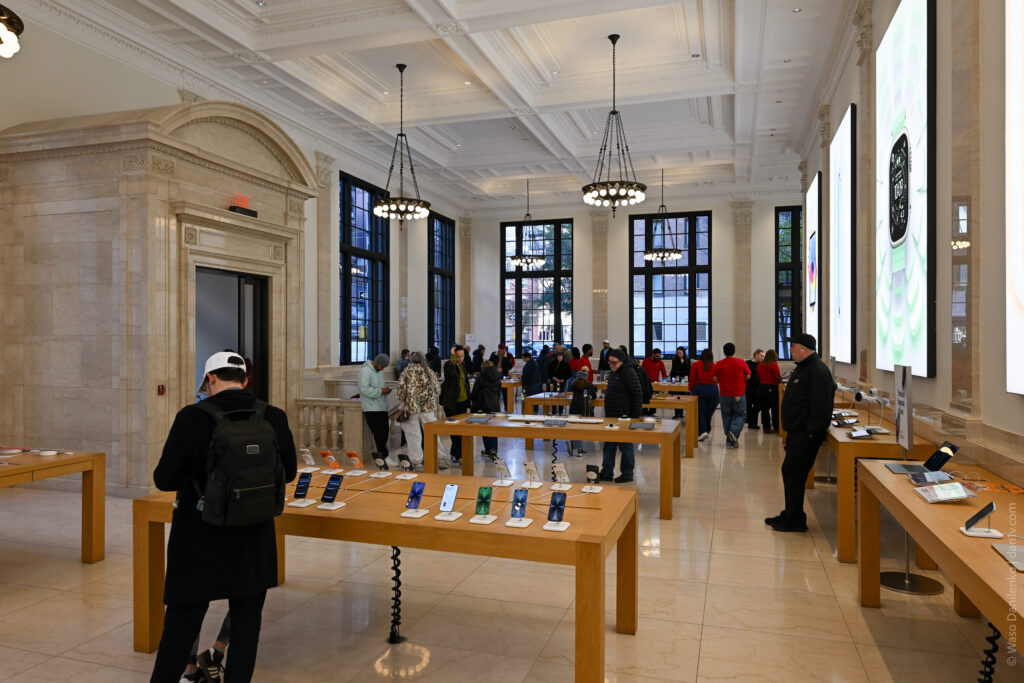
Inside, visitors will find very few of Apple’s signature display tables and almost none of the polished chrome finishes associated with the company’s newer stores. Those elements were deliberately minimized to avoid obscuring the building’s carefully restored historic interior. Instead, the space highlights soaring windows, a coffered ceiling, marble pilasters, and elegant chandeliers, allowing the architecture itself to remain the centerpiece.
Restoring 940 Madison Avenue on the Upper East Side for Apple
The renovation was carried out by Bohlin Cywinski Jackson, with teams from its San Francisco and Philadelphia offices. This became Apple’s fifth retail store in New York City. The same architectural firm also designed the iconic glass cube on Fifth Avenue and the Apple Store at the World Trade Center.
The project was divided into four major components: restoring and conserving the exterior façade, reconstructing lost historic interior finishes, making carefully targeted alterations to the floor plan—including new spaces in the basement—and completely replacing the building’s mechanical, electrical, and plumbing systems.
After nearly a century, portions of the Indiana limestone and Tennessee pink marble had deteriorated, and many of the windows required extensive restoration. Conservators analyzed historic paint layers and mortar compositions to accurately recreate the building’s original exterior colors. Botticino marble for the floors, wall panels, and pilasters was imported from Italy, while the chandeliers were reconstructed using archival photographs.
Several specialized restoration firms participated in the project. Aurora Lampworks restored the historic lighting fixtures, EverGreene Architectural Arts recreated decorative plasterwork and historic finishes, and Nine Stone Marble & Tile handled the stone restoration. EverGreene, in particular, redesigned, sculpted, cast, and installed new plaster ornamentation to restore the building’s coffered ceilings and replace missing decorative elements, relying on surviving photographs and architectural drawings to reproduce the original forms.
The primary objective was to restore the sense of height, natural light, and openness that architect Henry Otis Chapman had envisioned when designing the building in 1921.
The Bank Vault Inside Apple Store on the Upper East Side
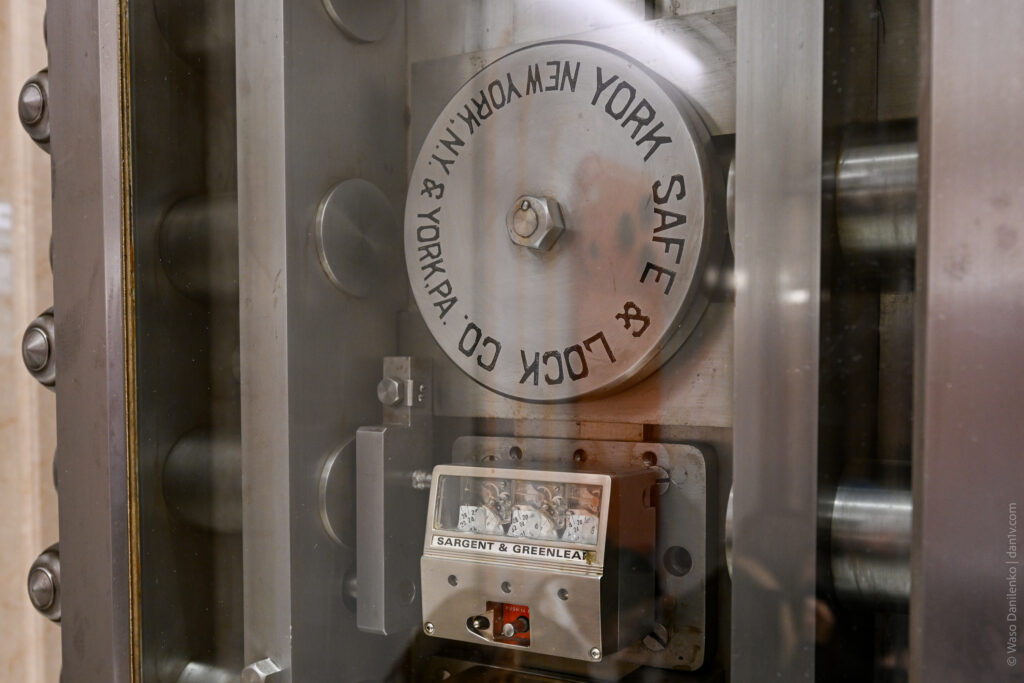
Apple chose to preserve the original bank vault, including its massive steel door.
Behind it is now the Experience Room, where customers are introduced to Apple’s products. When the store opened in 2015, the room was primarily used for appointments to view and try on the Apple Watch Edition, the solid-gold smartwatch that at the time cost as much as a luxury automobile. The space outside the vault, enclosed by its original security grilles, now serves as a waiting area.
Interestingly, preserving the vault was not only an aesthetic decision but also a practical one. Large bank vaults are typically built as structural components of the building itself. Removing one without dismantling a significant portion of the structure is virtually impossible. In this case, preserving the vault proved to be both the most elegant and the most practical solution.
Practical Information
📍 Apple Upper East Side / 940 Madison Ave, New York, NY 10021
Opening hours: Monday through Saturday, 10:00 AM–8:00 PM; Sunday, 10:00 AM–7:00 PM. It is always a good idea to check Apple’s website before visiting, as hours may change.
Subway: Take the 6 train to 77th Street (Lexington Avenue), then walk two blocks west.
Bus: M1, M2, M3, and M4 along Madison Avenue and Fifth Avenue; M79 SBS along 79th Street.
Admission is free, as this is a regular retail store. Visitors are welcome to enter and admire the historic interior without an appointment. However, appointments are required for the Genius Bar, and walk-in wait times can be several hours.
Nearby Attractions
- Sotheby’s at 945 Madison Avenue, directly across the street in the former Breuer Building. Public exhibitions are free; check Sotheby’s website for the current schedule.
- The Metropolitan Museum of Art, approximately seven blocks southwest via East 74th Street to Fifth Avenue.
- The Frick Collection at 1 East 70th Street, now returned to its historic mansion following its major renovation.
- The Whitney Museum of American Art, now located in the Meatpacking District on Manhattan’s west side.