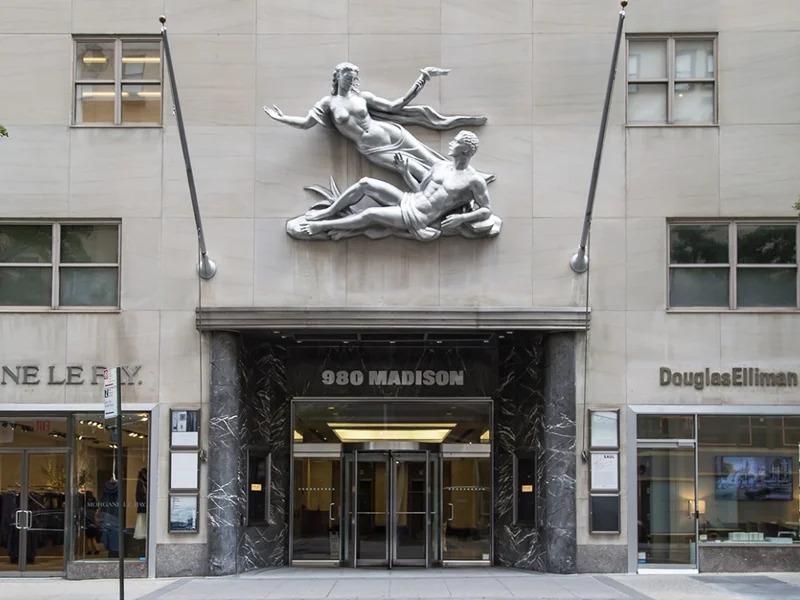
Gagosian is one of the largest commercial contemporary art galleries and, according to the Financial Times, one of the most influential art dealers in the world. The gallery has 15 exhibition spaces in seven countries, more than 300 employees, its own publishing house with hundreds of books published, and a quarterly magazine. Admission to all Gagosian galleries is free: no tickets or advance reservations are required.
In New York, Gagosian has five exhibition spaces: two on the Upper East Side and three in Chelsea. They show works by Duchamp, Rauschenberg, Picasso, Jasper Johns, and Richard Serra.
Interesting Facts About Gagosian Gallery
- On May 10, 2022, Larry Gagosian personally purchased Andy Warhol’s Shot Sage Blue Marilyn at Christie’s for $195 million, making it the most expensive Warhol painting ever sold.
- Gagosian started out selling framed posters. In the late 1960s, he rented a small patio in Westwood near UCLA and sold posters in frames, borrowing the idea from a street vendor he had seen while working as a parking attendant.
- In September 2008, according to Bloomberg, buyers from Russia and the former Soviet countries accounted for about half of Gagosian’s global sales.
- At the opening of a Gagosian exhibition at Moscow’s Krasny Oktyabr in 2008, motorcyclists burned tire marks across a special platform, turning their movement into a form of painting.
- In 2007, developer Aby Rosen proposed adding a 26-story residential tower designed by Norman Foster on top of the gallery building. The proposal was rejected by a vote of nine to one.
- In 2007, a residential high-rise was proposed above the Gagosian building on Madison Avenue, but local residents opposed the project. Among its critics was writer Tom Wolfe.
- In the year he graduated from university, Gagosian pleaded guilty to using someone else’s credit card and received a suspended sentence.
- Admission is free and no reservations are required at all five Gagosian exhibition spaces in New York.
Biography of Gagosian Gallery Owner Larry Gagosian
Lawrence Gilbert Gagosian was born in Los Angeles in 1945 to a family of Armenian immigrants. He studied English literature at UCLA, had no formal education in art, and worked at a record store, a bookstore, and the William Morris Agency before beginning his career in the art world.
In the late 1960s, Gagosian worked as a parking attendant in Westwood and noticed a street vendor selling posters. He rented a small space near UCLA, called it the Open Gallery, bought posters wholesale, had them framed, and resold them at a higher price. This simple model — buy, frame, and resell — marked the beginning of his future career as an art dealer.
By the mid-1970s, posters had given way to fine art. Gagosian opened Prints on Broxton, where he sold prints by Diane Arbus and Lee Friedlander, and later began organizing exhibitions of contemporary artists. Through photographer Ralph Gibson, he was introduced to Leo Castelli, one of the most important American gallerists of the postwar period, and later made connections with Charles Saatchi and Si Newhouse.
In 1978, Gagosian opened a gallery in West Hollywood and, at the same time, acquired a loft on West Broadway in New York, across from Castelli’s gallery. In 1979, it hosted David Salle’s first New York exhibition, and in 1982 Gagosian and Annina Nosei organized an exhibition of Jean-Michel Basquiat in Los Angeles. The official founding date of the Gagosian Gallery is considered to be 1980.
In the 1980s, Gagosian focused on the secondary market — buying and reselling already established works by Warhol, Lichtenstein, de Kooning, and other artists. The aggressive speed of his deals earned him the nickname “Go-Go.” In the middle of the decade, he opened a space in Chelsea, long before the neighborhood became New York’s leading gallery district.
One of his first major deals involved Jasper Johns’s False Start: in 1988, Gagosian paid more than $17 million for the painting on behalf of Si Newhouse, setting a record at the time for a work by a living artist. In 2022, he repeated the same strategy on a completely different scale, personally purchasing Andy Warhol’s Shot Sage Blue Marilyn at Christie’s for $195 million — a record price for a work of twentieth-century art at public auction.
At the same time, Gagosian has never particularly tried to present himself as a traditional gallerist. He prefers the word “dealer” and openly treats art as a business. He was among the first to aggressively recruit artists from competing galleries, ultimately breaking an unwritten code that had long existed in the art world.
980 Madison Avenue: From Parke-Bernet to Gagosian
The building at 980 Madison Avenue was constructed in 1949 for Parke-Bernet Galleries, the largest American auction house of its time. Architects A. Stewart Walker and Alfred Easton Poor designed a restrained modernist building measuring 4,200 square meters, with ten exhibition galleries and a main auction room seating 2,000 people. The building was deliberately limited to six stories so that it would not block the light reaching the neighboring Carlyle Hotel.
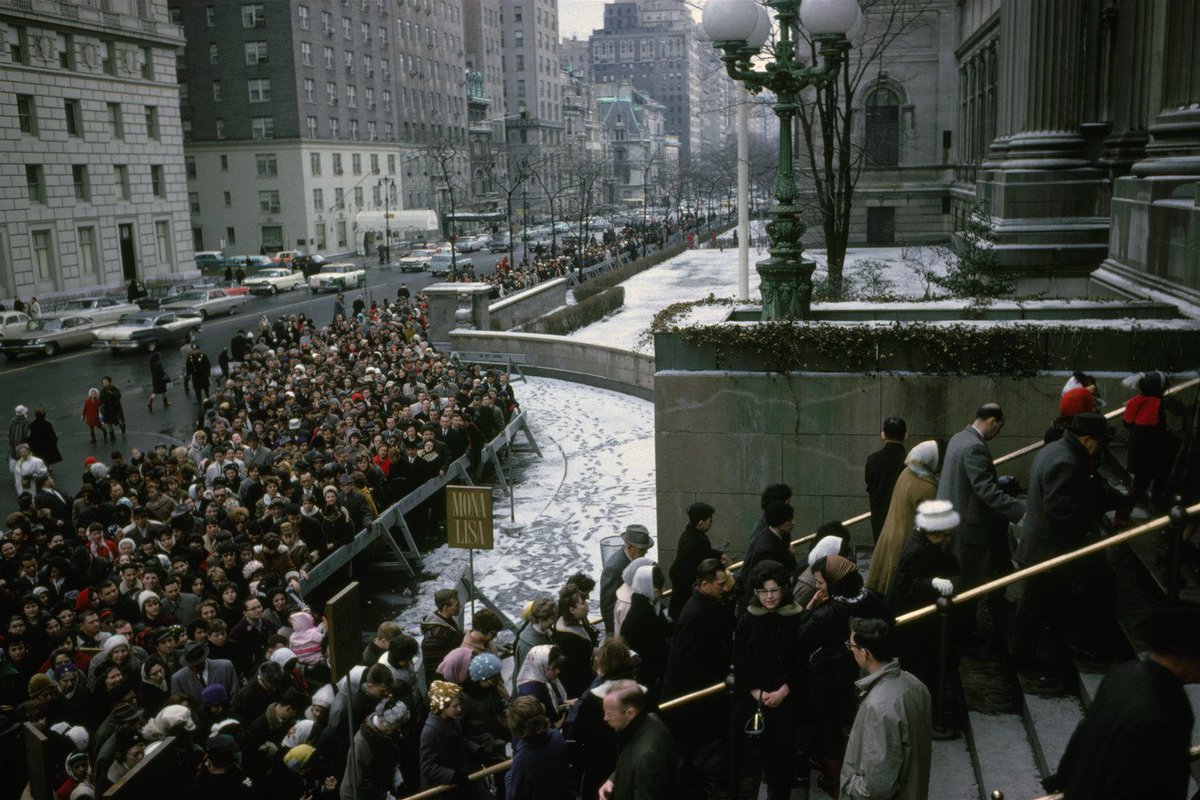
Parke-Bernet’s move to Madison Avenue effectively established the Upper East Side as a gallery district. The building itself soon became such an important center of the art market that The New York Times called it the “Grand Central Station of the art world”: collectors, dealers, curators, and artists met there.
Interestingly, in 2007, developer Aby Rosen proposed adding a 26-story residential tower designed by Norman Foster on top of the building. The Landmarks Preservation Commission rejected the proposal by a vote of nine to one.
In 1987, Sotheby’s, which by then owned Parke-Bernet, closed the auction rooms and moved to York Avenue. The vacated building was divided into separate spaces, and this was when Larry Gagosian arrived. He initially rented a small office, gradually took over several floors, and in February 1989 opened his first exhibition there, Jasper Johns: Maps. Over the next 37 years, the Madison Avenue location hosted exhibitions of works by Picasso, Warhol, Pollock, Twombly, Rauschenberg, Lichtenstein, and many other major artists of the twentieth century.
In 2024, Bloomberg Philanthropies purchased the entire building for $560 million, after which Gagosian had to vacate the upper floors. The final exhibition there was Jasper Johns: Between the Clock and the Bed, which closed on April 24, 2026.
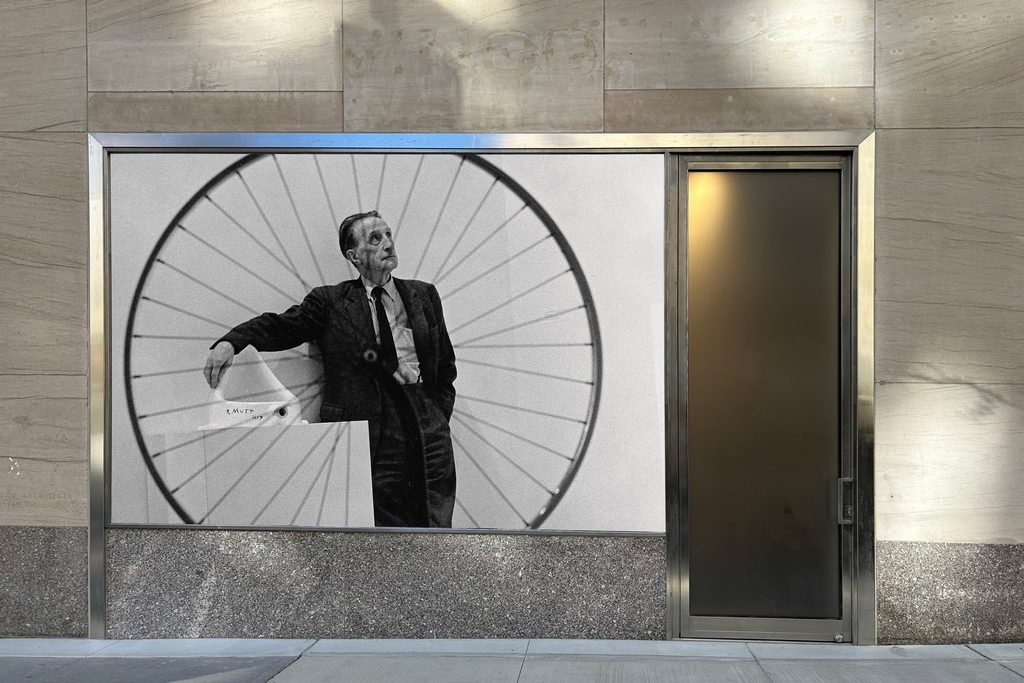
However, Gagosian did not leave the building. On April 25, 2026, the gallery opened a new ground-floor space, combining three former retail units into a single 211-square-meter exhibition gallery. Architect Jonathan Kaplan designed the space to be flexible: it can be divided into three sections with partitions or opened up into one large gallery. The inaugural exhibition featured Marcel Duchamp’s readymades, while a smaller room presented early works by Robert Rauschenberg.
Five Gagosian Galleries in New York
Today, Gagosian has five exhibition spaces in New York: one on the Upper East Side and four in Chelsea. They differ considerably in size and character, ranging from a small, intimate gallery to spaces designed for monumental works:
- 980 Madison at 76th Street — Gagosian’s main Upper East Side location. The new ground-floor gallery in the former Parke-Bernet building opened in April 2026. It hosts major historical exhibitions featuring artists such as Duchamp, Rauschenberg, Picasso, Jasper Johns, and Nam June Paik. The entrance is at 974 Madison Avenue, next to Kappo Masa.
- 555 West 24th Street — Gagosian’s main and largest gallery in Chelsea, opened in 1999. It was designed by architect Richard Gluckman specifically for large-scale art. The first exhibition featured Richard Serra’s Switch — six steel plates more than four meters tall.
- 522 West 21st Street has operated since 2006 and was also designed by Richard Gluckman. It has hosted important exhibitions of Warhol and Picasso, including Mosqueteros, a major project devoted to Picasso’s late works, organized by his biographer John Richardson.
- 541 West 24th Street — the smallest and newest of Gagosian’s major Chelsea locations. The gallery opened in 2020 in the former space of Mary Boone Gallery and primarily presents solo projects by contemporary artists.
- Park & 75 at 821 Park Avenue — an intimate space of less than 100 square meters, opened in 2014. It is more of a small showcase for compact projects and emerging artists, and is worth visiting if you are already on the Upper East Side.
Separate from the five galleries are Gagosian Shop and the Kappo Masa restaurant on Madison Avenue. The shop sells books, editions, and gallery publications, while the restaurant occupies the lower level of the building.
Visitor’s Information
Upper East Side:
📍Gagosian / 980 Madison Ave, New York, NY 10075
📍Gagosian / 821 Park Ave, New York, NY 10021
📍Gagosian Shop / 976 Madison Ave, New York, NY 10075
Chelsea:
📍Gagosian / 555 W 24th St, New York, NY 10011
📍Gagosian / 541 W 24th St, New York, NY 10011
📍Gagosian / 522 W 21st St, New York, NY 10011
Hours: Tuesday through Saturday, 10 a.m. to 6 p.m.; closed on Sundays and Mondays. During the summer, from approximately late June to late August, the gallery is open Monday through Friday, 10 a.m. to 6 p.m.
Website: gagosian.com/locations