
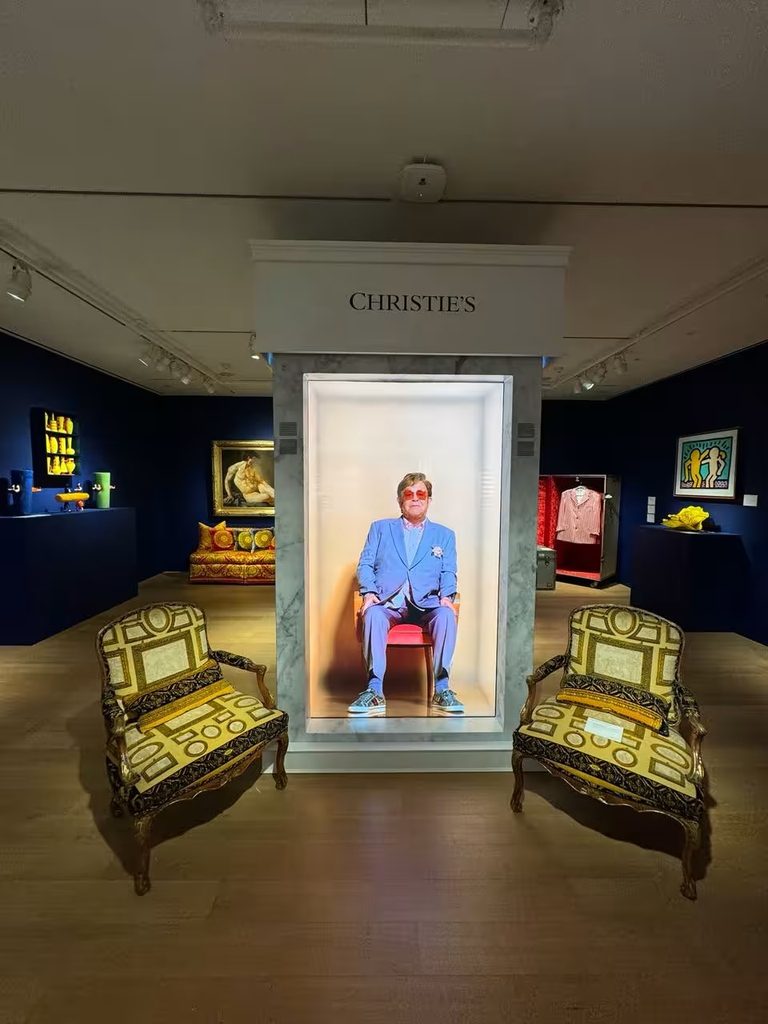
In mid-February, I visited Christie’s auction house in New York for the first time. I admit that I went there with the naive hope of winning a lot at auction someday, even if it had to be in my next life. But something else turned out to be a much more pleasant surprise. Christie’s operates not only as an auction house, but also as a full-fledged free gallery that anyone can walk into directly from the street. After my very first visit, I added Christie’s to my personal list of must-visit cultural destinations in New York, and here is why.
Interesting Facts About Christie’s
- A $450,000,000 record. In 2017, Leonardo da Vinci’s Salvator Mundi was sold at Christie’s for $450 million. It remains the most expensive painting ever sold at auction.
- René Magritte’s L’ami intime was sold for just £90,000 in 1980. In March 2024, after spending 25 years out of public view, the same painting was sold for £33,600,000, or approximately $43,200,000.
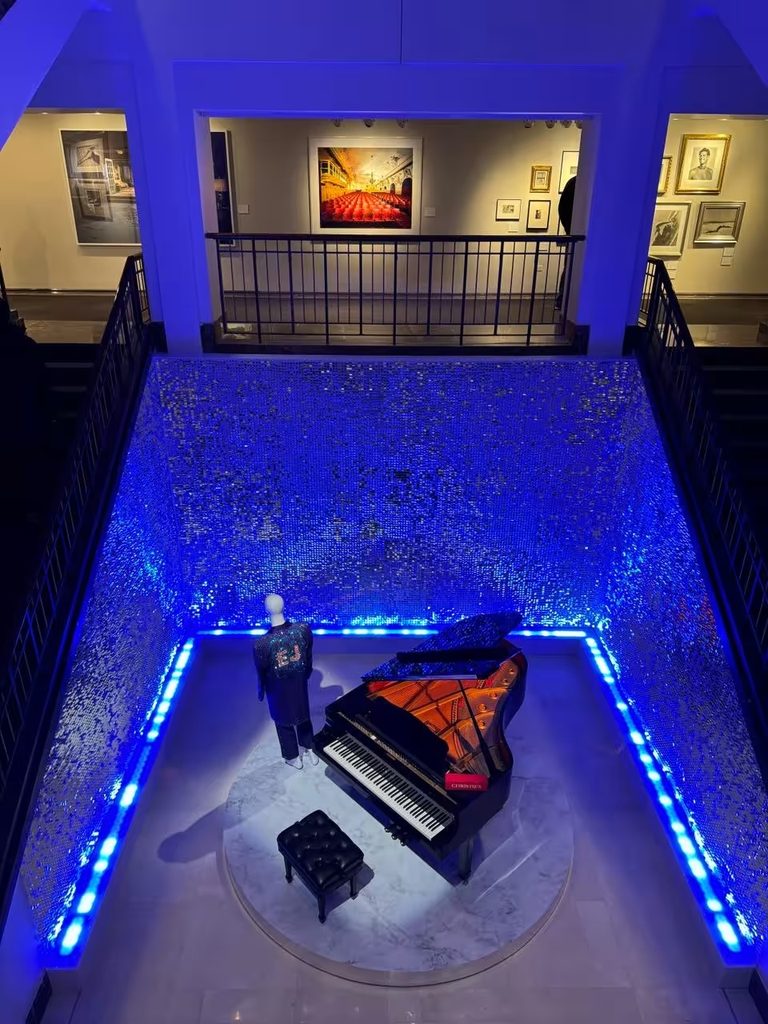
- Elton John’s concert grand piano. At the 2024 auction of Elton John’s collection, his Yamaha concert grand piano was offered for sale. He used the piano to write songs including “Daniel,” “Candle in the Wind,” and “Goodbye Yellow Brick Road.”
- A price next to every artwork. Unlike traditional museums, Christie’s galleries display not only descriptions but also prices next to the artworks. This makes Christie’s a unique place in New York where you can look at art on a museum level while simultaneously viewing it as a potential buyer.
- A Sol LeWitt mural in the three-story lobby. A work specially created by the artist decorates the lobby of Christie’s New York building and is itself considered an architectural landmark of Rockefeller Center.
- A connection to the Hermitage dating back to 1778. That year, the founder of the auction house, James Christie, organized the sale of the collection of Robert Walpole, which was purchased by Catherine the Great. These works later became part of the foundation of the Hermitage collection.
- David Hockney’s California. The painting remained in a private collection for more than 40 years before being exhibited in New York ahead of its London auction.
- Christie’s has occupied 20 Rockefeller Plaza since 1997. The auction house operates there under a 40-year lease and is expected to remain at the location for at least another ten years.
- Completely free admission. There are no tickets, registration, or lines. Anyone can simply walk in from the street and visit the Christie’s galleries during opening hours.
What Is Christie’s?
Christie’s is one of the oldest and most famous auction houses in the world. It was founded in London in 1766 by James Christie. Over nearly 260 years of operation, the house has handled collections belonging to Robert Walpole, which were purchased by Catherine the Great, as well as the jewelry of Madame du Barry. In 2017, Leonardo da Vinci’s Salvator Mundi was sold at Christie’s for $450,000,000, which remains the record price for a work of art ever sold at auction.
The main reason to visit Christie’s at least once, besides the art itself, is its location. The gallery is right inside Rockefeller Center, in the heart of Manhattan, just a couple of minutes’ walk from Fifth Avenue, the skating rink, and the Top of the Rock observation deck.
Today, Christie’s has around eighty offices in 43 countries, as well as salerooms in London, Paris, Hong Kong, Milan, Geneva, and Dubai. The New York branch has occupied 20 Rockefeller Plaza since 1997 under a 40-year lease that runs through 2037. The house has approximately 28,800 square meters of space here, right in the heart of Rockefeller Center.
Inside, Christie’s feels more like a museum than a corporate office. The three-story lobby is decorated with a specially commissioned mural by artist Sol LeWitt, while just around the corner there is a free café with a decent selection of teas where you can sit quietly between the galleries. There is no hustle and bustle and no ticket counter, just security at the entrance and exhibition spaces that constantly change depending on what is being prepared for the upcoming auctions.
The Collection and Prices at Christie’s
One of the particular pleasures for anyone who loves both art and numbers is that next to almost every object, there is not only a description but also an estimate, meaning the expected price range for the sale. This format makes walking through the galleries feel almost like a game: you are not simply looking at a painting, but immediately trying to guess how much collectors from around the world might be willing to pay for it.
A good example of just how accessible the starting price range can be was a pink Louis Vuitton suitcase, estimated at $800, while a pair of Elton John’s glasses could be purchased for an estimate starting at $2,000. In the end, the February 21 evening sale brought in $8,000,000, with all 49 lots sold. Some items went for several times their low estimates, including the famous 1971 platform shoes, which ultimately sold for $94,500 instead of the initial $5,000 estimate.
In another wing, private sales unrelated to Elton John’s collection were taking place at the same time. There, the works were on the level of museum highlights and could disappear into private collections for decades, potentially never being shown publicly again.
The main highlight of the gallery was David Hockney’s California (1965), depicting his signature swimming-pool motif. The painting, measuring 168 by 198.8 centimeters, had not been shown publicly for more than 40 years. After its New York exhibition, it was sent to London for auction on March 7, 2024, with an estimate of approximately $20,000,000.
Several works by René Magritte were also displayed nearby. Among them was L’ami intime (1958), which had last been shown publicly in Brussels in 1998 and had not appeared at auction since 1980. It carried an estimate of up to $64,000,000 ahead of its London sale, held to mark the centenary of Surrealism. Also on display were Le paysage de Baucis and perhaps the most unusual of Magritte’s works in the exhibition, L’évidence éternelle, genoux.
The exhibition was completed by Edvard Munch’s Hage (1902), painted at his summer home in Åsgårdstrand, Norway. The work depicts a summer garden in shades of pink and gold and looks completely different from his much more famous The Scream.



Visitor’s Information
📍Christie’s / 20 Rockefeller Plaza, New York, NY 10020
Admission: Free
Hours: 10:00 AM to 5:00 PM weekdays and Saturdays; 1:00 PM to 5:00 PM Sundays