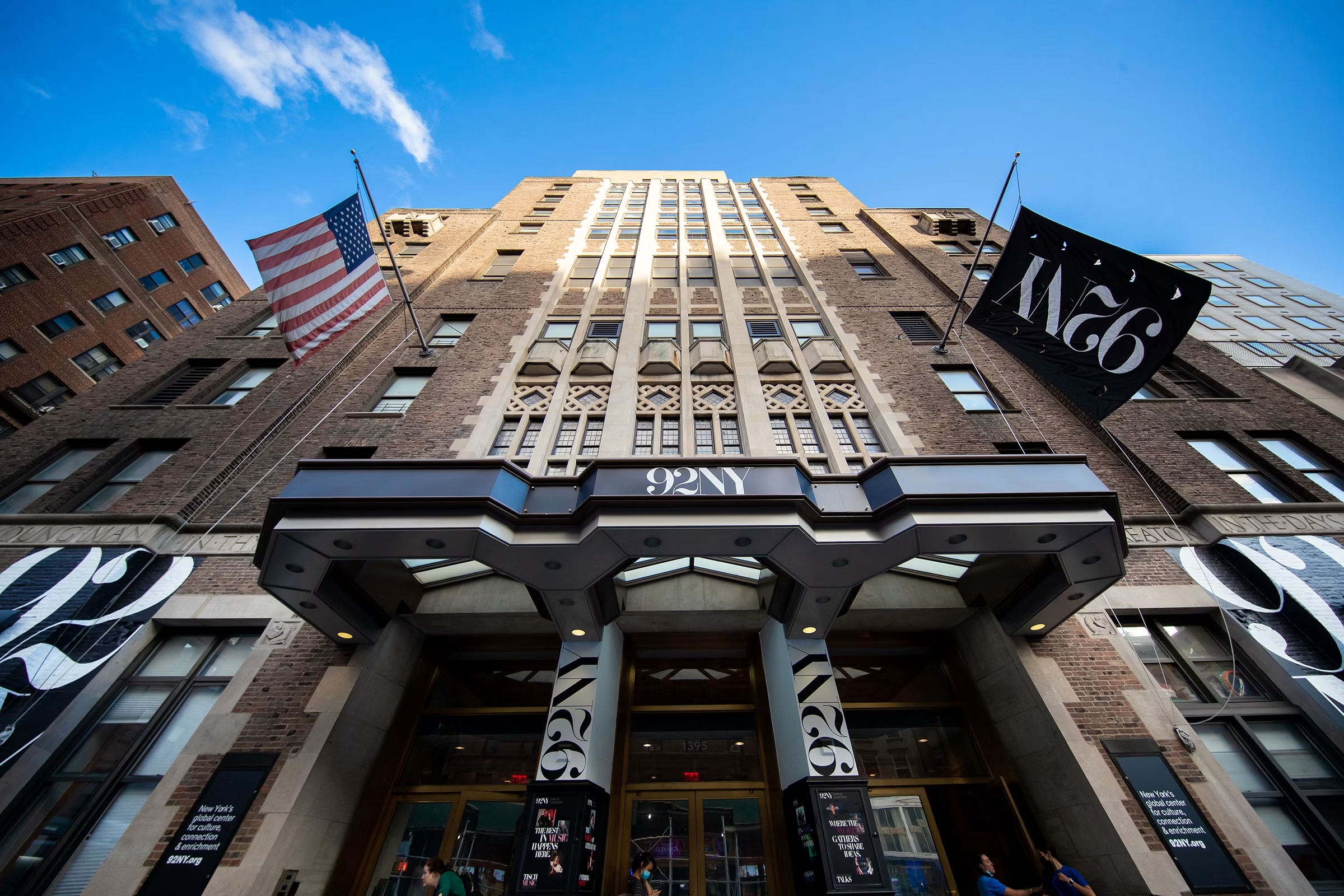
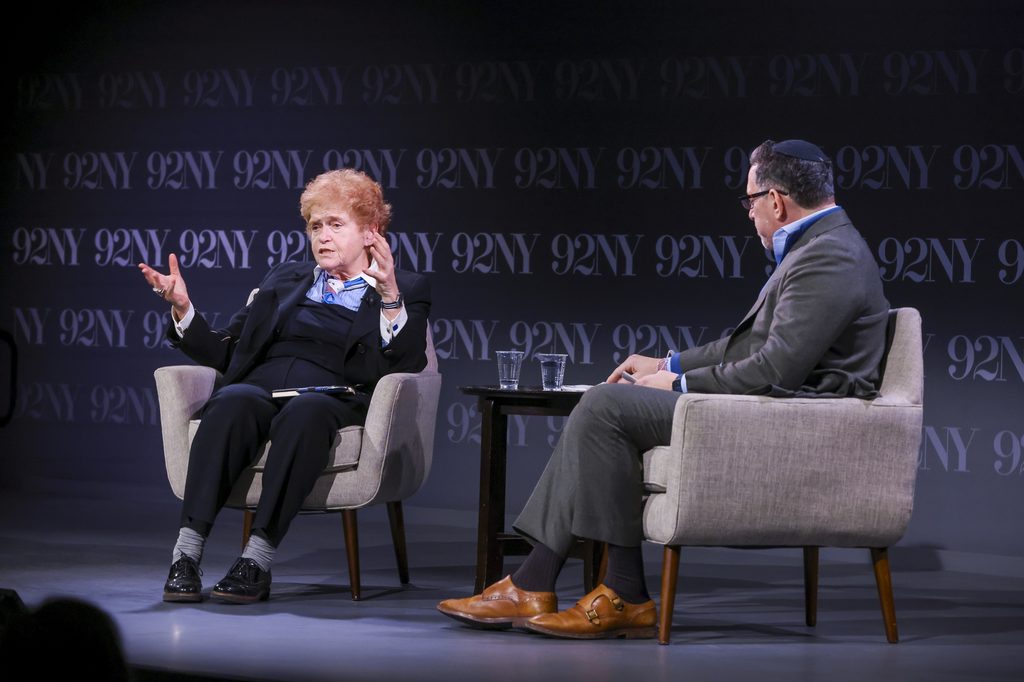
The 92NY cultural community center in New York is known for its educational programs, exhibitions, concerts, children’s and family activities, and interest clubs. But above all, it is a space for meetings and live lectures with prominent figures. In the center’s halls, you can hear world opinion leaders, authors, actors, and entrepreneurs, often in an intimate setting with an opportunity to speak with them in person.
I attended a presentation of Bill Clinton’s book, a meeting with Al Pacino, a conversation with Tom Hanks’s daughter (the interview was conducted by Hanks himself!), and a conversation with architect Bjarke Ingels, the founder of BIG. Incidentally, it was his projects VIA 57, The Spiral, and Freedom Plaza that we covered in articles on this blog. I even managed to ask him a question about the “ugliest building in New York.” His answer was New York Penn Station, the railway station in the very heart of the city that is located underground. It is difficult to disagree with this choice, especially considering what PENN Station looked like in the past.
Interesting Facts About 92NY
- In 1874, a group of New York entrepreneurs of German-Jewish origin founded the Young Men’s Hebrew Association (YMHA), envisioned as a secular social and educational club.
- Before moving to its current location, the organization changed addresses three times: West 21st Street, then 42nd Street, and in 1886 and 1895, Lexington Avenue in the area of East 58th and 59th Streets.
- The center acquired its permanent home at the corner of 92nd Street and Lexington Avenue thanks to philanthropist and banker Jacob Schiff, who financed the construction of the 1900 building designed by architect Arnold Brunner, known for his synagogues built around the turn of the century.
- The current 10-story Art Deco building was constructed in 1929–1930 according to a design by the architectural firm Gehron, Ross & Alley, the same architects who designed the building of the Jewish Theological Seminary in Washington Heights.
- The building originally included a dormitory, gyms, a kosher kitchen, and an assembly hall. In other words, it was not simply a cultural center, but a full-fledged “home” for the Jewish community.
- The art center itself opened in 1934, while a year earlier William Kolodny became director. He convinced the board that art was part of the Jewish tradition of learning for the sake of learning and opened the concert hall and lectures to everyone, not only members of the organization.
- It was thanks to Kolodny that a dance center, a music school, and the famous Poetry Center (now the Unterberg Poetry Center) were established in the 1930s. It is one of the oldest poetry centers in the United States.
- In 1945, the organization merged with the Young Women’s Hebrew Association, and in 1972 it was renamed the “92nd Street Y.” In 2022, following a rebranding, the center became known as 92NY.
- It was 92NY that created and launched the worldwide #GivingTuesday initiative in 2012, the “Tuesday of giving” held after the American Thanksgiving holiday.
- More than 300,000 people visit the center’s physical venues every year, while millions of viewers watch free broadcasts of lectures and concerts online.
- Over the years, Ruth Bader Ginsburg, Malcolm Gladwell, Billy Joel, Paul McCartney, Richard Dawkins, Al Pacino, Jon Stewart, and dozens of other celebrities have appeared at 92NY.
- The building also operates as a residential boarding facility. For example, at the age of 18, future jazz pianist Harry Connick Jr. lived there after moving to New York in 1985.
- Since 2022, the center has been carrying out a $200 million renovation program designed to modernize the historic spaces and infrastructure of the building.
The History of the 92NY Building
The history of 92NY is essentially the story of how a secular Jewish mutual-aid club for immigrants gradually evolved into one of New York’s leading cultural venues. The organization was officially incorporated on September 10, 1874, and spent its early years in rented spaces across Manhattan until Jacob Schiff provided the funding for the first permanent building at the corner of 92nd Street and Lexington Avenue in 1900.
The building quickly became too small for the growing organization, and in 1929–1930 it was replaced with a new structure — the same 10-story Art Deco building that still stands there today. Until the mid-1930s, the club remained almost exclusively Jewish in both its membership and programming, but under director William Kolodny, it began opening its doors to the wider public: concerts, lectures, and dance evenings became available to everyone, not just members of the community. It was then that the formula that still defines 92NY today took shape — an educational and cultural center where high art exists alongside live conversations with prominent figures.
In the 1960s, a south wing was added to the building. It housed the Clara de Hirsch Home for Working Girls, which had merged with the organization, as well as new spaces for cultural and arts programs. In 2022, the institution changed its name from 92nd Street Y to 92NY and announced a major five-year renovation project costing approximately $200 million, aimed at upgrading the building’s engineering systems, halls, and public spaces while preserving its historic Art Deco facade.
The Architecture of the 92NY Building
The 1929–1930 Art Deco tower was designed by the architectural firm Gehron, Ross & Alley, the same architects responsible for the Jewish Theological Seminary building in Washington Heights. Its strict vertical silhouette, characteristic of late-1920s New York Art Deco, originally concealed a much more utilitarian interior program: a dormitory, sports facilities, a kosher kitchen, and an assembly hall. In other words, the building was designed from the very beginning as a multifunctional “home” for the community rather than simply an exhibition or concert venue.
The heart of the building is the wooden Kaufmann Concert Hall (Theresa L. Kaufmann Auditorium), donated in memory of the wife of philanthropist Henry Kaufmann. The acoustics of this hall played a major role in shaping the center’s future: its sound quality attracted musicians and lecturers and transformed an interest club into a full-fledged concert venue of international stature.
In 1968, another building was constructed on the southern part of the block, designed by architect Gilbert L. Seltzer and also funded by the Kaufmann family. The contrast between the ornate 1930 Art Deco building and the austere concrete structure from 1968 is still clearly visible today if you walk along Lexington Avenue.
Visitor’s Information
📍92NY / 1395 Lexington Ave, New York, NY 10128
Website: www.92ny.org