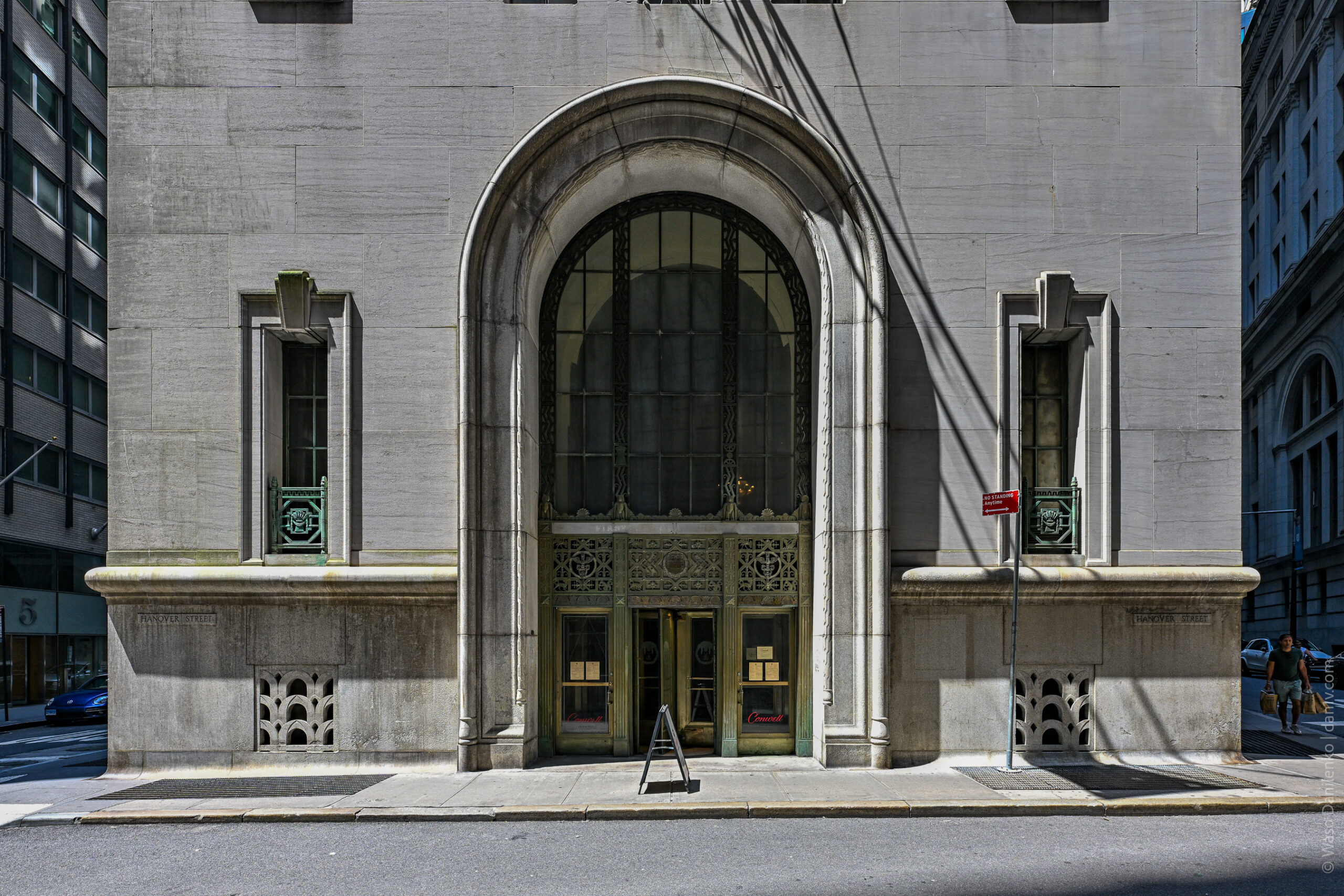
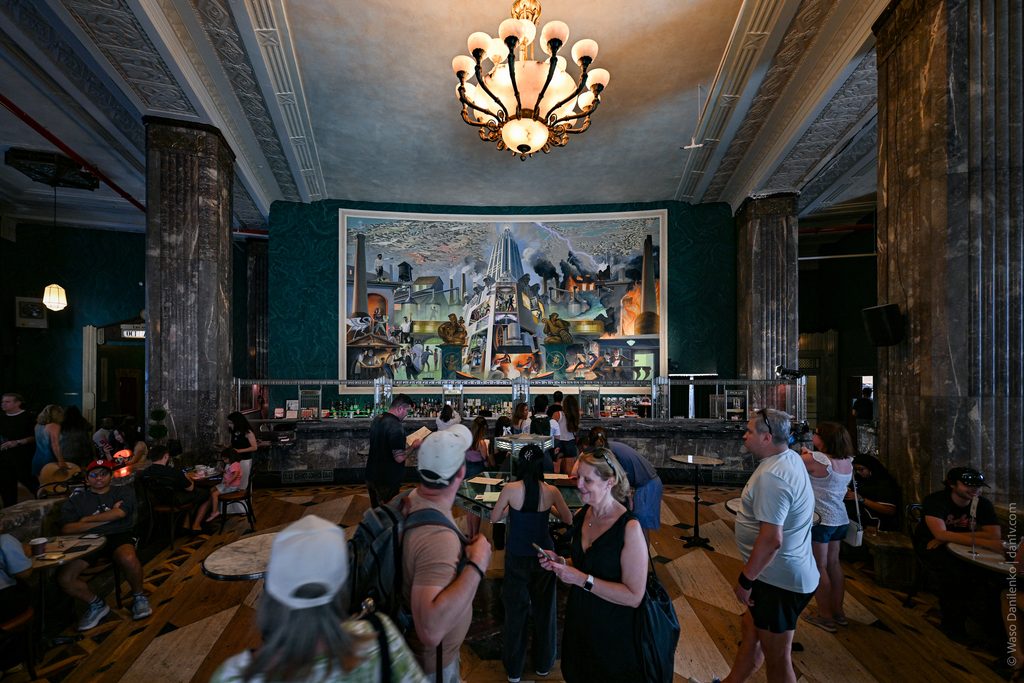
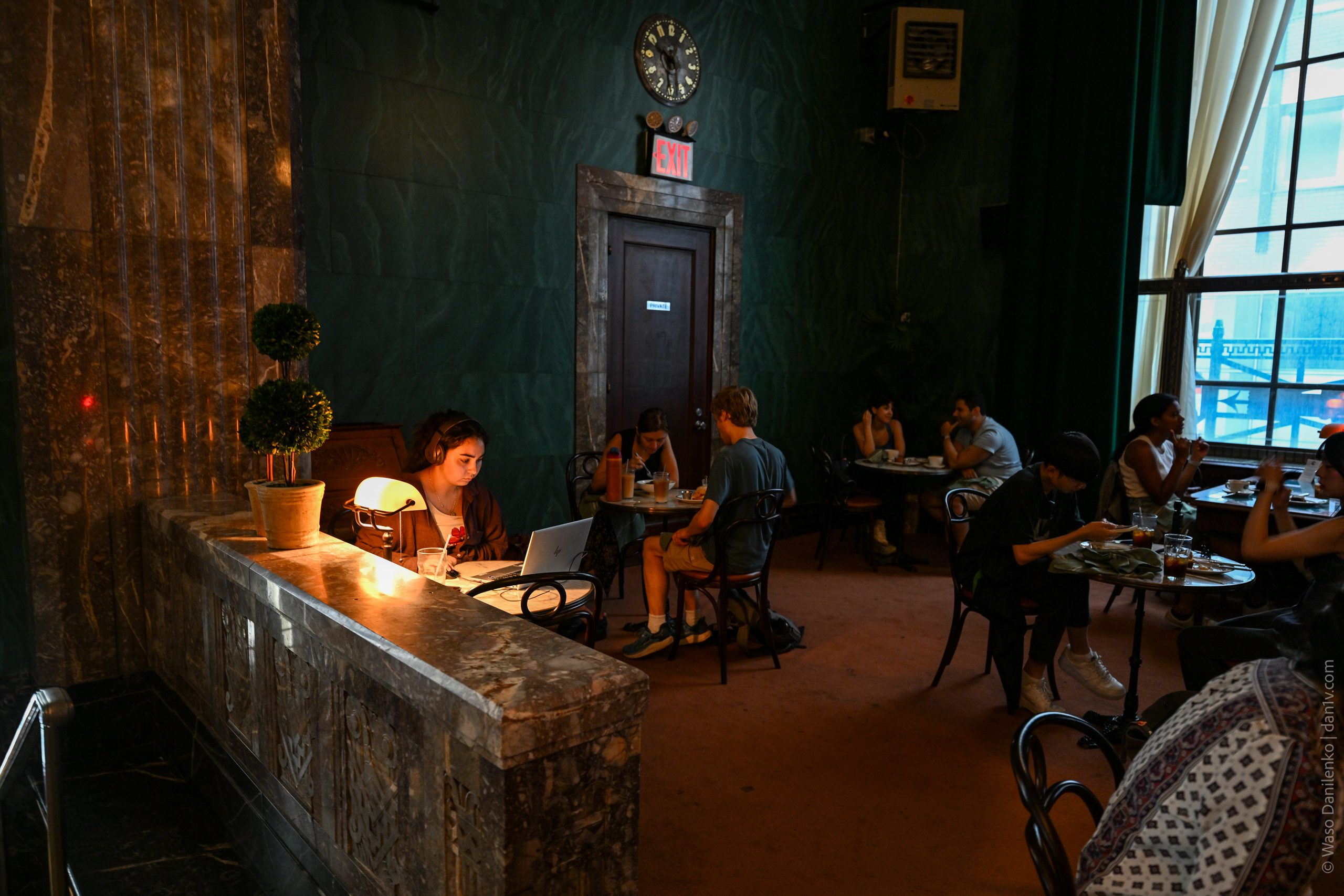
New York has coffee shops with good coffee and coffee shops with impressive interiors. Conwell Coffee & Cocktail Hall manages to combine both: for $6, you can have a latte in a former 1931 bank hall, surrounded by marble columns, teller windows, and the original vault door.
But the most interesting part begins when you learn the history of the place: J.G. Conwell, after whom the coffee shop is named, never existed.
Interesting Facts About Conwell Coffee & Cocktail Hall
- The coffee shop is located on the ground floor of 20 Exchange Place. When it opened, the building was the fourth-tallest in the world and the tallest building entirely clad in stone.
- The entrance is through golden revolving doors on Hanover Street. There is almost no signage, so people regularly walk right past it.
- During the day, it is the Coffee Hall, with no reservations required. From 5:00 p.m., it becomes the Cocktail Hall, with reservations available through Resy.
- Fourteen stone heads of the “giants of finance” look down at you from the building’s facade on the nineteenth floor.
- The venue is owned by Emursive, the same company that ran the immersive show Sleep No More in Chelsea for almost fourteen years.
- J.G. Conwell is a fictional character. He is the protagonist of Life and Trust, a show that ran in the same building from August 1, 2024, to April 19, 2025.
- Golden Hour runs from 5:30 to 7:00 p.m., with $12 martinis and $2 oysters. It is one of the best happy hours in the Financial District.
The Building That Houses Conwell Coffee & Cocktail Hall
To understand the coffee shop’s interior, it is worth looking at the building itself first. 20 Exchange Place was built in 1930–1931 as the new headquarters of City Bank Farmers Trust Company, which was created through the merger of two of the oldest financial institutions in the United States.
The tower was originally planned to be much taller, reaching 75 floors and approximately 925 feet. After the 1929 stock market crash, the project was revised, and the final building had 59 floors and stood approximately 685 feet tall. Construction took just one year: the first steel column was installed on February 25, 1930, and the building opened on February 24, 1931.
The building was designed by the New York firm Cross & Cross, founded by brothers John and Eliot Cross. They had been working in the city since the beginning of the twentieth century and later designed, among other buildings, the General Electric Building on Lexington Avenue and the Tiffany & Co. flagship store on Fifth Avenue.
Today, 20 Exchange Place is generally considered an Art Deco building, although its architecture differs noticeably from the style’s more familiar image. There are almost no zigzags or chevrons here: a strict classical composition is combined with Gothic motifs and metal details that were modern for the 1930s.
20 Exchange Place has a rather unusual composition. The base occupies an entire irregularly shaped block, a shape that dates back to the historic layout of Lower Manhattan. The tower above it, however, follows New York’s regular street grid and has an octagonal plan with chamfered corners.
As a result, the building really does look as though it consists of two different parts: historic Lower Manhattan at the bottom and a modern 1930s skyscraper above it.
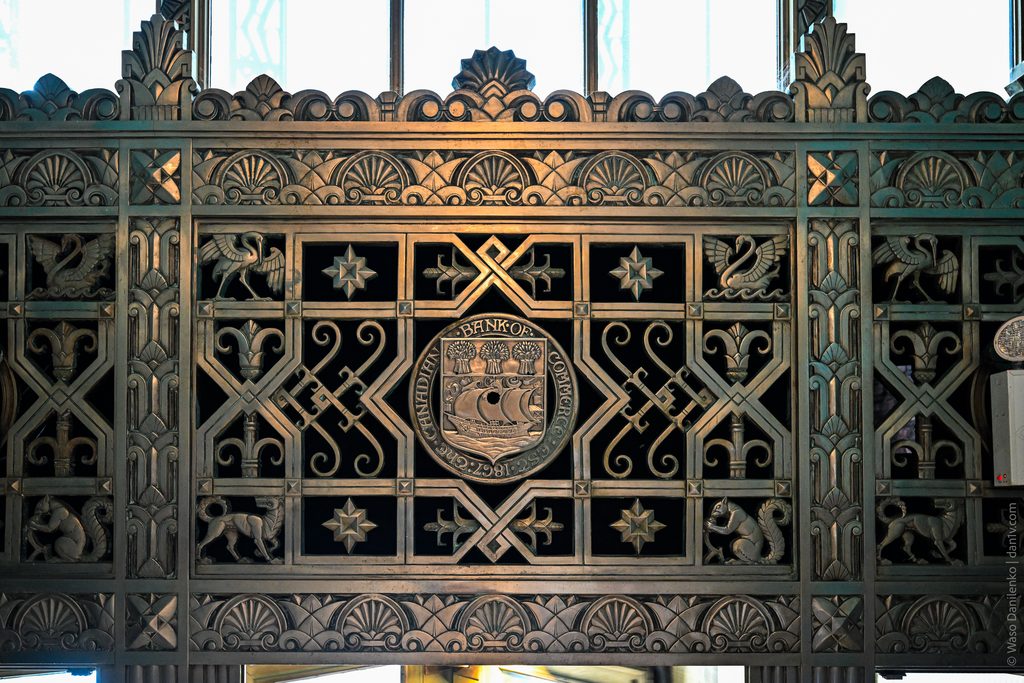
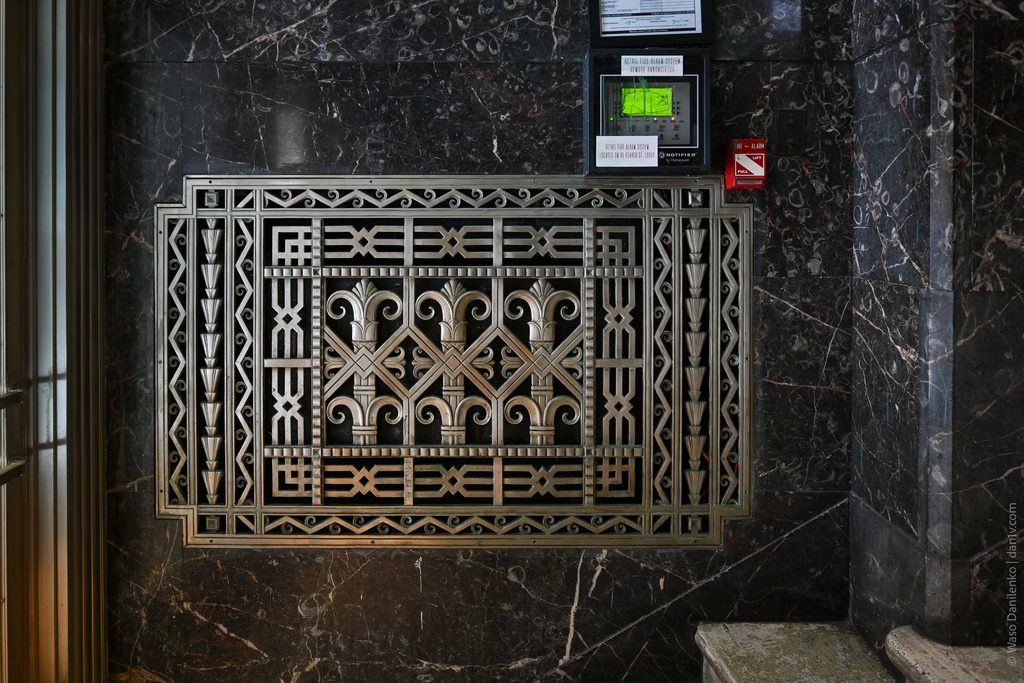
Another distinctive feature is the cool, silvery metal. The decorative elements are not made of the more familiar bronze, but of nickel silver, an alloy of copper, nickel, and zinc. For a building of this scale, this was an unusual choice, and it helps explain the distinctive cool sheen that is particularly noticeable today in the coffee shop’s interior.
What to See Outside Conwell Coffee & Cocktail Hall
20 Exchange Place has details that are easy to miss if you simply walk past.
At the 19th-floor level, the facade is decorated with fourteen enormous stone heads wearing helmets and hoods. They were created by British sculptor David Evans, who was responsible for the building’s entire decorative scheme. A popular interpretation connects the seven smiling and seven frowning faces to the biblical story of the seven years of plenty and seven years of famine, as well as the 1929 financial crisis. There is no such explanation, however, in the official documentation.
At the entrance on Exchange Place, eleven coins are carved into the granite arch, representing countries where National City Bank had branches. Their exact list is unknown. Another group of coins appears on the window lintels on the lower floors. They include ancient and historical examples, including an Athenian tetradrachm with an owl, a Sicilian coin with an eagle, and an American Indian Head nickel.
There is also a rather unexpected artifact here. Among the coins is an Italian 20-lire coin from 1927 featuring Roman fasces, a symbol of Italian Fascism under Mussolini. The fasces are repeated in the decorative window grilles. Unlike some other New York buildings where similar symbolism was removed after World War II, it remains here.
But the best details to examine are the doors on William Street. Four doors made of nickel silver are decorated with transportation motifs: the central doors feature sailing ships, hot-air balloons, and early trains, while the side doors show airplanes, ocean liners, and diesel engines. Above them are allegorical figures representing abundance and caution, and the composition is topped with four owls.
And one more detail: the street names are carved directly into the stone at the building’s corners. That is why it is worth walking all the way around 20 Exchange Place rather than limiting yourself to the facade by the coffee shop entrance.
What Was Inside the Building That Now Houses Conwell Coffee & Cocktail Hall
Inside 20 Exchange Place, an entire banking operation once functioned, and the coffee shop is now occupying a small part of it. Most of the original interior is no longer accessible, but the scale of the former bank can still be understood from its interiors and technical systems.
The main space was a rotunda approximately 30 feet high, with six red marble columns, eagle-shaped capitals, and a black-and-silver stepped ceiling. The decorative details included motifs that were quite modern for their time, including telephones and stock tickers.
The building contained five banking halls, a separate space for the Canadian Bank of Commerce, executive offices, and enormous underground vaults. The doors to the two main vaults weighed up to 36 tons, and there was even a small shooting range nearby for security personnel.
On the 15th floor, there was a telephone exchange that was described in the 1930s as the largest private telephone exchange in the world. It handled tens of thousands of calls a day. The building also had a pneumatic tube system, its own kitchens and dining rooms on the upper floors, and 31 elevators. Liquid soap was stored in a special underground tank and pumped through pipes to every sink.
Today, visitors can access only a small part of this enormous banking operation, including the space that now houses the coffee shop.
The building’s interior has been used as a filming location for Wall Street (1987), Inside Man (2006), The Amazing Spider-Man 2 (2014), and dozens of other films.
What Is Conwell and Who Created It?
Conwell was created by Emursive Productions, a company founded in 2010 by Jonathan Hochwald and Arthur Karpati. The company is best known for Sleep No More, which ran in Chelsea from 2011 to 2025. This immersive production was inspired by Macbeth and allowed audiences to move freely through the sets of the fictional McKittrick Hotel.
In 2024, Emursive opened Conwell Coffee Hall in the former Canadian Bank of Commerce banking hall. In August of the same year, a new immersive production, Life and Trust, opened on the upper floors of the building, and the coffee shop became part of the experience, serving as a lobby, bar, and box office. Within the production, the building itself was called Conwell Tower.
After Life and Trust closed in April 2025, the coffee shop gradually separated from the show. The sets were removed, a separate cocktail menu was introduced, and the venue became an independent Conwell Coffee & Cocktail Hall.
The name Conwell comes from the main character of Life and Trust, J.G. Conwell, a fictional banker who became wealthy from an addictive cough syrup and made a deal with Mephistopheles during the 1929 financial crisis.
In 2024, the coffee shop told a more elaborate “history” of Conwell. According to the story, in 1924 he met coffee merchant Wright Gillies and psychiatrist Emil Kraepelin here, and the three of them created the Skyscraper coffee blend. But the entire story is fictional: neither the Life and Trust bank nor Conwell ever existed, and construction of the building did not begin until 1930.
Wright Gillies and Emil Kraepelin, however, were real people. Gillies was the founder of Gillies Coffee Company, which does supply coffee to Conwell. Kraepelin was a German psychiatrist and one of the founders of modern scientific psychiatry. He did study the effects of caffeine, but had no connection to this building or its banking business.
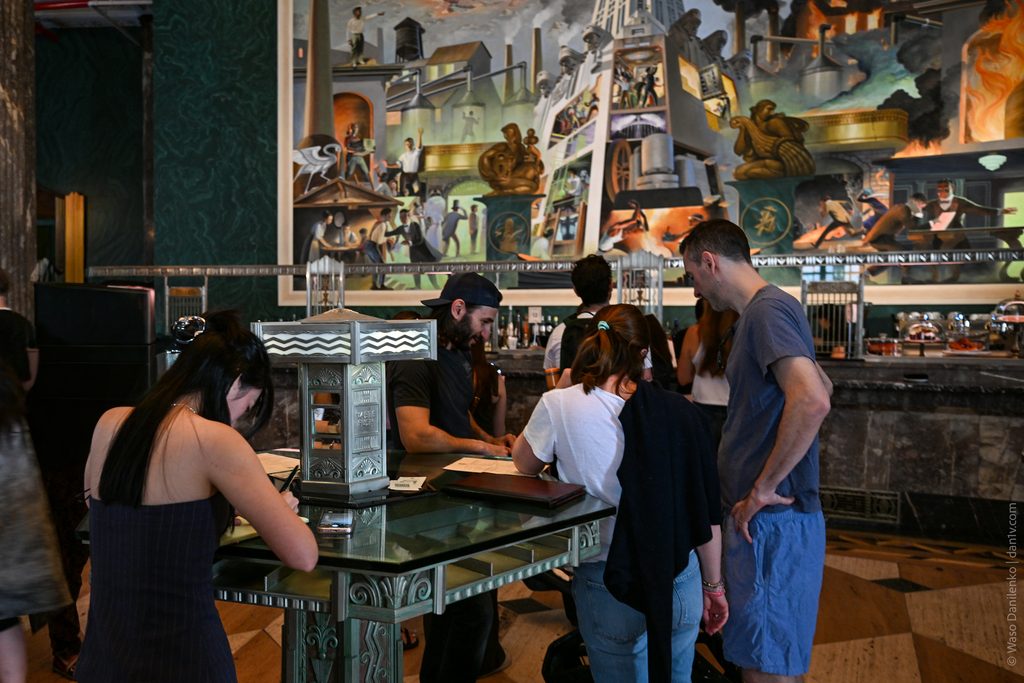
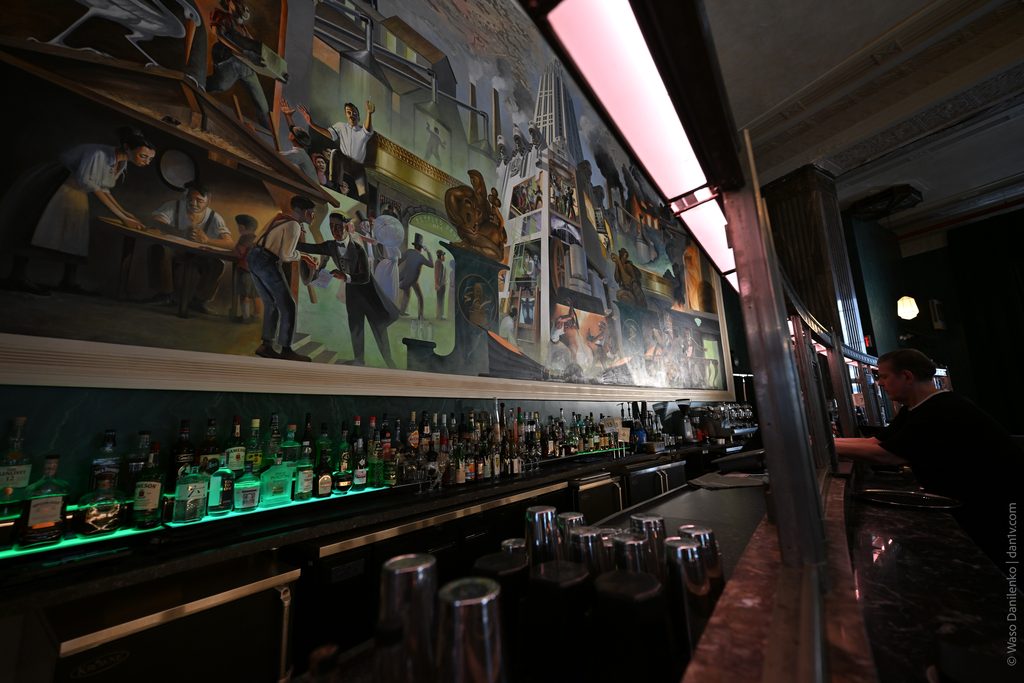
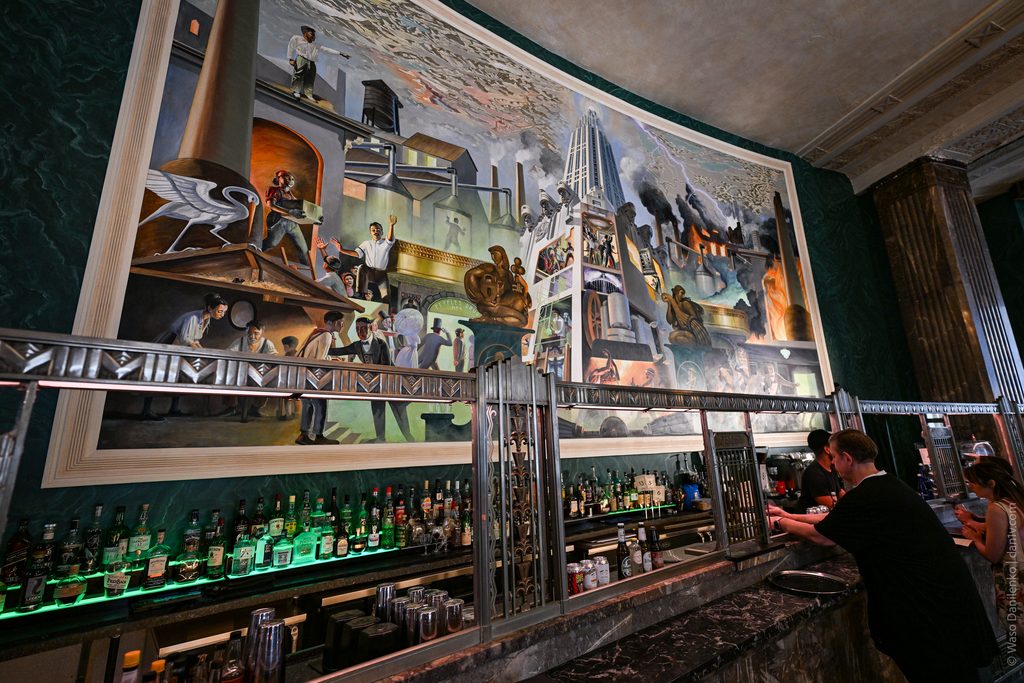
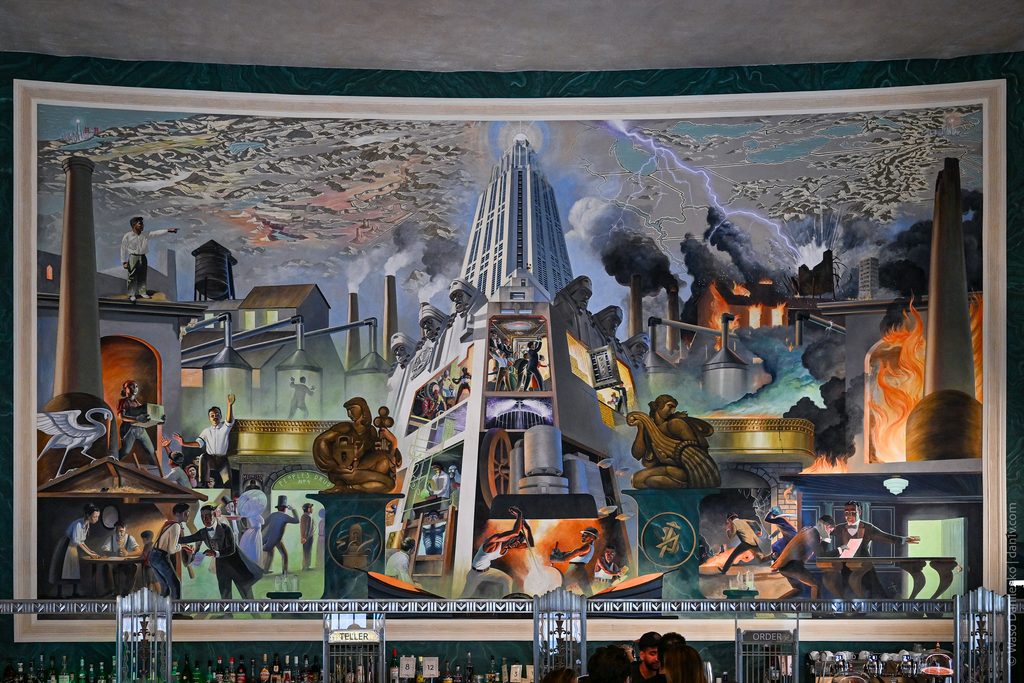
The mural Destiny, the Great Caretaker above the bar looks like a work from the era of Mexican muralism and focuses on labor, industry, and the history of New York. Conwell claims that it was commissioned by the Life and Trust bank in the early 1920s and that the artist’s name was lost over time. But the story does not add up: Life and Trust was a fictional bank, and construction of the building did not begin until 1930. The mural is therefore most likely a modern part of Conwell’s decor, created as part of its artistic concept.
Food and Drinks at Conwell Coffee & Cocktail Hall
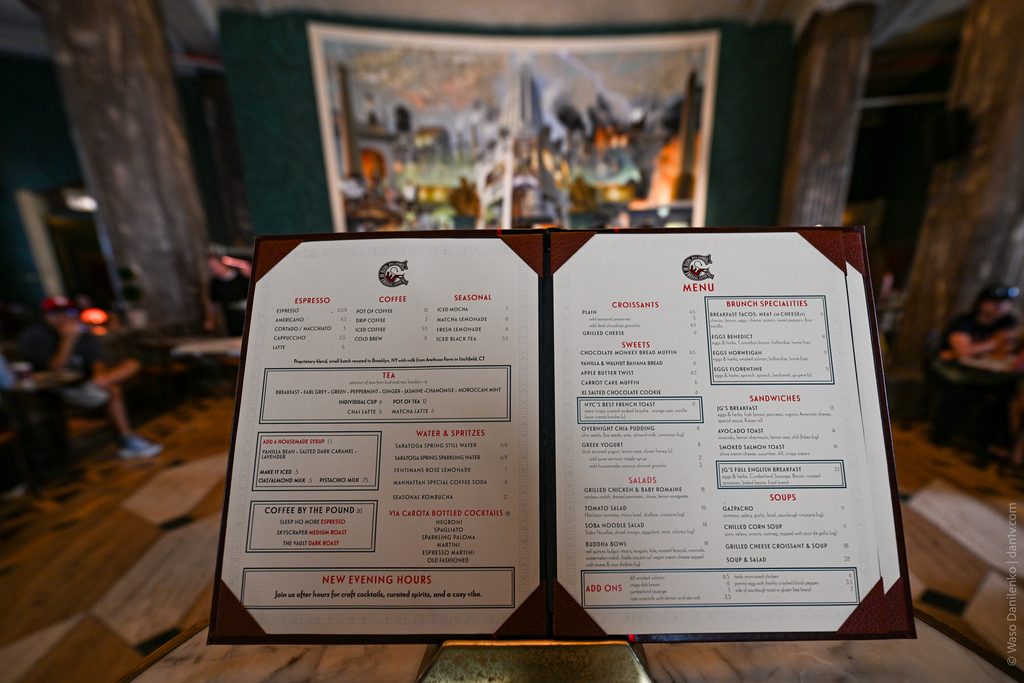
During the day, Conwell operates as a coffee shop; in the evening, it becomes a cocktail bar. The coffee is roasted by Brooklyn-based Gillies Coffee Company, founded in 1840. The menu features three signature blends: Sleep No More Espresso, Skyscraper — a blend of Central American Arabica and Sumatran coffee made specifically for Conwell — and the dark roast The Vault. A one-pound bag of beans to take home costs $20.
Classic coffee costs $3.50–$7, while matcha and tea are around $6–$8. Food options include croissants, pastries, soups, salads, toast, and breakfast dishes. Main dishes include grilled cheese with tomato soup, Caesar salad, Buddha bowl, avocado toast, salmon, and Eggs Benedict. The most interesting items are the $9 grilled cheese croissant, the large $6 salted chocolate cookie, and the $17 French toast.
On weekends, a separate brunch menu is available from 10:00 a.m. to 3:00 p.m., featuring Eggs Benedict, a full English breakfast, waffles, avocado toast, tuna Niçoise, and coffee-crusted salmon. Prices have increased noticeably over the past year: for example, Eggs Benedict went from $16 to $22, while avocado toast increased from $14 to $21.
After 5:00 p.m., the coffee shop transforms into the Cocktail Hall. The menu includes classics such as Sazerac, Aviation, and French 75, as well as original cocktails. The signature Conwell costs $18 and is made with coffee-infused bourbon, coffee liqueur, and banana liqueur. For groups, there is a $125 martini fountain and a $165 barrel-aged Bull Market cocktail.
The evening menu includes oysters, tuna tartare, crab, mac and cheese, lamb meatballs, a steak sandwich, and coffee-crusted salmon. From 5:30 to 7:00 p.m., Golden Hour offers classic cocktails and espresso martinis for $12 and oysters for $2 each. This is probably the best time for a first visit to the Cocktail Hall.
Events at Conwell Coffee & Cocktail Hall
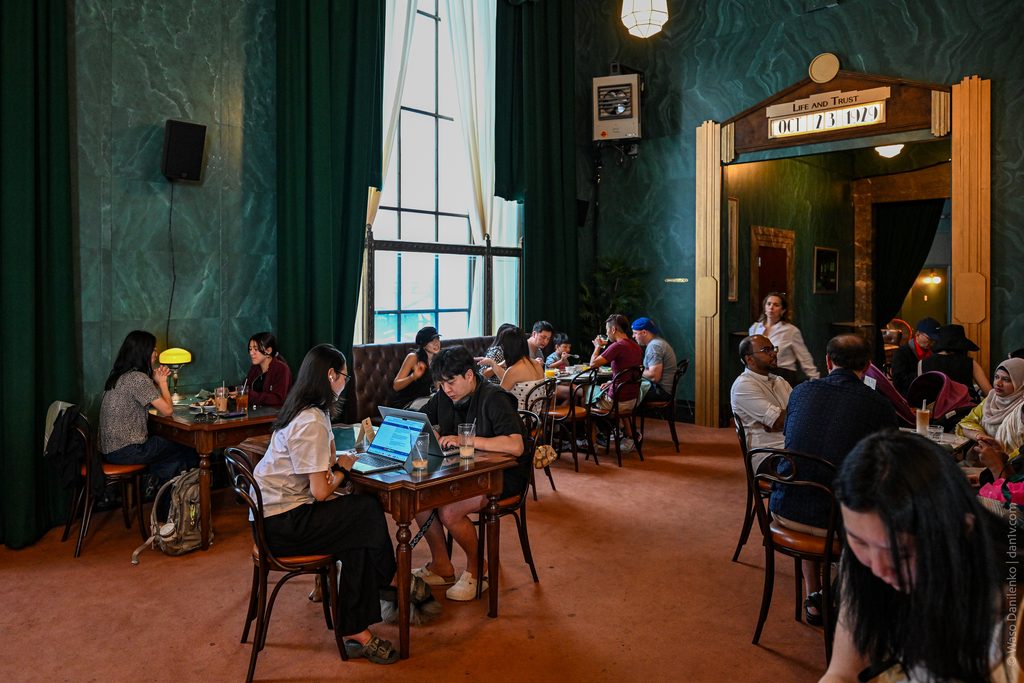
After Life and Trust closed, Conwell continued to operate not only as a bar but also as a small events venue. In the evenings, it hosts storytelling, concerts, stand-up comedy, film screenings, karaoke, and vinyl nights.
The program has included The Moth StorySLAM, The Tell, Sofar Sounds concerts, indie showcases called The Conwell Sessions, The HIFI vinyl parties, No Static Comedy stand-up shows, and the New York on Film series. For example, in summer 2026, the venue screened Paris Is Burning with donations benefiting the Ali Forney Center.
Another special program in summer 2026 was live screenings of the FIFA World Cup on a large screen. Admission to the matches was free, with seating available on a first-come, first-served basis.
The venue also hosts live-band karaoke and special themed nights. The entire space can be rented for private events, so Conwell may occasionally be closed to regular visitors.
Visitor’s Information
📍Conwell Coffee & Cocktail Hall / 6 Hanover St, New York, NY 10005
Website: conwellhall.com
Hours: weekdays from 7:30 AM till 10 PM, weekends from 9 AM till 11 PM