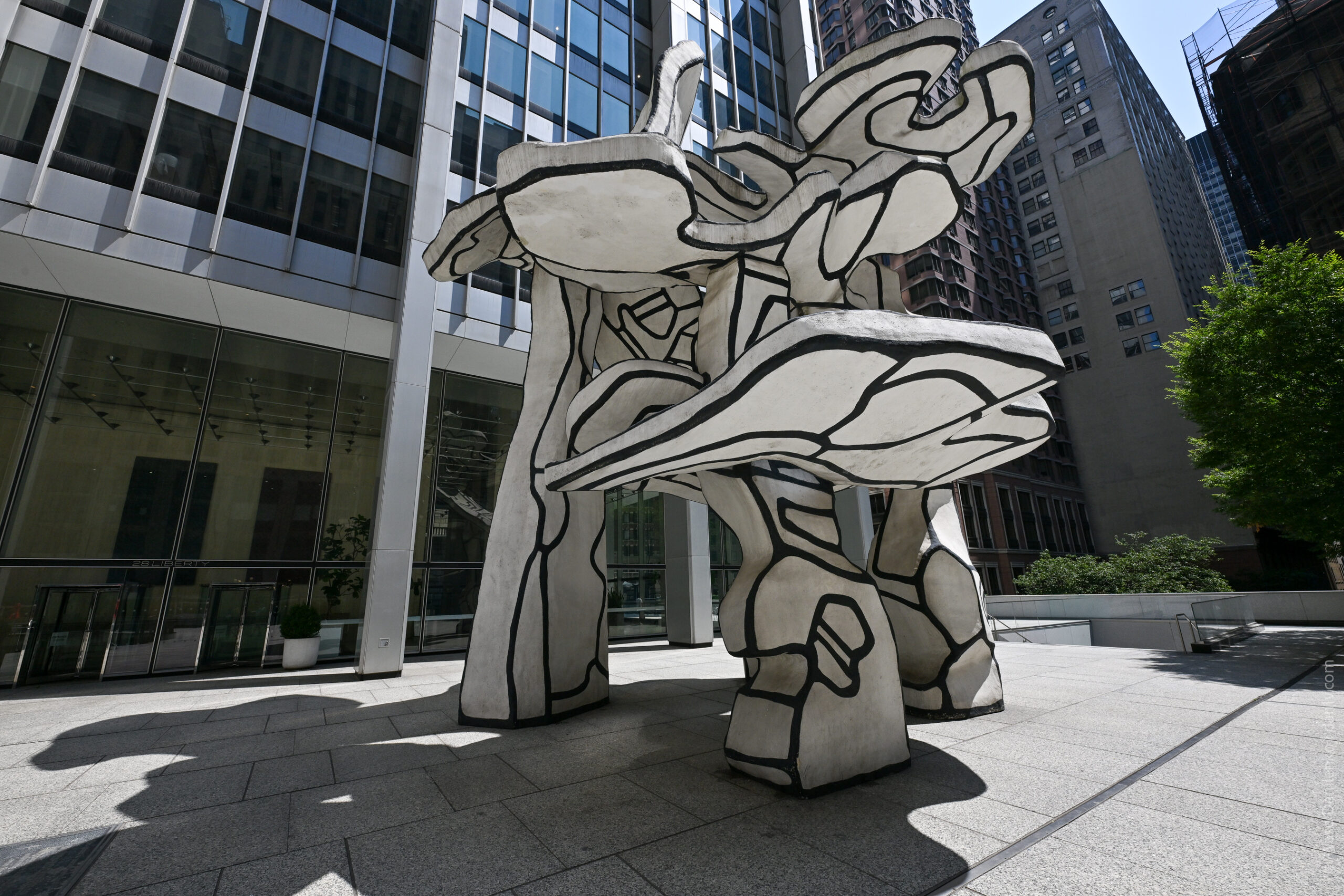
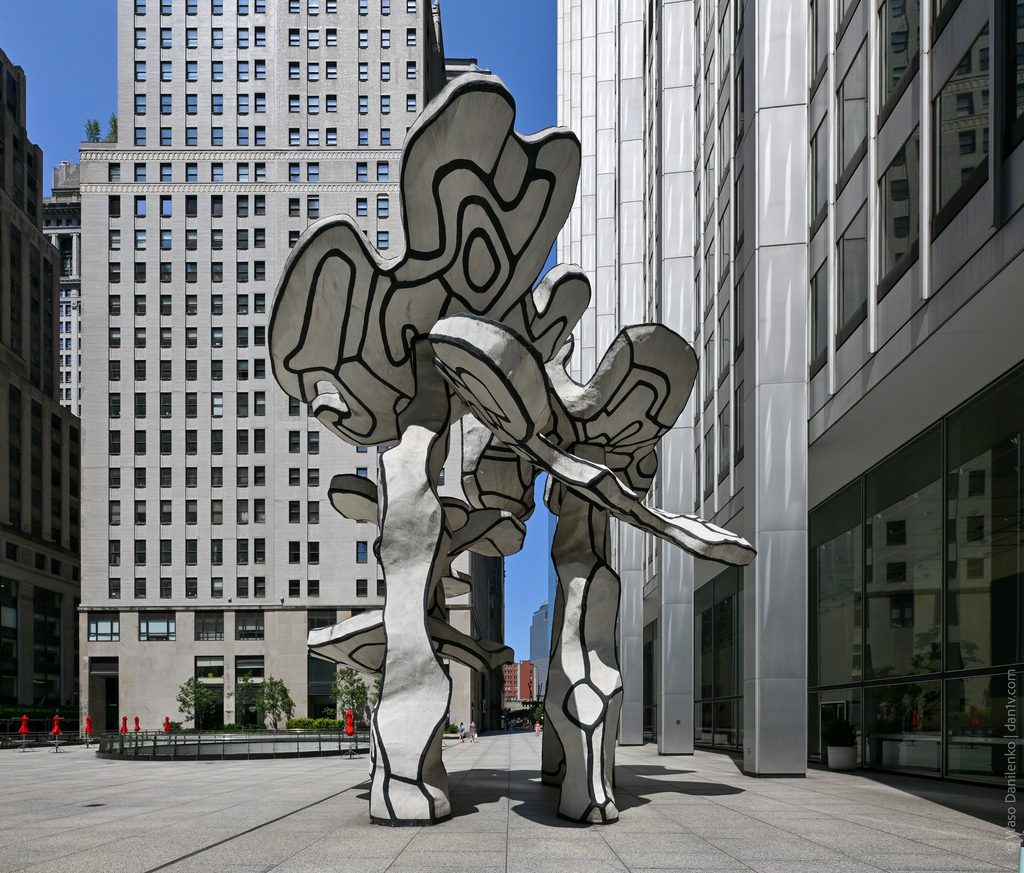
Jean Dubuffet was a former wine merchant who became an artist at the age of 41, coined the term “Art Brut,” and, among other things, created one of the largest and most underrated sculptures in Manhattan. His black-and-white “trees” have stood in the Financial District since 1972. Thousands of people walk past them every day, and almost no one knows who created them.
Dubuffet had a forty-year relationship with New York: he lived here, drew homeless people on the Bowery, sent 1,200 works by psychiatric patients to East Hampton, staged a theatrical performance of animated paintings at the Guggenheim, and left the city one enormous sculpture.
Key Facts About Jean Dubuffet and New York
- Dubuffet’s first solo exhibition in the United States took place in 1947 at the Pierre Matisse Gallery, founded by the artist Henri Matisse’s son, in New York — three years before European collectors began seriously buying his work.
- From November 1951 to April 1952, Dubuffet and his wife, Lili, lived in New York for six months. His studio was near the Bowery.
- It was in New York that he created the series “Bowery Bums” (Les Clochards du Bowery), the only work from his American period in which the city itself is visible.
- In 1952, he sent his Art Brut collection — about 1,200 objects — to The Creeks estate in East Hampton on Long Island. It remained there for ten years.
- “Group of Four Trees” was commissioned by David Rockefeller in 1969 and installed in 1972. It was Dubuffet’s first outdoor sculpture in the United States.
- The sculpture is about 13 meters (four stories) tall and weighs 25 tons. It was assembled on the plaza over eight weeks.
- In 1973, the Guggenheim Museum presented a Dubuffet retrospective and the premiere of his “animated painting,” Coucou Bazar, featuring costumes, moving scenery, and electronic music.
- Dubuffet’s works can be found at MoMA, the Guggenheim, and the Metropolitan Museum of Art. His Kiosque l’évidé sculpture stands at the PepsiCo Sculpture Gardens, about an hour’s drive from the city.
Who Was Jean Dubuffet?
Dubuffet was born in 1901 in Le Havre in a family of wine merchants. He studied painting, gave it up, returned to the family business, and spent almost twenty years selling wine. He finally committed himself to painting in 1942, at the age of 41. His first solo exhibition took place in 1944 at the René Drouin Gallery in Paris. He was 43 at the time.
Dubuffet argued that true creativity lived outside museums and academies. In 1945, he coined the term Art Brut — “raw” or “rough” art. He used it to describe work created by people untouched by formal artistic culture: psychiatric patients, children, self-taught artists, prisoners, and mediums.
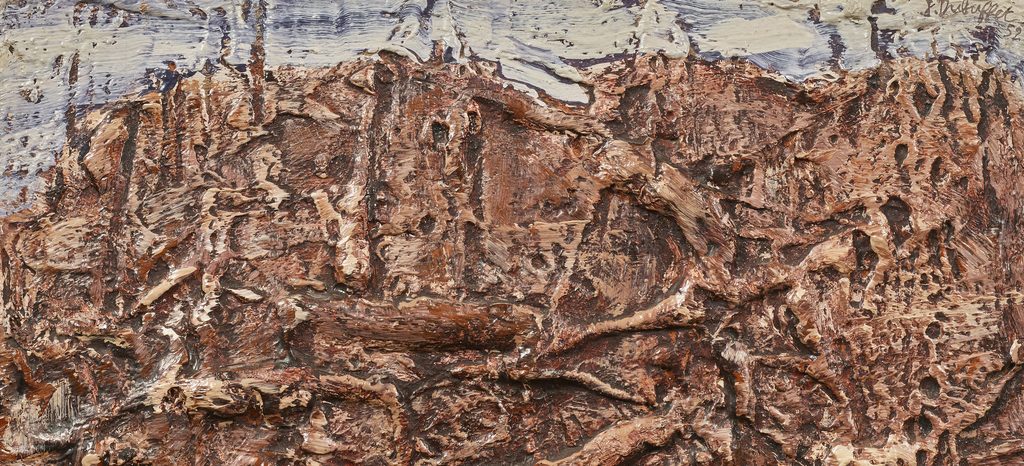
He made his own paintings accordingly: thick mixtures of oil paint, sand, tar, gravel, and broken glass. His figures were deliberately crooked, as if drawn by a child or scratched onto the wall of a back alley. He considered beauty a harmful habit.
In 1948, Dubuffet founded the Compagnie de l’Art Brut, an organization dedicated to collecting and promoting this kind of art. Its members included, among others, Surrealism founder André Breton, poet Benjamin Péret, critic Michel Tapié, and collector Charles Ratton. Works were purchased directly from their creators or collected from psychiatric hospitals, where doctors handed them over in the hope that they would at least be preserved. By 1951, the collection contained about 1,200 objects. Then Dubuffet decided that the future of Art Brut was in America.
Six Months on the Bowery: Jean Dubuffet Lives in New York
In November 1951, Dubuffet and his wife, Lili, boarded the Île-de-France and sailed to New York. Officially, there were two reasons for the trip: an exhibition at the Arts Club of Chicago, opening on December 18, and the need to personally oversee the relocation of his Art Brut collection to America. In practice, he stayed in the city for six months, until April 1952.
He rented a studio near the Bowery. In the early 1950s, it was one of the most run-down streets in Manhattan: flophouses, cheap bars, and people sleeping on the sidewalks. Dubuffet, who had spent his career searching for art at the bottom of society, found his subject right outside his window.
This was how the Les Clochards du Bowery series came about — drawings, gouaches, and watercolors depicting the people of the street. The figures are hunched, distorted, and seemingly falling apart. One work from the series, Bowery Bum, dated December 1951 and made with ink on paper, is now held by MoMA.
Interestingly, almost everything else Dubuffet created in America — including the Sols et terrains landscape series — looks as though the artist never left his Paris studio. There is no recognizable trace of America in these works. The only direct imprint of New York in his art is the Bowery bums.
In New York, Dubuffet became friends with Surrealist artist Yves Tanguy and his wife, artist Kay Sage, and also socialized with Marcel Duchamp. In February 1952, the Pierre Matisse Gallery presented his new paintings.
In 1965, Turkish composer İlhan Mimaroğlu, who was living in New York at the time, wrote to Dubuffet. He was composing experimental electronic music inspired by the Bowery bums series. Dubuffet replied that he was struck by how accurately the music captured the series and recalled working in his studio right by the Bowery, where these people were constantly in front of him. Six years later, he invited Mimaroğlu to compose the music for his major theatrical project — the one that would eventually be presented at the Guggenheim.
1,200 Works by Psychiatric Patients in a Long Island Mansion Thanks to Jean Dubuffet
In 1950, Dubuffet met Alfonso Ossorio, an American artist of Filipino descent, heir to a sugar fortune, a Harvard graduate, and a close friend of Jackson Pollock. Ossorio owned The Creeks, an estate in East Hampton on Long Island. He offered Dubuffet a place to house his entire Art Brut collection.
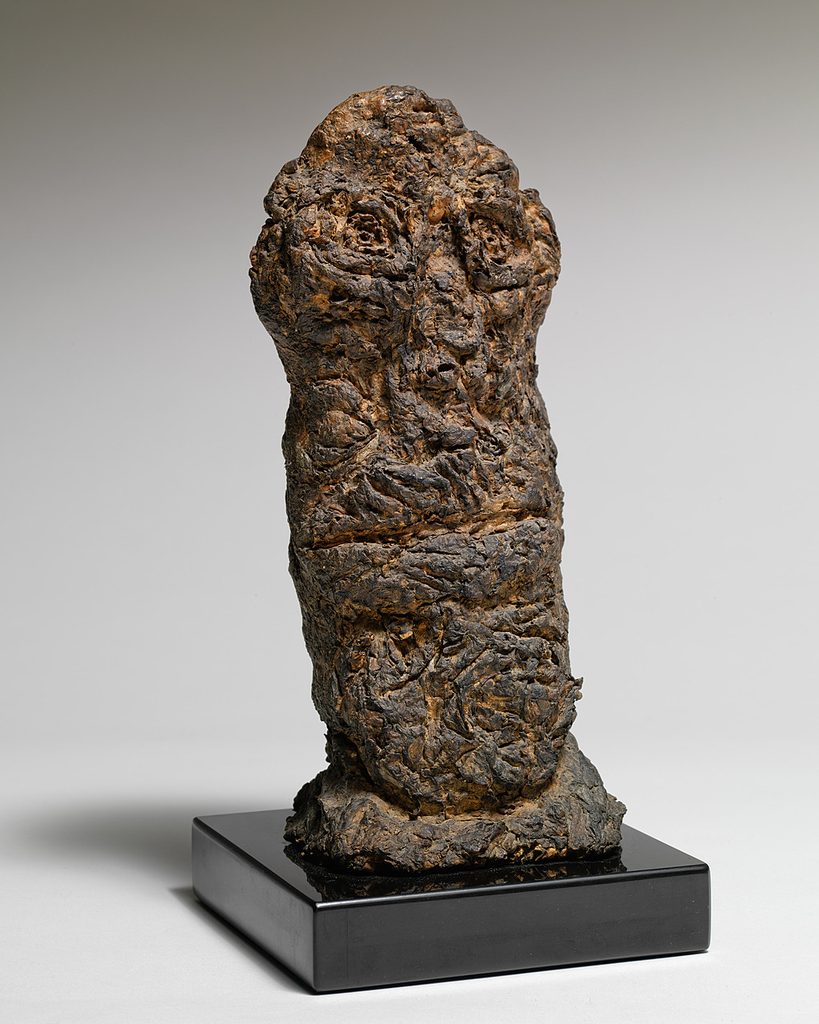
In 1951, the Compagnie de l’Art Brut was dissolved, and the collection — about 1,200 works — was packed up and shipped across the Atlantic. From 1952 to 1962, drawings by psychiatric patients, embroidery, handmade sculptures, and wooden mechanisms lived in the mansion on Long Island, two and a half hours from Manhattan.
Jackson Pollock and Lee Krasner, Willem and Elaine de Kooning, and critics Clement Greenberg and Harold Rosenberg came to see the collection. The reaction was polite but cool. The American avant-garde was busy with its own revolution, and it was not particularly interested in the work of psychiatric patients.
Dubuffet’s plan did not work: America did not embrace Art Brut. In 1962, the collection returned to Europe. Dubuffet later donated it to the city of Lausanne, where the Collection de l’Art Brut opened in 1976 and remains the world’s leading museum dedicated to this art.
The New York chapter was revisited by the American Folk Art Museum, which presented the exhibition Art Brut in America: The Incursion of Jean Dubuffet in 2015–2016.
“Group of Four Trees”: Jean Dubuffet’s Main Sculpture in New York
By the late 1950s, Chase Manhattan Bank was building a new headquarters in the Financial District. The 60-story skyscraper was designed by Gordon Bunshaft of Skidmore, Owings & Merrill and opened in 1961. The tower occupied less than a third of the site; the rest was given over to a public plaza elevated above street level, which opened in May 1964.
The plaza was spacious and completely lifeless. The bank’s art program was overseen by vice chairman David Rockefeller. The first artwork to arrive was Isamu Noguchi’s Sunken Garden (1964) — a circular basin below the level of the plaza containing seven basalt stones brought from Japan, from the Uji River.
It took almost ten years to find the second artist. The idea of commissioning Dubuffet came from Bunshaft himself, the architect of the tower. In 1969, Rockefeller commissioned the work and timed it to coincide with his 25th anniversary of working on Wall Street. Dubuffet sent several maquette designs. On November 24, 1970, Rockefeller publicly announced that the plaza would receive “Group of Four Trees.”
The sculpture belongs to the L’Hourloupe cycle, the main and longest period of Dubuffet’s career.
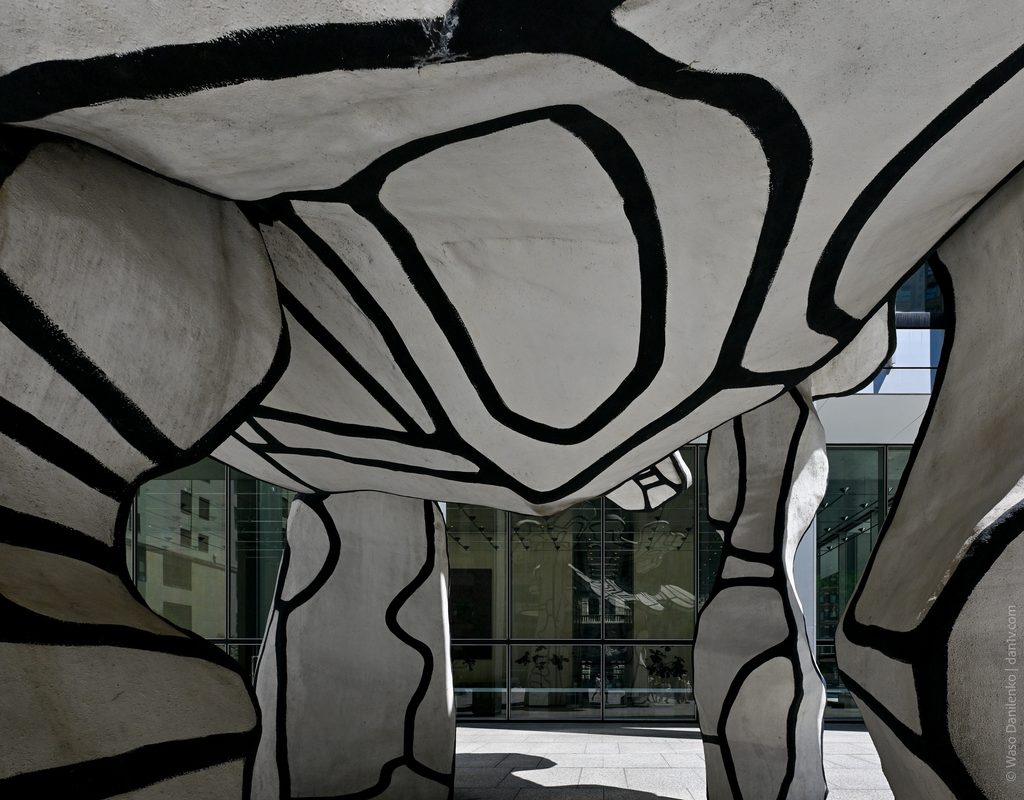
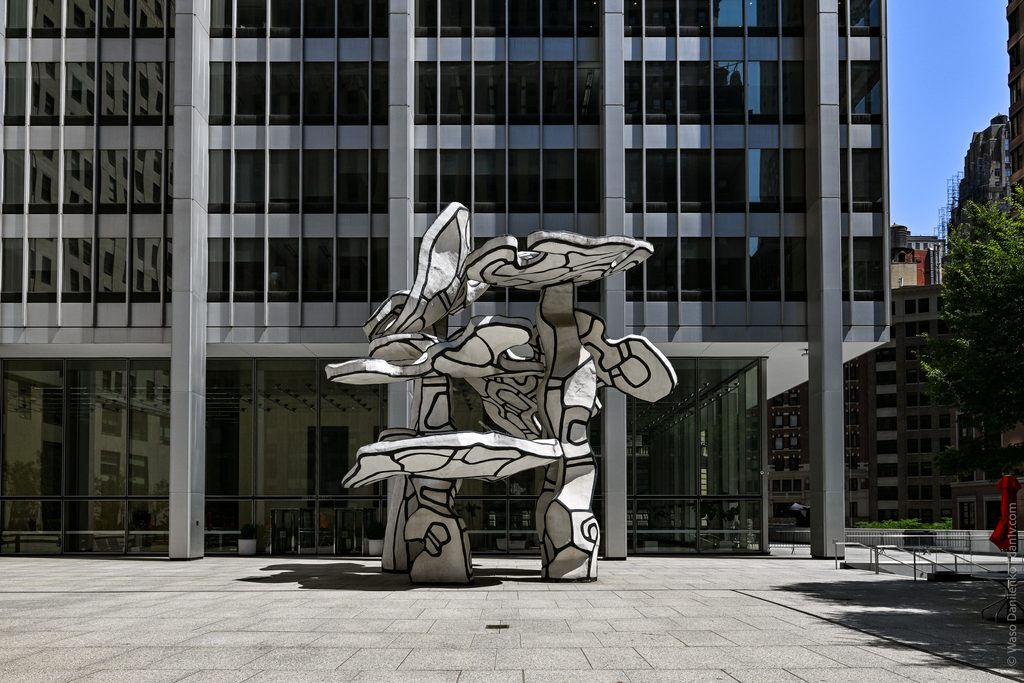
The structure consists of a steel framework covered with fiberglass and finished with black-and-white polyurethane paint of the type used for marking road surfaces. It weighs 25 tons and stands about 13 meters tall, or roughly four stories. By the standards of New York at the time, it was one of the largest outdoor sculptures in the city and Dubuffet’s first outdoor work in the United States.
The sculpture was manufactured in sections at the artist’s workshop in Périgny, outside Paris. The “trees” arrived in New York disassembled; sources give the number as anywhere from “more than a dozen” to 19 fragments. A team of five French and four American workers assembled them on the plaza. The installation took eight weeks.
Criticism of Jean Dubuffet’s Sculpture
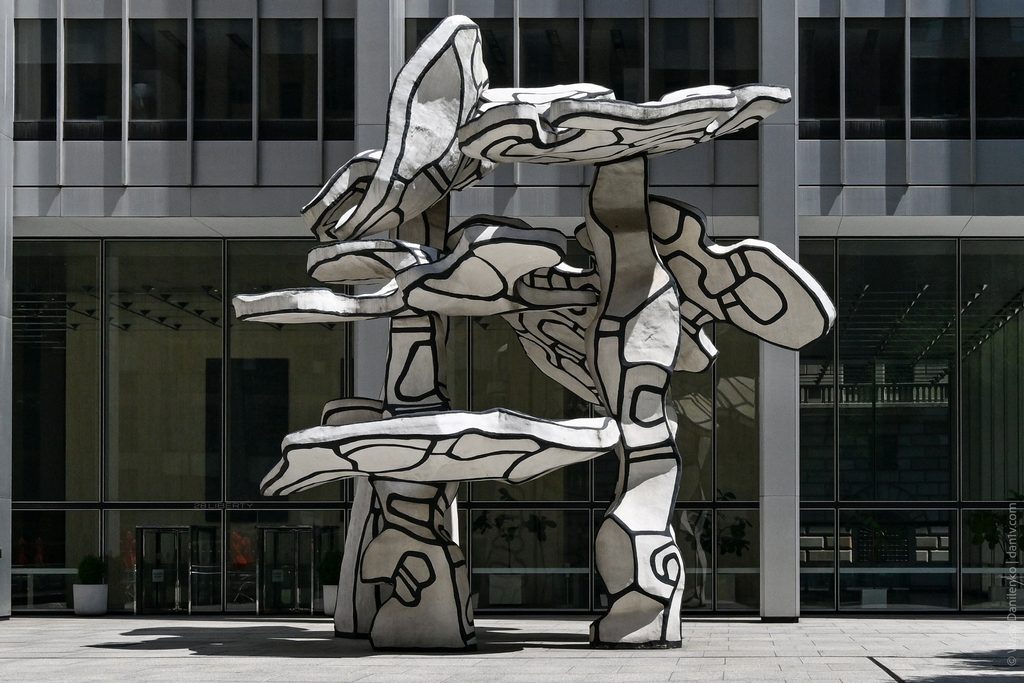
After seeing the maquette, The New York Times critic David Shirey wrote that the thing looked like a cross between giant mushrooms from Alice in Wonderland and a jigsaw puzzle for giants. Collector Joseph Hirshhorn said at the opening that he would happily steal it, except that it was bolted down. Architect Bunshaft called the work one of the significant public sculptures of the twentieth century — although he was also the one who proposed it.
In 1983, art historian Harold Rosenberg wrote that Group of Four Trees was among Dubuffet’s finest works: its irregular horizontal forms seem to float above deliberately awkward “trunks,” while its scale strikes a perfect balance between the human figure and the surrounding skyscrapers.
Architectural historian Harriet Senie viewed the sculpture in a different context — as a remedy for New York’s corporate plazas. Under the 1961 zoning regulations, developers were allowed to build taller in exchange for providing public space at the base of their buildings. The result was dozens of empty concrete plazas where no one wanted to walk. Dubuffet’s “trees” are a rare example of such a plaza actually coming to life.
The building at 28 Liberty Street itself was designated a New York City Landmark on February 10, 2009, along with the plaza. Dubuffet’s sculpture, however, was not included in the landmark designation. Technically, the plaza is not classified as a POPS (privately owned public space), either, but it remains open to the public and hosts fairs, film screenings, and food festivals.
L’Hourloupe: Jean Dubuffet’s Cycle That Began with Boredom on the Phone
It is worth explaining where this black-and-white pattern came from, because so much of Dubuffet’s later reputation is tied to it.
In July 1962, Dubuffet was talking on the phone and absentmindedly doodling with a ballpoint pen. He ended up with interlocking cells outlined in thick black lines. He looked at them and decided that they could become a system.
This was the beginning of the L’Hourloupe cycle — a word Dubuffet invented himself, roughly echoing French words associated with howling, growling, and something unsettling and fantastical. There is no real point in translating it.
The cycle lasted twelve years, from 1962 to 1974, and encompassed everything: drawings, paintings, prints, sculpture, architecture, and even theater. The rules were simple: flat, irregularly shaped cells, thick black outlines, and areas filled with red, blue, or white. To work on a large scale, Dubuffet abandoned oil paint and turned to industrial polymers, including polystyrene, polyester, and epoxy resin.
It was because of L’Hourloupe that Dubuffet’s work during the last twenty years of his life looks as though it was made by an entirely different person. Early Dubuffet is dirt, sand, and tar. Late Dubuffet looks like a coloring book that has escaped into three-dimensional space.
Coucou Bazar: How Jean Dubuffet Brought a Living Painting to the Guggenheim
Dubuffet’s first major retrospective at the Guggenheim took place in 1966–1967 and was titled Jean Dubuffet: 1962–1966 — meaning it was devoted entirely to his L’Hourloupe cycle.
But the real spectacle came in 1973. For a new retrospective, Dubuffet brought to New York a project he had been working on since 1971 at a former gunpowder factory in Vincennes, outside Paris: Coucou Bazar, also known as Bal de l’Hourloupe.
It was neither a performance nor an exhibition, but a hybrid of the two. Dubuffet created 175 freestanding elements, which he called praticables — a theatrical term for three-dimensional stage structures that performers can move around or even walk on. Some stood on wheels, while others moved using electric mechanisms. He also created twenty character costumes made of interchangeable masks, hats, cloaks, and gloves. Dancers were inside the costumes.
The hour-long performance had no plot. The music was composed by the same İlhan Mimaroğlu — at Dubuffet’s insistence, it had to be deliberately loud, with sudden drops into silence.
Coucou Bazar opened at the Guggenheim on May 16, 1973, and ran until July 29. That fall, a second version was presented at the Grand Palais in Paris, followed by a third version in Turin in 1978.
The Guggenheim collection includes Nunc Stans (1965), one of Dubuffet’s largest paintings: three panels measuring more than eight meters in total length. The title is a Latin philosophical term meaning “the standing now,” or the eternal present. Dubuffet said that L’Hourloupe compositions should be “without boundaries or a center, like the open sea.” In 2025, the Guggenheim loaned the work outside the museum for the first time, for an exhibition at Pace Gallery.
Visitor’s Information
📍Group of Four Trees / 28 Liberty St, New York, NY 10005
Admission: free