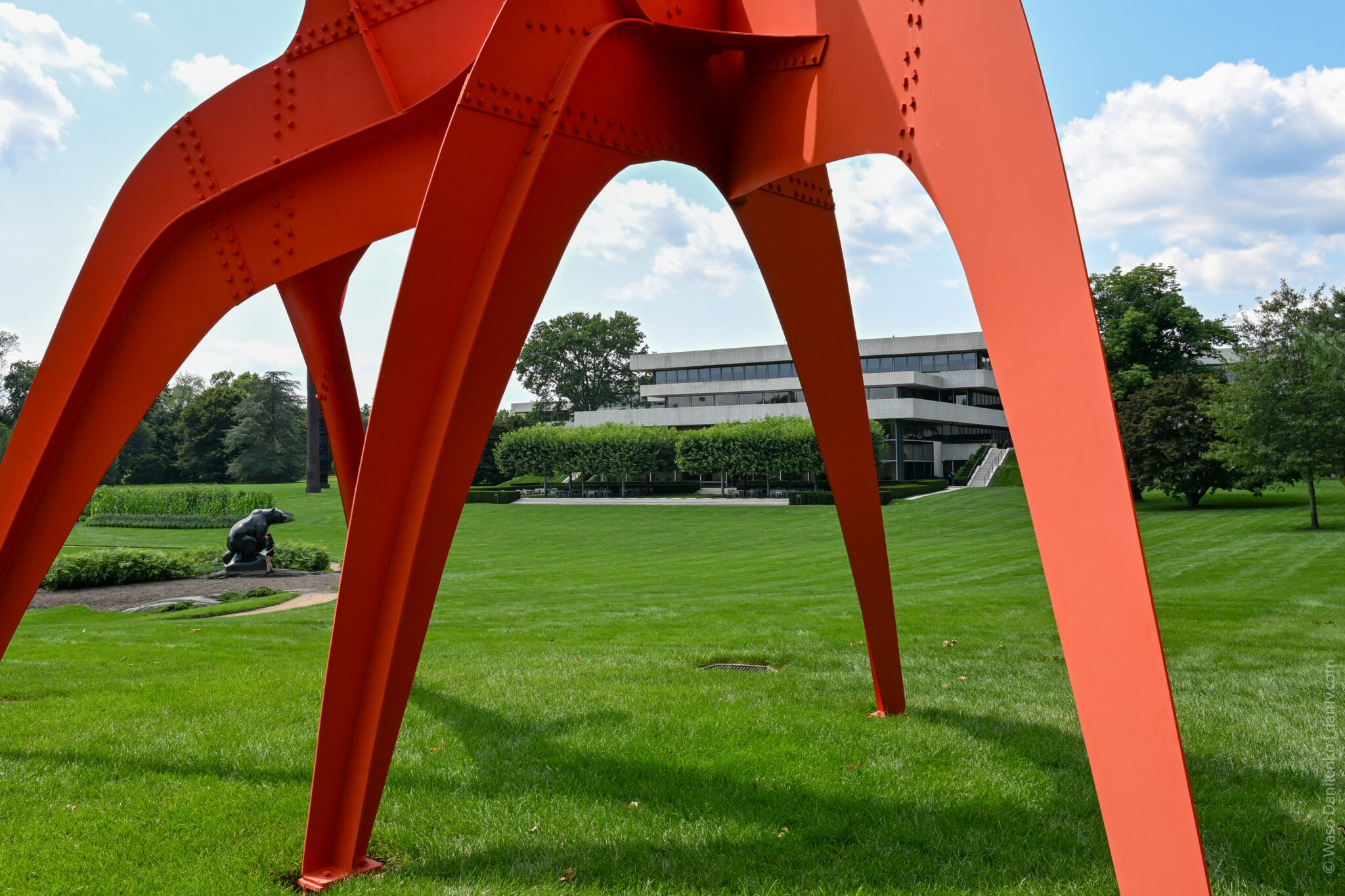
The Donald M. Kendall Sculpture Gardens, located at PepsiCo’s headquarters, is a free outdoor sculpture park featuring works by some of the world’s most celebrated sculptors.
In terms of the significance of its collection, it ranks among the most remarkable outdoor museums of modern sculpture in the United States — and admission is completely free. Forty-five monumental works by Auguste Rodin, Henry Moore, Alexander Calder, Alberto Giacometti, Joan Miró, and others are displayed across 168 acres of beautifully landscaped English-style gardens. At the center stands a white modernist “temple” designed by architect Edward Durell Stone, best known for the John F. Kennedy Center for the Performing Arts in Washington, D.C.
Key Facts About PepsiCo Headquarters
- The complex was built between 1967 and 1970 and designed by Edward Durell Stone, one of the most influential American architects of the mid-twentieth century. His notable works include the John F. Kennedy Center for the Performing Arts, the U.S. Embassy in New Delhi, and the original Museum of Modern Art (MoMA) building in New York.
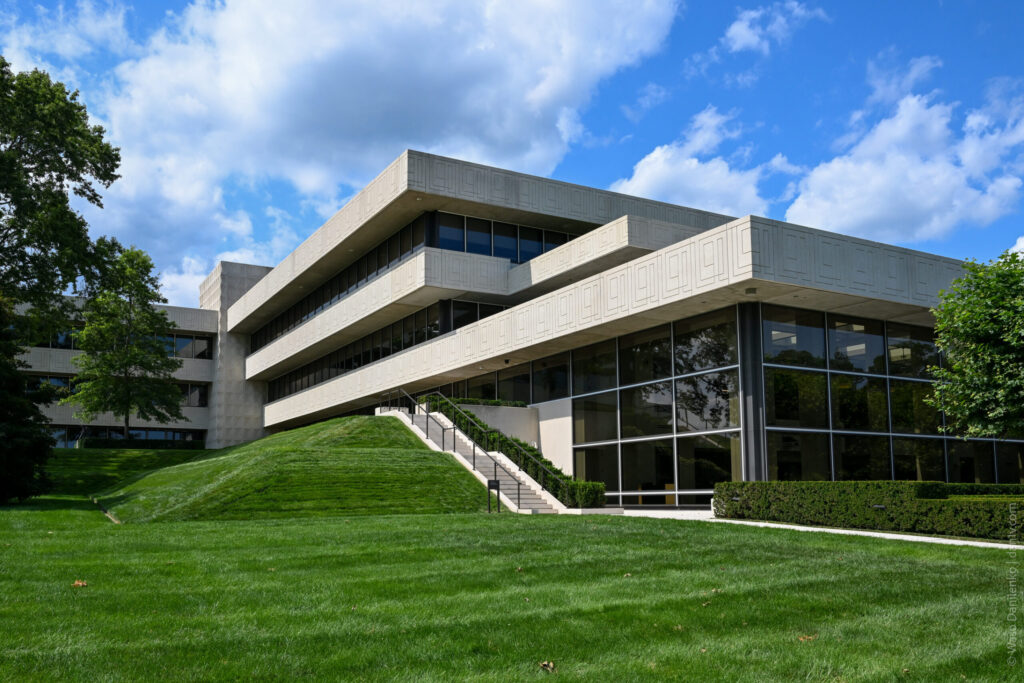
- The headquarters consists of seven identical three-story buildings shaped like inverted ziggurats, connected at their corners to form a giant cross.
- The site was originally a polo field.
- The gardens are named after Donald M. Kendall, PepsiCo’s chief executive from 1963 to 1986. He personally selected every sculpture and described his vision as “a museum without walls.”
- The collection includes 45 works by Auguste Rodin, Henry Moore, Alexander Calder, Joan Miró, Max Ernst, Jean Dubuffet, Claes Oldenburg, Isamu Noguchi, Louise Nevelson, and many other renowned artists.
A Virtual Tour of the PepsiCo Headquarters Sculpture Park
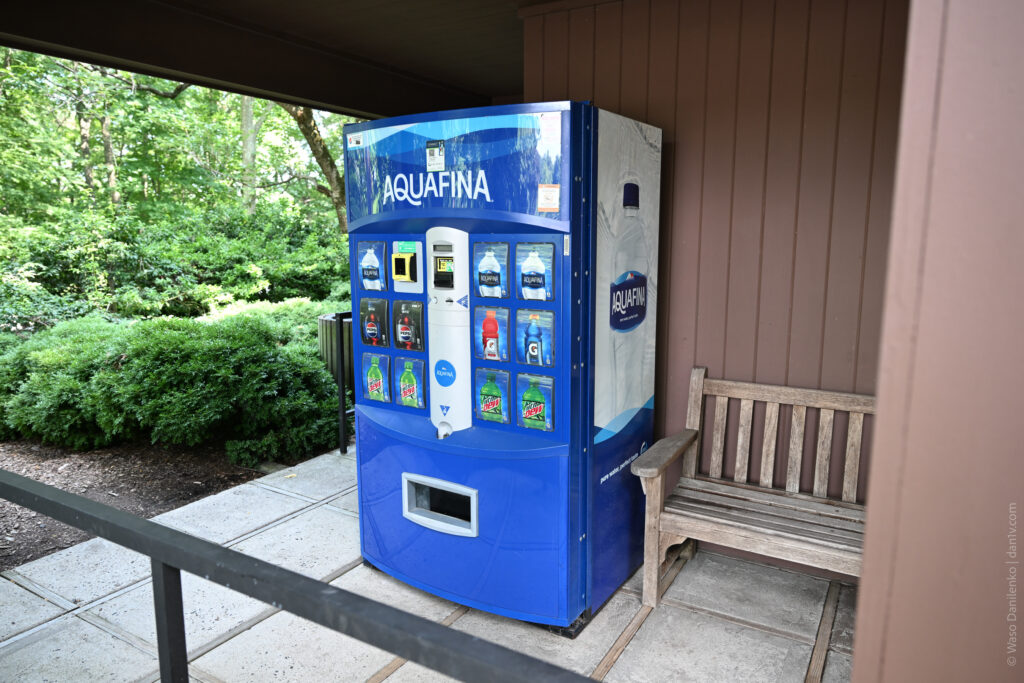
Your visit will almost certainly begin at the parking lot and the small Visitor Center. It is a modest kiosk staffed by a security guard and stocked with park maps and brochures. There is also a public restroom and a vending machine.
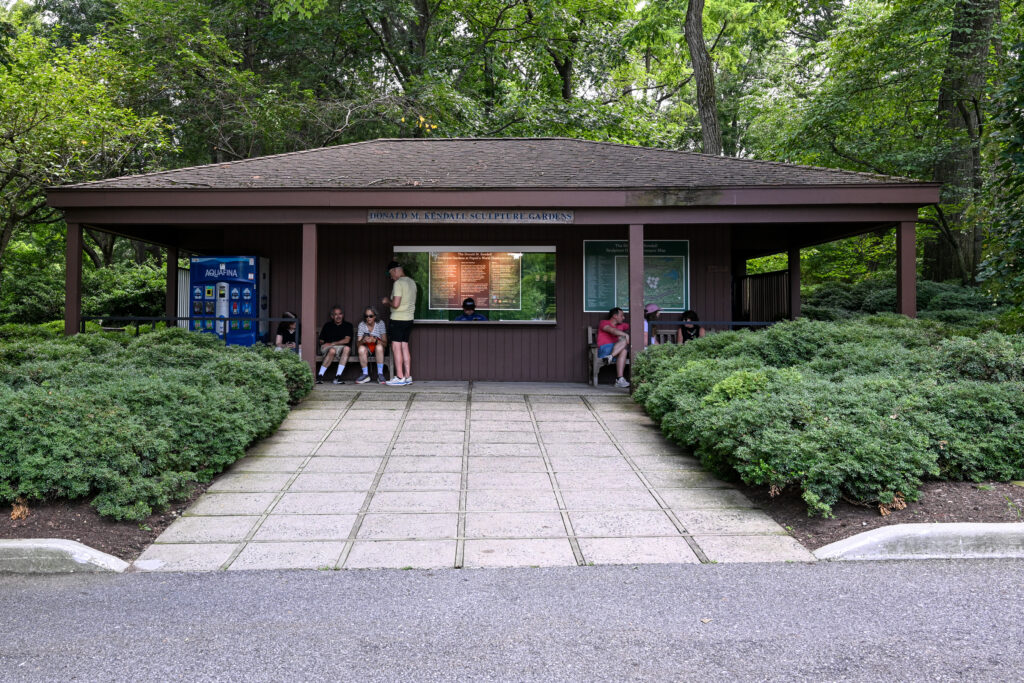
Unfortunately, my fantasy of enjoying a complimentary cup of ice-cold Pepsi on a hot July day outside PepsiCo’s global headquarters did not come true. Instead, visitors are greeted by a vending machine that looks much like the ones you would find in the parking lot of an average-sized American town.
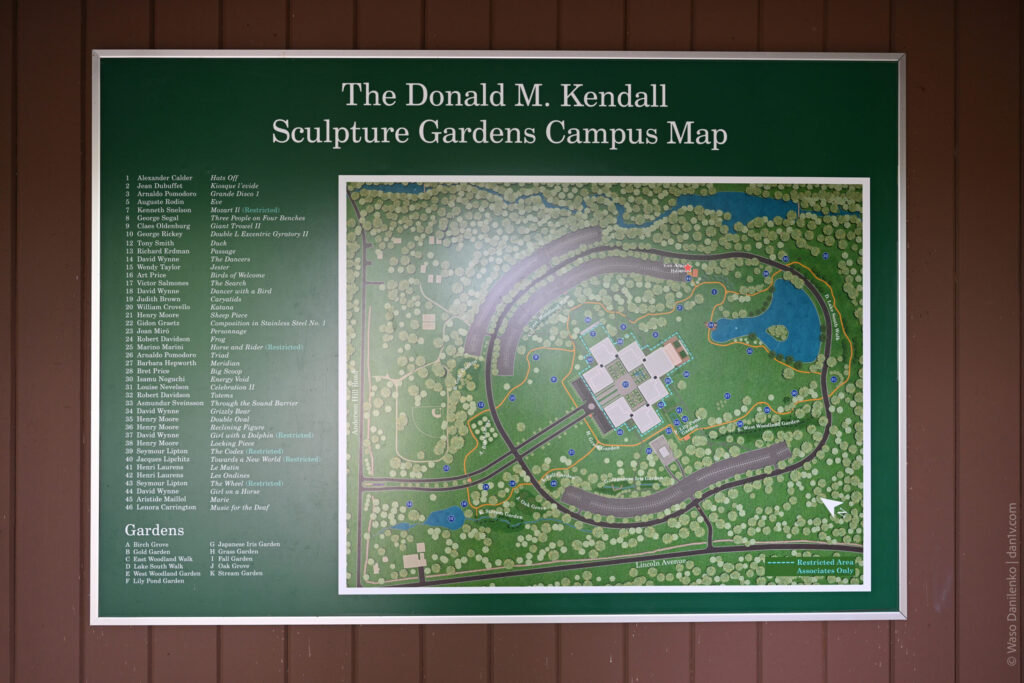
You can explore the park however you like, but the easiest approach is to pick up a map and follow one of the suggested walking routes.
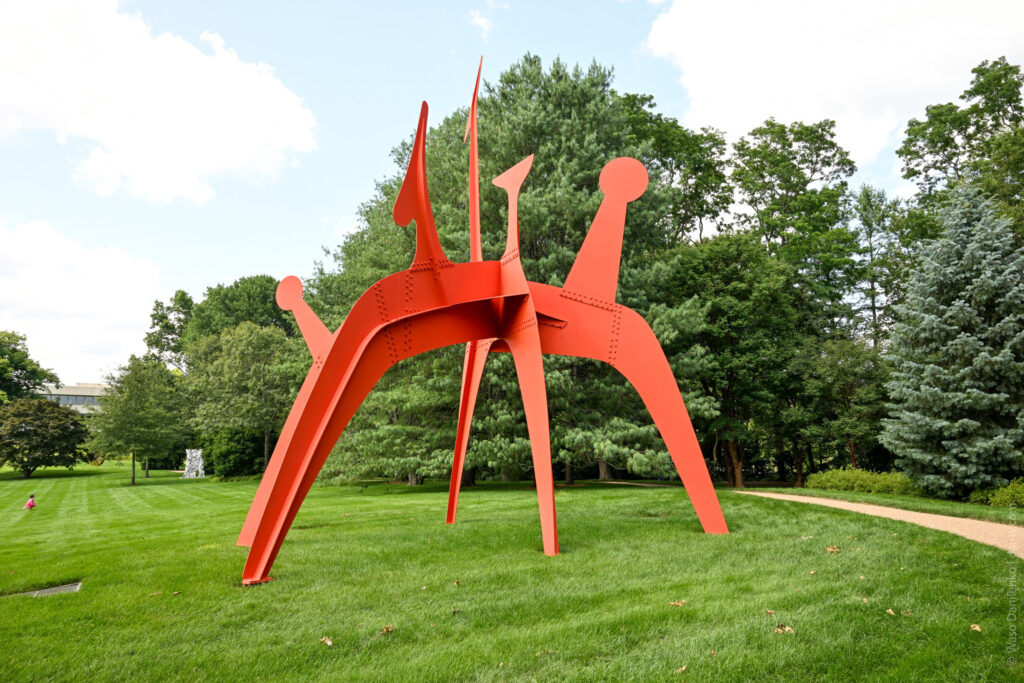
One of the first works you will encounter is Alexander Calder’s Hats Off, a nearly 31-foot (9.5-meter) sculpture by the renowned American artist (1898–1976). According to the park, Calder personally selected its location within the gardens.
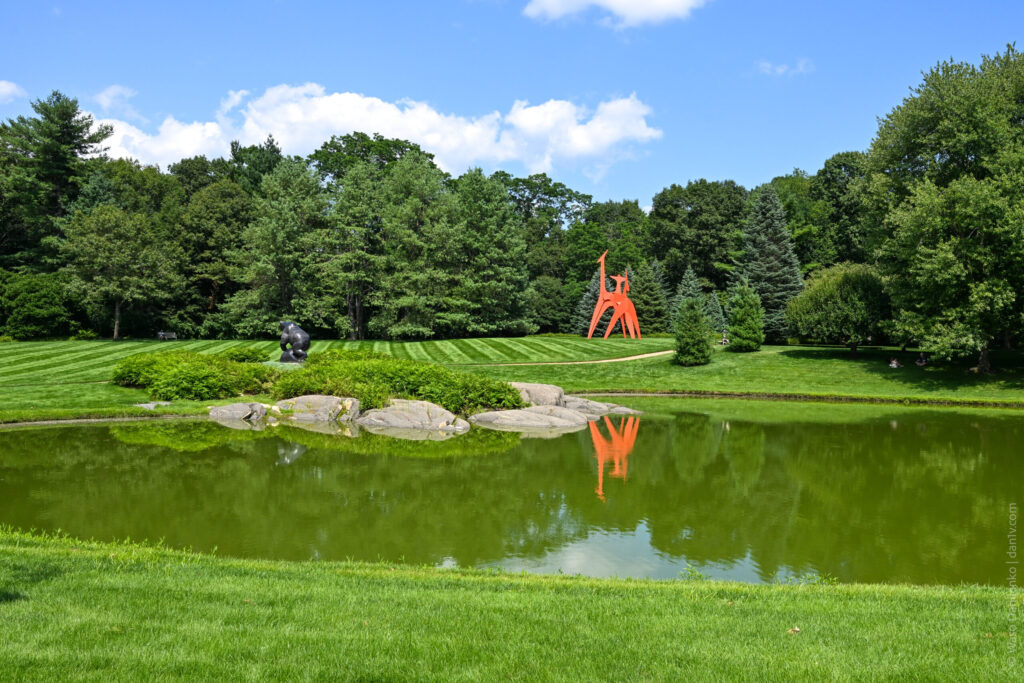
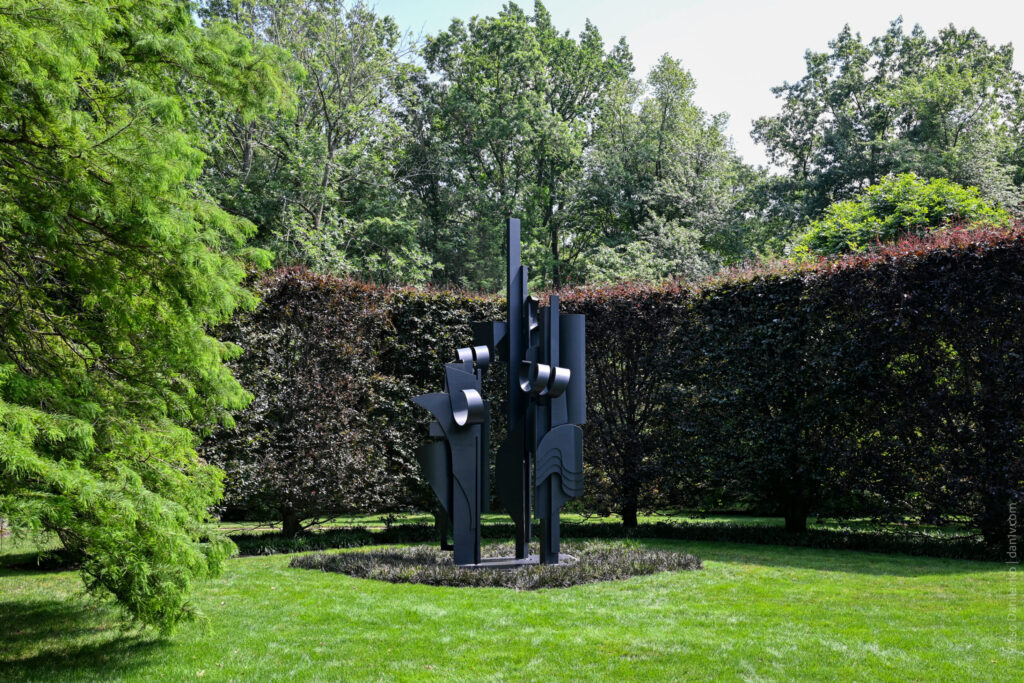
You may also recognize Louise Nevelson, the artist whose work is featured in Louise Nevelson Plaza in New York City. Born in what was then the Poltava Governorate of the Russian Empire (present-day Ukraine), she is represented here by Celebration II.
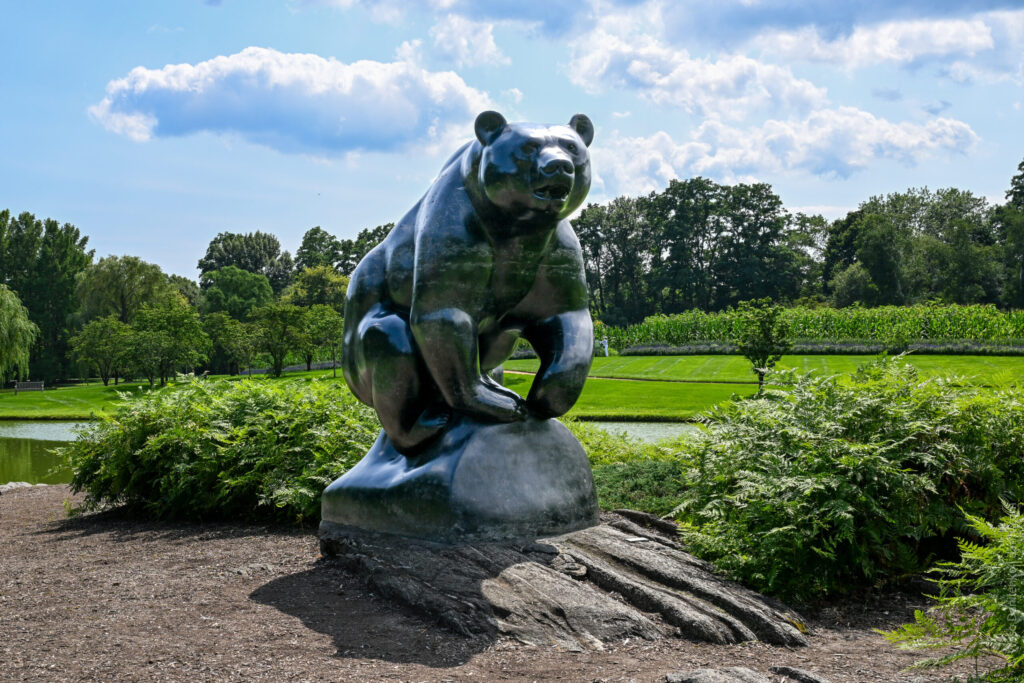
Incidentally, the British sculptor William Turnbull was Donald Kendall’s undisputed favorite. The gardens feature five of his works, including the bronze Grizzly Bear by the lake and the elegant The Dancers.
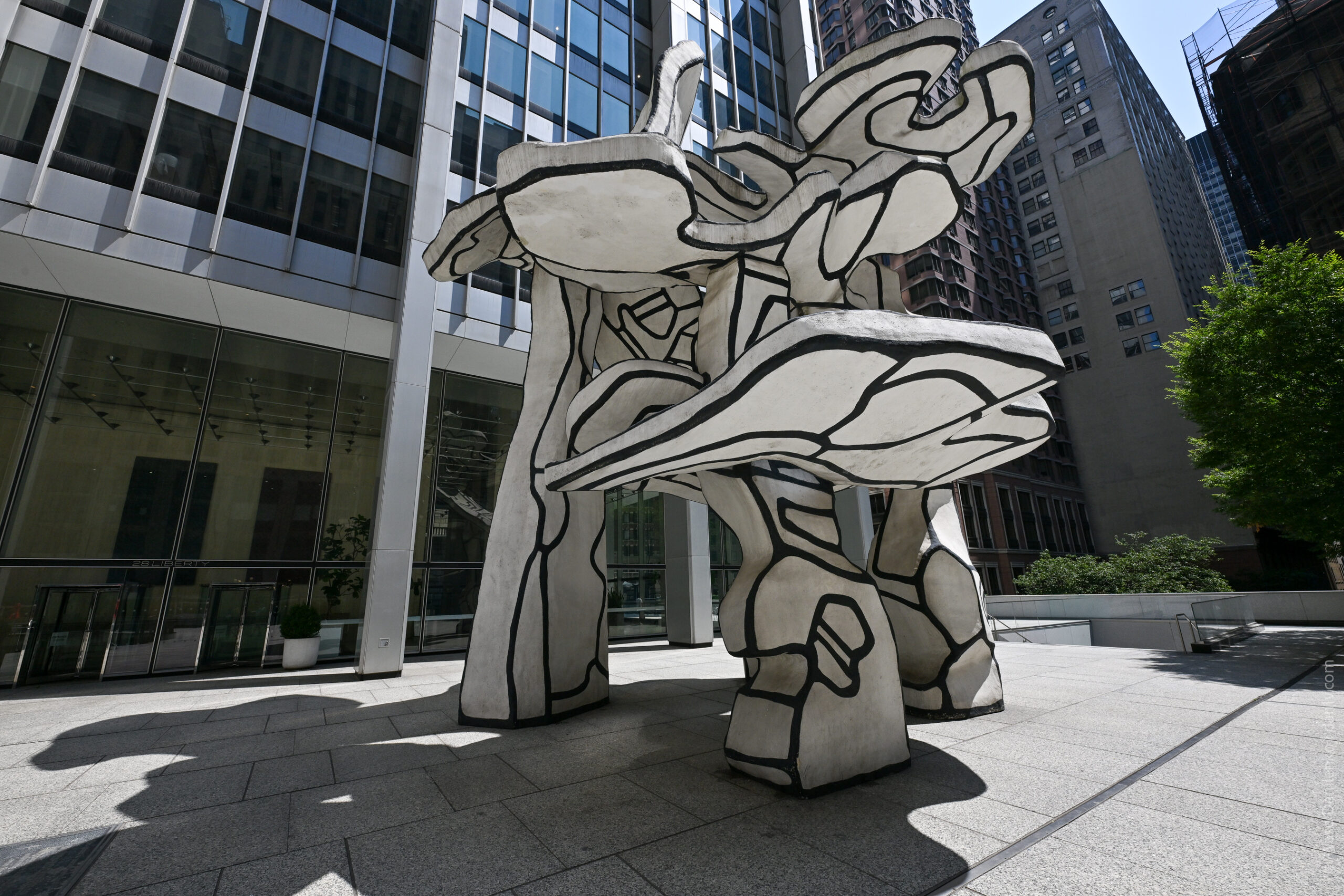
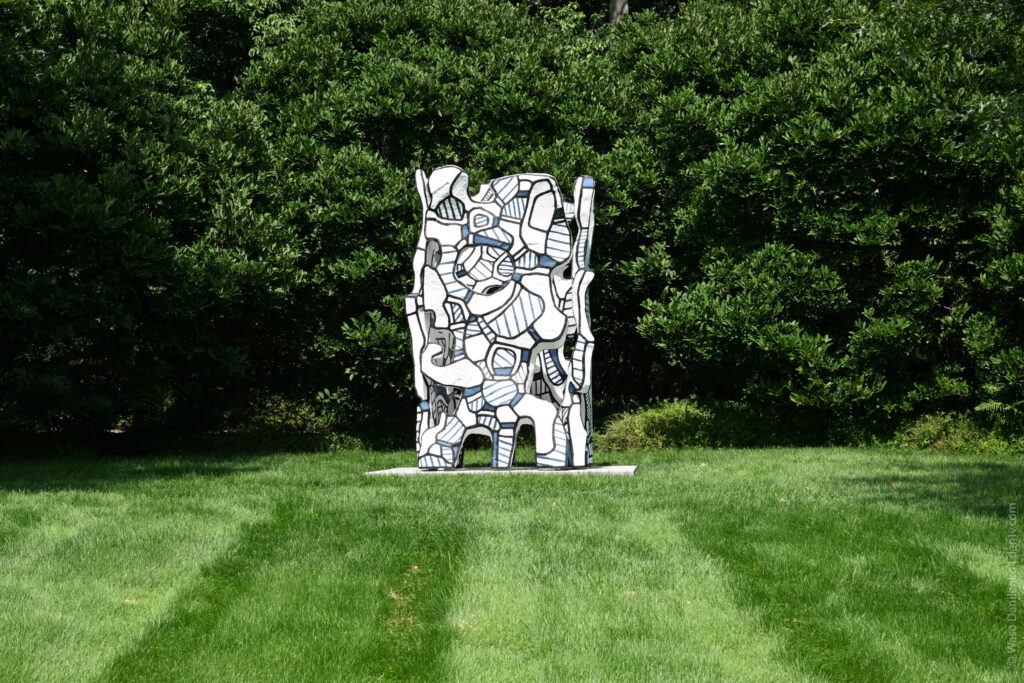
Another highlight is Jean Dubuffet’s Kiosque l’évidé (Hollowed-Out Kiosk). Interestingly, Dubuffet originally proposed the sculpture to David Rockefeller as the centerpiece for the plaza outside the Chase Manhattan Bank headquarters. Rockefeller ultimately chose Group of Four Trees, which was installed on Wall Street in 1972. Kiosque l’évidé eventually found its home in the PepsiCo Sculpture Gardens in 1984.
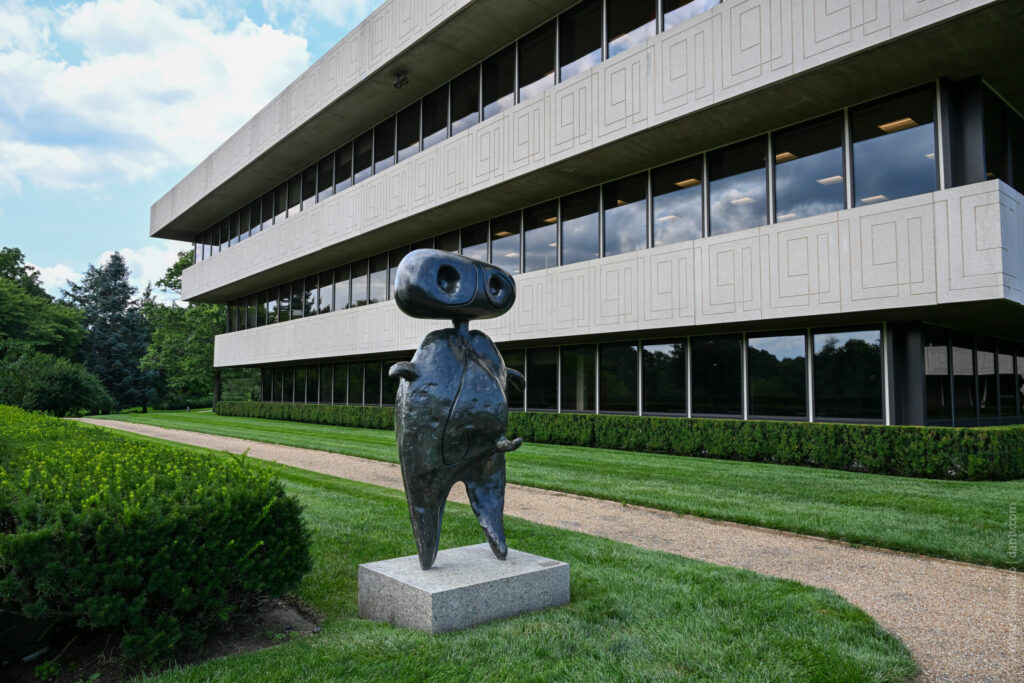
Personnage by Joan Miró.
Energy Void by Isamu Noguchi.
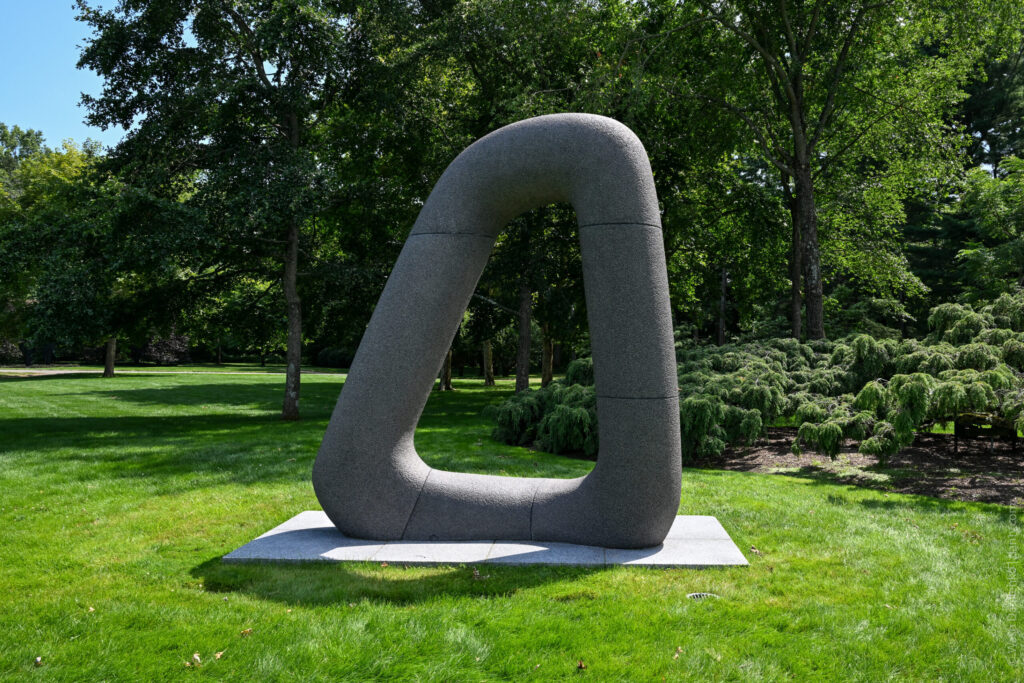
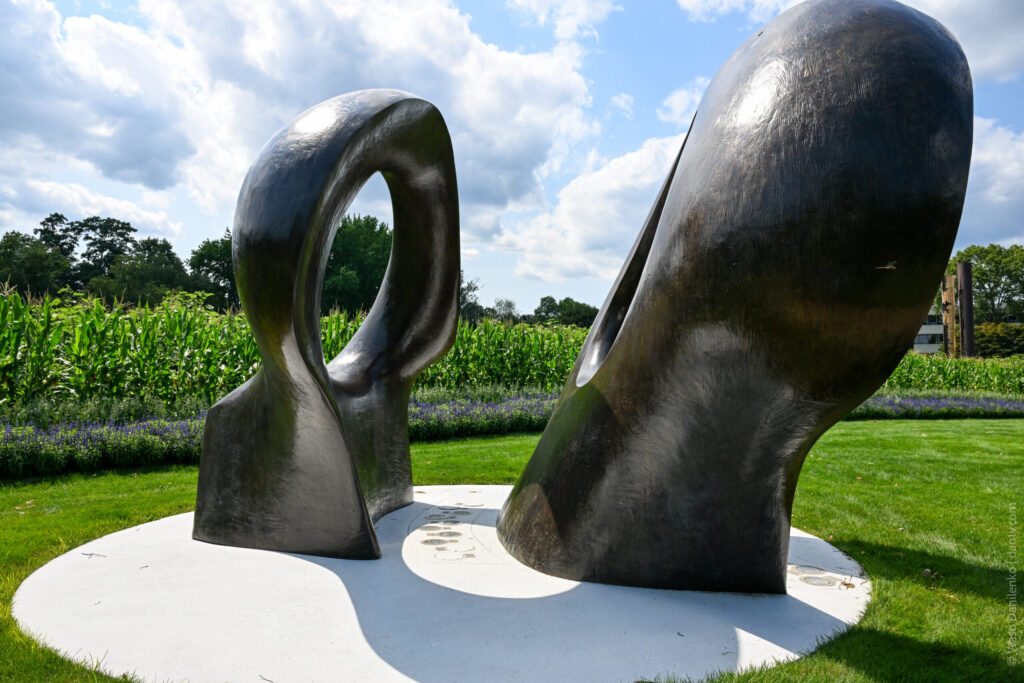
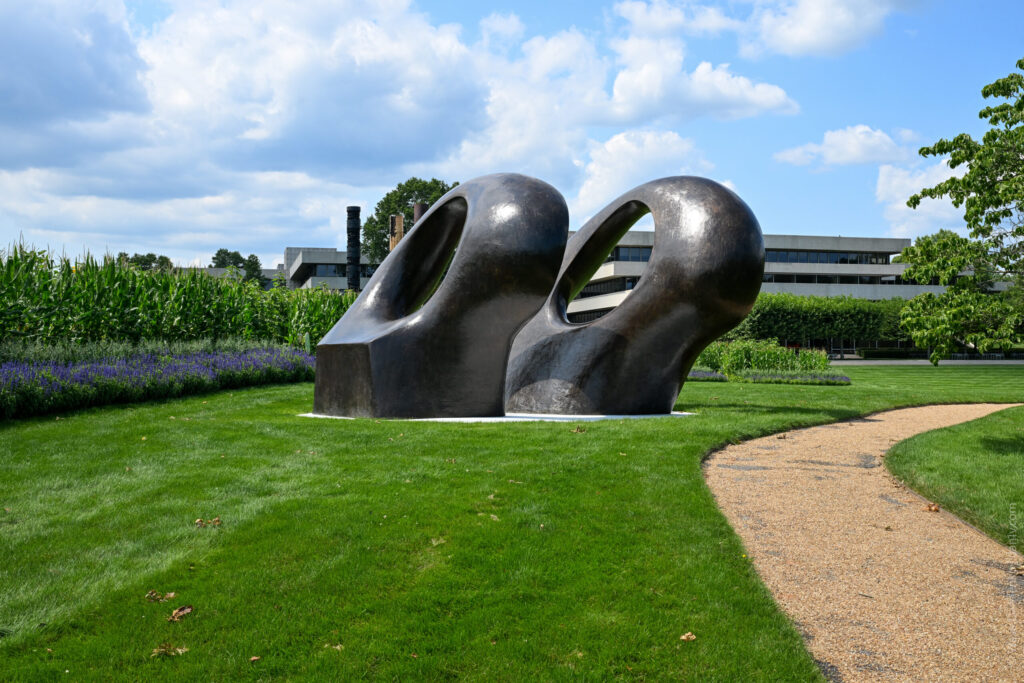
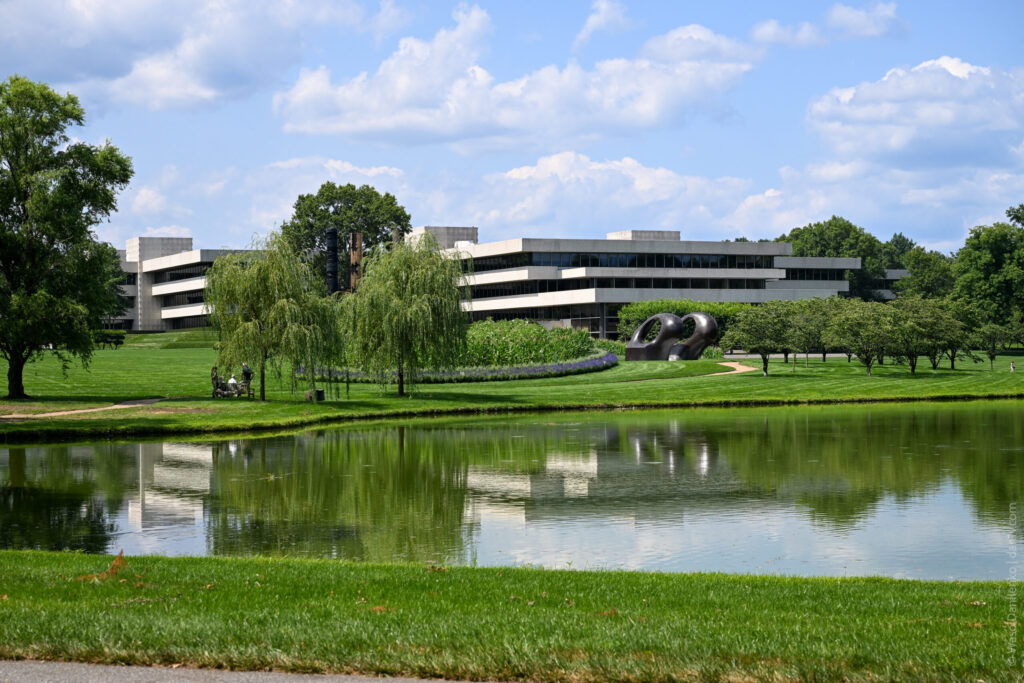
The gardens feature four sculptures by Henry Moore, including the iconic Double Oval, set beside the lake (pictured here), and Sheep Piece.
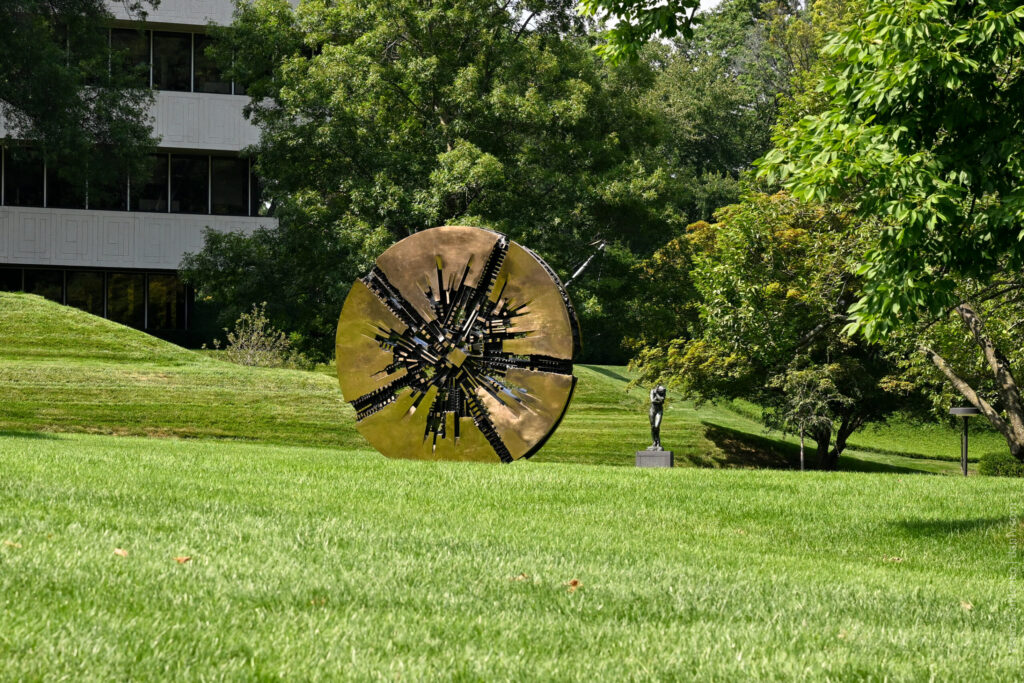
Il Grande Disco by Arnaldo Pomodoro. Pomodoro began his career as a jeweler, which explains a great deal about his work. From the outside, the disc is a flawlessly polished bronze form, while its interior reveals an intricate mechanical world of gears and cogs. This contrast between perfect geometry and an exposed inner “wound” became Pomodoro’s signature motif, one he repeated in spheres, cubes, and pyramids installed around the world. To the right of the disc stands a far more modest figure by a universally recognized master: Eve by Auguste Rodin, created in 1881, the oldest sculpture in the collection.
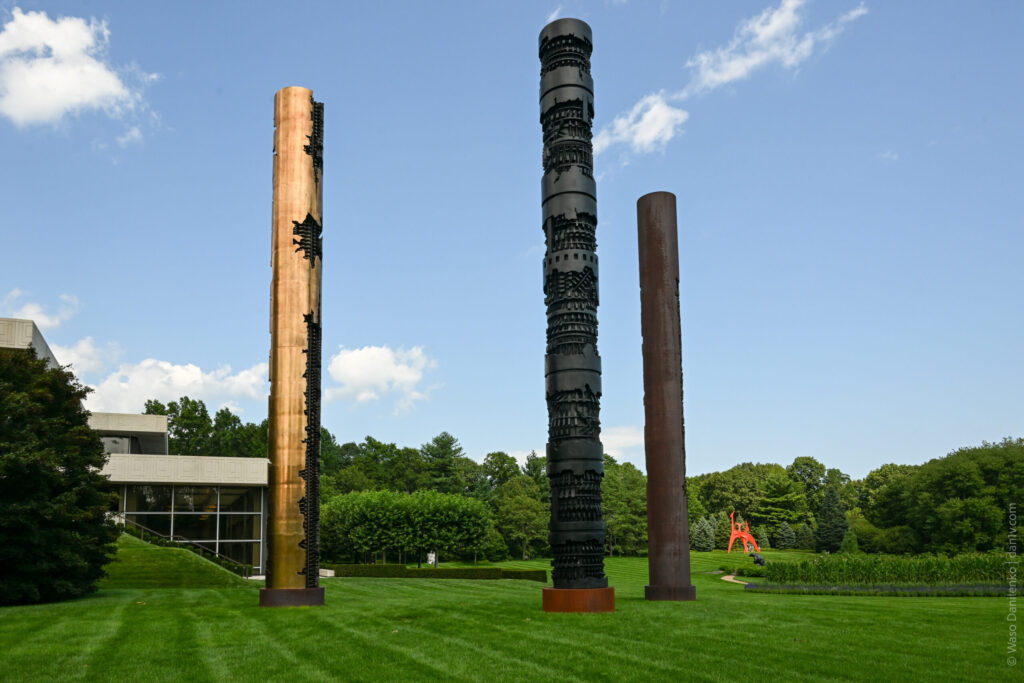
Triad by Arnaldo Pomodoro. Created in the late 1970s, these three columns continue the artist’s long-running Traveler’s Columns series, which began in the late 1950s. Their surfaces are covered with the same intricate mechanical textures found inside Il Grande Disco, but here those hidden mechanisms have been brought to the exterior. The columns can be read in two very different ways: as monuments from a vanished civilization or as rocket stages poised for launch. Pomodoro intentionally embraced this ambiguity, creating works that appear both unearthed from antiquity and ready to leave the planet.
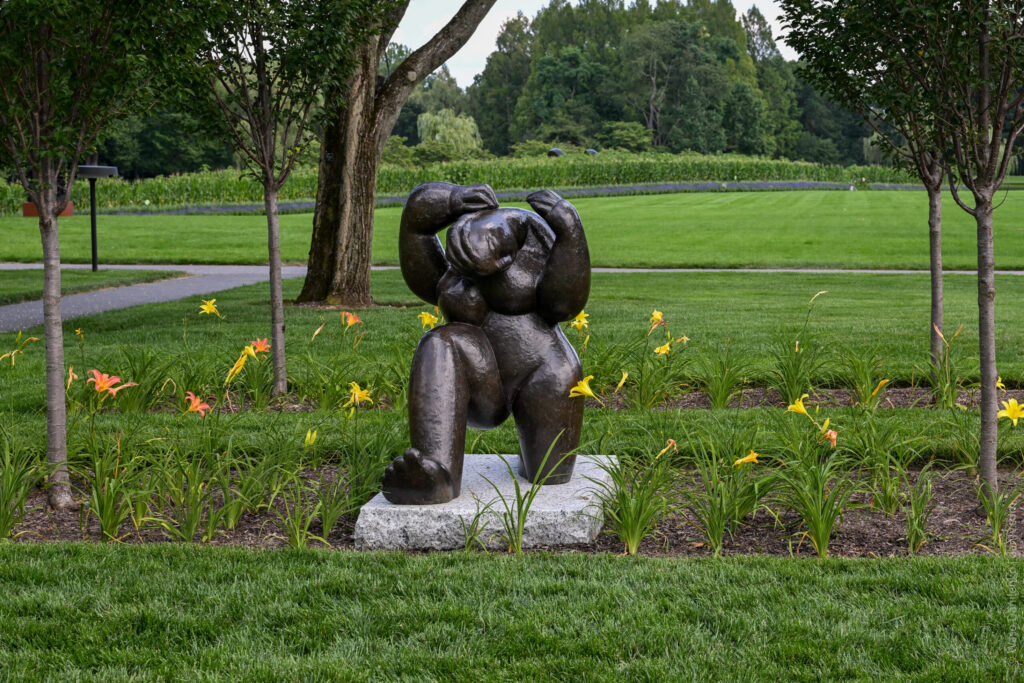
Le Matin (Morning) by Henri Laurens is a bronze sculpture from 1944, created in occupied Paris, where Laurens witnessed the persecution of many artists in his circle. The kneeling female figure stretches one leg forward as though preparing to rise, yet an invisible weight presses the back of her head toward her chest, preventing her from standing. Art historians often interpret the sculpture as Laurens’ response to the suffering of the occupation: Morning in title, but a morning that never truly arrives.
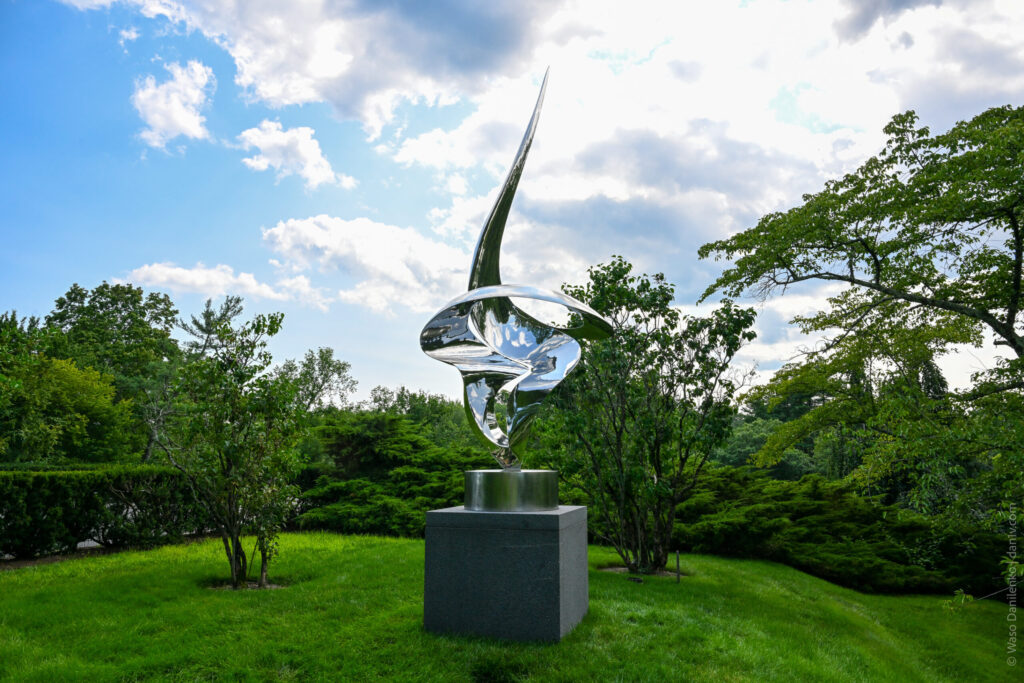
Swedish-Israeli sculptor Gidon Graetz, who was born in Italy, is represented by Composition in Stainless Steel No. 1. Crafted from polished stainless steel, the abstract sculpture captures reflections of the surrounding landscape, drawing the entire garden into its mirrored interior.
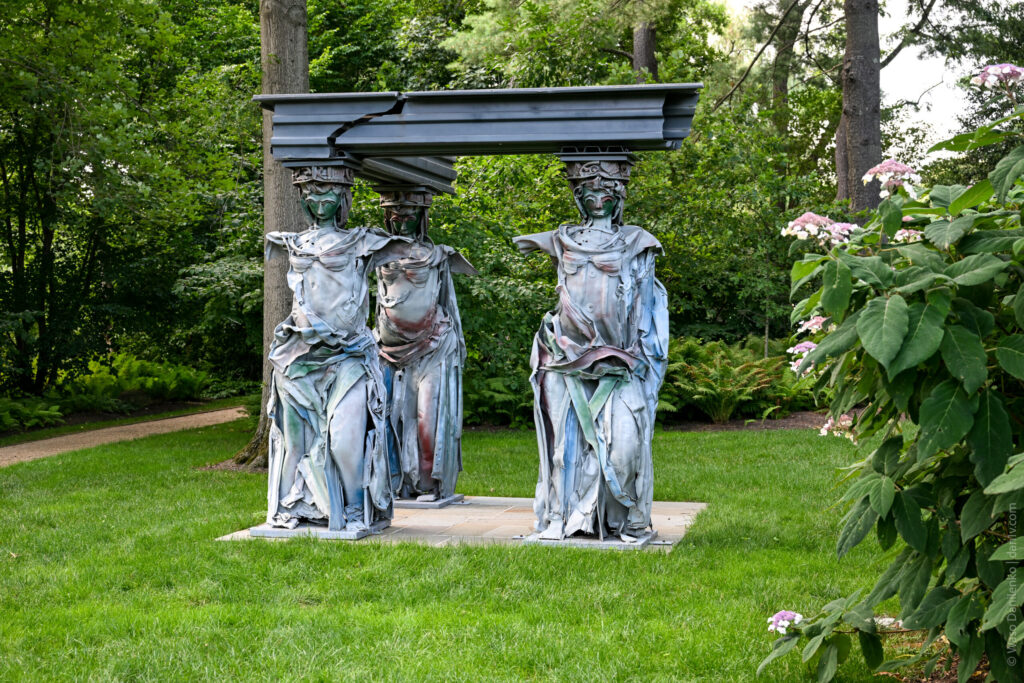
Caryatids by Judith Brown reimagine the classical female columns of ancient architecture using crushed automobile parts welded together. Your eyes instinctively search for a fourth figure, but it is not there. Chipmunks are known to make their homes inside the sculptures’ hollow interiors, much to the frustration of conservators.
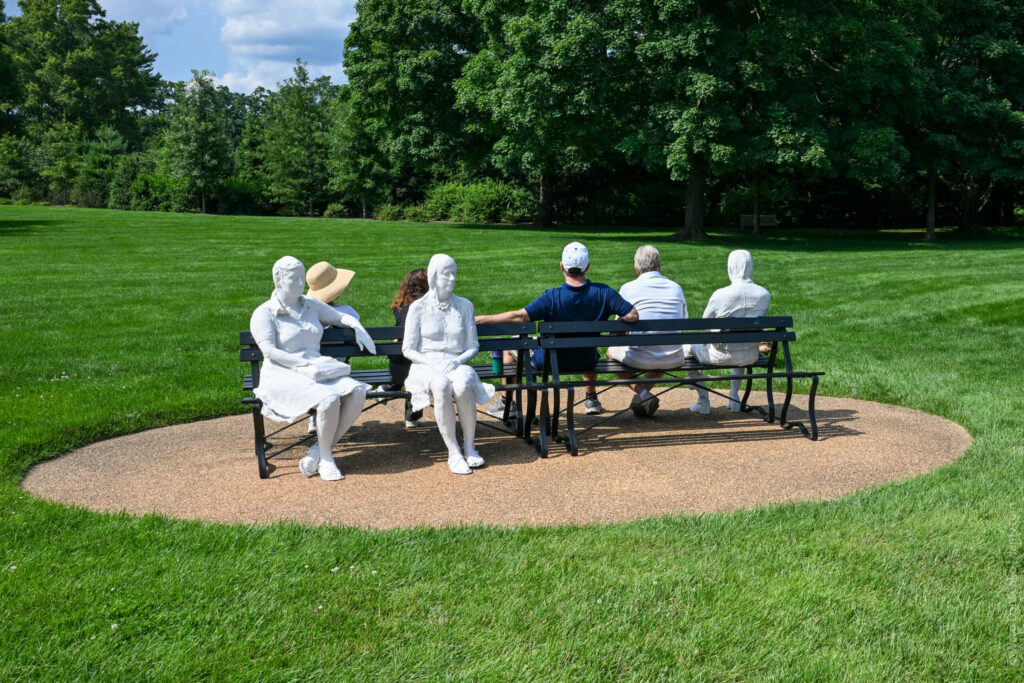
One of the park’s most touching and human works is Three on Four Benches by George Segal. Three white plaster-and-bronze figures have welcomed visitors onto their benches for decades, becoming one of the park’s favorite photo spots. Segal reportedly enjoyed this interaction. According to one of the sculpture’s conservators, he was even amused by the lipstick marks that visitors occasionally left behind on his figures.
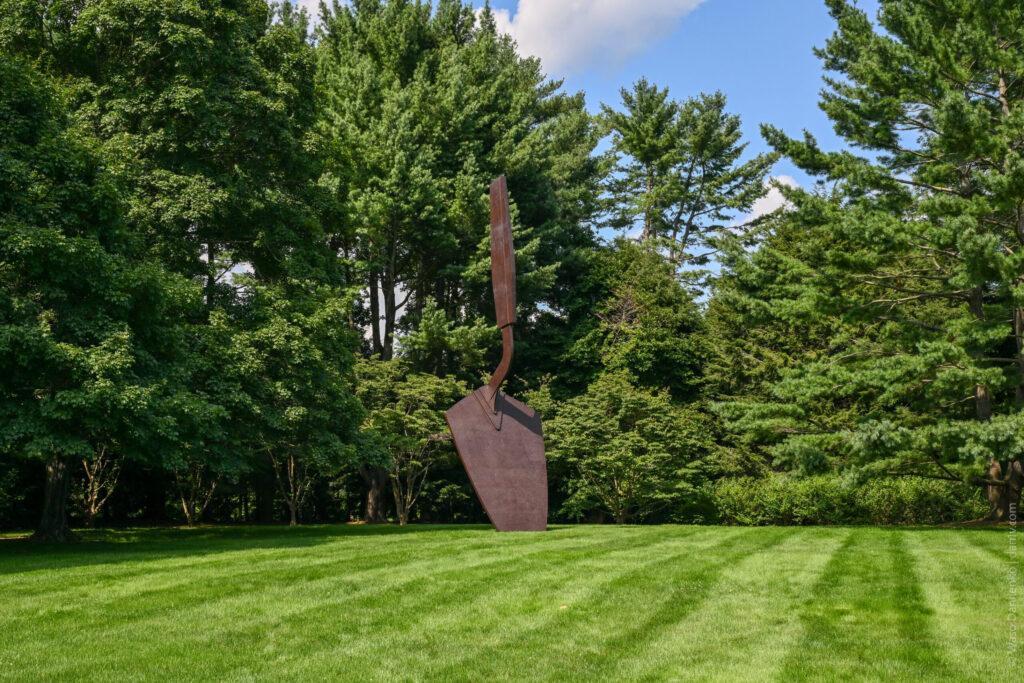
The 30-foot (9-meter) Giant Trowel II by Pop Art pioneer Claes Oldenburg bears a striking resemblance to Plantoir, Red on Park Avenue in Manhattan.
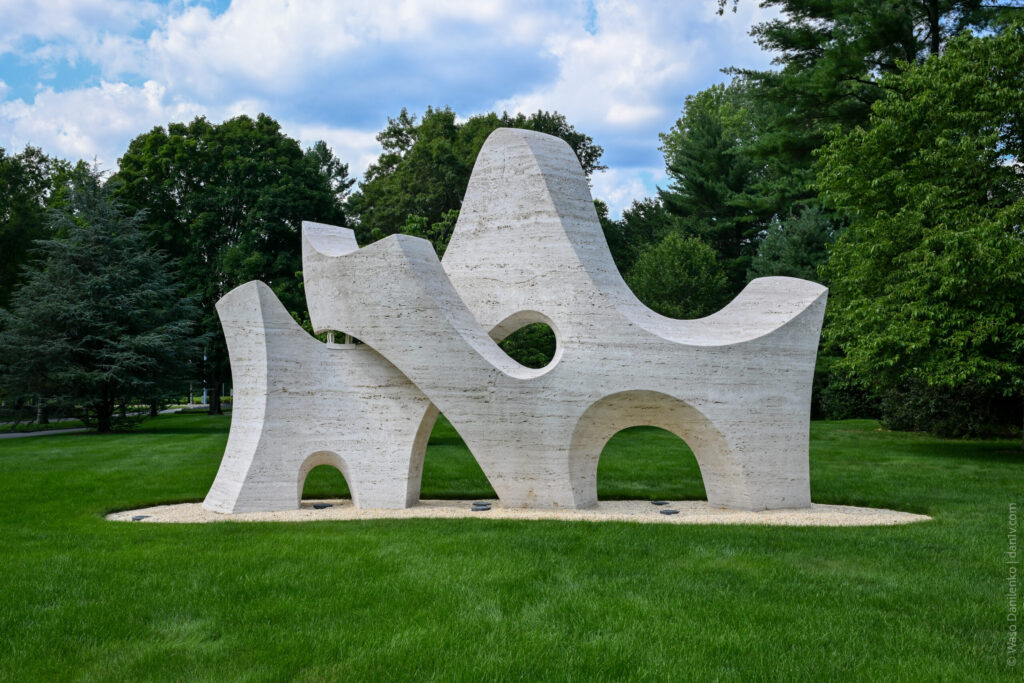
Passage by Richard Erdman is believed to be one of the largest sculptures in the world carved from a single block of travertine, measuring approximately 25 feet (7.5 meters) wide and 16 feet (5 meters) tall.
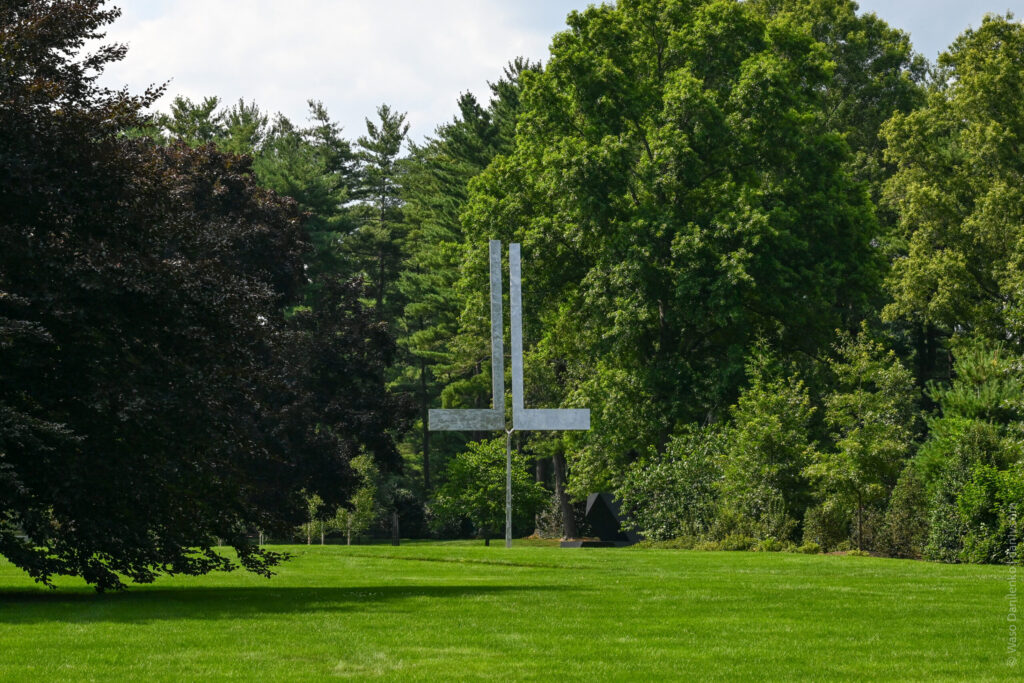
Double L Excentric Gyratory II by George Rickey (1981) consists of two stainless steel L-shaped forms mounted on a steel column, where they rotate freely. Rickey personally selected the sculpture’s location so that its continuous movement would interact perfectly with the surrounding landscape. There is no motor hidden inside — the wind alone powers the work.
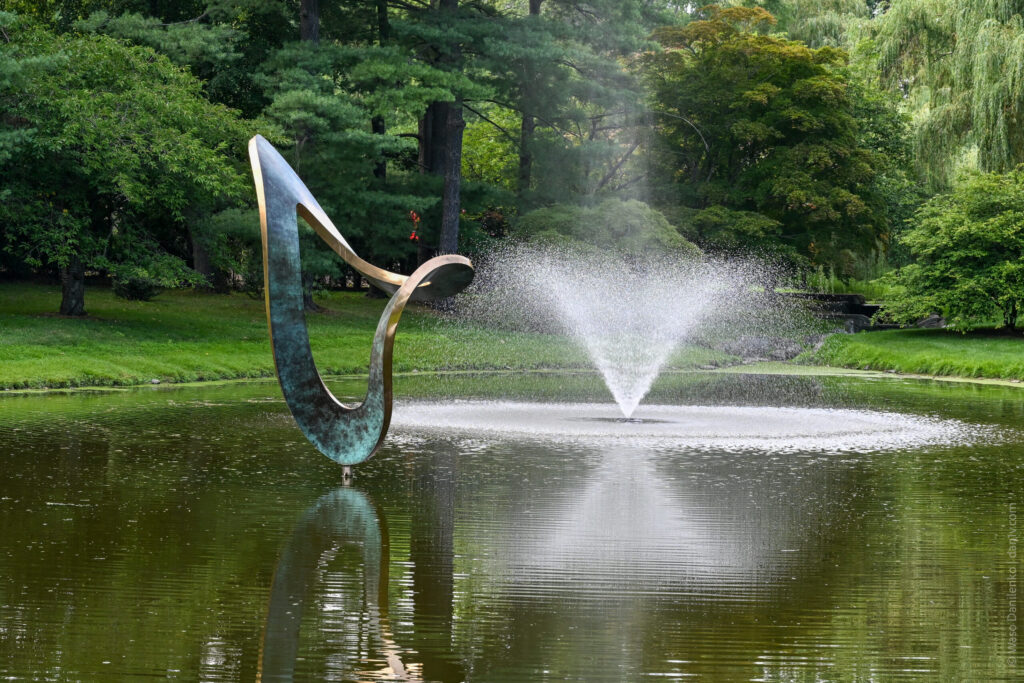
Jester II by Wendy Taylor (1994) exemplifies the sculptor’s signature style: large-scale structures engineered to appear as though they are balancing on the edge of collapse, with precision engineering disguised as illusion. Taylor is best known for Timepiece, the monumental sundial installed near London’s Tower Bridge.
How PepsiCo Moved from Manhattan to Purchase
In 1965, Pepsi-Cola merged with the snack manufacturer Frito-Lay, creating PepsiCo. As Donald Kendall himself explained, the logic behind the merger was brilliantly simple: people who eat potato chips usually want something to drink as well.
The newly formed company quickly outgrew its Manhattan headquarters — an elegant glass tower on Park Avenue, designed by Skidmore, Owings & Merrill and completed just five years earlier.
The Pepsi-Cola Building at 500 Park Avenue (at the corner of East 59th Street) is considered one of the masterpieces of New York modernist architecture and is now a designated New York City landmark. That makes PepsiCo one of the few companies whose former and current headquarters are both regarded as architectural icons.
PepsiCo then followed the path that IBM had taken in the late 1960s, leaving expensive, crowded Manhattan for the greener suburbs. It was part of a broader era of corporate migration, when major American companies built expansive modernist campuses throughout Westchester County and neighboring Connecticut, commissioning many of the country’s leading architects.
PepsiCo chose the site of a former polo field in Purchase, a small hamlet within the Town of Harrison, about 30 miles (50 kilometers) north of Manhattan. Construction took place between 1967 and 1970, and the new headquarters officially opened on October 2, 1970.
At the dedication ceremony, Donald Kendall announced his ambition to create “one of the world’s greatest exhibitions of modern sculpture,” featuring works by “all of the leading sculptors of our time.” Remarkably, it turned out to be far more than corporate rhetoric.
The Architecture of PepsiCo Headquarters
To design PepsiCo’s new headquarters, the company commissioned Edward Durell Stone, the architect whom the press once described as a “populist of modernism.” The Purchase campus became one of the final major projects of his career.
Edward Durell Stone (1902–1978) helped design Radio City Music Hall at Rockefeller Center during the 1930s and, in 1939, collaborated with Philip Goodwin on the original Museum of Modern Art (MoMA) building on West 53rd Street. He achieved international recognition with the U.S. Embassy in New Delhi (1954), celebrated for its intricate perforated concrete screens. In March 1958, Stone appeared on the cover of Time magazine — an exceptionally rare honor for an architect. His later works include the John F. Kennedy Center for the Performing Arts in Washington, D.C., the General Motors Building on Fifth Avenue, and the enigmatic 2 Columbus Circle in New York.
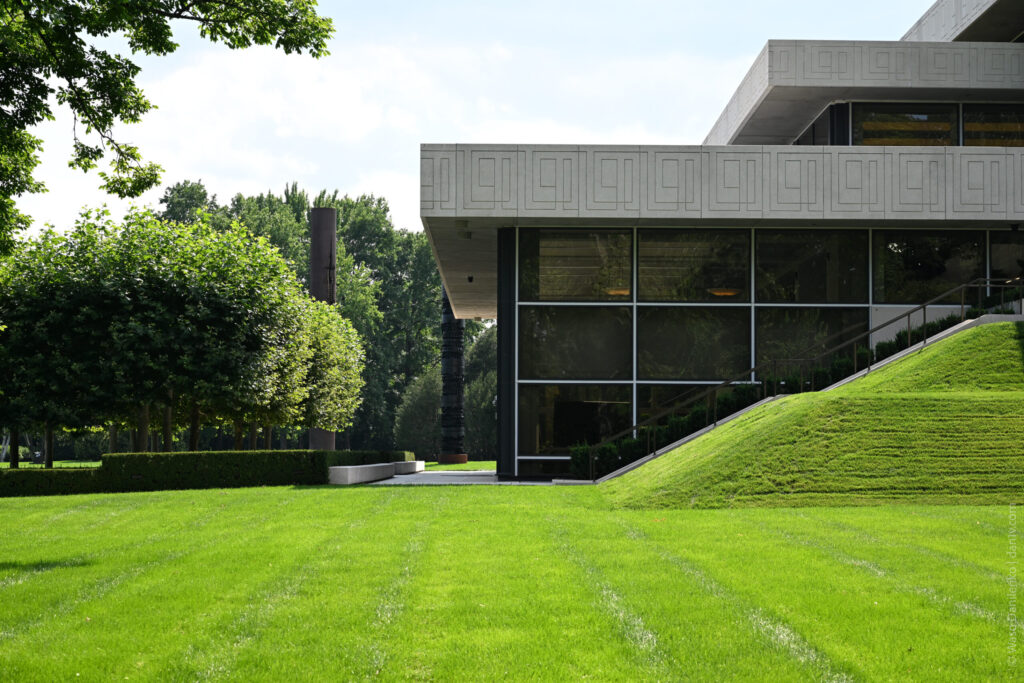
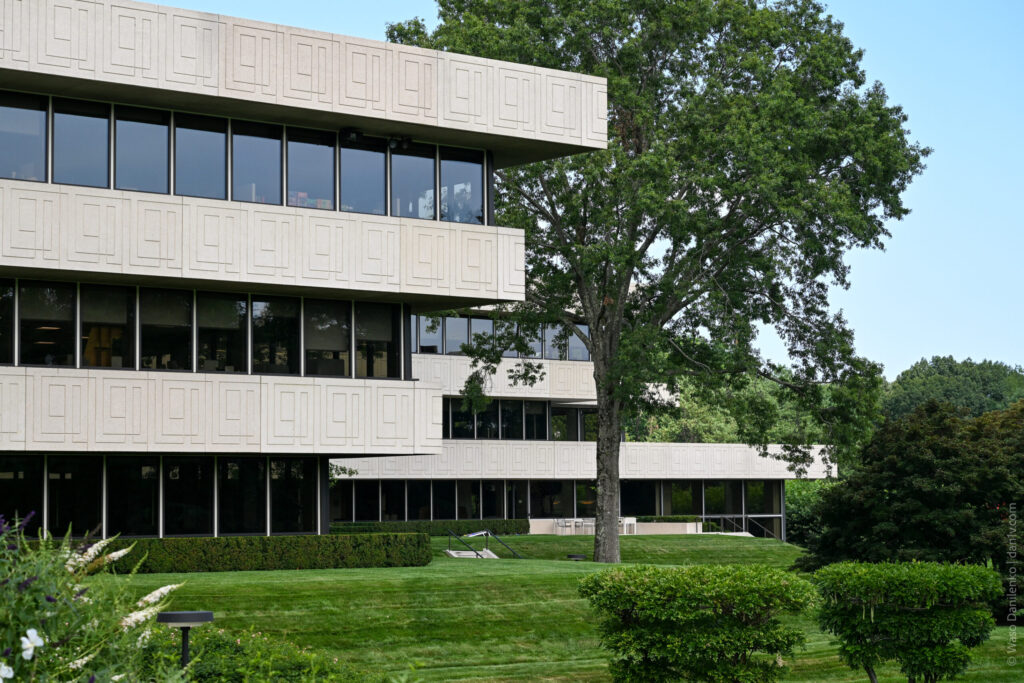
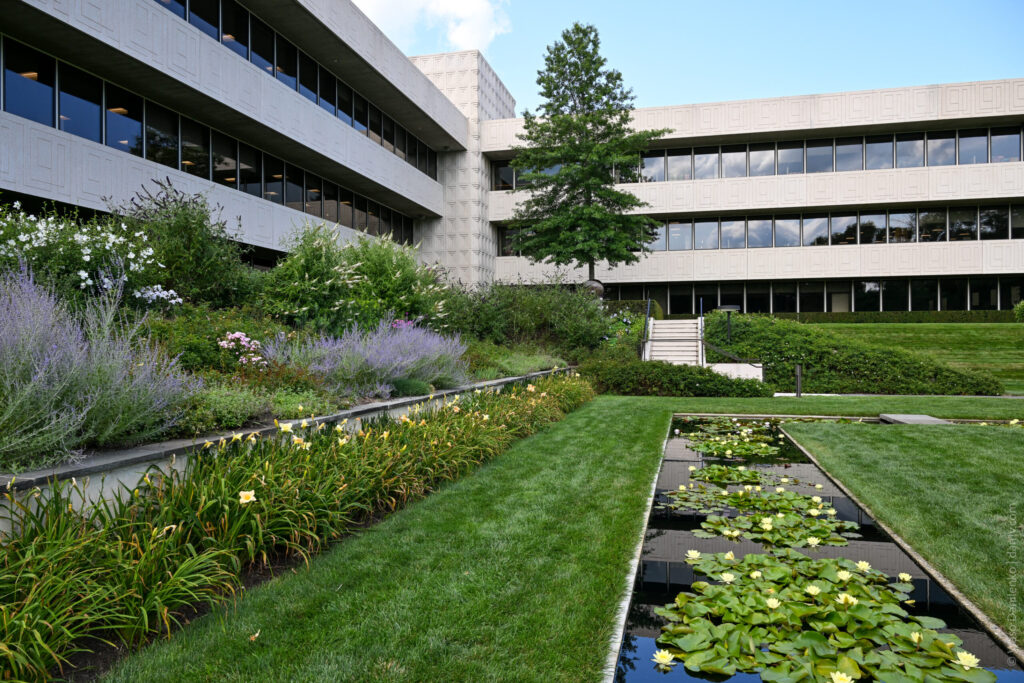
Viewed from above, the headquarters consists of seven identical square buildings connected at their corners to form a giant cross surrounding a cross-shaped central courtyard. Each building is a three-story inverted ziggurat, with each successive floor stepping outward as it rises. The façades alternate between horizontal bands of dark glass and light-colored textured concrete.
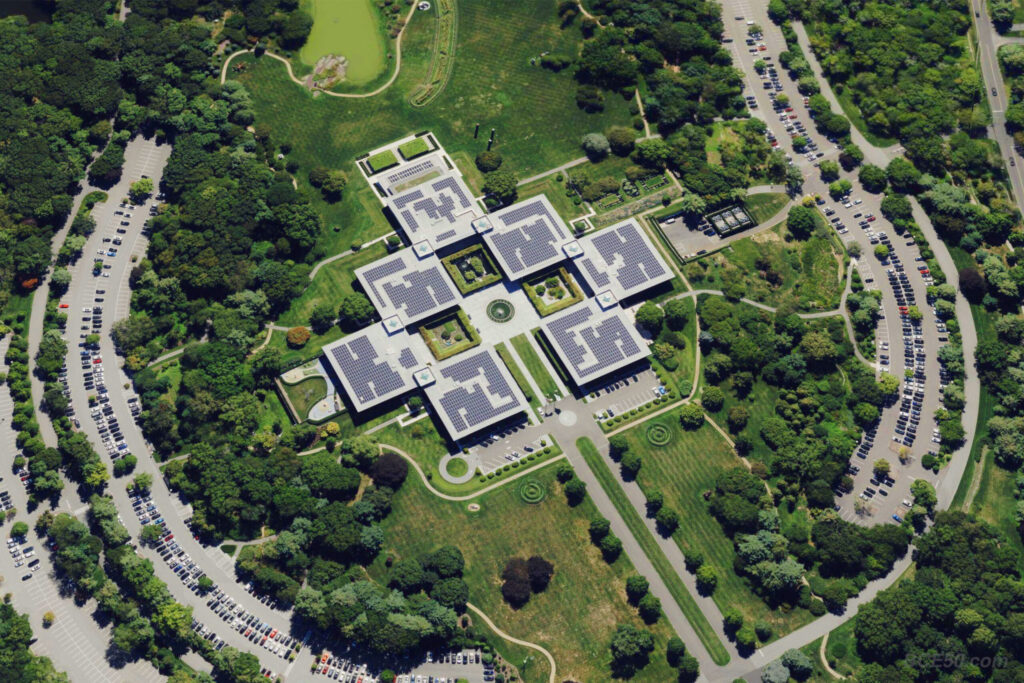
Stone, who was known throughout his career for his love of decorative screens and ornamental details — a trait that drew frequent criticism from modernist purists — reduced decoration here to a disciplined geometric language. Even so, the refined elegance that became his trademark remains unmistakable.
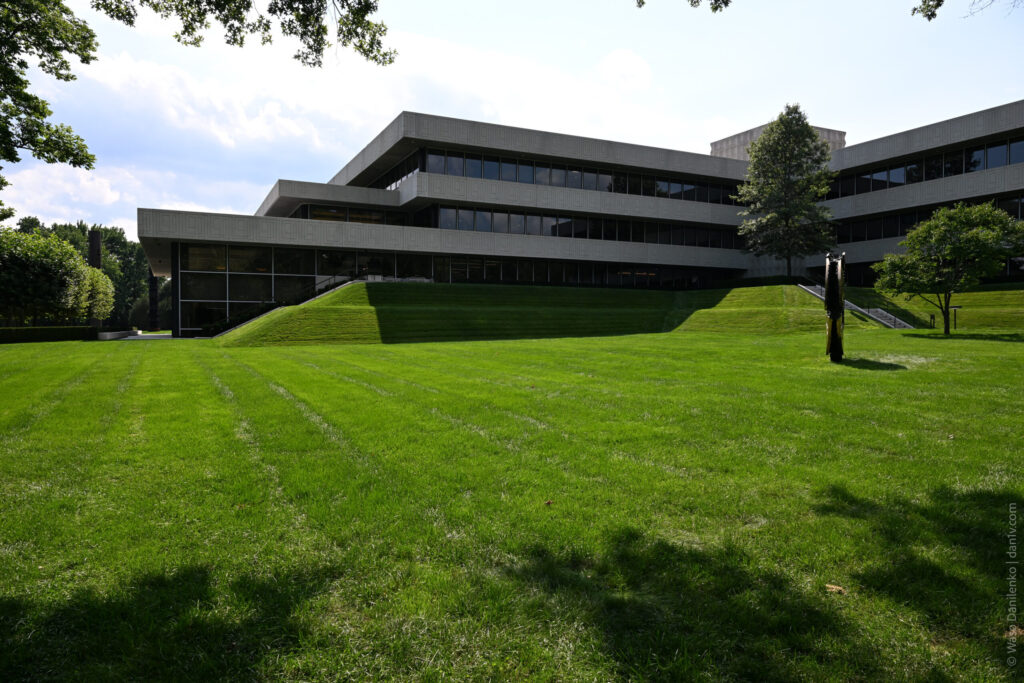
The design was also practical. The cross-shaped layout was intended to allow the complex to expand by adding new modules as the company grew, much like the expandable IBM campus that Stone’s friend Eero Saarinen designed in Rochester. The central courtyard opens only to the north, where a long, straight entrance drive leads in from Anderson Hill Road. At the point where the driveway meets the courtyard, the PepsiCo corporate flag flies beside the flag of the United States.
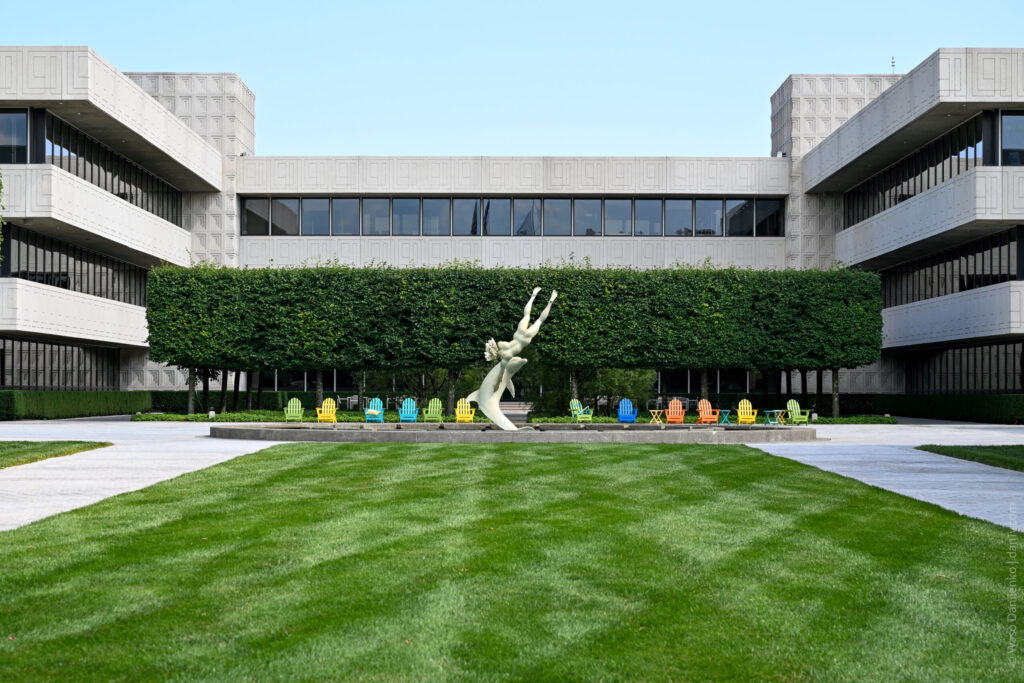
The courtyard’s three enclosed wings contain sunken gardens filled with mature trees and a small reflecting pond. At the very center stands a circular fountain featuring Girl with a Dolphin, a sculpture by David Wynne.
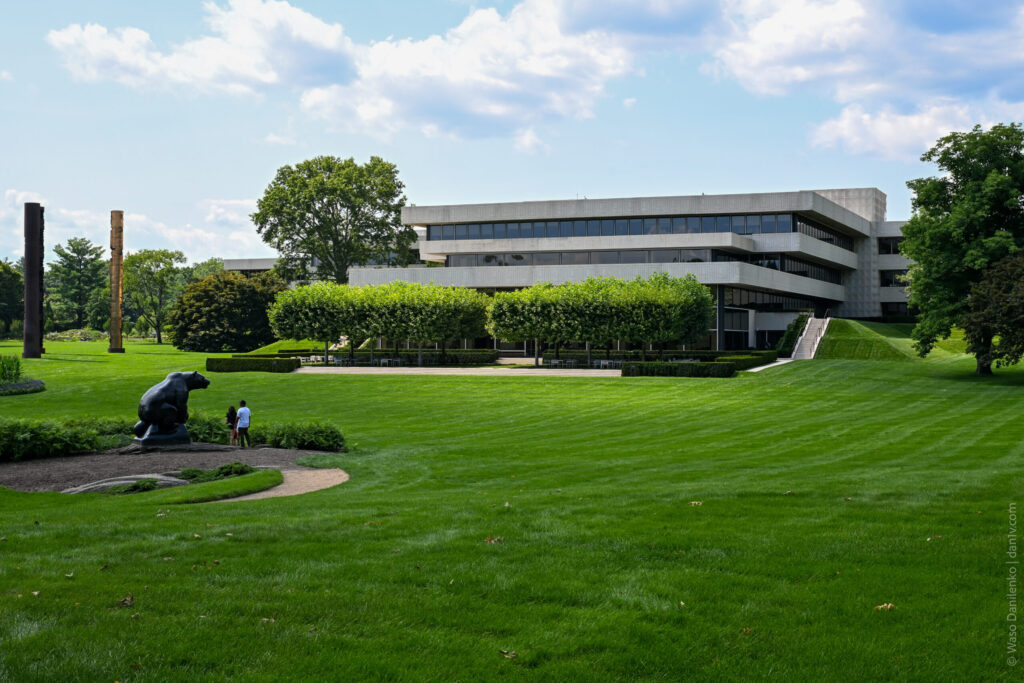
The finest view of the headquarters is from the expansive lawn on the south side of the complex. There, the ground slopes gently downward, making the otherwise modest three-story buildings appear far more monumental than they actually are. From the main entrance, this effect is intentionally softened by rows of trees and the level landscape.
Donald Kendall: The Syrup Salesman Who Got Khrushchev to Drink Pepsi
The story of this park cannot be separated from the life of one man. Donald MacIntosh Kendall was born in 1921 on a dairy farm in Washington State. During World War II, he served as a naval aviator, and in 1947 he joined Pepsi-Cola as a salesman, selling syrup for soda fountains. What followed was a classic American success story: by the end of the 1950s, he was already leading the company’s international division.
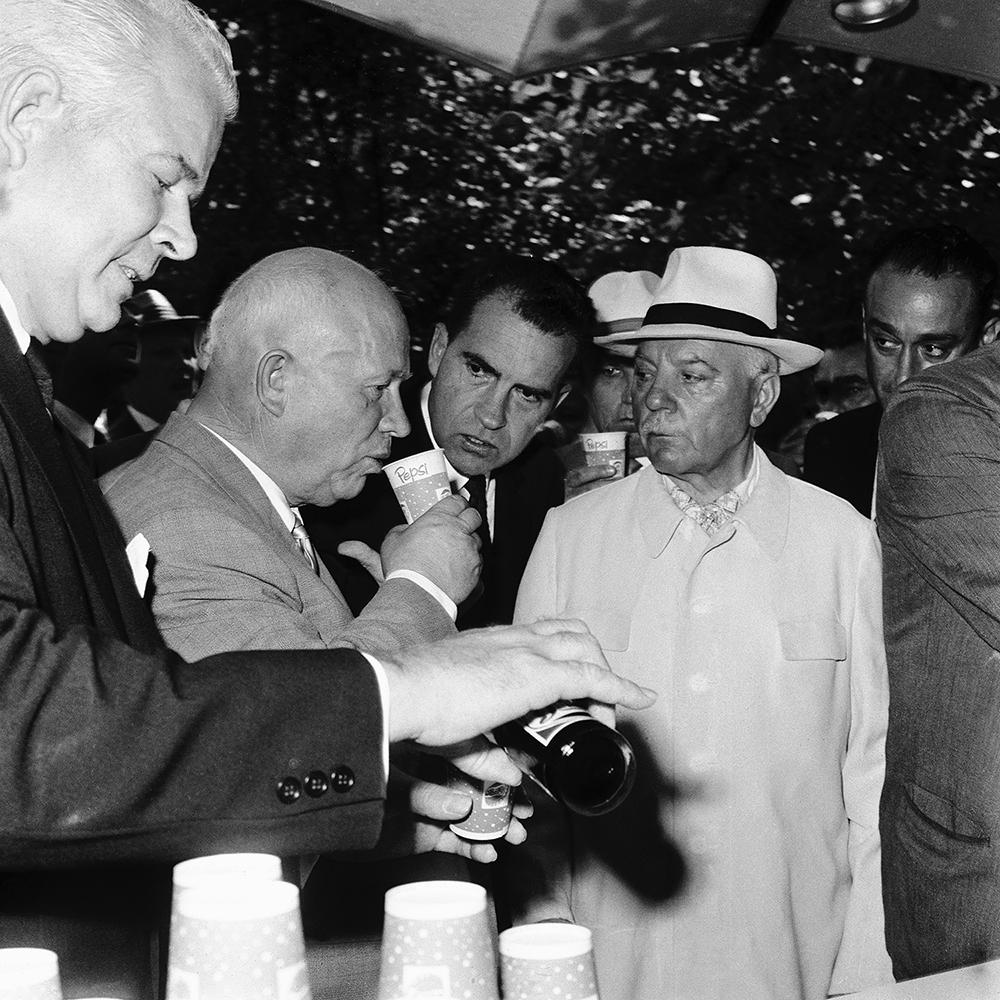
Kendall’s defining moment came in the summer of 1959. The American National Exhibition was about to open in Moscow’s Sokolniki Park. It was designed as a showcase of the American way of life at the height of the Cold War, featuring automobiles, fashion, color television, and a model American home. Pepsi participated in the exhibition despite the objections of company executives, who considered it a waste of money, and Kendall urgently needed to prove them wrong.
On the eve of the opening, during a reception at the United States Embassy, he approached Vice President Richard Nixon with an unusual request: “I need Pepsi to end up in Khrushchev’s hands.” Nixon delivered.
On July 24, 1959, at the height of the famous “Kitchen Debate” over the merits of capitalism and socialism, Nixon casually guided Nikita Khrushchev to the Pepsi exhibit. There, the Soviet leader was invited to compare two glasses: one of Pepsi made with American water and another made with Moscow water. Khrushchev, unsurprisingly, declared the Soviet version superior and described the drink as “very refreshing.” Photographs of the Soviet leader holding a glass of Pepsi appeared in newspapers around the world the following day. It was a publicity triumph beyond anyone’s expectations. (Khrushchev’s son, Sergei, later recalled that many Russians thought Pepsi tasted like shoe polish, but everyone remembered the drink.)
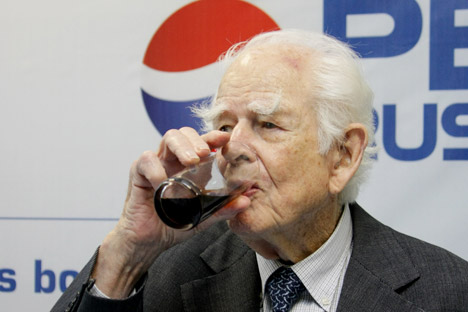
Kendall’s career soared after that. In 1963, at the age of 42, he became president of Pepsi-Cola. In 1965, he orchestrated the merger with Frito-Lay and became the head of the newly formed PepsiCo. During his 23 years at the helm, the company’s annual revenue increased nearly fortyfold, from $200 million to $7.6 billion. It was under Kendall’s leadership that Diet Pepsi was introduced, and Pizza Hut, Taco Bell, and KFC became part of the company’s portfolio.
The Gardens: Three Landscape Designers and a Vice President of Sculpture
The first version of the landscape was created in the late 1960s by Edward Stone Jr., the son of the architect, who built a successful career of his own as a landscape designer. His firm planted approximately 6,000 deciduous trees representing 38 species, along with thousands of flowering bulbs. The plantings also served a practical purpose: they concealed the vast parking lots surrounding the campus behind a curtain of greenery. At first, there were only eight sculptures on the grounds. Employees embraced the idea so enthusiastically that Kendall decided to turn a hobby into a long-term strategy and began systematically expanding the collection.
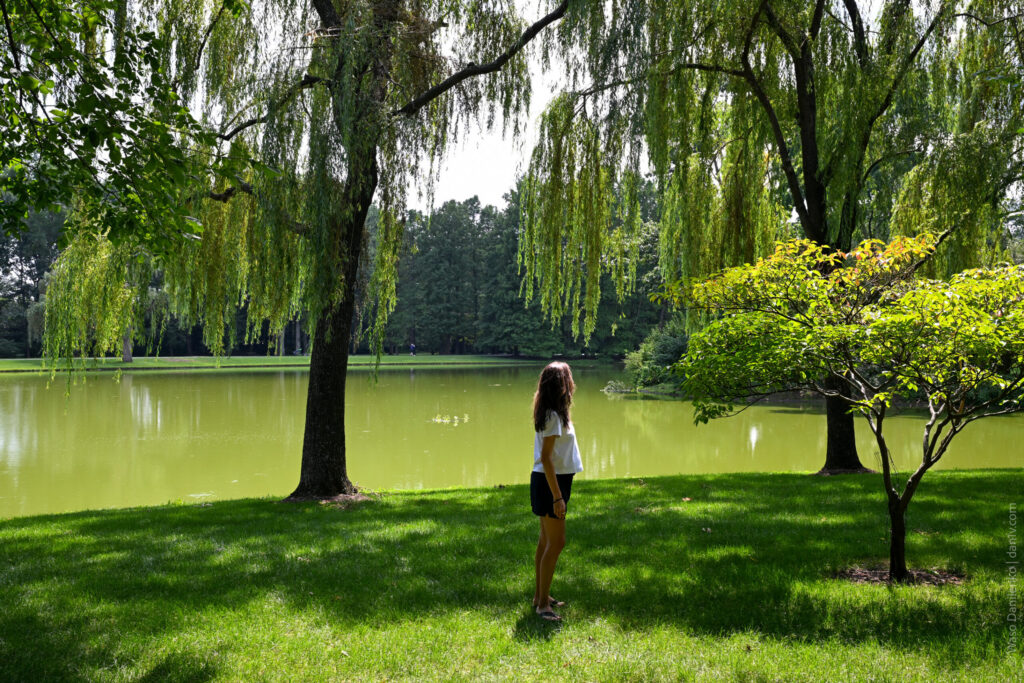
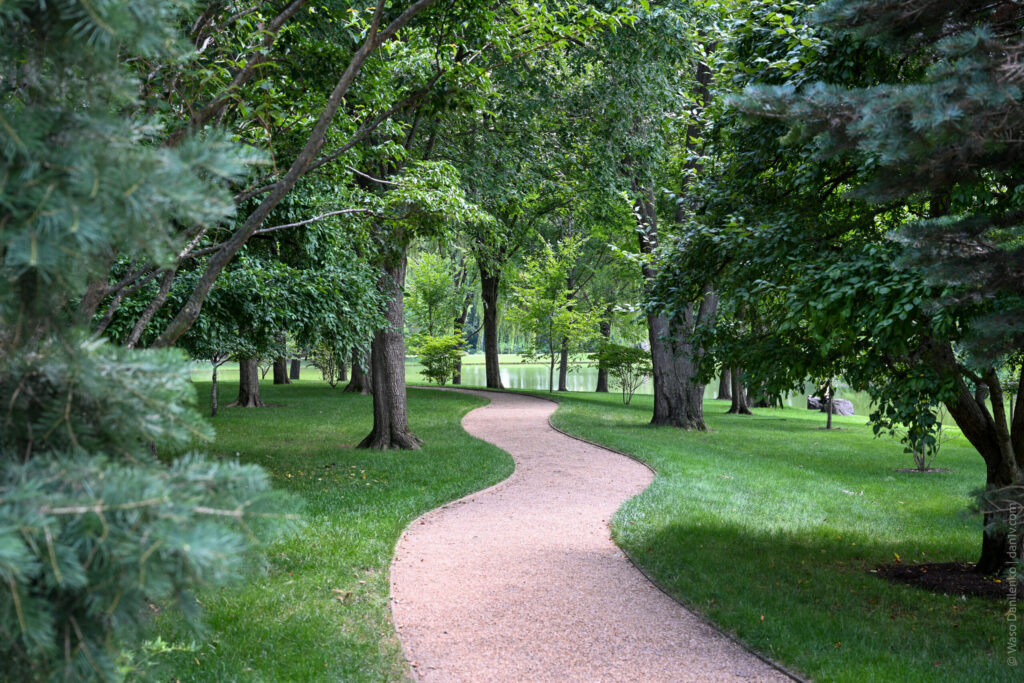
In 1981, he invited Russell Page, arguably the most celebrated British garden designer of the twentieth century and the author of the classic book The Education of a Gardener. Page spent nearly five years working on the PepsiCo campus and completely reimagined the landscape. He organized the park around its sculptures. Together with Kendall, he commissioned full-scale mock-ups of artworks and moved them across the property until each piece found its ideal location, taking into account light, topography, and sightlines. Page also connected the entire landscape with a single walking route known as the Golden Path, a trail of amber-colored gravel that allows visitors to explore the entire collection in one continuous loop.
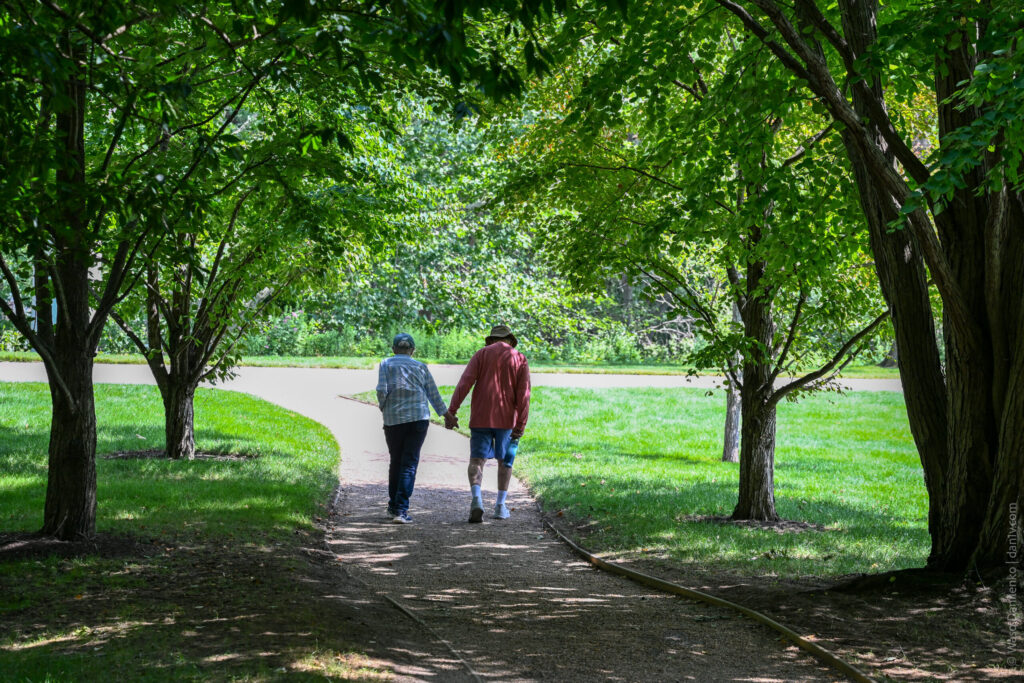
He also designed around ten themed “garden rooms,” including an ornamental grass garden, an azalea garden, a marsh garden with a stream, and a water lily garden featuring three rectangular reflecting pools surrounded by perennial plantings. Finally, Page transformed the grounds into a true arboretum. The trees were selected as a curated collection, and most specimen trees are labeled with their species names, a welcome detail for visitors with an interest in botany.
Page continued working on the gardens until the final months of his life. He died in January 1985, making the PepsiCo campus one of his last and largest projects in the United States. Since 1985, the gardens have been developed by Belgian landscape designer François Goffinet.
Kendall remained the collection’s de facto curator even after stepping down as PepsiCo’s Chief Executive Officer in 1986. As late as the early 1990s, journalists still found him discussing where the next sculpture should be installed. He died in 2020 at the age of 99, having lived long enough to see his “museum without walls” reopen after a major renovation.
The 2012–2017 Renovation: Five Years Behind Closed Gates
By the early 2010s, Stone’s headquarters had become outdated, and PepsiCo seriously considered relocating. In the end, the company chose to remain in Westchester County. In 2012, New York Governor Andrew Cuomo announced a $243 million renovation of the headquarters, the first comprehensive modernization since the campus was built.
A glass atrium measuring approximately 4,200 square meters was added at the center of the seven-building complex. Office capacity increased by 15 percent, the engineering systems and parking facilities were modernized, and a new visitor center was constructed along Anderson Hill Road for guests visiting the sculpture gardens.
Although the renovation was originally expected to take about 30 months, the project lasted much longer. The gardens were closed to the public beginning in 2012 and did not reopen until March 30, 2017. They reopened with new visitor regulations, weekend opening hours, and a mobile audio guide. For local residents, it was a significant occasion: one of Westchester County’s finest parks had remained closed behind locked gates for five years.
Visitor Information
- 📍 PepsiCo, 700 Anderson Hill Road, Purchase, NY 10577
- The gardens are open on Saturdays and Sundays from March 29 through November 22, between 10:00 AM and 4:00 PM. They are also open on selected holidays: Memorial Day, Juneteenth (June 19), Independence Day (July 4), Monday, July 6, Labor Day, and Columbus Day / Indigenous Peoples’ Day.
- Admission and parking are free of charge. Visitors are not permitted inside the office buildings, and, as PepsiCo notes, the schedule may change without prior notice, so it is a good idea to check the official website before making a long trip.
- A downloadable PDF map showing the location of every sculpture is available on the PepsiCo website. When the gardens reopened in 2017, the company also introduced a free mobile audio guide.
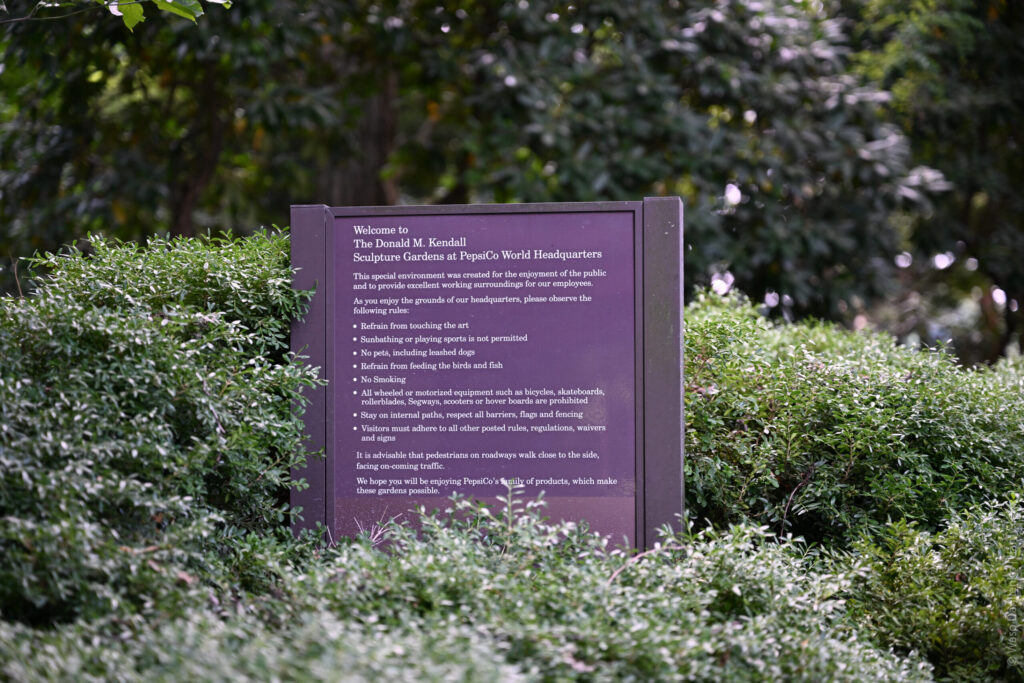
- The rules are strict. Visitors are asked not to touch the sculptures, bring pets (including those on leashes), feed birds or fish, sunbathe, play sports, or smoke. All wheeled vehicles — including bicycles, scooters, skateboards, and hoverboards—are prohibited. Guests are expected to remain on designated paths and respect barriers and marked-off areas.
- Group visits, including school groups and summer camps, must be arranged at least 10 business days in advance and must arrive by bus. Reservation forms and contact information are available on the official website.
- There are no indoor visitor facilities on the grounds, so the gardens are not an ideal destination in rainy weather. Checking the forecast before your visit is recommended.
- By car, the PepsiCo campus is approximately 45 minutes from Manhattan, depending on traffic.
- By public transportation, take a Metro-North Railroad train from Grand Central Terminal to White Plains on the Harlem Line or to Rye on the New Haven Line. From either station, the gardens are a 10–15 minute taxi ride away. From White Plains Station, visitors can also take Bee-Line Bus No. 12 to the headquarters.
- Plan to spend between two hours and half a day exploring the grounds.
- The best times to visit are late April and May, when the gardens are in bloom, and October, when autumn foliage coincides with the final weeks of the season.
- Gardens phone number (general inquiries, security, and lost and found): +1 (914) 253-3500.
Bonus: The Neuberger Museum of Art Across the Street
Directly across Anderson Hill Road from the PepsiCo headquarters is the campus of Purchase College, State University of New York (SUNY Purchase). It is home to the Neuberger Museum of Art, one of the largest university art museums in the United States and a destination known for its outstanding collection of twentieth-century American art.
Pairing a morning walk through Kendall’s sculpture gardens with an afternoon at the Neuberger Museum makes for a rewarding full-day art itinerary in Purchase. Better yet, both attractions offer free admission, making this one of the best-value cultural outings in the New York metropolitan area.