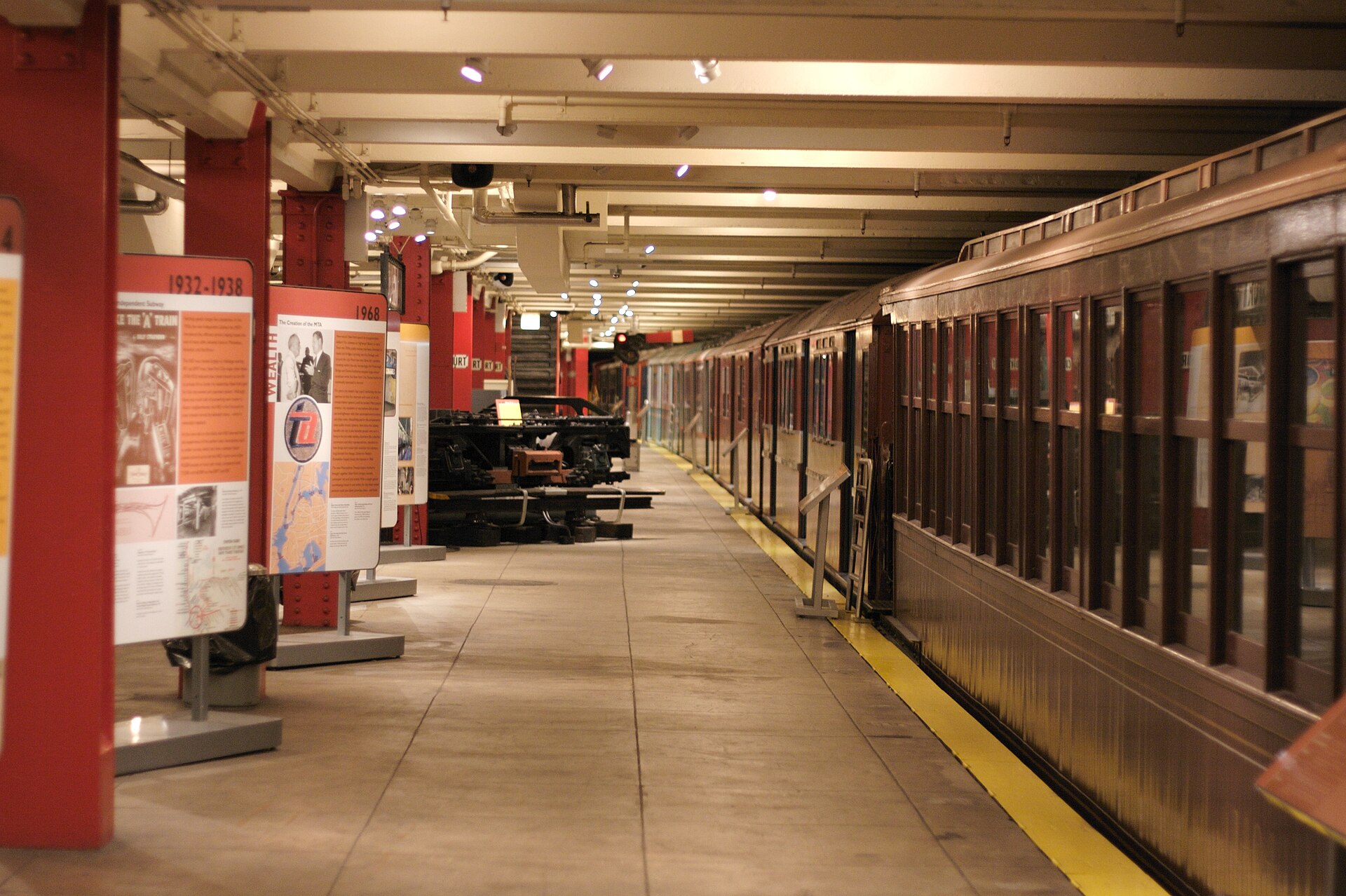
The New York Transit Museum is housed in a real subway station that was closed to passengers in 1946. You descend two flights of stairs as you would in any ordinary subway station, but at the bottom, instead of waiting trains, you find vintage subway cars that carried New Yorkers throughout the early 20th century. The tracks are still connected to the active subway network, and the station itself is rightly considered the museum’s main exhibit.
The museum opened on July 4, 1976, as a temporary exhibition celebrating the United States Bicentennial, but it became a permanent institution. In 2026, it celebrates its 50th anniversary. The main museum is located in Brooklyn, while a free gallery and museum shop can be found in Manhattan’s Grand Central Terminal.
Interesting Facts About the New York Transit Museum
- One proposed version of the Second Avenue Subway project included extending the line into Brooklyn and connecting it to the dead-end tracks at Court Street station. However, the plan was never implemented.
- Court Street station opened on April 9, 1936, but operated for only ten years. Few passengers used its single, short route, and the station cost $19,903 a year to operate.
- After the station closed, it became a filming location. Movies shot here include Guilty Bystander (1949), The FBI Story (1956), and The Taking of Pelham One Two Three (1974).
- In 1956, experimental bus No. 3100, equipped with air conditioning and owned by the Fifth Avenue Coach Company, was brought to the station. It was later used by the Transit Police.
- In 1961, there were plans to turn the abandoned station into a bowling alley, but the project was never carried out.
- In 1976, an exhibition opened at the station, with admission costing one subway token. It was originally scheduled to close on September 7, but its popularity led to the decision to keep it open permanently.
- The station’s tracks are still in use: vintage subway cars are brought in through a tunnel. The signal tower is also operational, and its levers are used when moving the cars.
- Since 1994, the museum has opened its doors free of charge each year during the Bus Festival, held alongside the Atlantic Antic street fair. The festival features vintage buses.
- The history of subway fare payment is explored in the FAREwell, MetroCard exhibition. It traces the transition from tokens to the MetroCard in 1994 and the gradual replacement of cards with the contactless OMNY system.
History of the New York Transit Museum
Court Street station opened on April 9, 1936, as part of the subway system. The opening ceremony was led by New York City Mayor Fiorello La Guardia. According to the original plan, the station was supposed to serve as the terminus for local trains, but through service was never introduced. Instead, the station was served by a short shuttle to Hoyt–Schermerhorn Streets.
Due to low passenger numbers, the station closed on June 1, 1946. Most of its street entrances were sealed off, and the station was occasionally used for maintenance purposes. In 1960, a new method of cleaning the station’s tiles was tested here, and later the station became a film location.
On July 4, 1976, a temporary exhibition dedicated to the history of New York City’s public transportation opened in the former station. The exhibition featured vintage subway cars, models, and other artifacts, with admission costing one subway token. It proved so popular that organizers decided to keep it open. The abandoned station thus became a permanent museum.
In the 1990s, the museum expanded its scope to include exhibits on commuter railroads, bridges, and tunnels. In 1993, a gallery and museum shop opened at Grand Central Terminal. The first Bus Festival took place in 1994, and in 1995, the Friends of the New York Transit Museum organization was established to raise funds for the museum’s development.
In 2011, the museum was equipped with a lift to improve accessibility for visitors who use wheelchairs. In 2026, it celebrates its 50th anniversary with an exhibition titled The New York Transit Museum: 50 Years of Stories and a digital project called Our Journey, dedicated to the history of the station and the museum’s collection.


Architecture of the New York Transit Museum
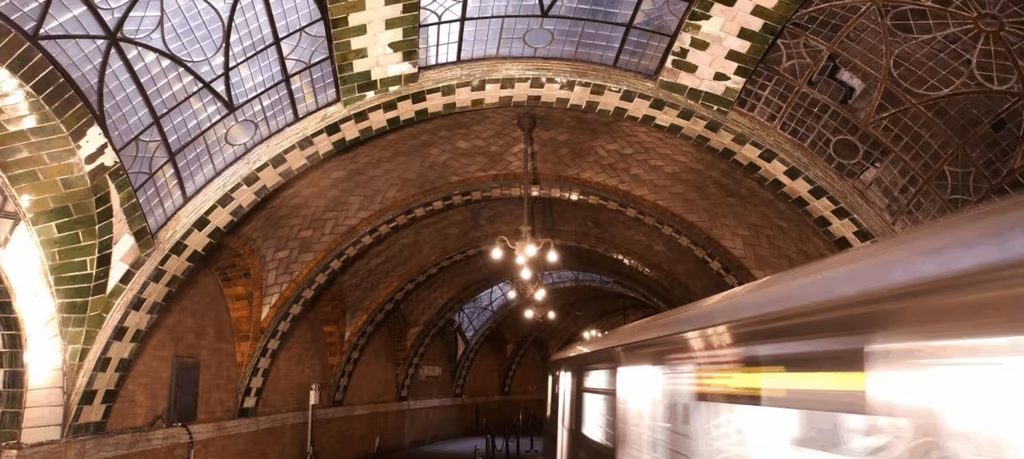
The museum is housed in the former Court Street subway station, which opened in 1936. Its original layout, finishes, and structural elements have been preserved, making the station itself part of the exhibition.
The station consists of a single island platform with a track on each side. Its walls are decorated with aquamarine tiles bordered by a deep blue trim, a characteristic feature of local stations on the IND subway system. The platform stretches for almost an entire city block and can accommodate around twenty subway cars. The tracks are still used to move train cars through a tunnel connecting the station to Hoyt–Schermerhorn Streets.
The station also retains its underground signal tower, which was once used to control train movements. Its track diagram, indicator lights, and levers are still operational and are used when moving subway cars around the station. Visitors can look at the equipment through a window and learn how signal operators ensured the safe movement of trains.
Most of the museum’s exhibition spaces are located in the mezzanine, the upper level of the station, which also houses the museum shop, restrooms, and a small screening room. Stairs lead down to the platform, and one of the entrances is equipped with a lift. However, the historic building has no elevator, and climate control is available only in certain areas.
Collection of the New York Transit Museum
The museum’s archives contain more than one million objects, including subway cars, models, turnstiles, tokens, signs, blueprints, photographs, posters, and advertisements.
Around twenty subway cars are displayed on the platform:
- BU elevated railway cars (1904) and Q-type car 1612C (1938). These wooden cars had gates at their entrances and remained in service until the late 1960s.
- BMT D-Type Triplex 6095 (1925). A train made up of three connected sections that was restored to working order in 2015.
- AB Standard 2204 (1915) and Lo-V 4902 (1916). Early steel subway cars used during the first decades of the New York subway system.
- R1 100 (1931). The first car built in the R1–9 series, representing the first generation of cars designed for the city’s IND subway system.
- R7A 1575 (1938). An experimental car that served as the prototype for the R10 series.
- R44 5240 (1971). A car with orange and yellow seats that became a visual symbol of the subway in the 1970s. It remained in service until 2010.
- R110B 3007 (1992). The only representative of its series in the museum’s collection.
- Locomotives and work cars. The SBK Steeplecab 5 electric locomotive (1910) is considered the oldest locomotive in the museum. The collection also includes Long Island Rail Road caboose C-60 (1961) and a General Electric 35-ton diesel locomotive (1959).
Some cars do not fit on the museum platform and are kept in a depot. They occasionally return to service for Nostalgia Rides, special trips on vintage subway trains for which tickets are sold in advance.
Inside the museum, the On the Streets exhibition features a 12-seat city bus and the cab of a fishbowl-style bus, named for its distinctive rounded windshield. Other buses are stored in a depot and brought out for the annual Bus Festival.
A separate gallery is dedicated to streetcars. The Dr. George T.F. Rahilly Trolley and Bus Study Center houses more than 50 scale models of streetcars and work cars, with a particular focus on Brooklyn.
The museum also has an extensive collection of subway turnstiles, ranging from those used when the subway opened in 1904 to models that remained in use as late as 2003. Visitors can pass through many of them. The collection includes turnstiles installed at the 1939 World’s Fair, which required passengers to pay a double fare — once upon entering and again upon exiting. Nearby, visitors can see tokens from different periods, bus fareboxes, and other fare-collection equipment.
Signs and station plaques are another important part of the collection. They illustrate how subway signage and platform etiquette notices have changed over time, allowing visitors to compare earlier designs with the standardized signage system based on the Helvetica typeface that the MTA adopted later.
Objects featured in the museum over the years have included a mosaic sign from the 137th Street station dating to 1904, a brass light fixture from Court Street station itself, and a poster for the lost film Subway Sadie (1926).


Exhibitions at the New York Transit Museum
The museum’s exhibitions are divided into permanent and temporary displays. The permanent galleries remain open for years, while temporary exhibitions change over time, so it is worth checking the museum’s website before your visit.
Permanent Exhibitions
- Steel, Stone & Backbone. This exhibition explores the construction of New York’s first subway line at the turn of the 20th century, including the methods used and the immense labor involved. It features artifacts, videos, and photographs.
- Moving the Millions. The story of the subway’s development and the events that shaped the largest public transportation network in North America. The exhibition is located on the platform alongside vintage subway cars and the working signal tower.
- On the Streets. The history of streetcars and buses from the early 19th century to the present day. Interactive street objects, ranging from traffic lights to fire hydrants, help visitors explore how urban infrastructure has changed. The exhibition also examines the evolution of fuel technology and its environmental impact.
- No Spitting on the Platform. A collection of historical signs and etiquette notices from the museum’s archives. The exhibition explores what subway signage looked like before the adoption of the standardized Helvetica typeface.
- Subway Science. This exhibition looks at the laboratories where transit workers tested materials for strength and safety from 1900 through the mid-1990s.
- Dr. George T.F. Rahilly Trolley and Bus Study Center. A collection of more than 50 streetcar models, with a particular focus on Brooklyn.