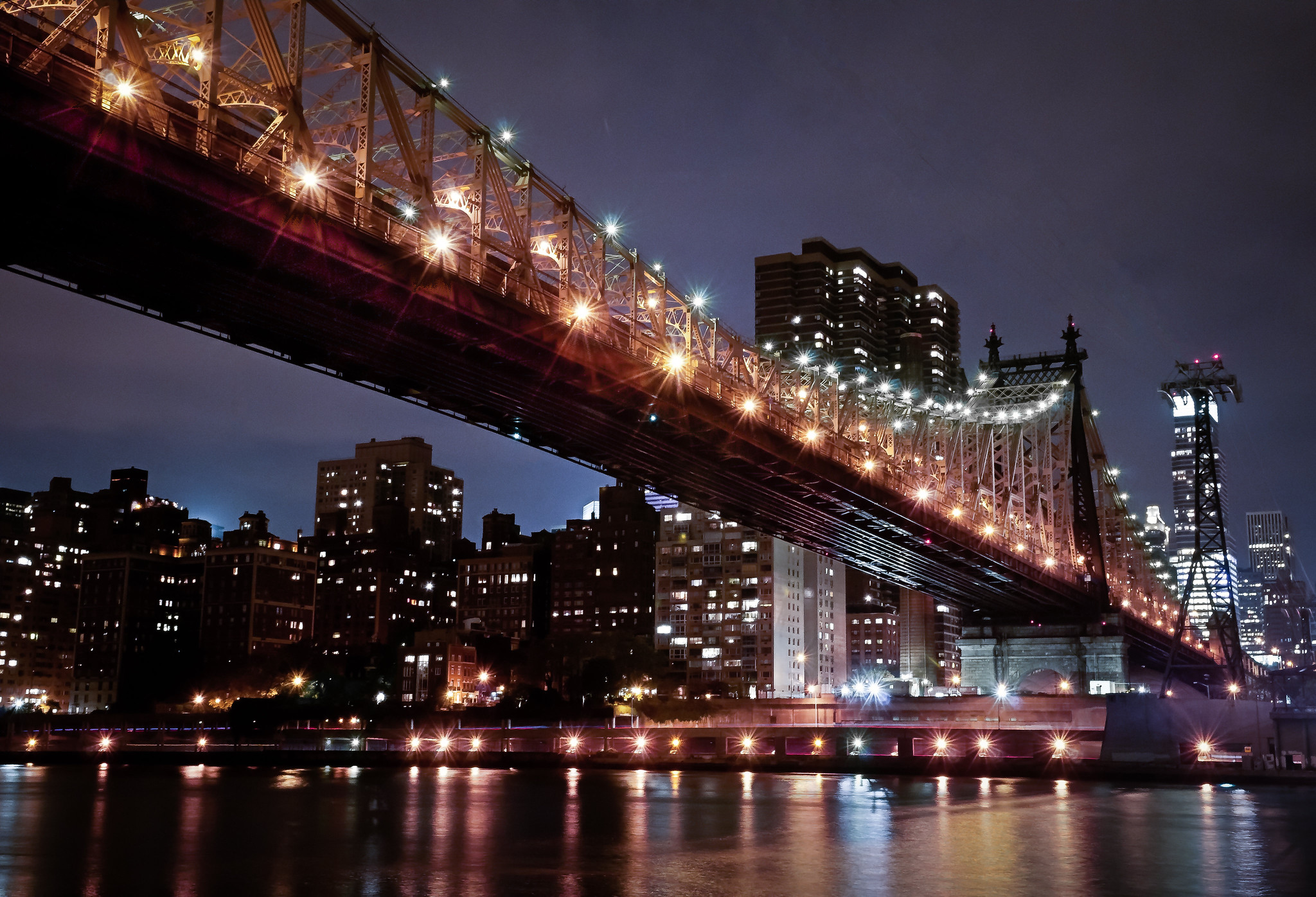
The Queensboro Bridge, officially called the Ed Koch Queensboro Bridge since 2011, is one of New York City’s most recognizable bridges. It connects Manhattan with Queens across the East River. Unlike many other bridges in New York City, the Queensboro Bridge does not have suspension cables: two enormous steel structures rise above the river, while in the middle the bridge rests on Roosevelt Island.
However, the bridge is interesting not only because of its unusual design. The Queensboro has a special connection to New York City culture. F. Scott Fitzgerald mentioned the view from the bridge in The Great Gatsby. Woody Allen filmed one of the most famous scenes from Manhattan beneath it. And the popular American folk-rock duo Simon & Garfunkel named one of their songs after the bridge.
Interesting Facts About the Ed Koch Queensboro Bridge
- The Queensboro is the only one of the four major bridges across the East River that connects Manhattan with Queens rather than Brooklyn. It is also the only one of the four without suspension cables.
- The bridge opened on March 30, 1909, although the official celebration did not take place until June 12. Its construction cost approximately $18 million, and around 50 workers died during construction.
- The bridge was designed by architect Henry Hornbostel and engineer Gustav Lindenthal. At 360 meters long, the western span was the longest cantilever span in North America until 1917.
- After a similar bridge collapsed in Quebec in 1907, the Queensboro’s calculations were reviewed and the design was modified. Among other changes, the number of elevated railway tracks on the upper level was reduced from four to two.
- The last streetcar in New York City ran across the bridge. It operated here until April 7, 1957, stopping on Roosevelt Island. From there, passengers could take a special elevator down to the hospitals.
- The Guastavino vaults beneath the bridge are similar to those at Grand Central Terminal.
- In 1973, the Queensboro Bridge was designated a New York City landmark. In 2011, it was officially renamed the Ed Koch Queensboro Bridge in honor of former Mayor Ed Koch, but the old name is still used much more often.
- The Queensboro has become part of New York City culture: Fitzgerald described the view from the bridge in The Great Gatsby, Woody Allen filmed a scene from Manhattan beneath it, and Simon & Garfunkel named a song after the bridge.
- In May 2025, the pedestrian and bicycle paths on the bridge were separated. Before that, they had shared the same path for decades.
- During the New York City Marathon, runners cross the Queensboro Bridge. It is one of the quietest sections of the route: there are almost no spectators, so instead of crowds and music, runners get a much quieter stretch of the race.
Architecture of the Ed Koch Queensboro Bridge
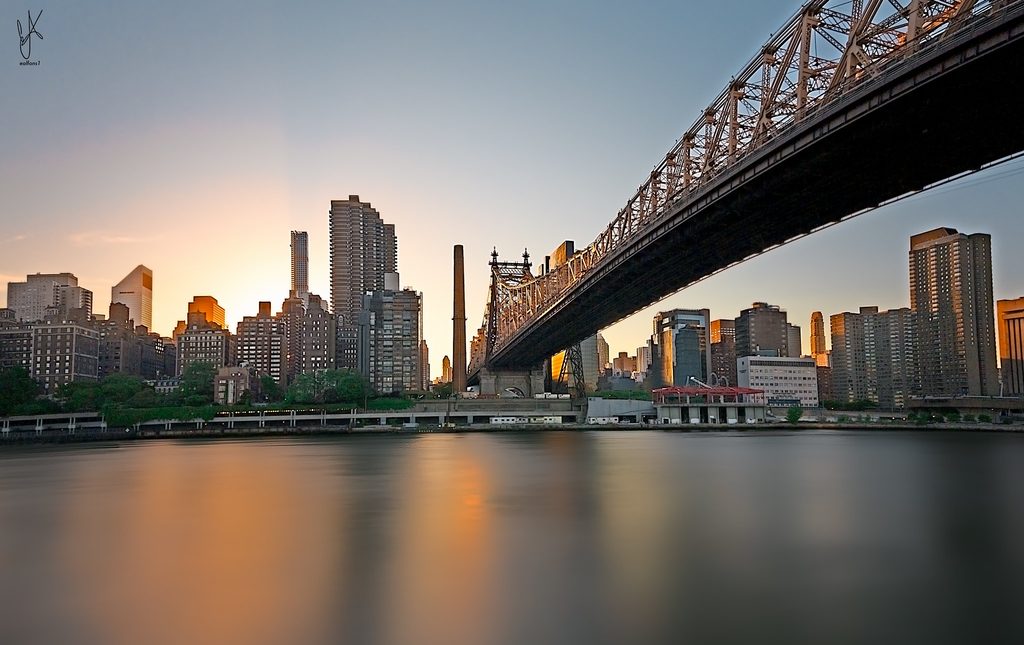
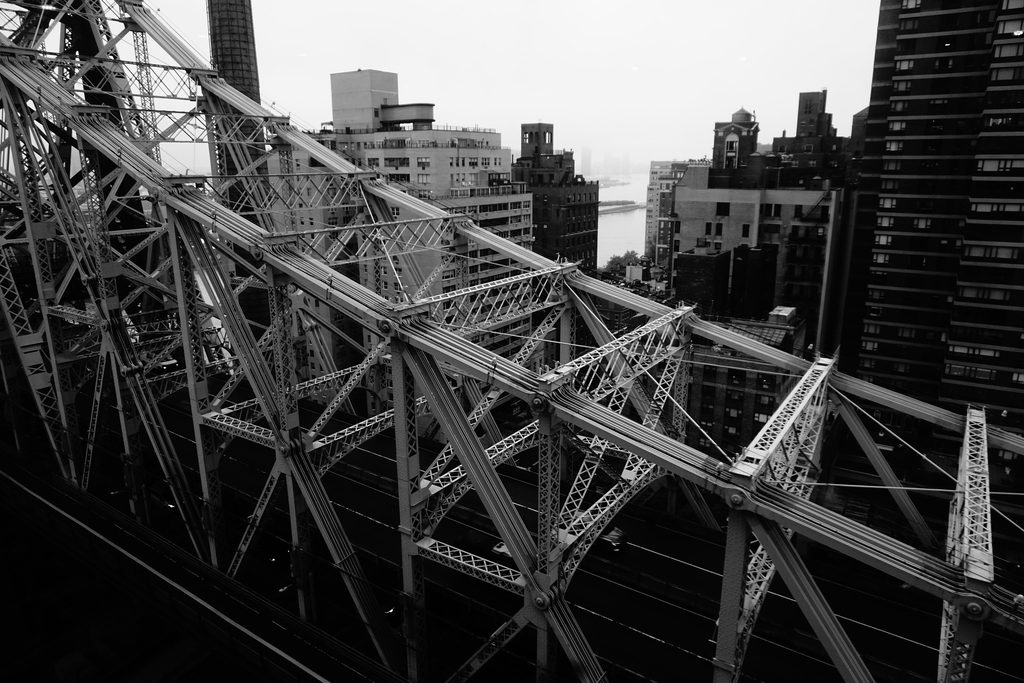
The Queensboro Bridge is designed differently from most of New York City’s famous bridges: it has no suspension cables. Its structure is based on a balance of forces. From four towers — one on each riverbank and two on Roosevelt Island — large steel structures extend outward. They support one another and connect in the middle of each span.
The towers are about 107 meters high, and the bridge is about 30 meters wide.
Traveling from Manhattan to Queens, the bridge consists of five spans:
- the approach span on the Manhattan side — 143 meters;
- the western span between Manhattan and Roosevelt Island — 360 meters;
- the span over Roosevelt Island — 192 meters;
- the eastern span between Roosevelt Island and Queens — 300 meters;
- the approach span on the Queens side — 140 meters.
The upper level has four lanes for cars. The lower level has five central lanes for cars, with separate pedestrian and bicycle paths along the sides.
The Market Under the Queensboro Bridge
At the Manhattan approach to the bridge, between First and Second Avenues, Hornbostel designed a large covered space. It is topped by dozens of low domes made of light-colored ceramic tiles, supported by rows of granite columns.
The vaults were built by the company of Rafael Guastavino, the same master whose work can be seen in the Oyster Bar at Grand Central Terminal.
The space was originally designed to house Bridgemarket. Today, it is home to a Trader Joe’s supermarket and Guastavino’s restaurant.
History of the Ed Koch Queensboro Bridge
The idea of building a bridge at this location dates back to the 1830s. The island in the middle of the East River made it possible to build two shorter spans instead of one long one. A private company spent about thirty years raising money for the project, but went bankrupt in the 1890s after completing only the foundation.
After the consolidation of New York City in 1898, the project was taken over by the city. The first design was prepared by engineer R. S. Buck. In 1902, Gustav Lindenthal became Commissioner of Bridges. He revised the design and brought in architect Henry Hornbostel, who was responsible for the appearance of the bridge.
On August 29, 1907, a cantilever bridge of a similar design collapsed in Quebec. Seventy-five workers were killed. The cause was an error in calculating the weight of the bridge itself. The Queensboro design was subsequently reviewed, and engineers discovered the same problem: the structure was heavier than originally estimated. The design had to be modified, and two elevated railway tracks were left on the upper level instead of four.
The Queensboro Bridge opened on March 30, 1909. Streetcars ran across it from 1909 to 1957. They stopped on Roosevelt Island, where passengers could take an elevator down to the hospitals. In 1955, a separate bridge to the island was built from the Queens side, so the elevators gradually became less important.
In 1973, the Queensboro Bridge was designated a New York City landmark. In 2011, it was officially renamed the Ed Koch Queensboro Bridge in honor of former Mayor Ed Koch, but most New Yorkers still call it the Queensboro or the 59th Street Bridge.
What to See Near the Ed Koch Queensboro Bridge
The Queensboro Bridge is located at 📍 61 Ed Koch Queensboro Bridge Path, New York, NY 10044. Nearby, you can visit:
Manhattan Side
- Bridgemarket / Trader Joe’s, with Guastavino vaults beneath the Manhattan approach.
- Sutton Square, a dead-end section of East 58th Street by the river and the location where the iconic shot from Manhattan was filmed.
- The Roosevelt Island Tramway station at the corner of 59th Street and Second Avenue. A historic streetcar pavilion from the early twentieth century has also survived nearby.
Roosevelt Island
- Four Freedoms Park, a memorial to Franklin D. Roosevelt designed by Louis Kahn.
- The ruins of the Smallpox Hospital, a Gothic Revival building designed by James Renwick, the architect of St. Patrick’s Cathedral.
- Roosevelt Island Tramway, with views of the bridge from the side and above.
Queens Side
- Gantry Plaza State Park, a Long Island City waterfront park with historic gantry cranes and the Pepsi-Cola sign.
- MoMA PS1, a contemporary art center affiliated with the Museum of Modern Art.
- Queensbridge Houses, the largest public housing development in North America, and the place where rappers Nas and Mobb Deep grew up.