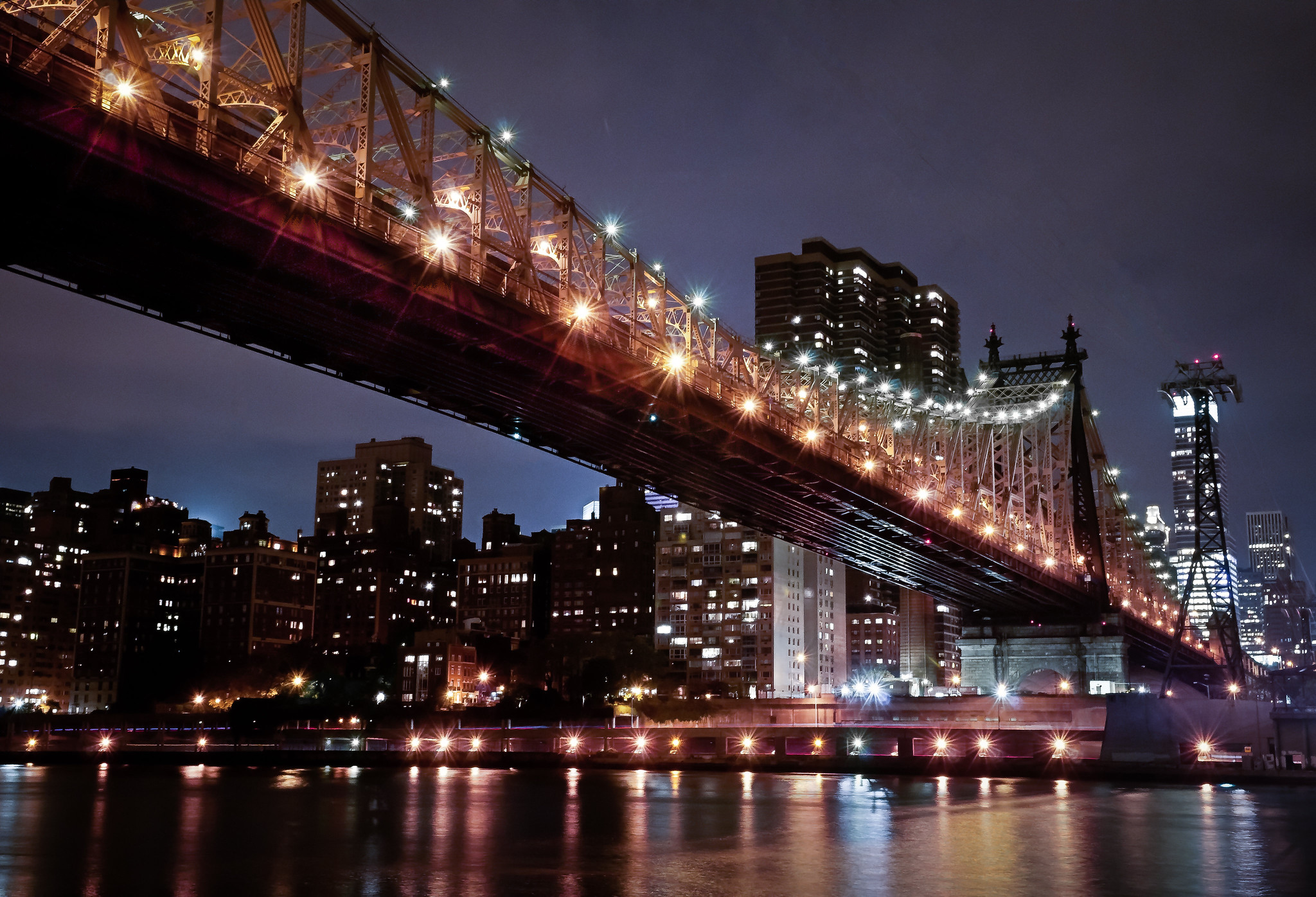
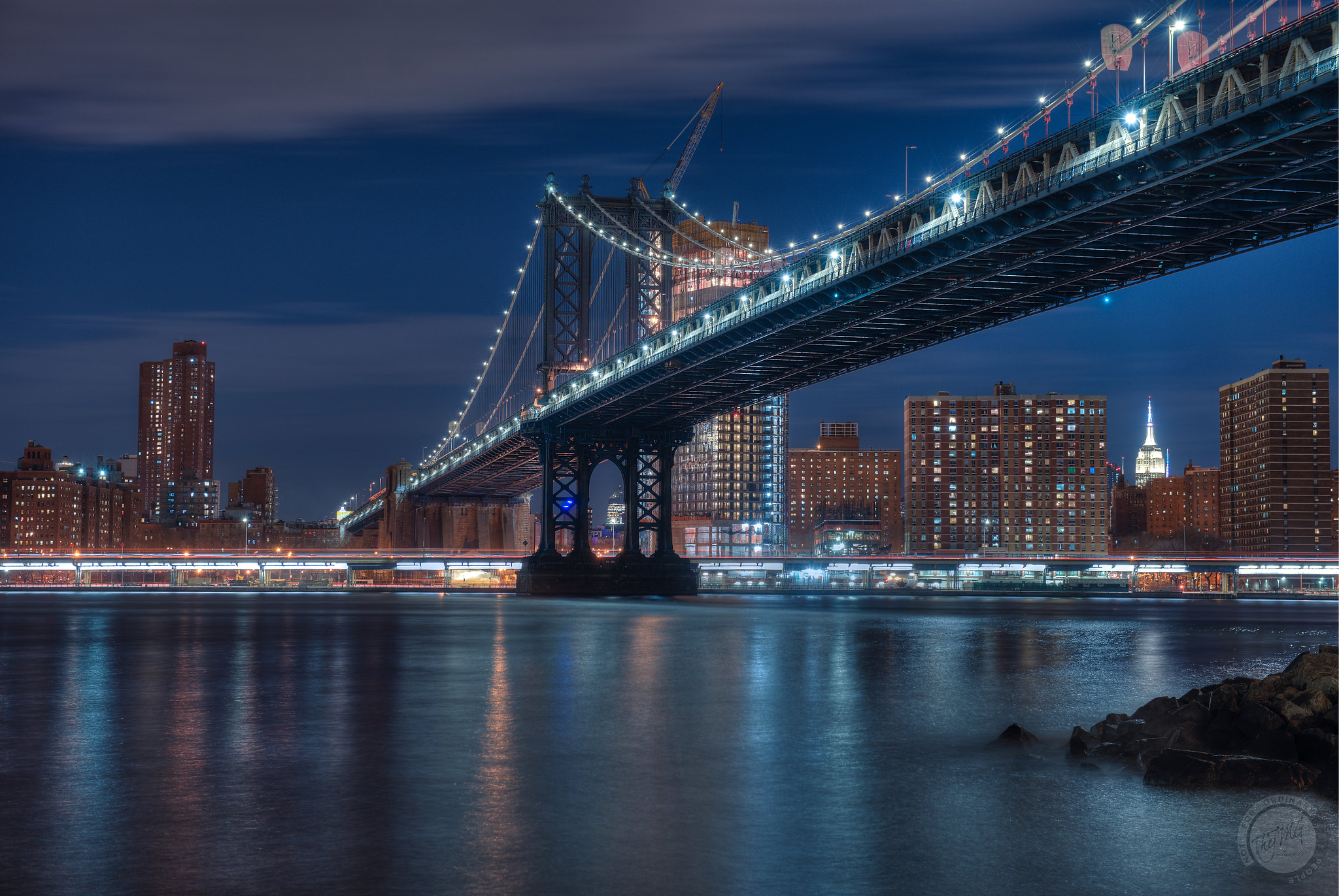
The Manhattan Bridge connects Chinatown in Manhattan with Downtown Brooklyn. It is easy to recognize from one of the most famous views of New York: a cobblestone street, two old brick buildings, and the bridge support between them, with the Empire State Building visible through its arch. Such photographs are often labeled “Brooklyn Bridge,” even though they actually show the Manhattan Bridge.
The bridge has an interesting and complicated history. It was designed by engineer Leon Moisseiff, who later became known because of the collapse of the Tacoma Narrows Bridge. During the first few decades after its opening, subway trains ran across the Manhattan Bridge, causing the structure to sway and deform noticeably. At the same time, the bridge was the first to use a new method of structural calculation, which was later used in the construction of the George Washington Bridge and the Golden Gate Bridge.
Interesting Facts About the Manhattan Bridge
- The bridge was originally called simply “Bridge No. 3,” and the name “Manhattan Bridge” was adopted only in 1902.
- The Manhattan Bridge opened to traffic on December 31, 1909. This was the last public event attended by New York City Mayor George McClellan Jr.: his term ended the following day.
- The Manhattan Bridge was the first major suspension bridge designed using the deflection theory. The same principle was later used in the design of the George Washington Bridge and the Golden Gate Bridge.
- In addition to the Manhattan Bridge, engineer Leon Moisseiff designed the Tacoma Narrows Bridge in Washington State, which collapsed in 1940, only four months after opening.
- The main cables were made by the Roebling company, which had also participated in the construction of the Brooklyn Bridge.
- Each of the Manhattan Bridge’s four main cables contains 9,472 steel wires.
- Subway trains have run across the bridge since it opened. For decades, the trains created strong vibrations and literally twisted the bridge’s structure.
- The Manhattan-side entrance looks like a triumphal arch. It was inspired by the Porte Saint-Denis in Paris and Bernini’s colonnade at St. Peter’s Basilica. The arch and colonnade were built from white granite from Maine.
- Above the opening is a frieze called “Hunt of the Buffalo,” and the center of the keystone features a carved buffalo head.
- Sculptor Daniel Chester French, the creator of the famous Lincoln Memorial in Washington, created two granite pylons for the bridge. They now stand near the Brooklyn Museum.
- In 1928, Edward Hopper painted Manhattan Bridge Loop. Today, the painting is held by the Addison Gallery in Massachusetts.
- In 1978, the name DUMBO (Down Under the Manhattan Bridge Overpass) appeared. According to the most common version, local artists came up with the name to discourage developers from investing in the area. It had the opposite effect: the neighborhood eventually became one of the most expensive areas in Brooklyn.
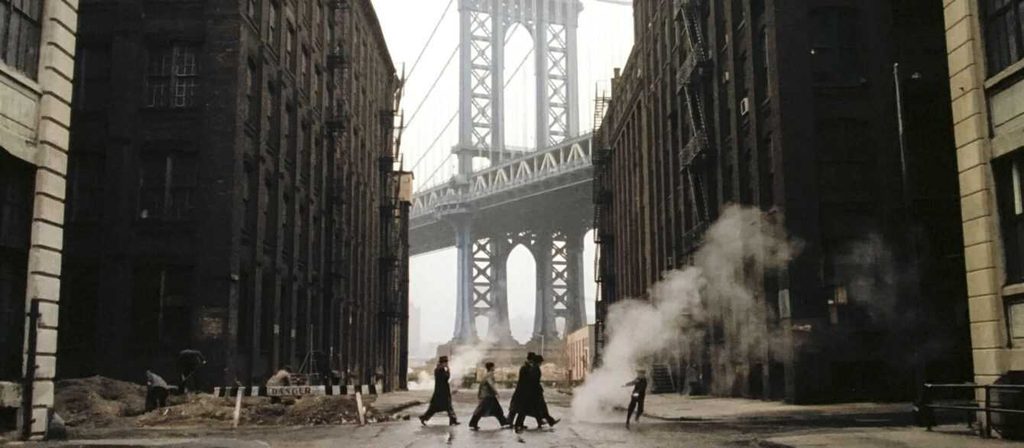
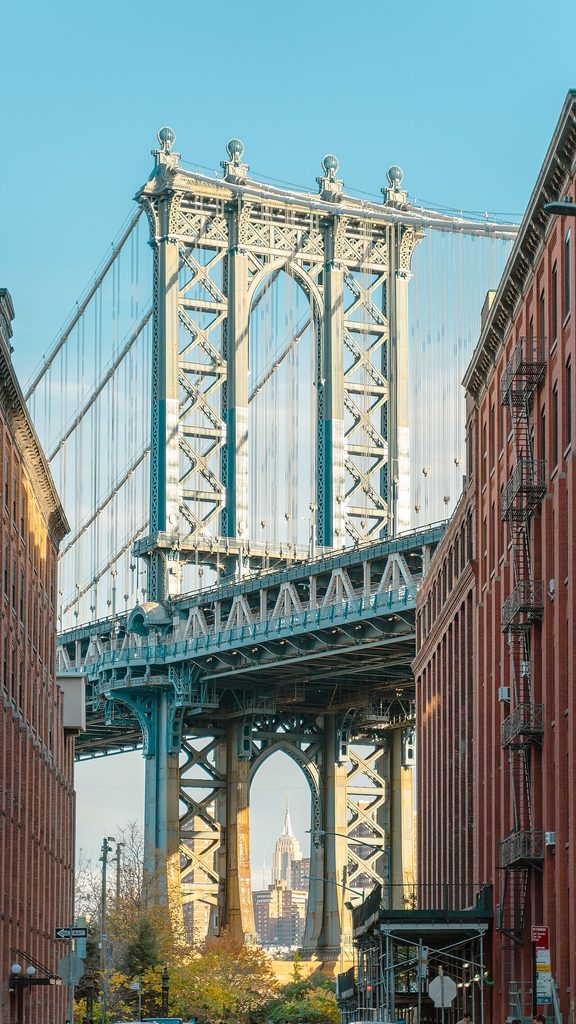
- The most famous view of the bridge is on Washington Street. The Empire State Building is visible directly through the bridge’s arch. This photograph is often mistaken for a view of the Brooklyn Bridge, although it actually shows the Manhattan Bridge. It was also featured on the poster for the 1984 film Once Upon a Time in America.
- For the first year and a half after the bridge opened, crossing it cost 10 cents. The toll was eliminated in 1911.
- The reconstruction lasted 22 years. Work began in 1982 and was originally expected to be completed by 1995 at a cost of $150 million. In the end, the renovation was not completed until 2004, and the cost had risen to approximately $800 million.
History of the Manhattan Bridge
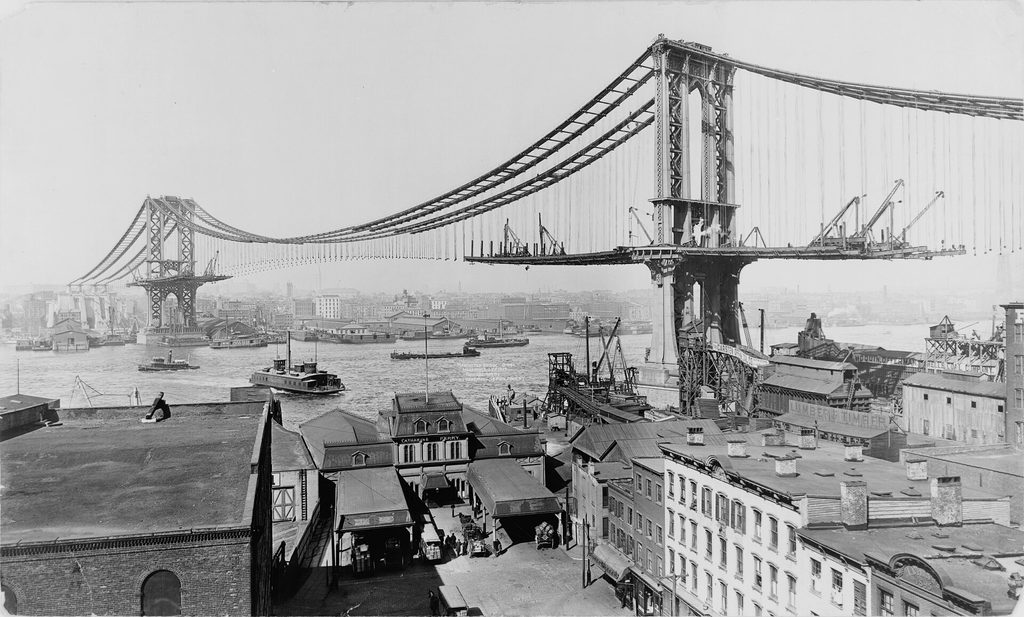
After New York and Brooklyn were consolidated in 1898, the city needed another bridge across the East River. The Williamsburg Bridge was already under construction, while the next project was initially known simply as “Bridge No. 3.” In 1902, the city council officially named it the Manhattan Bridge. Not everyone liked the decision: critics pointed out that all the bridges across the East River already led to Manhattan, so the name did little to distinguish it. Nevertheless, the name remained.
Construction of the tower foundations began in 1901, but the project changed direction several times. The first design was prepared by engineer R. S. Buck, and then Gustav Lindenthal became the bridge commissioner. Together with architect Henry Hornbostel, he proposed a completely different structure: instead of the conventional wire cables, they wanted to use chains made of flat steel links. They even planned to create meeting rooms inside the bridge’s anchorages.
The debate was not just about the bridge’s appearance. Lindenthal believed that chains would be stronger and cheaper, while supporters of wire cables relied on the proven technology of the Roebling company, which had participated in the construction of the Brooklyn Bridge. In 1904, the city’s Art Commission selected the design with wire cables, and Lindenthal’s proposal was rejected. Hornbostel was also replaced by the firm Carrère and Hastings, which was designing the New York Public Library on Fifth Avenue at the same time. The dispute over the cable design was not finally settled until 1906, by which point construction was already about two years behind schedule.
The problems did not end there. A legal dispute arose over the contract for manufacturing the steelwork: one of the competitors proved that the bidding requirements had been written to favor a specific contractor, so the bidding had to be repeated. Entire blocks had to be demolished to build the bridge approaches, and residents of hundreds of buildings on both sides of the East River had to be relocated. The task of developing the final design was eventually given to Leon Moisseiff, an engineer with the city’s Department of Bridges.
Moisseiff was born in 1872 in Riga, then part of the Russian Empire. In 1891, he moved to the United States with his family. He graduated from Columbia University with a degree in civil engineering in 1895 and began working for New York City’s Department of Bridges in 1897. For the Manhattan Bridge, he used the deflection theory, a new approach to the design of suspension bridges at the time.
The idea was fairly simple: a tensioned cable itself helps resist the loads and deformation of the bridge. This meant that it was not necessary to build an enormous rigid truss beneath the roadway, as on the Williamsburg Bridge. The longer and heavier the bridge, the greater the share of the load that could be carried by the cable system. This made it possible to use less steel and build longer spans.
Moisseiff’s calculations seemed so bold that the city brought in an independent expert, Ralph Modjeski, to review the design. In September 1909, he confirmed that the bridge was safe. Because of this, Modjeski was sometimes incorrectly described as the bridge’s designer.
The Manhattan Bridge marked the beginning of Moisseiff’s major career. In the following decades, he worked on projects including the George Washington Bridge, the San Francisco–Oakland Bay Bridge, and the Golden Gate Bridge. But his name is most closely associated with the Tacoma Narrows Bridge in Washington State. It opened in July 1940, and on November 7 of the same year, the bridge collapsed during severe wind-induced oscillations. Moisseiff had made the structure very light and flexible but had not adequately accounted for aerodynamic forces. The Manhattan Bridge, meanwhile, continues to stand: the deflection theory itself proved sound; the problem was how it was applied to the Tacoma Narrows design.
The Manhattan Bridge opened on December 31, 1909. This was the last public event attended by Mayor George McClellan Jr.: his term ended the following day. For the first year and a half, crossing the bridge cost ten cents. In 1911, Mayor William Jay Gaynor eliminated tolls on the city’s East River bridges. Streetcars began crossing the bridge in 1912, followed by subway trains in 1915.
Architecture and Engineering of the Manhattan Bridge
The Manhattan Bridge is interesting not only because of its history, but also because of its engineering. It was the first major test of Leon Moisseiff’s deflection theory. As a result, its structure is much lighter than that of the Williamsburg Bridge, and its towers look less like massive stone structures and more like lightweight steel frames. They were designed to deform slightly along with the cables. Under heavy loads, the tops of the towers can visibly move toward the center of the river. For this bridge, this is normal structural behavior, not a defect.
The bridge looks particularly impressive from the Manhattan side. If you exit the subway at Canal Street and walk east, the street leads between fish markets and jewelry stores to a large white granite arch with a semicircular colonnade. This is the ceremonial entrance to the bridge, designed by the architects Carrère and Hastings and completed in 1915. The arch was inspired by the Porte Saint-Denis in Paris, while the colonnade repeats the design of Bernini’s colonnade at St. Peter’s Basilica. White granite from Hallowell, Maine, was used for the construction. The entire composition reflects the ideas of the City Beautiful movement: in the early twentieth century, urban spaces were intended to be not only functional, but also monumental and visually impressive.
Several details of the arch are worth a closer look. Above the opening is the “Hunt of the Buffalo” frieze, created by sculptor Charles Cary Rumsey, while the keystone features a carved buffalo head. On either side are two sculptural groups by Carl Augustus Heber, “The Spirit of Commerce” and “The Spirit of Industry.” Inside the arch, you can see a coffered ceiling with rosettes, while lion heads decorate the cornice.
After more than a century, the arch had become badly deteriorated. It is one of New York City’s three major triumphal arches, along with the arch at Washington Square and the Soldiers’ and Sailors’ Memorial Arch in Brooklyn, but it receives much less attention. Cars pass through it constantly, rather than crowds of tourists. During the twentieth century, plans were made to build an interchange for the Lower Manhattan Expressway nearby, but the project was abandoned. By the 1990s, the arch was covered in graffiti, and the space around the colonnade was being used as a parking lot. Restoration was completed in 2001.
The Brooklyn side of the bridge also had its own ceremonial elements. In 1916, two granite pylons with allegorical figures representing “Brooklyn” and “Manhattan” were installed there. They were created by Daniel Chester French, the same sculptor who created the seated Lincoln for the Lincoln Memorial in Washington. The pylons were removed in 1963 during a reconstruction of the bridge approaches. Today, both sculptures stand on either side of the main entrance to the Brooklyn Museum.
Another important feature of the Manhattan Bridge is related not to its architecture, but to its operation. Four subway tracks run along the edges of the lower level, with two tracks on each side. When a train travels along one side of the bridge, that side moves slightly downward while the opposite side rises. This puts additional twisting stress on the structure every time a train crosses. Over time, the situation became more complicated because most trains were using one pair of tracks, creating an uneven load.
By the 1970s, cracks had appeared in the cross beams. The city was in serious financial difficulty, so there was not enough money for repairs for many years. A major reconstruction finally began in 1982. It was originally expected to be completed by 1995 at a cost of approximately $150 million, but the work continued until 2004, and the cost rose to about $800 million. The subway tracks were closed one pair at a time, sometimes for several years. After the reconstruction, the bridge was strengthened and its structure was adapted to withstand the constant loads created by subway traffic.
DUMBO and the Iconic View of the Manhattan Bridge
At the beginning of the twentieth century, warehouses, factories, and cardboard box manufacturers operated beneath the Brooklyn side of the Manhattan Bridge. By the 1970s, most of these businesses had closed, and artists began moving into the abandoned industrial buildings. According to the most widely accepted version, in 1978 they came up with the name DUMBO, short for Down Under the Manhattan Bridge Overpass. The idea was that such a strange name might discourage developers from investing in the area. The opposite happened: the neighborhood began to develop rapidly and is now considered one of the most expensive areas of Brooklyn.
One of the most famous places for a photograph is at the intersection of Washington Street and Water Street. If you stand on Washington Street facing the river, the Manhattan Bridge support will be directly in the center of the street, with the Empire State Building visible in the lower part of the arch. This view appeared on the poster for Sergio Leone’s film Once Upon a Time in America (1984) and has since become one of the most recognizable images of New York.
The area is usually crowded on weekend afternoons, so it is better to come early in the morning for a photograph. You also need a fairly long lens for this shot: with a wide-angle lens, the Empire State Building will look too small.
Artists noticed the bridge long before bloggers did. Edward Hopper painted Manhattan Bridge Loop in 1928, showing an empty approach, long shadows, and a single figure. The painting is held by the Addison Gallery of American Art in Andover, Massachusetts.
What to See Near the Manhattan Bridge
Manhattan Side
- Chinatown. The bridge leads directly into the heart of Chinatown. The surrounding streets are full of inexpensive and authentic dumpling shops and small stores.
- Mahayana Buddhist Temple. Located at 133 Canal Street, right next to the arch. Inside, you can see a large golden statue of the Buddha.
- Lower East Side. About a five-minute walk north.
- South Street Seaport. About a fifteen-minute walk south along the river.
Brooklyn Side
- DUMBO. Washington Street, Empire Stores, and Time Out Market with its rooftop terrace.
- Brooklyn Bridge Park and Jane’s Carousel. A waterfront park with views of both bridges and a carousel inside a glass pavilion.
- Vinegar Hill. Several blocks of nineteenth-century houses near the bridge. It is quiet enough to feel like a different city.
- Brooklyn Museum. It is farther away, about twenty minutes by subway, but this is where French’s pylons are located.
Visitors’ Information
📍 Manhattan Bridge / Manhattan Brg, New York, NY 11201