New York City is a bottomless treasure trove of culture, and it can be difficult to find a truly worthy treasure. We’ve simplified your search by telling you about one such find. The Nicholas Roerich Museum will allow you to immerse yourself in the captivating, American blockbuster-like life of the artist who created 7,000 (!) paintings.
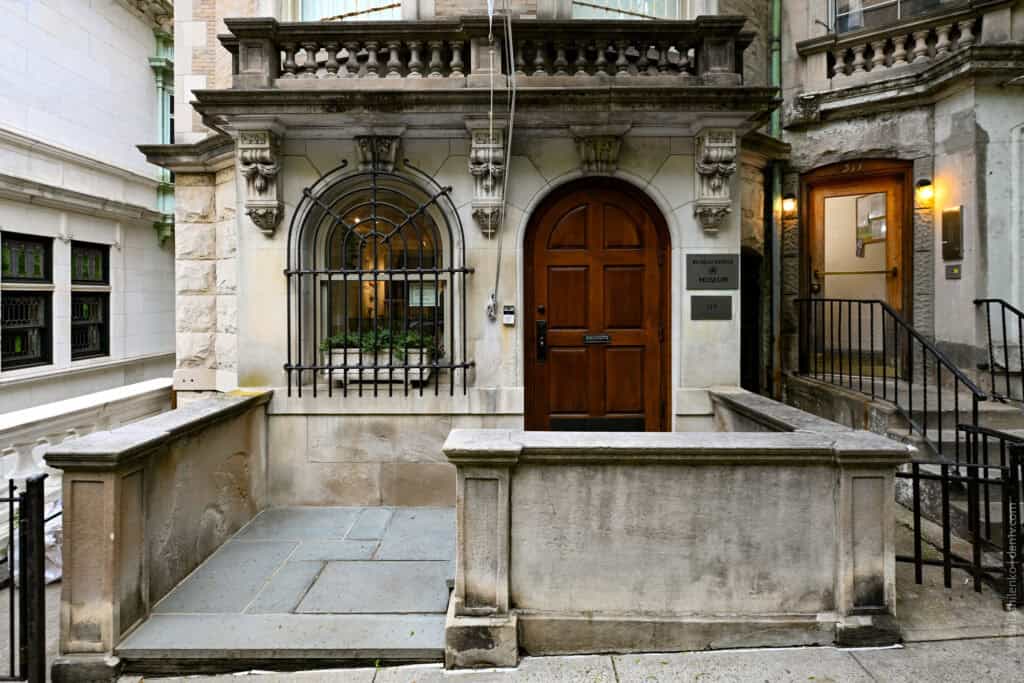
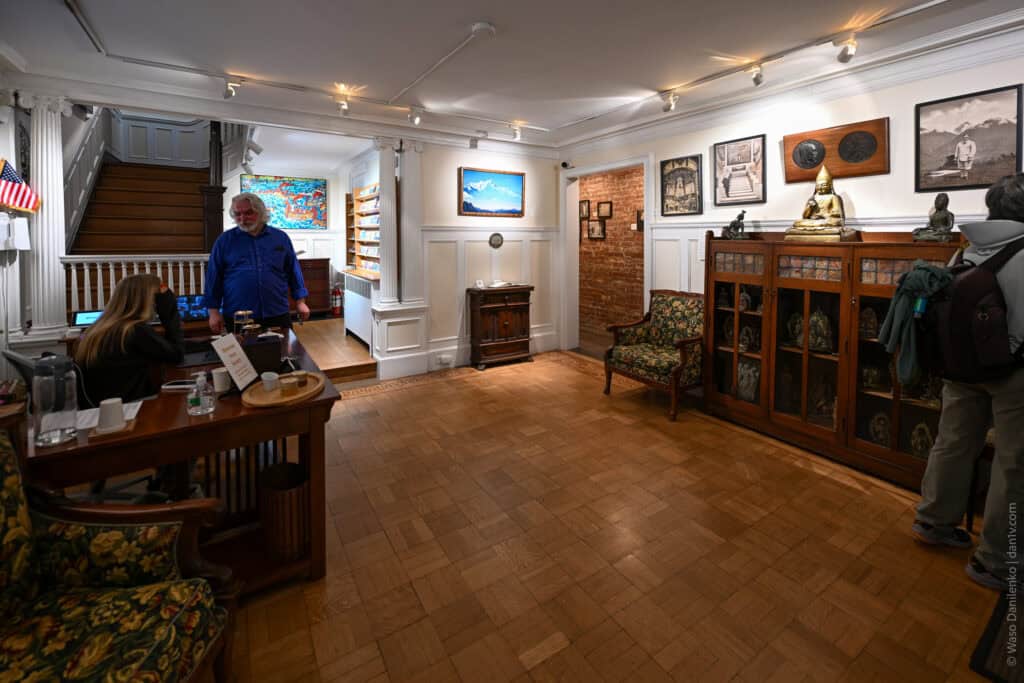
This small townhouse in a quiet neighborhood on the Upper West Side offers free admission, three floors of paintings, and the feeling that you’ve entered not a museum, but someone’s very beautiful and very strange home. There are no crowds here, and they don’t sell souvenirs with magnets. It’s a quiet and beautiful place, a must-see in New York.
Interesting Facts about the Nicholas Roerich Museum in New York
- This is the only museum in New York City entirely dedicated to a single Russian artist. It was founded by American admirers of Roerich during his lifetime.
- Roerich was associated with the idea of the Banner of Peace — an international pact for the protection of culture. He promoted the treaty protecting museums and monuments during wars long before the creation of UNESCO.
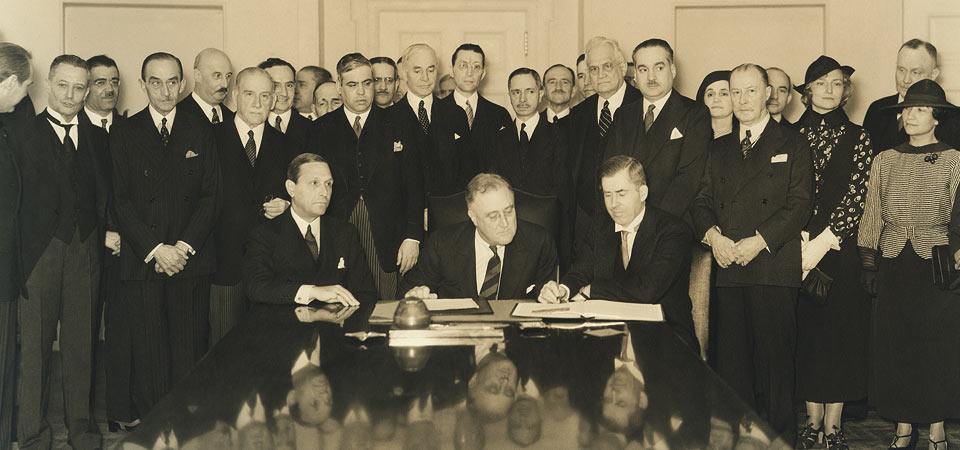
- The Roerich Pact was signed by US President Franklin Roosevelt in the White House in 1935.
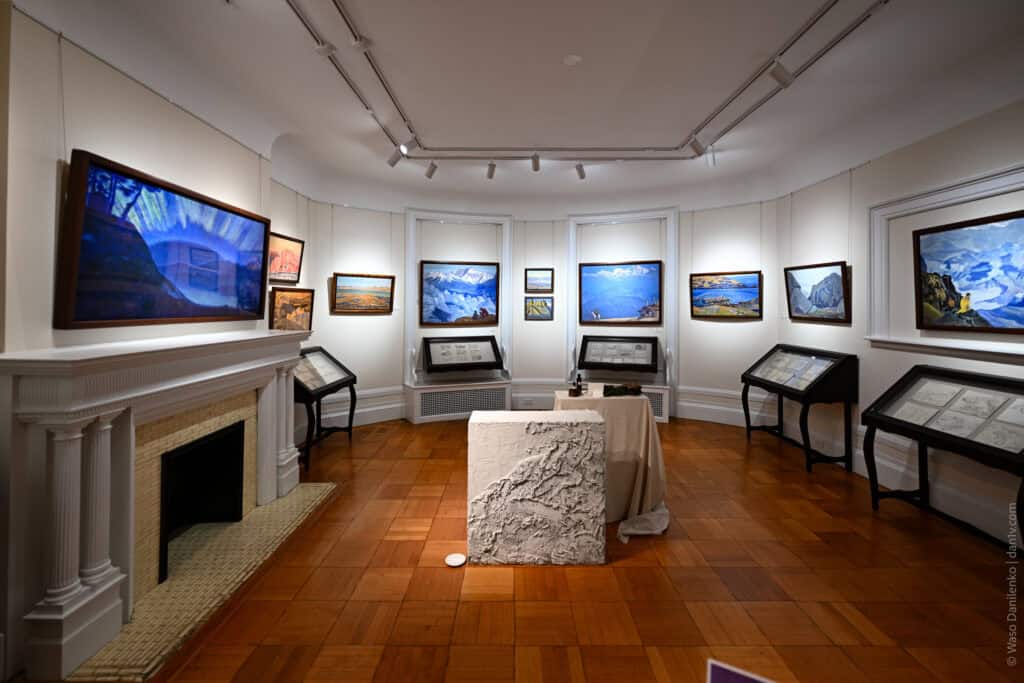
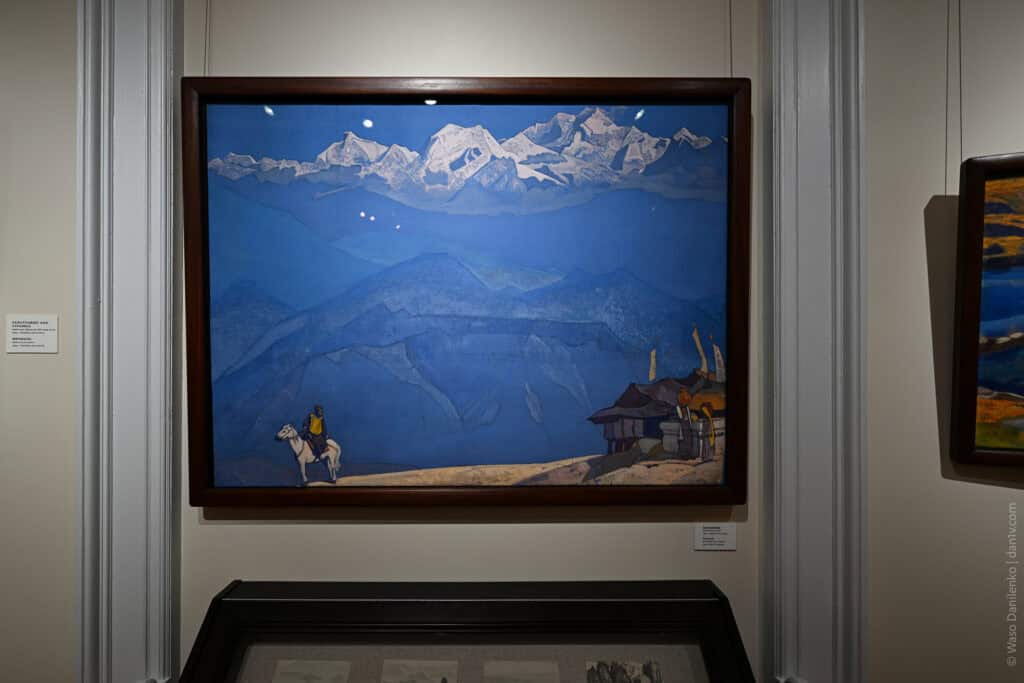
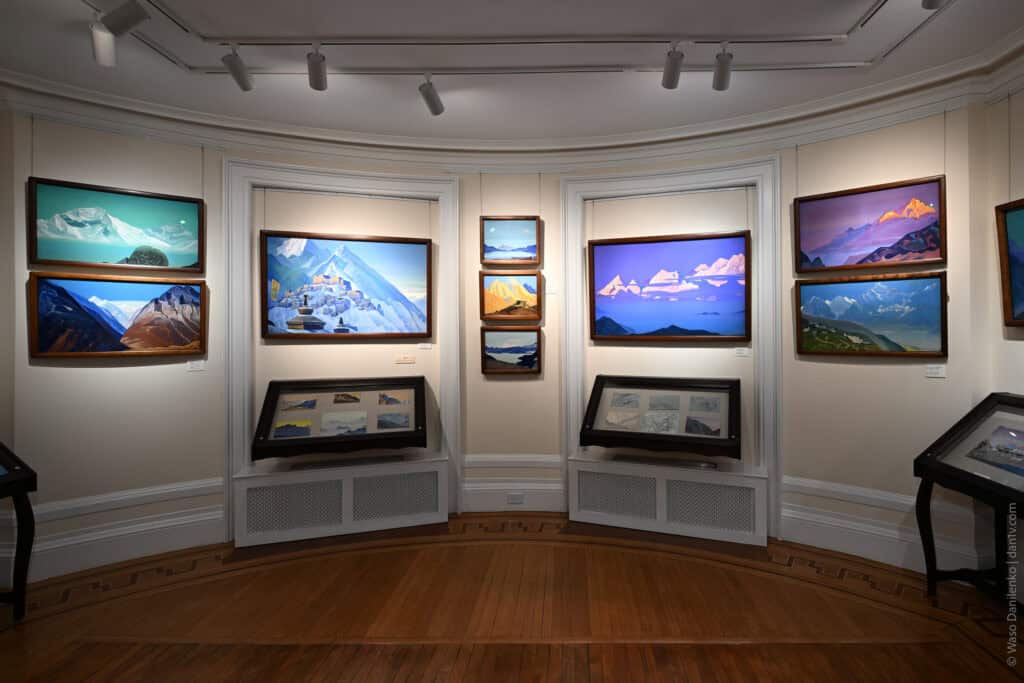
- Most of the paintings in the museum are dedicated to the Himalayas, even though the museum is located in Manhattan.
- The interiors create the feeling of a “mountain temple” amidst an ordinary New York neighborhood.
- The museum is almost always completely silent, leading many to compare it to a meditative space or a chapel of art.
- The museum building itself is a historic townhouse from the early 20th century. This intimate space allows the paintings to be experienced in a very personal way. Roerich traveled through Tibet, India, Mongolia, and the Altai Mountains, sometimes in extremely dangerous conditions. His son became a world-renowned orientalist of the 20th century.
- The museum is located near Riverside Park, but not even all New Yorkers know about it.
- Admission to the museum is always free, but donations are accepted. The idea is that art should be accessible to everyone, regardless of income.
- The Nicholas Roerich Museum appears surprisingly small from the outside, but inside it houses one of the largest collections of the artist’s works outside of India and Russia.
History of the Nicholas Roerich Museum
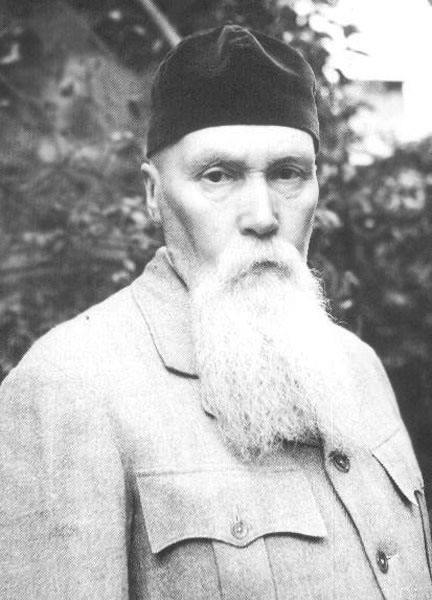
Nikolai Konstantinovich Roerich was born in 1874 in St. Petersburg to a wealthy notary. Already in his teens, he participated in archaeological excavations of Scythian burial mounds, built his own arboretum, and realized he wanted to become an artist. At the same time, he enrolled in law school at his father’s insistence and graduated with honors, although law had no interest for him.
In 1897, while still a student, he painted his first significant work, a painting of ancient Slavs on a riverbank. Leo Tolstoy personally told him: “One feels that such a people existed, that this existed.” Critics compared Roerich to Vrubel.
Roerich joined the “World of Art” movement, the main artistic association in Russia at the time, and met Sergei Diaghilev, who changed his destiny.
The Rite of Spring
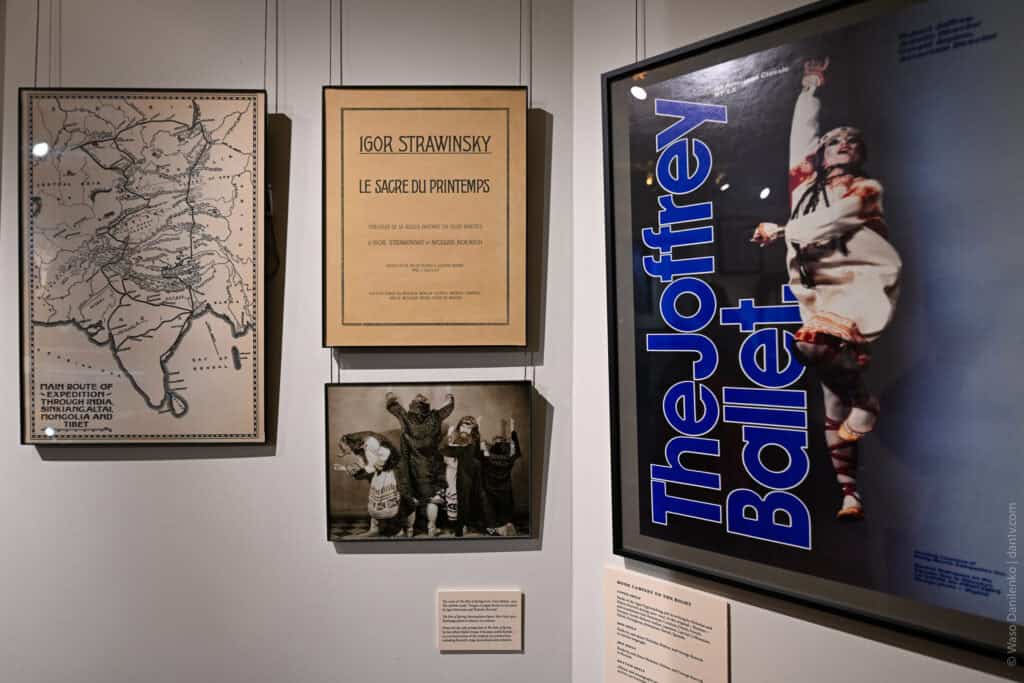
In 1910, Diaghilev brought Roerich and Stravinsky together. Together, they conceived something utterly impossible: a ballet set in the Stone Age, where a young girl is sacrificed to the gods of spring.
Roerich wrote the libretto, conceived the concept, and designed the sets and costumes. Stravinsky wrote the music. Nijinsky choreographed.
On May 29, 1913, The Rite of Spring premiered at the Théâtre des Champs-Élysées in Paris. The audience booed the performance, and a full-blown brawl broke out in the auditorium. The police arrived before the end of the first act.
One of the most famous controversies in the history of music concerns who originated the idea for The Rite of Spring. Stravinsky wrote in his 1935 memoirs that the idea came to him in a dream: he saw a pagan sacrificial rite. Roerich insisted throughout his life that the idea was his — and it was he who, back in 1909, described the scenario of a "sacrifice in the name of spring" to Diaghilev. Documents from that time tend to support Roerich: it was he who, in letters to Diaghilev, formulated the "beautiful cosmogony of earth and heaven." But Stravinsky outlived Roerich by 24 years and managed to write more memoirs.
“The Rite of Spring” is today considered one of the most important works of 20th-century music.
Emigration to New York
In 1918, Roerich, his wife Elena, and their two sons left Russia, first for Finland, then for London. In 1920, he arrived in the United States: the director of the Art Institute of Chicago invited him to organize a large-scale tour — 30 cities over three years, with approximately 400 paintings.
New York greeted Roerich enthusiastically. He was charismatic, spoke several languages, and knew everything about European art. His paintings, vibrant, mystical, and unlike anything else, had a revelatory effect on the American public.
The Roerich Pact
The idea originated with Roerich during World War I, when he observed troops destroying churches, monasteries, and museums. These were sites of no military significance, but their destruction was irreparable. He asked a simple question: why were hospitals protected by the Red Cross, while museums and universities were not?
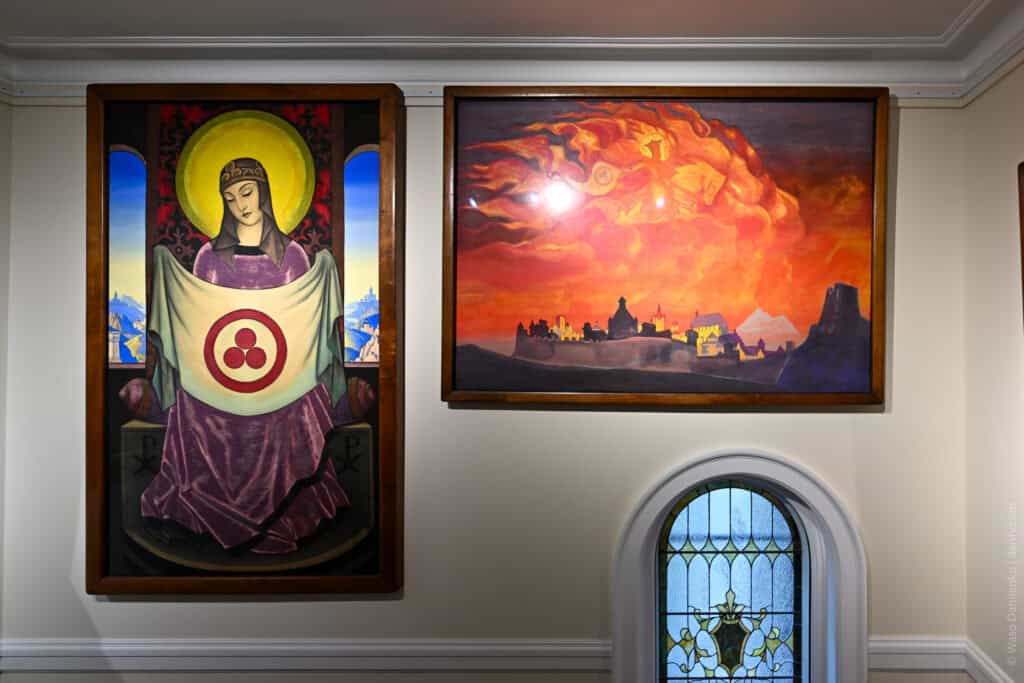
For fifteen years, Roerich promoted the idea of an international treaty that would obligate warring parties to respect cultural sites in the same way they were obligated to respect Red Cross sites. For this system, he developed his own symbol, the “Banner of Peace”: a white cloth with three red circles within a larger red circle. The three circles symbolize the unity of the past, present, and future, as well as religion, art, and science.
On April 15, 1935, at the White House, in the presence of President Franklin Roosevelt, the Roerich Pact was signed by 21 states of the Pan-American Union. This was the first international treaty in history to protect cultural heritage in both peacetime and wartime.
The Roerich Pact is still in force. Moreover, it was the direct predecessor of the Hague Convention for the Protection of Cultural Property in the Event of Armed Conflict (1954), developed by UNESCO. Roerich did not live to see its signing (he died in 1947), but the idea, structure, and symbolism of this document are his. It can be said that Roerich single-handedly devised what would later become the UNESCO system.
For this work, Roerich was nominated for the Nobel Peace Prize three times: in 1929, 1932, and 1935. Nominations came, among others, from the University of Paris. He never received the prize.
Himalayan Expeditions
In parallel with his activities in New York, Roerich organized expeditions of an unimaginable scale.
1923–1928: Central Asian Expedition. Roerich, his wife Elena, their son Yuri, and a group of Europeans traveled through Ladakh, Xinjiang, Altai, Mongolia, the Gobi, and Tibet. The route covered approximately 25,000 kilometers through some of the most inaccessible territories on Earth.
In Tibet, the expedition was detained by authorities, despite having Tibetan passports. The group was stopped and held in tents for five months in freezing temperatures. Due to the appalling conditions (poor food, subzero temperatures), five members of the expedition died.
In March 1928, they were finally released, and the Roerichs descended to the Kulu Valley in the Indian Himalayas. There they remained. They founded the Urusvati Himalayan Research Institute, which focused on botany, ethnology, linguistics, and archaeology.
It was there, in the Kullu Valley, that Roerich lived the last 20 years of his life and painted most of his most famous paintings.
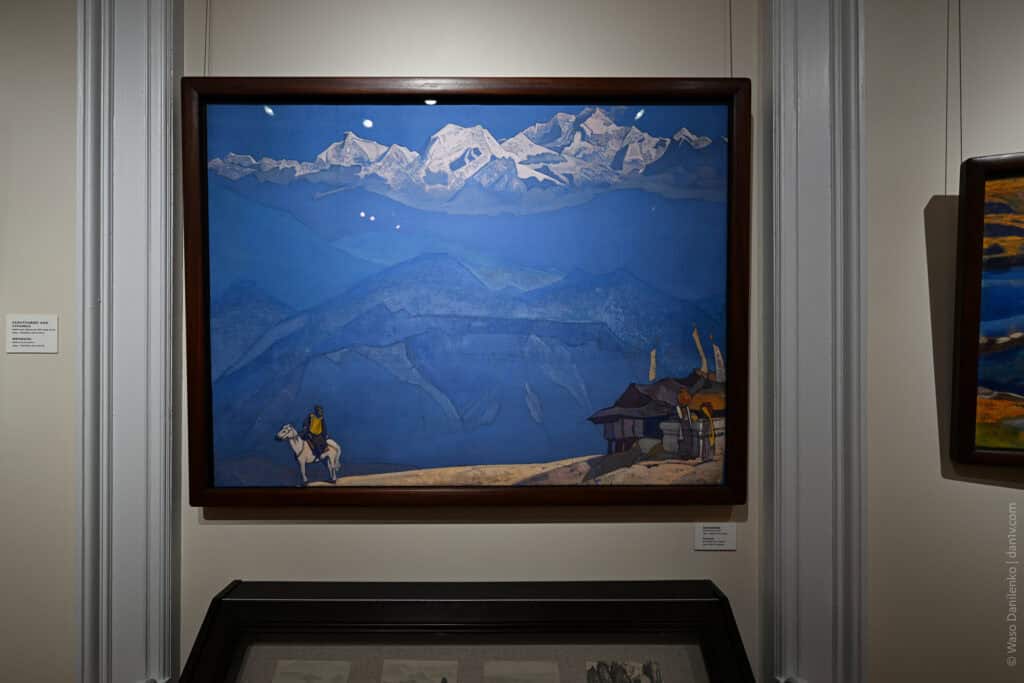
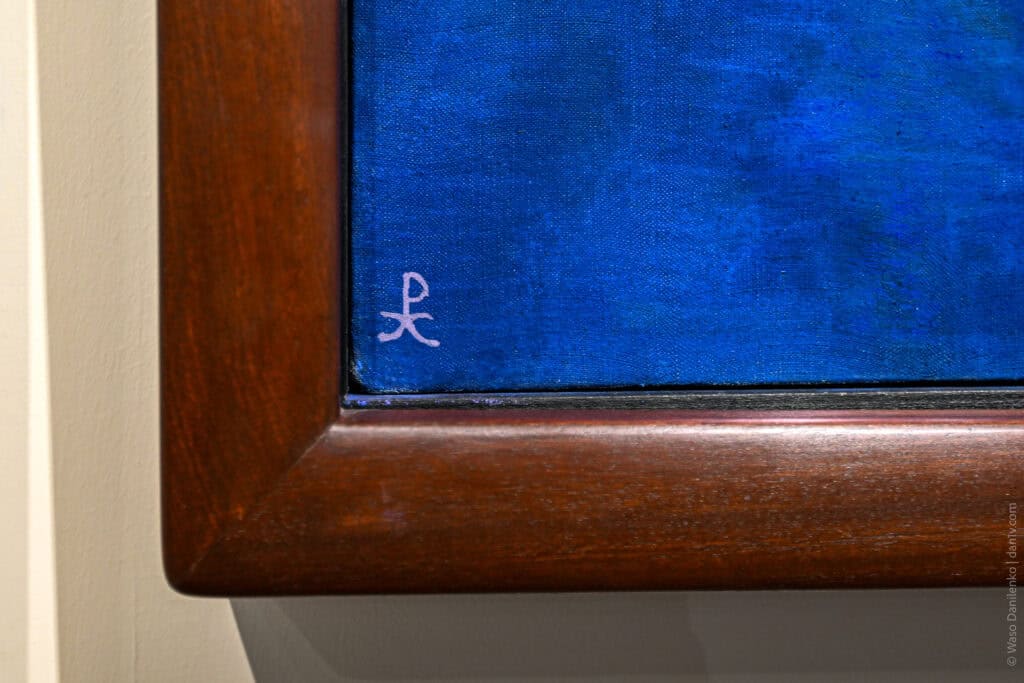
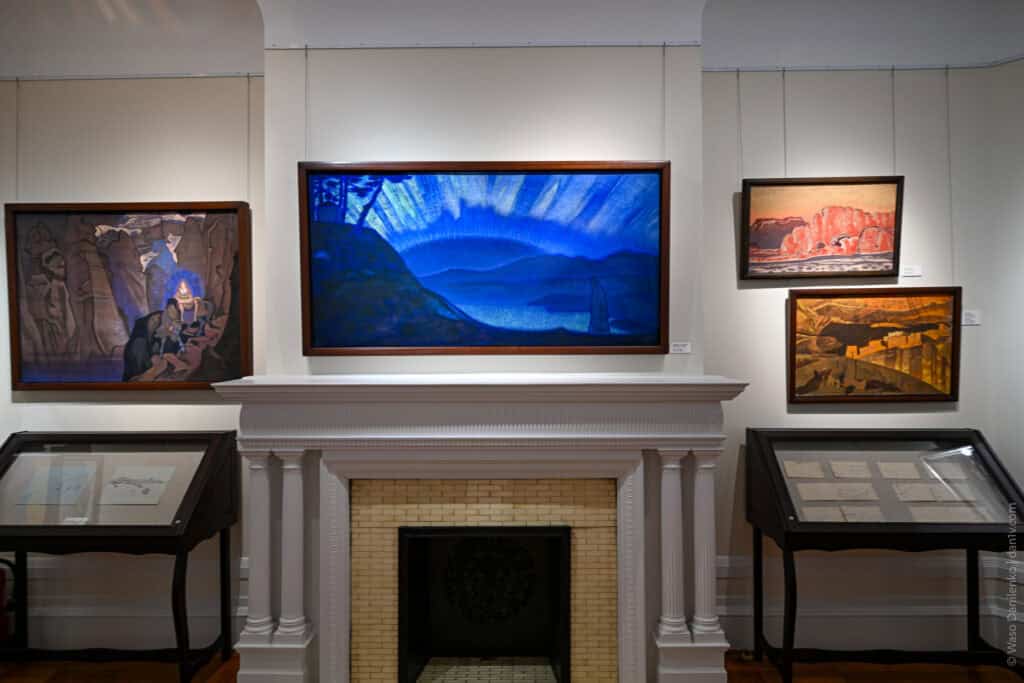
Roerich's expeditions remain a subject of debate among historians to this day. Officially, they were artistic and scientific expeditions. However, Roerich and his group also visited Moscow during their travels and had contacts with Soviet officials. Some researchers believe the expedition had a political component, possibly related to Soviet interests in Central Asia. The truth remains unclear.
During his lifetime, Roerich painted approximately 7,000 paintings — and this is no exaggeration. Of these, more than 500 were created during and after the first Central Asian expedition alone.
Master Building
In the early 1920s, Roerich acquired a patron, Louis Horch, a Wall Street financier who, along with his wife, Nettie, became fascinated with Roerich’s art and mystical ideas. Horch fell in love with Roerich as a phenomenon and began investing enormous sums of money in his projects.
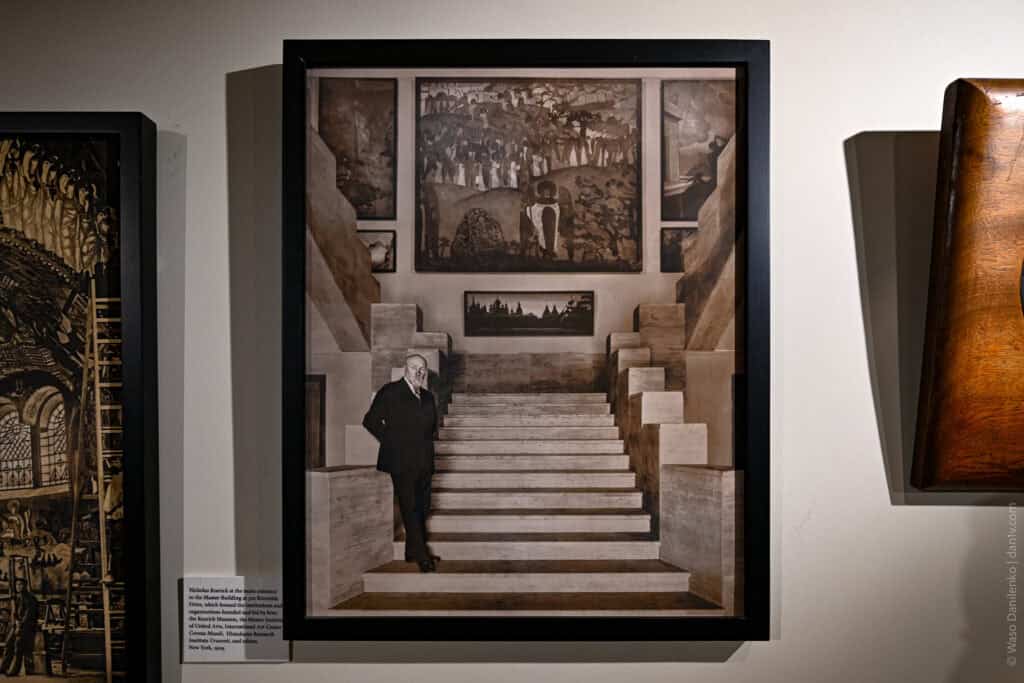
By 1925, several organizations were already operating in New York: the Master Institute of United Arts (a school of painting, architecture, sculpture, music, and dance), the international art center Corona Mundi (“Crown of the World”), and the Roerich Museum itself, which housed over a thousand of his works. All of this was housed in an old mansion on Riverside Drive. Horch decided to build something worthy of it all.
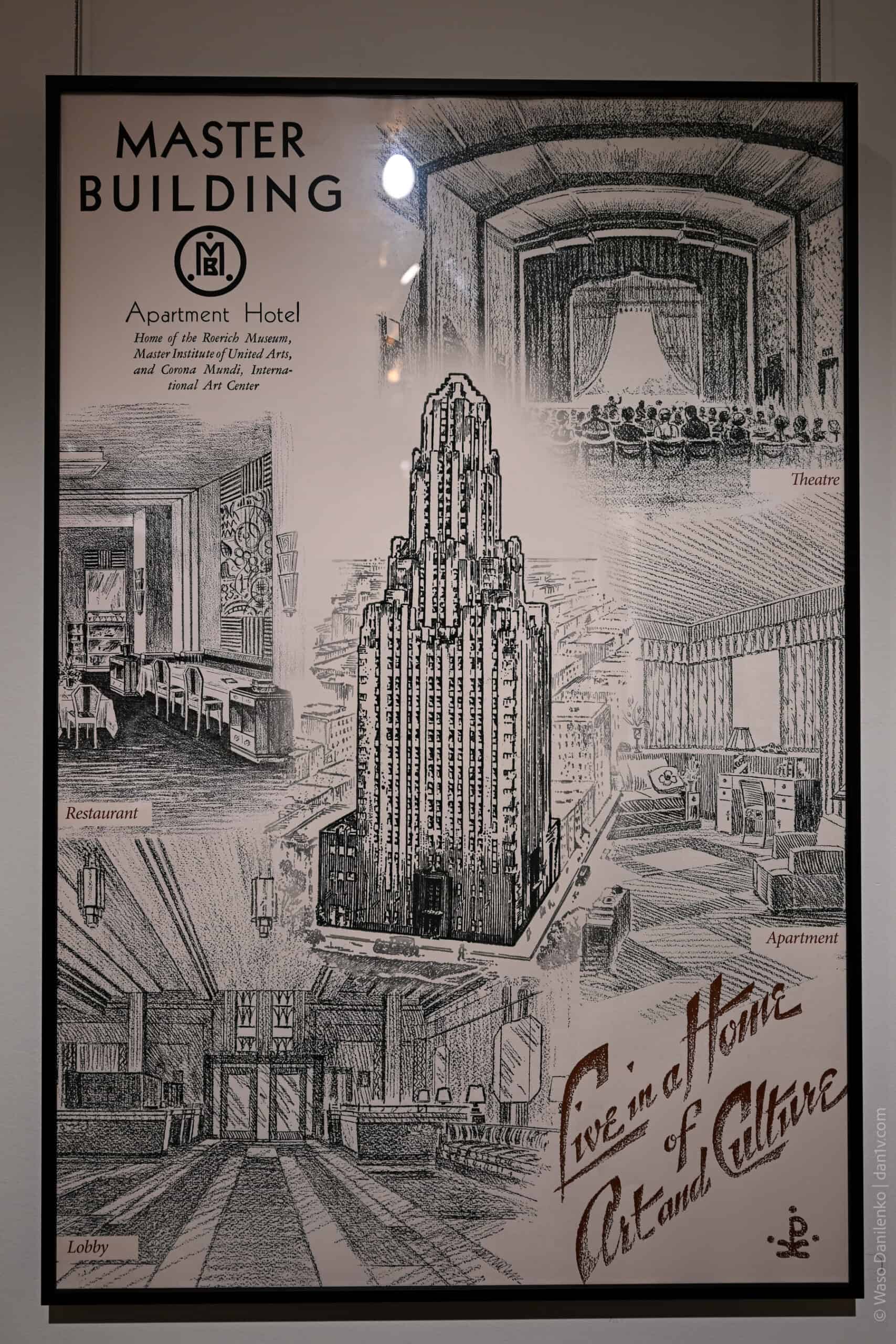
In 1928, construction began on the Master Building (310 Riverside Drive, corner of 103rd Street). The design was developed by architect Harvey Wiley Corbett of Helmle, Corbett & Harrison—one of New York’s leading Art Deco architects and himself a member of the Roerich Society.
Corbett created a 27-story tower in pure Art Deco style, which became the tallest building on Riverside Drive at 135 meters (443 feet). At the time of its opening, only three residential buildings in New York City were taller.
Details that make this building exceptional:
- This is the first building in New York City with corner windows, which have become one of the building’s defining elements.
- The brick is selected so that it is dark purple on the lower floors, fading to lavender in the middle, and pure white at the top. Corbett explained: “It’s a sense of growth.” The building seems to reach upward from the earth toward the light.”
- In the initial plans of 1928, the tower was to be crowned with a Buddhist structure shaped multi-stage pyramid. This was a direct architectural homage to the Buddhist and Tibetan influences in Roerich’s worldview. Ultimately, the stupa was abandoned in favor of three additional floors, but the tower’s silhouette, with its stepped terraces and single pinnacle, retained this “Oriental” character.
- Cornerstone with the “Banner of Peace” symbol. The cornerstone of the building (still visible at ground level, on the southwest corner) is engraved with the year 1929 and the Roerich symbol — three circles within a larger circle — along with the R.M. monogram (Roerich Museum).
The first three floors of the building housed the Roerich Museum (with over 1,000 paintings), an art school with halls for painting, sculpture, architecture, music, and dance, a theater, galleries, conference rooms, a library, and a cafeteria. Above were over 300 residential apartments, the revenue from which was intended to fund cultural activities.
How the Great Depression and a Patron’s Betrayal Affected the Roerich Museum
The building opened in October 1929, but Wall Street collapsed three weeks later. The Great Depression hit the Master Building immediately: tenants defaulted on rent, revenues plummeted, and the building went into receivership. At the same time, a personal conflict erupted between Roerich and Horch.
In the mid-1930s, Horch turned against his protégé. He sued Roerich for $200,000 in unpaid loans and reported him to the IRS.
By 1938, Horch had complete control of the building. Roerich’s paintings were moved to the basement. The museum was renamed the Riverside Museum and refocused on contemporary American art. Roerich’s followers were expelled.
Roerich himself did not return to the United States in 1938. He died at the age of 73 in Nagar, in India’s Kullu Valley, where he lived his last years.
The Master Building Today
The building still stands on the corner of Riverside Drive and 103rd Street. In 1988, it was converted to a housing cooperative. The studios were combined into larger apartments, and the lobby was restored. Today, it houses 335 apartments.
At the entrance on 103rd Street, the words “Riverside Museum” can still be read in small letters above the door — the last physical remnant of that era. On the southwest corner of the first floor, just at sidewalk level, stands a 1929 cornerstone bearing the “Banner of Peace” symbol and the R.M. monogram.
The Nicholas Roerich Museum Today: A Townhouse on 107th Street
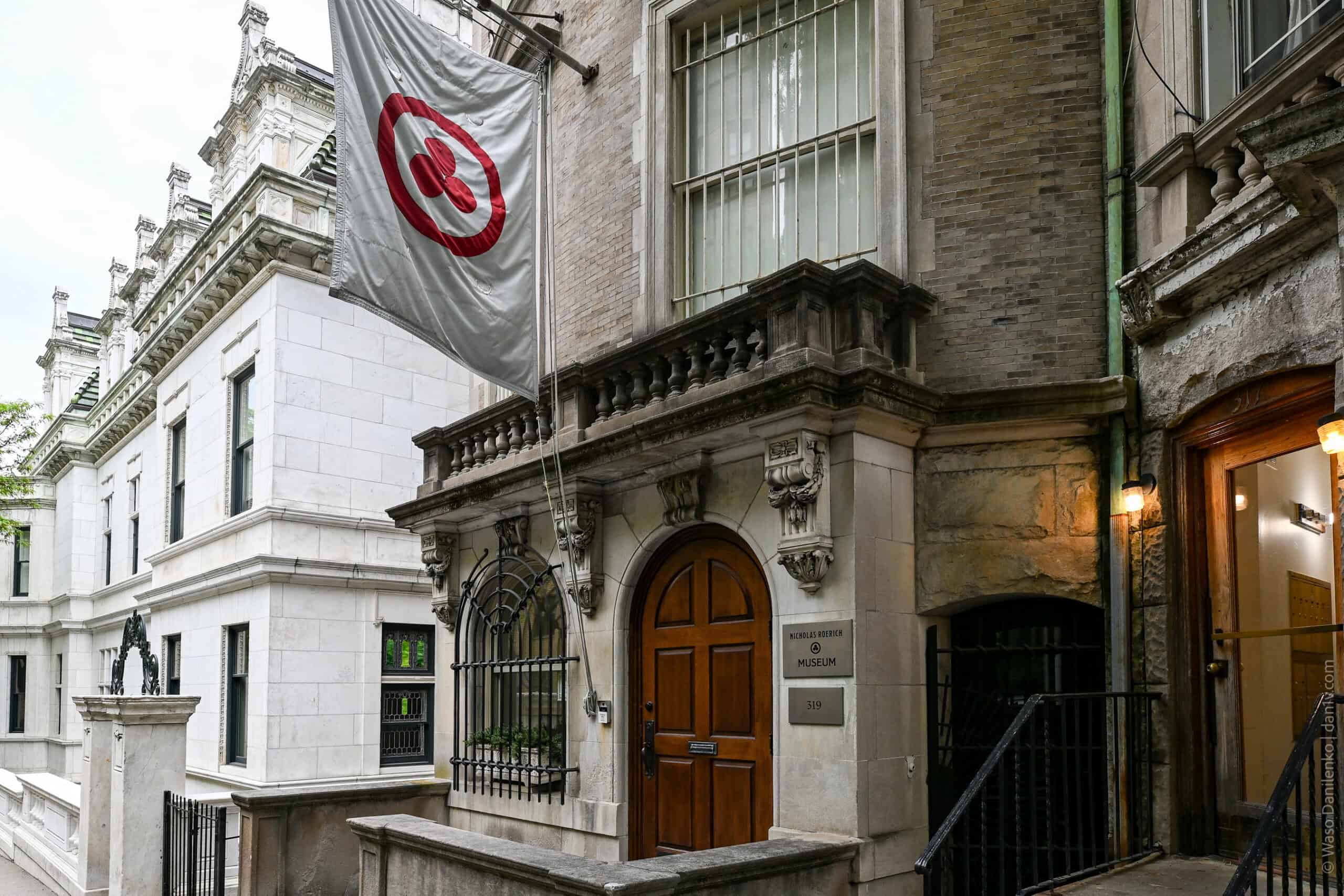
In 1949, after the artist’s death, the collection moved to a townhouse built in 1898 at 319 West 107th Street, two blocks east of Riverside Park.
Nothing has changed significantly here since then. It’s a brown-red brick townhouse from the late 19th century, like hundreds of others on the Upper West Side. However, a white banner with a red “Banner of Peace” symbol now hangs on the facade.
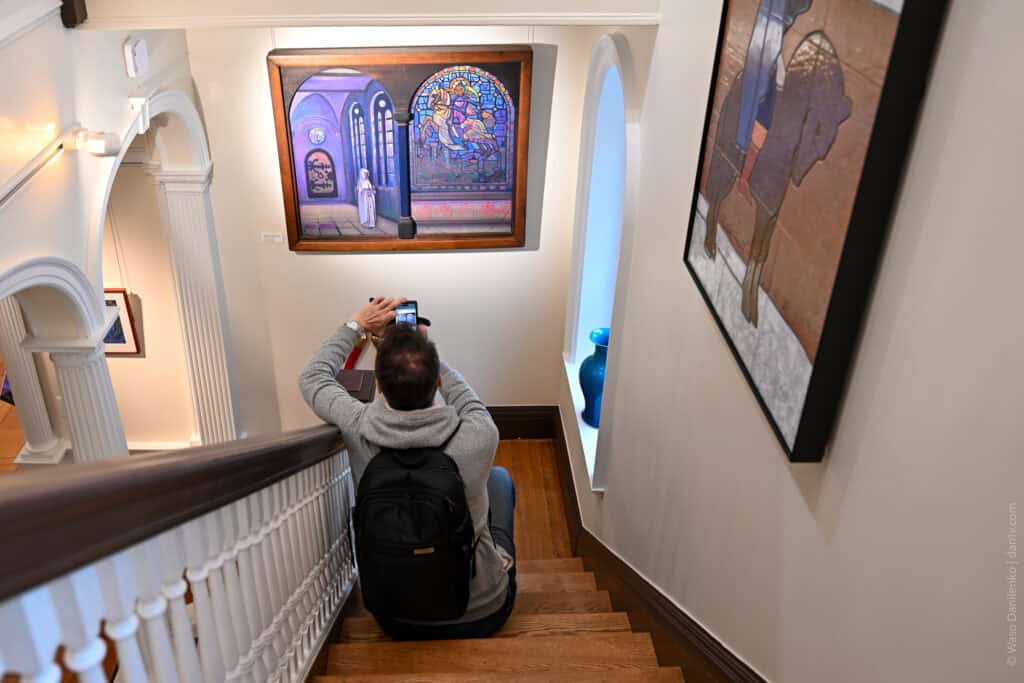
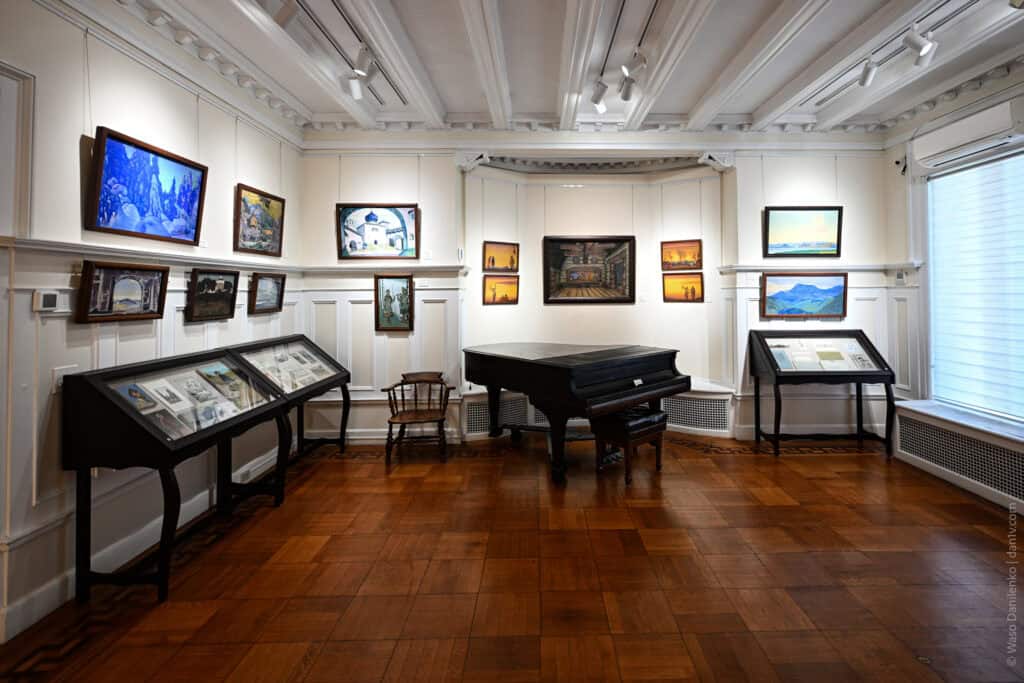
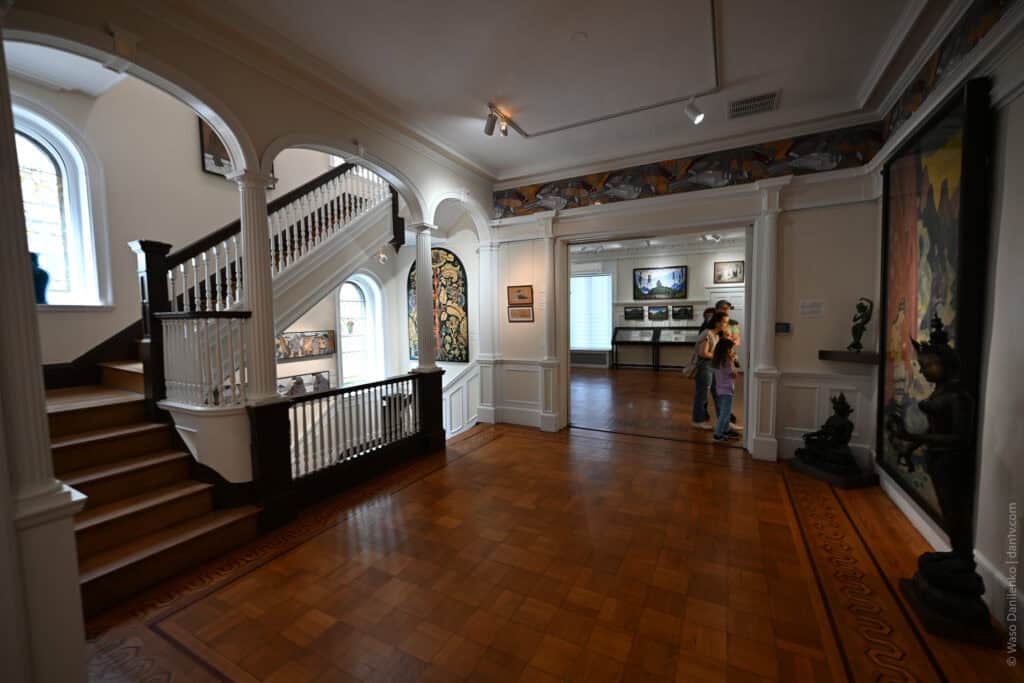
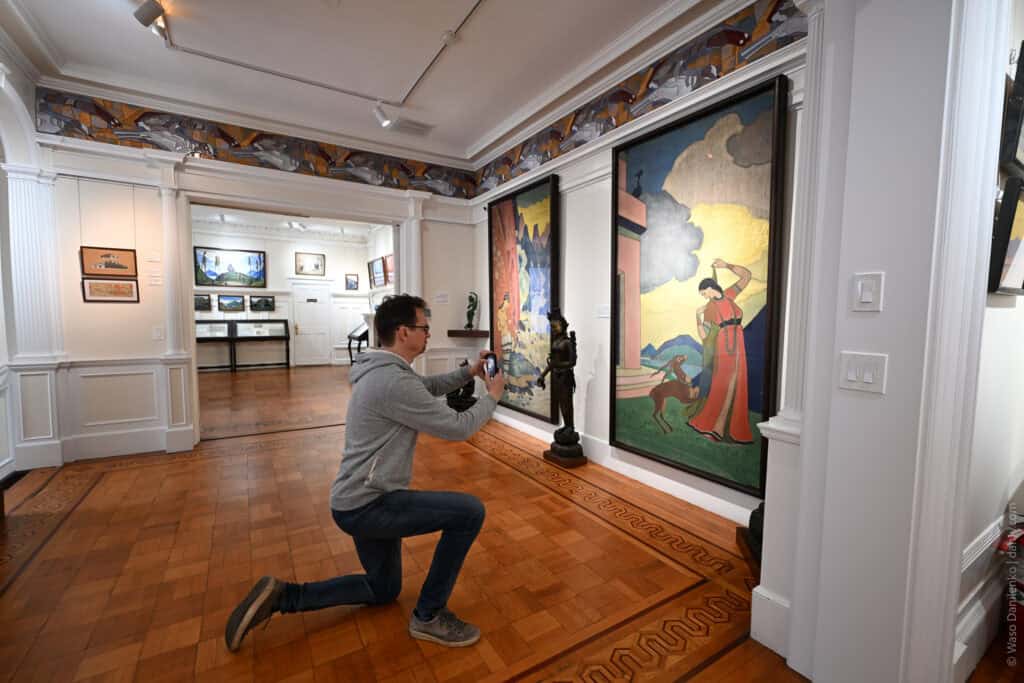
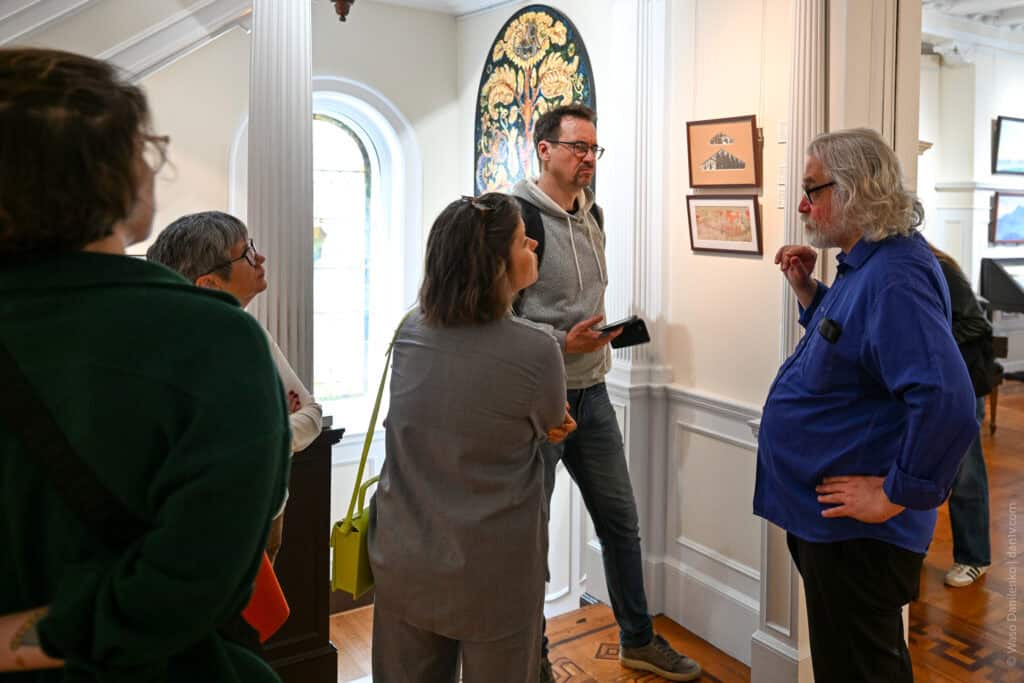
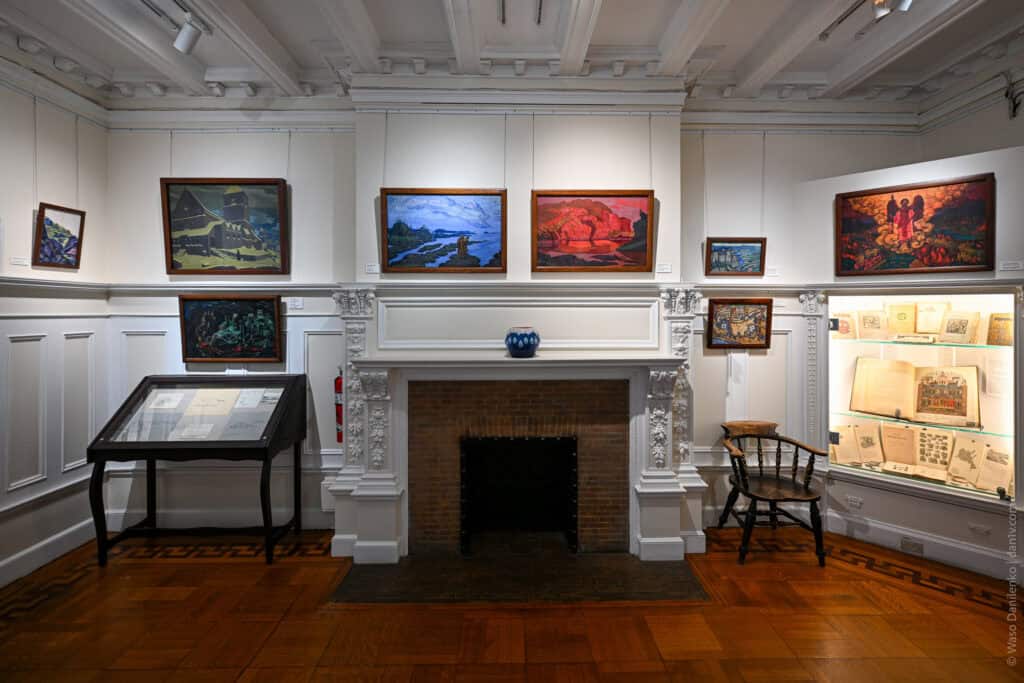
Inside, there are three floors of galleries connected by a wooden staircase with carved railings. The ceilings are low. The acoustics here are unique; raised voices can be heard on all floors. This is why it is customary to speak quietly, and the museum is generally quiet.
The Nicholas Roerich Museum Collection
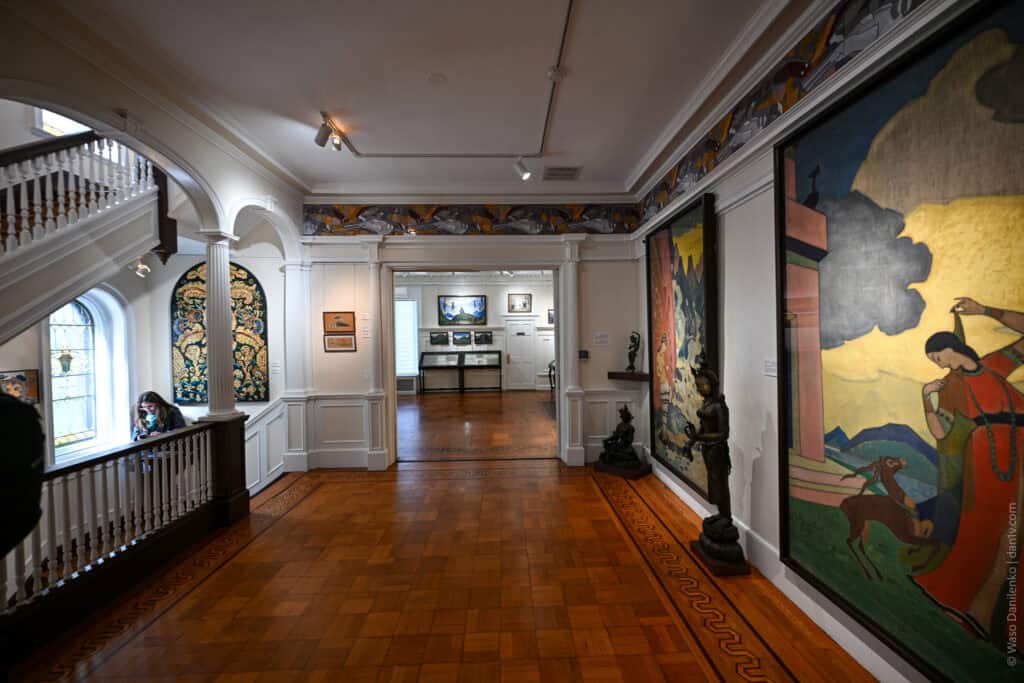
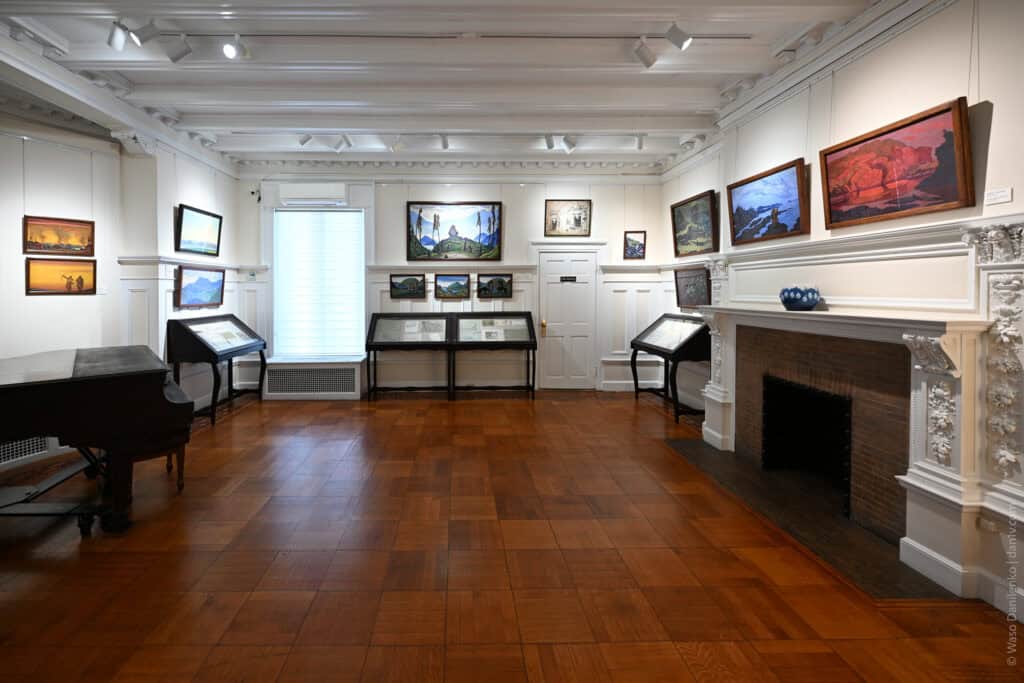
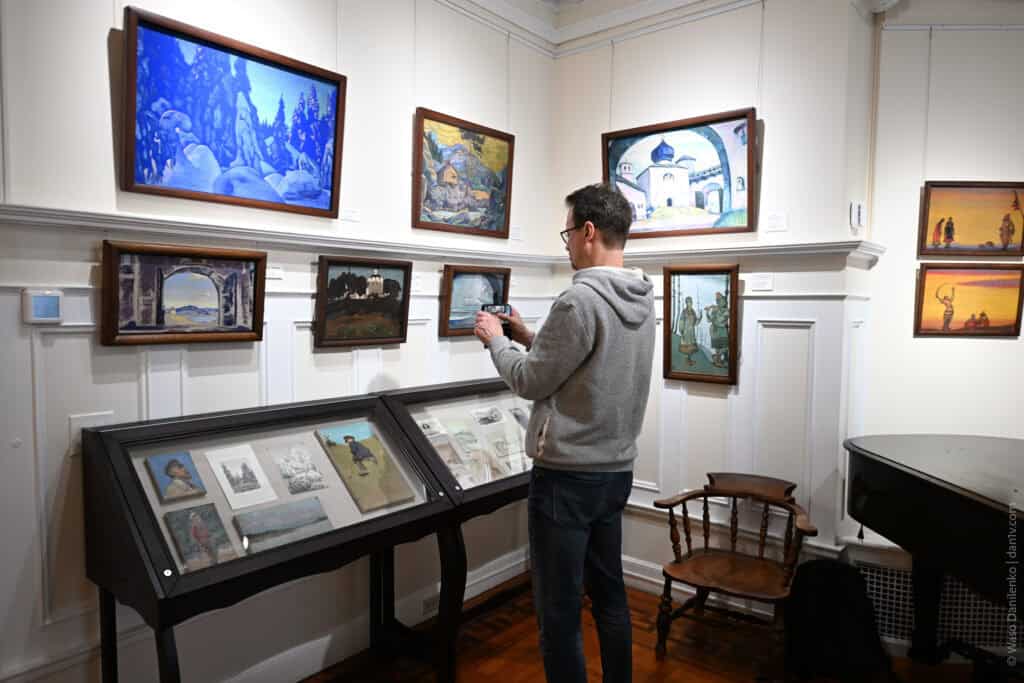
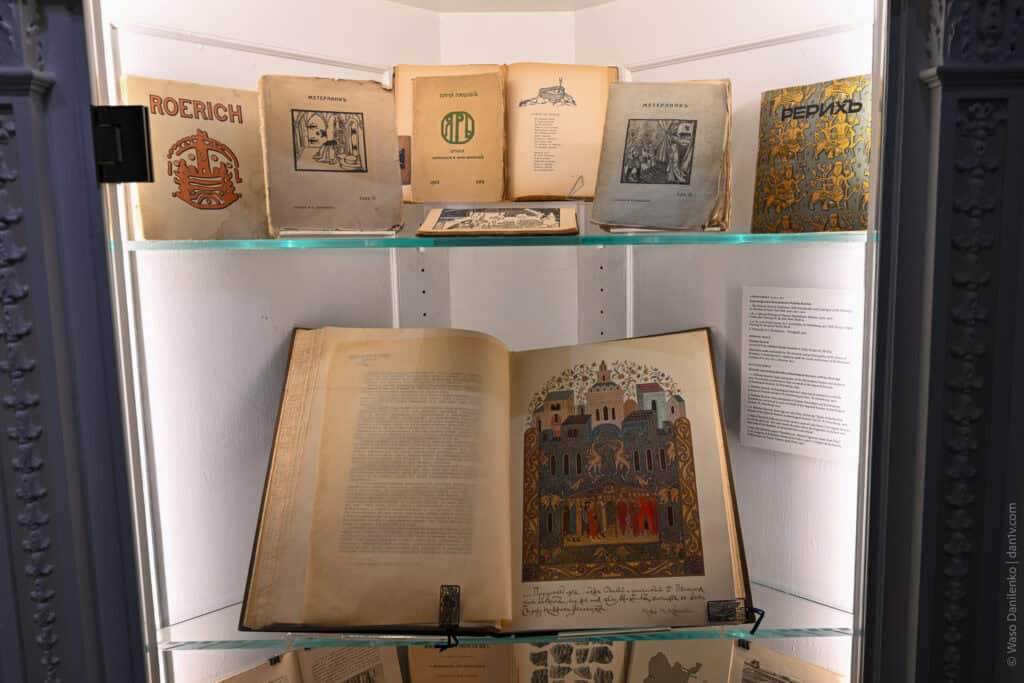
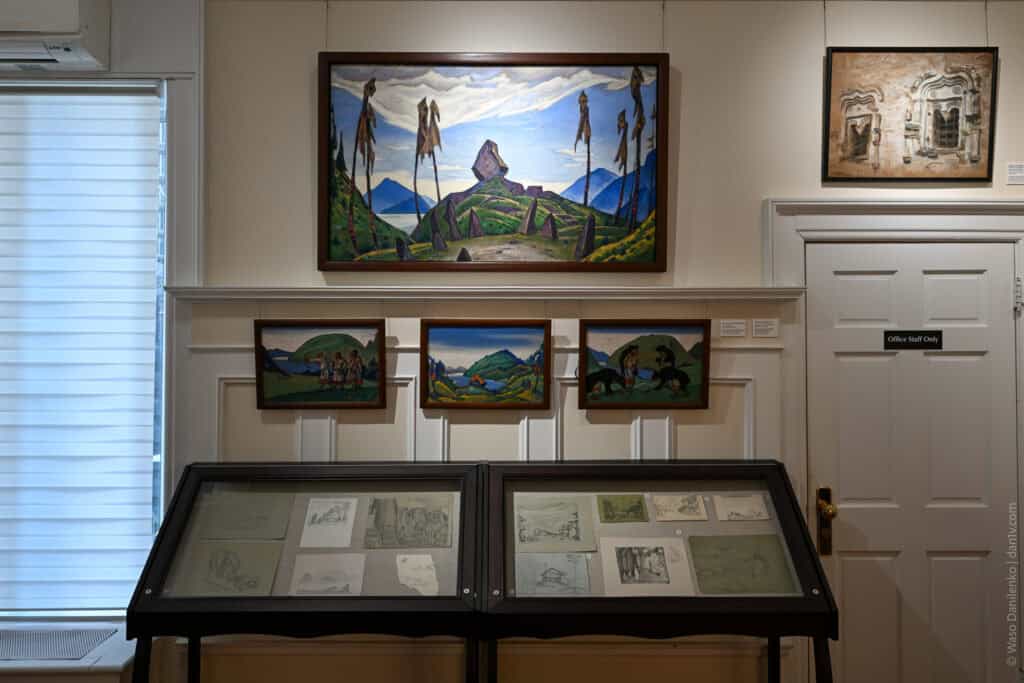
Over 200 original paintings by Roerich are housed on three floors, with the works rotating and changing their placement. The museum’s complete collection comprises 700 works, as well as correspondence, manuscripts, and photographs.
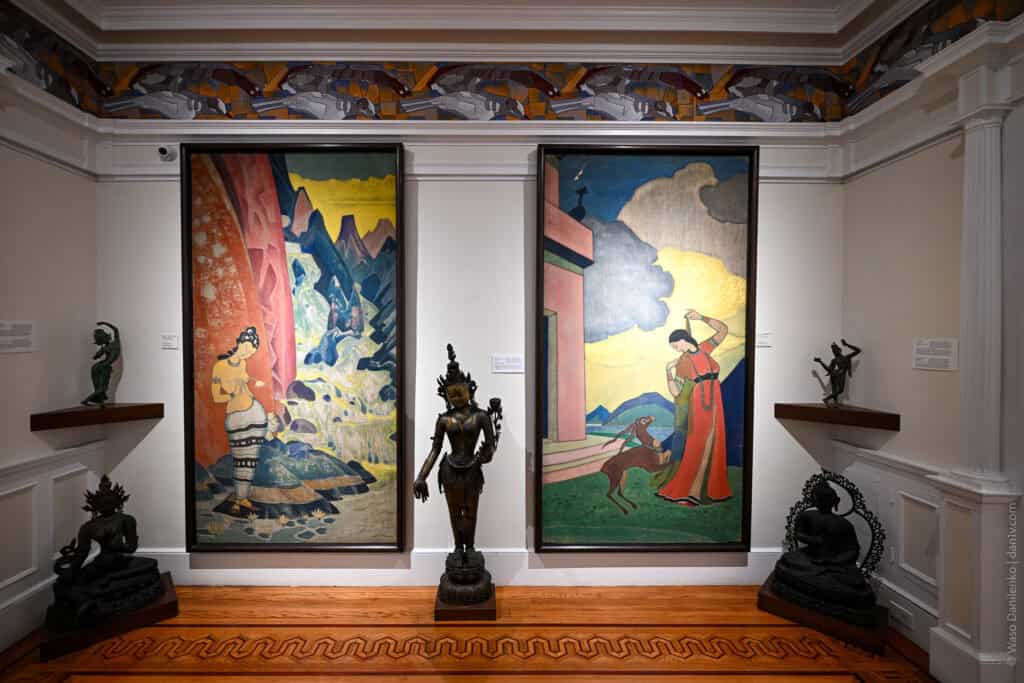
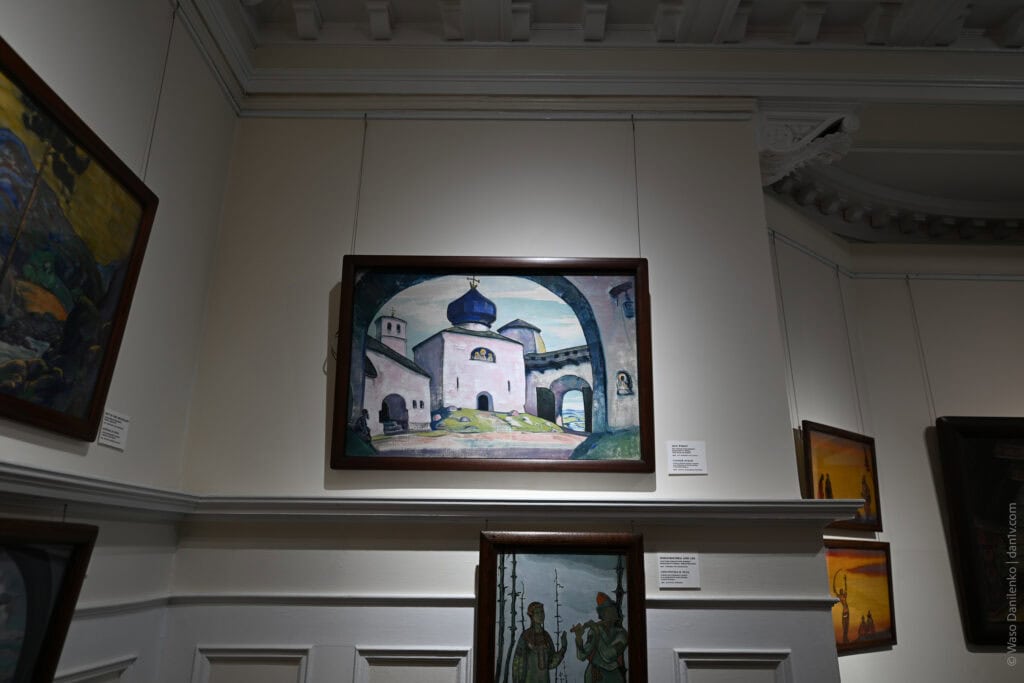
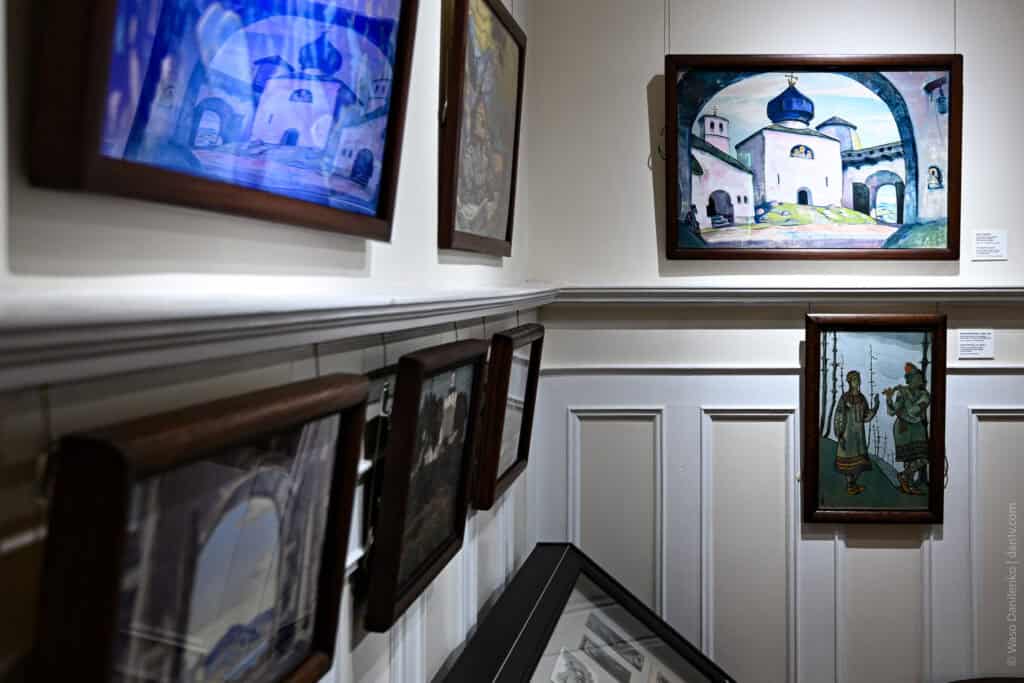
First floor – early period: Russia and pre-emigration works. Paintings completed before Roerich’s emigration include Russian landscapes, Orthodox churches, scenes from Russian history, mythology, and chronicles. Costume and set designs, including for “Polovtsian Dances” and Rimsky-Korsakov operas.
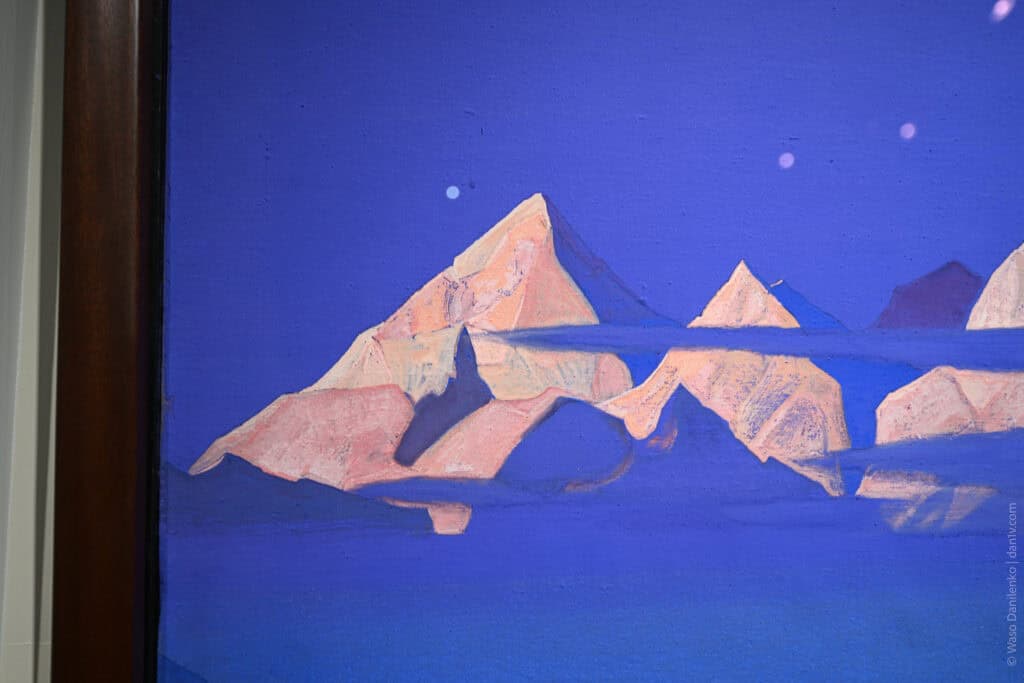
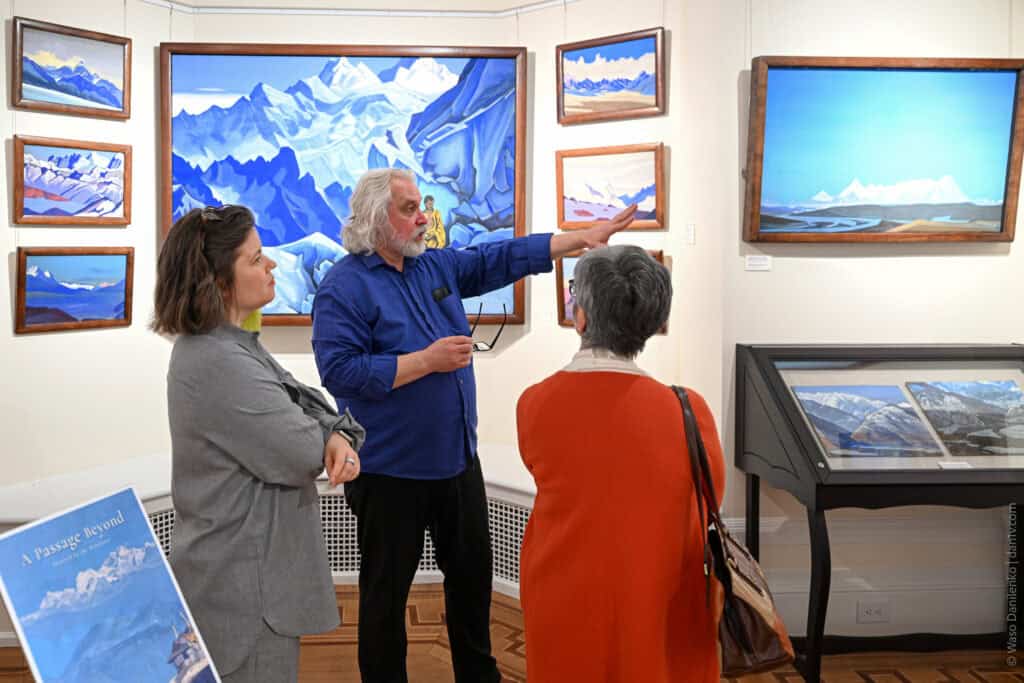
Second floor – the Himalayas and Central Asia. Mountains and snow-capped peaks painted in purple, blue, pink, and gold. Such colors are found in nature only at high altitudes under certain light. The Himalayas series, the Kulu series, and Leh. Ladakh” (1925), monasteries on cliffs, meditating figures against the backdrop of endless mountain plateaus.
The third floor is dedicated to the spiritual and mythological period. Paintings depict Krishna, Buddha, Tibetan monasteries, Christ, and various Eastern and Western spiritual figures. Roerich was convinced that the world’s great religions spoke of one thing, and his paintings from this period attempt to express this unity. Several geodes and minerals from expeditions are also displayed here.
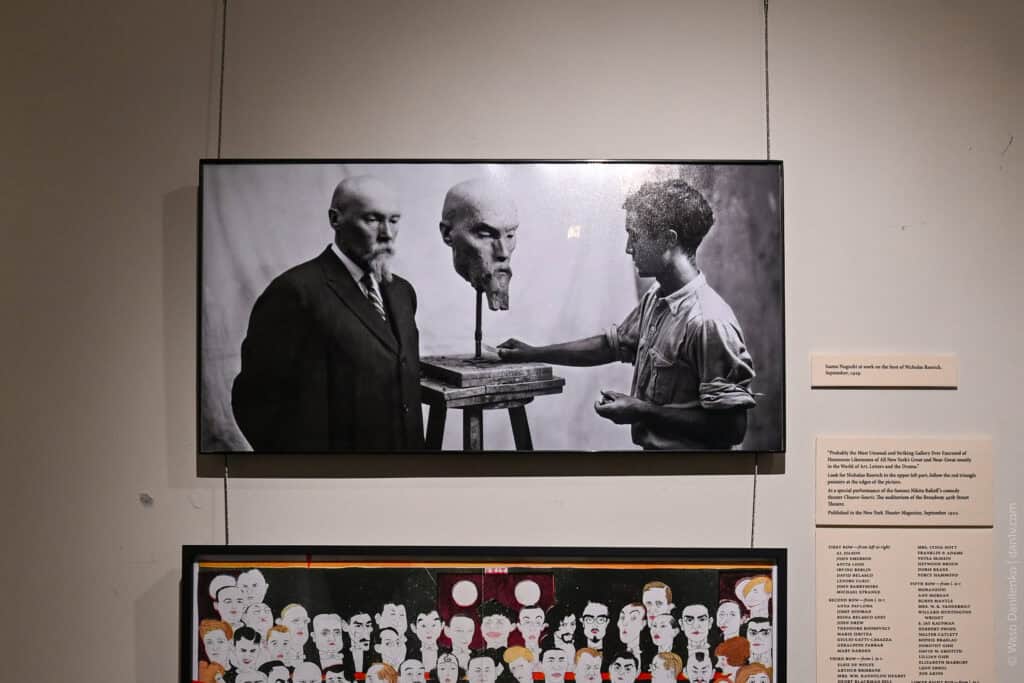
On the landing between floors hangs a large portrait of Roerich, surrounded by his paintings.
The museum also holds tens of thousands of Roerich’s correspondence with Diaghilev, Stravinsky, Roosevelt, Indian scholars, and artists from around the world. Roerich was an incredibly prolific correspondent and wrote in several languages.
Visitor Information
Admission: Free, donations welcome