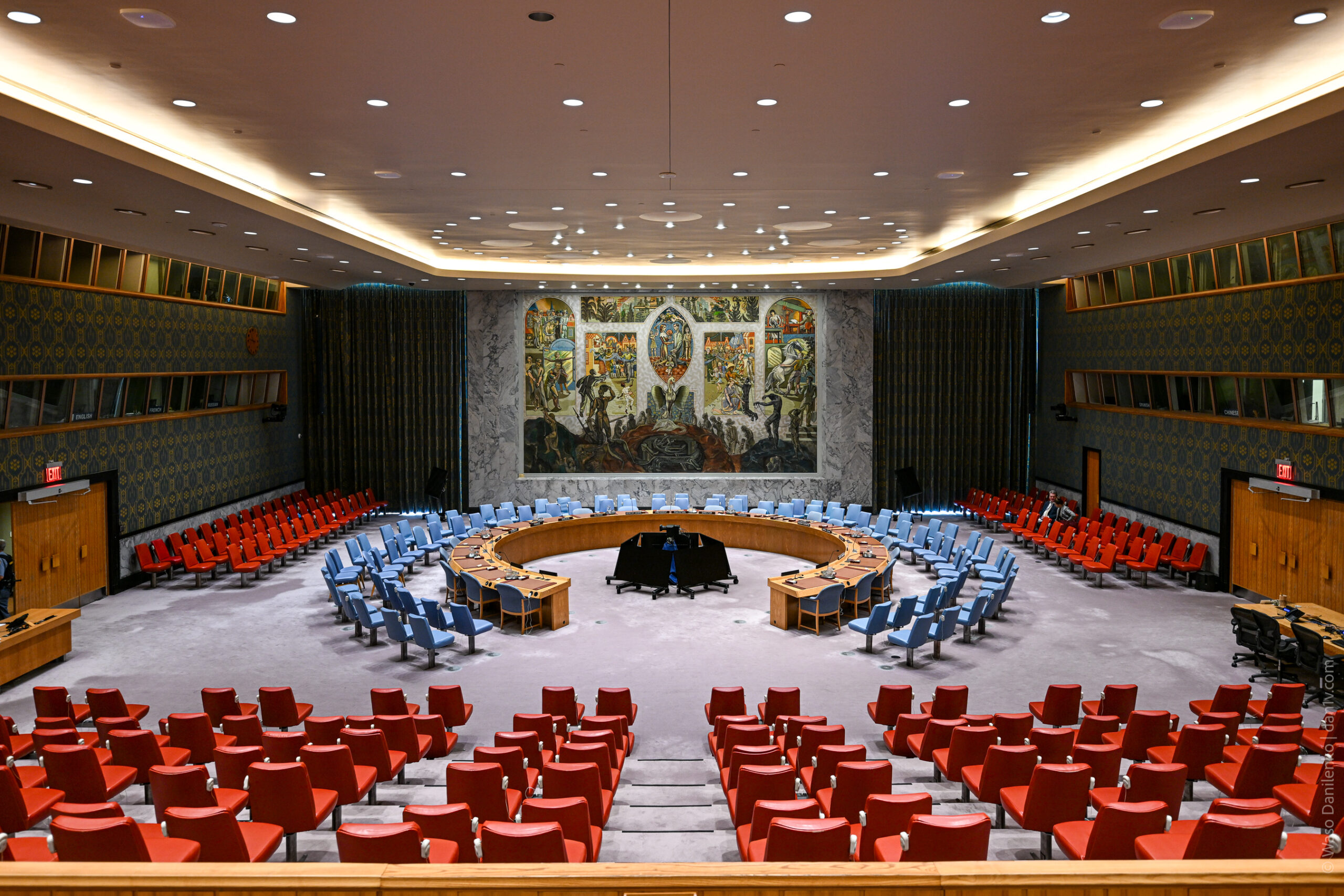
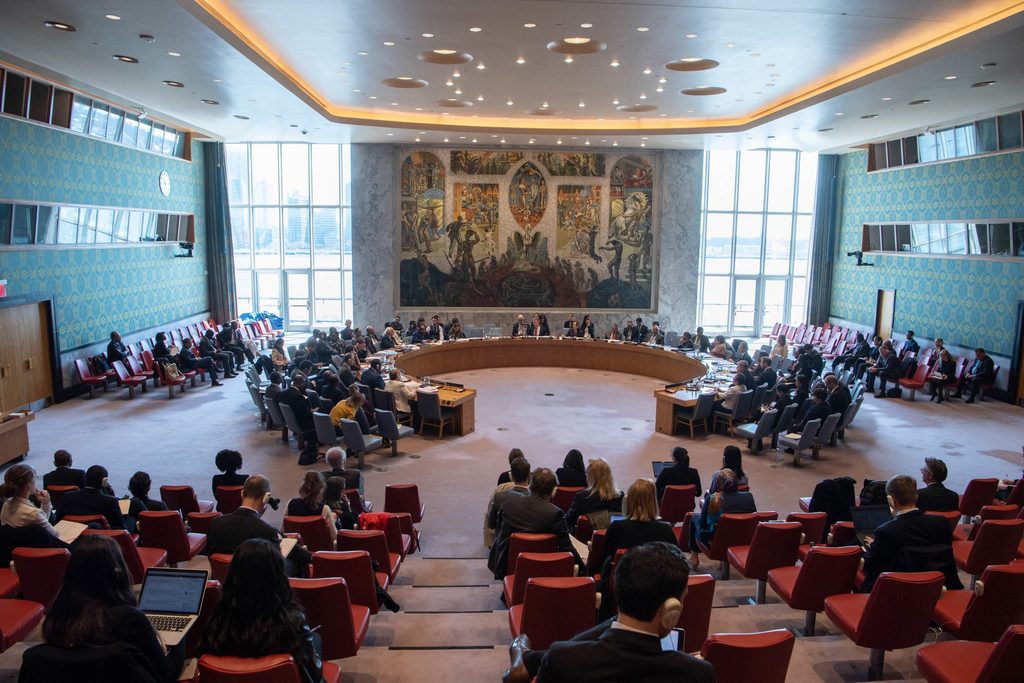
An interesting fact about the United Nations: besides the familiar General Assembly Hall, there is also the Security Council Chamber.
The Security Council is the main United Nations body responsible for maintaining international peace and security. It considers wars, armed conflicts, and international crises; imposes economic sanctions and arms embargoes; sends peacekeeping missions; and, in some cases, authorizes the use of military force. Its decisions can be binding on all United Nations member states.
The Council has 15 countries: five permanent members — the United States, Russia, China, the United Kingdom, and France — and ten non-permanent members, elected for two-year terms.
An observant reader will notice the huge curtains in the background. It is not difficult to guess what they cover: enormous windows overlooking the East River.
But why are the curtains closed? Anyone who watches the news at least occasionally might think the answer is obvious: security. Floor-to-ceiling transparent windows create several potential risks.
But there is another reason, perhaps an even more important one. With the windows uncovered, natural light falls unevenly on the participants, and someone is always left in the shadows.
Before television, nobody cared. With the arrival of television broadcasts in the 1950s, the issue became important: everyone wanted to be lit equally, in both senses of the word, and not remain in the shadow of their colleagues. Artificial lighting thus defeated natural light.
Interestingly, the curtains are sometimes opened. The most famous recent example took place on April 3, 2019, when, at the request of Germany, which held the presidency of the Security Council at the time, the curtains were fully opened during two meetings as a symbol of the Council’s “transparency.” It was deliberately presented as an unusual event.
📍 United Nations Headquarters / New York, 10017, USA