Pace Gallery in Chelsea is one of the few galleries in the world that seriously influence what is considered art and how much it is worth. Although the gallery was founded in 1960 as a tiny shop in Boston, its collection today includes Picasso, Rothko, Calder, Brancusi, de Kooning, Modigliani, and Agnes Martin. Admission is free, and no reservation is required. Inside, there are eight floors, five of them dedicated to exhibitions, a library with 10,000 volumes, a 150-seat auditorium, and a sculpture terrace.
Interesting Facts About Pace Gallery
- In June 2026, Pace Gallery dropped approximately 50 artists and 50 employees. Marc Glimcher, the gallery’s chief executive officer, explained that the gallery model itself is not simply broken but beyond repair.
- The freight elevator in the building was designed to withstand the weight of a monumental sculpture intended for the terrace. It was later discovered that it could also support a food truck, so visitors can now order food on the gallery’s rooftop.
- The building is leased for 20 years; the gallery does not own the building itself.
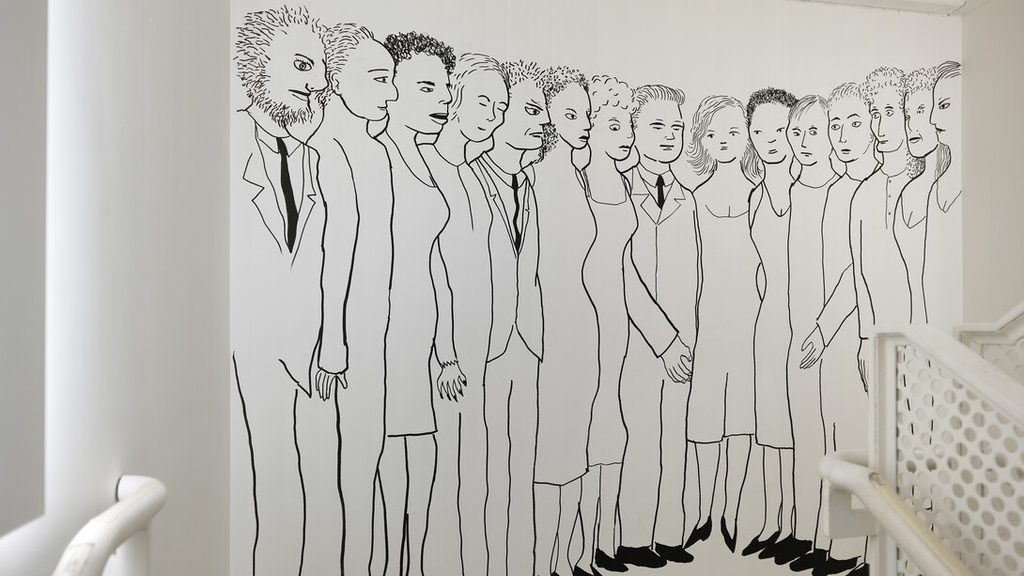
- There are nine drawings by David Byrne of the band Talking Heads on the landings between the first and seventh floors. He drew them directly onto the walls in April 2025.
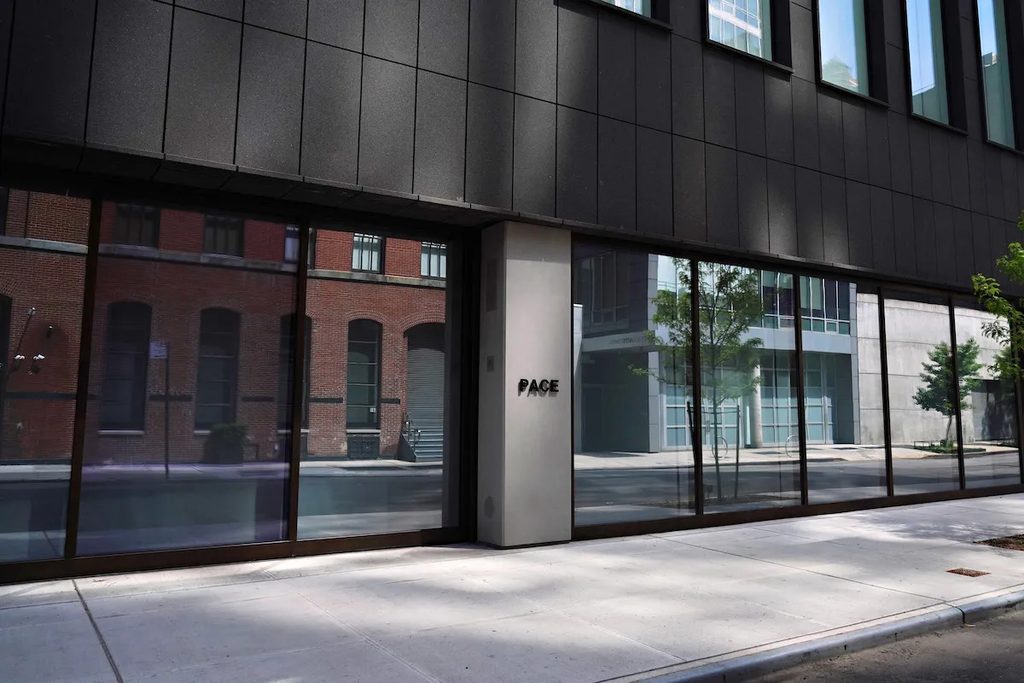
- The facade up to the sixth floor is clad in fired volcanic stone from Mount Etna. Above it are panels made of aluminum foam.
- The name Pace was chosen in honor of Arne Glimcher’s father’s nickname, Pacey. He died shortly before the gallery opened.
- The gallery was founded in Boston in 1960 by Arne Glimcher with starting capital of $2,800.
- Pace now has locations in New York, Los Angeles, London, Geneva, Berlin, Seoul, and Tokyo, as well as the 125 Newbury space in Tribeca.
- Admission is always free. It is a commercial gallery that makes money from selling artworks, not from visitors.
The Pace Gallery Building at 540 West 25th Street
When Weinberg Properties was developing the building at 540 West 25th Street, Arne Glimcher initially wanted to rent two or three floors for his gallery. However, his son convinced him to build a vertical gallery instead of a horizontal one, and they ultimately decided to lease the entire building.
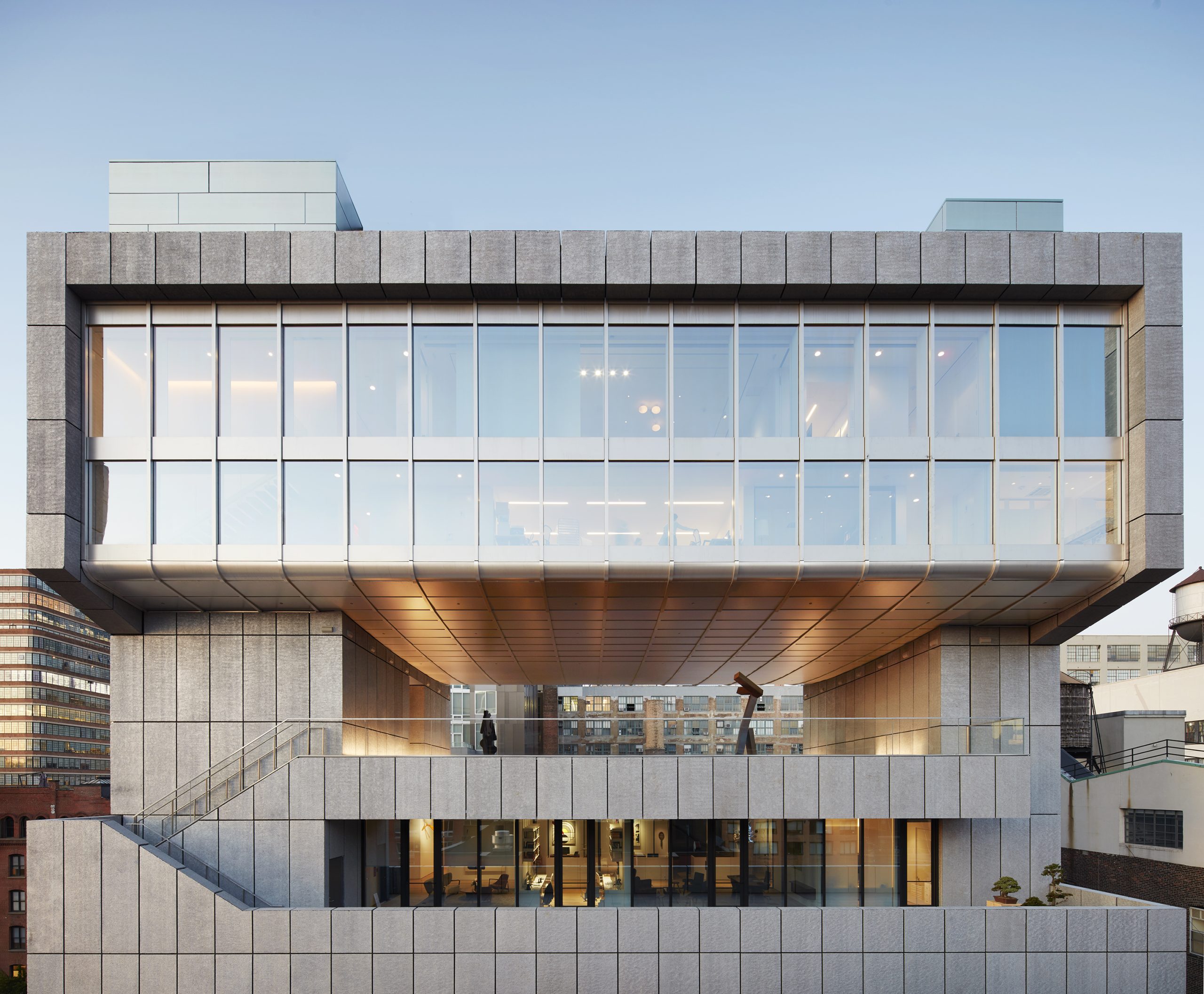
The main material used on the facade is volcanic stone from Mount Etna in Sicily. It is fired at a high temperature, causing the surface layer to melt and turn matte black. There are exactly 900 of these panels on the facade, extending up to the sixth floor. Above them are panels made of aluminum foam, a material rarely seen in residential architecture.
The architects’ concept becomes immediately apparent when viewed from across the street. The surrounding buildings are brick warehouses dating from the early twentieth century, typical of West Chelsea. The black facade of Pace Gallery does not compete with them in scale, but it does not pretend to be their neighbor either.
However, the best angle for photographs is not from the sidewalk but from the High Line. The park runs alongside this block, offering views of the black volume of the building, the curved stainless steel structure, and the glass above the terrace, none of which can really be seen from street level.
The gallery has eight floors:
- The first floor contains the main exhibition hall, measuring 334 square meters, with a polished concrete floor and 5.5-meter ceilings. A giant glass door opens directly onto the street.
- The second floor contains an exhibition space that is typically used for paintings.
- The third floor has two smaller galleries with a combined area of 177 square meters and solid oak floors. It is probably the most intimate space in the building.
- The fourth floor contains offices that, in practice, serve as private viewing rooms for art buyers.
- The fifth floor has an open-air sculpture terrace paved with blocks of white acacia wood. It offers panoramic views of Manhattan and the Hudson River.
- The Pace Live auditorium, with 150 seats for performances, is located on the seventh floor.
- There is a penthouse and a rooftop sculpture garden.
- The building also contains a 10,000-volume library, which is occasionally used for small exhibitions, as well as a dining room for receptions.
All of the exhibition floors are column-free, which was the architects’ main engineering challenge. Lighting was designed by Arnold Chan of the London-based Isometrix studio, the structural engineering was handled by WSP, and construction was carried out by AECOM Tishman.
Of the building’s 7,000 square meters, only 1,530 are allocated to public exhibition space, and just over 930 square meters of that is actually indoors. For a mega-gallery, this sounds strange, but three-quarters of the building’s volume is not exhibition space at all, but infrastructure. Whether such an idea would pay off remained an open question for seven years. In 2026, however, it received a fairly definitive answer.
David Byrne’s Staircase at Pace Gallery
The most underrated part of the building is not the gallery itself, but the staircase. In April 2025, David Byrne of Talking Heads spent several days drawing nine life-size figures directly onto the walls of the stairwell landings between the first and seventh floors. The artist wanted visitors to literally run into the drawings rather than view them from a distance. The gallery announced that the drawings would remain indefinitely.
Byrne is not an outside star brought in for a one-off project. He has been a Pace artist since 2003, and in 2016 he collaborated with the gallery on The Institute Presents: Neurosociety.
If you came to see an exhibition, do not take the elevator. Walk up and down the stairs instead. Half of the visitors to the building have never seen Byrne’s drawings.
The staircase is closed during the installation of new exhibitions. In the summer of 2026, it was closed and is scheduled to reopen on September 10, 2026.
Pace Gallery’s Second Location: A Garage Under the High Line
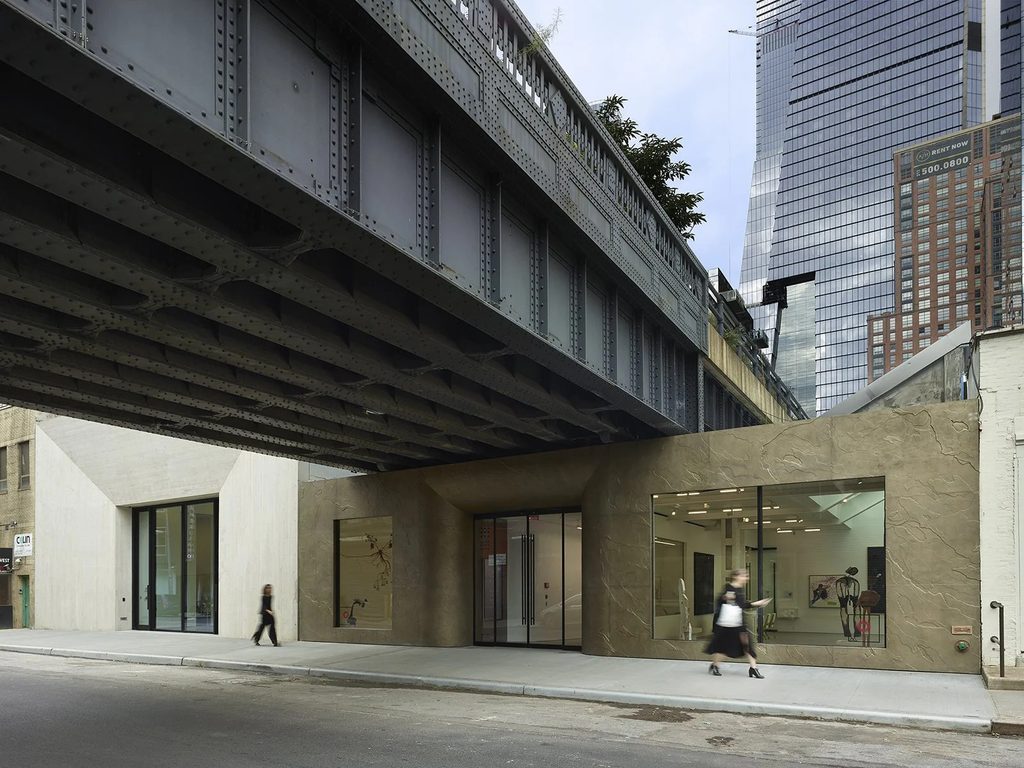
At 508 and 510 West 25th Street, Pace has a second, single-story location. It was once an abandoned automobile garage that HS2 Architecture, together with Bill Katz’s studio, transformed into an exhibition space with six-meter ceilings. Pace initially occupied 510 West 25th Street, covering approximately 372 square meters, and later purchased the neighboring 508, doubling the total area to approximately 743 square meters.
The main challenge was not the budget but the High Line itself. The park runs directly above the building and severely limits its height. The architects used thin steel elements to maximize the ceiling height, while lighting was installed in long strips along the side walls.
In the summer of 2026, the space hosted a retrospective of Australian artist Emily Kam Kngwarray, her first exhibition in New York. An exhibition by Arlene Shechet was scheduled to open on September 11.
The History of Pace Gallery: From a Boston Shop to a Mega-Gallery
Arne Glimcher studied at the Massachusetts College of Art and later completed his master’s degree at Boston University. In 1960, he opened a gallery at 125 Newbury Street in Boston with starting capital of $2,800. There were three people working there: Glimcher, his wife Millie, and his mother Eva.
In 1963, Glimcher opened a location in New York on East 57th Street with his partner Fred Mueller. In 1965, the Boston gallery closed, and the family moved to New York permanently.
Young Glimcher entered a market where most of the best artists had already been claimed. Leo Castelli dominated Pop Art, while André Emmerich represented Color Field painting. Glimcher chose artists who could not be grouped under a single aesthetic banner: Louise Nevelson, Robert Irwin, Agnes Martin, and Lucas Samaras. All four remained with the gallery for decades.
After Mark Rothko’s death, his heirs spent ten years in litigation with the artist’s former gallery, Marlborough Fine Art. When the case ended, the heirs chose Glimcher as their new dealer.
In 1980, Glimcher sold Jasper Johns’s Three Flags to the Whitney Museum of American Art for $1 million, marking the first time a work by a living artist sold for a seven-figure sum. By 2011, Pace’s annual turnover exceeded $400 million.
After the 1990 art-market crash, Glimcher agreed to merge with Daniel Wildenstein, creating PaceWildenstein in 1993. In 2010, the galleries separated, and the Glimcher family bought out the Wildensteins’ stake for approximately $100 million.
Beginning in 2008, the gallery opened and closed locations around the world: Beijing, which closed in 2019, London, Palo Alto, Seoul, Geneva, Los Angeles, and Tokyo. The Hong Kong location, which had operated for 11 years, closed in 2025.
Arne Glimcher also made films. His directorial debut, The Mambo Kings (1992), starring Antonio Banderas, received an Academy Award nomination for its song. He later directed The Juror (1996), starring Demi Moore and Alec Baldwin, and a documentary about Picasso and Braque, which he made at the suggestion of Martin Scorsese.
The Economics of Pace Gallery
The building’s shell was constructed by its owner, Weinberg Properties, and was valued at approximately $80 million. Pace paid for the interior build-out, which was reported to have cost $18.2 million. The gallery does not own the building; it is leased for 20 years.
At an initial rate of $112.66 per square foot, the rent comes to approximately $8.45 million in the first year, or about $704,000 per month. Over the full 20-year term, with a 3 percent annual increase, the total exceeds $220 million. By 2038, the building could cost the gallery approximately $300 million, after which Pace will have the option to renew the lease or move out.
In 2019, Marc Glimcher made no secret of the fact that the building was expensive, describing the lease as a bet that the gallery’s successful sales would generate enough revenue to keep the business running.
Pace has also experimented with other projects. Superblue, conceived in 2020 as an exhibition business aimed at a mass audience, opened in Miami in 2021, but the planned locations in New York and Houston never materialized. Pace Verso, the gallery’s NFT platform launched in late 2021 at the height of the crypto boom, has since experienced a decline in trading volume.
On June 3, 2026, it became known that Pace was carrying out major cuts. The number of artists represented by the gallery was being reduced from 135 to 80–85, while the staff was being reduced from 250 to approximately 200 employees. According to Marc Glimcher, the art world has changed radically over the past decade, and the current gallery model is not simply broken but beyond repair.
Visitor’s Information
📍 Pace Gallery / 540 W 25th St, New York, NY 10001
📍 Second location under the High Line / 508 и 510 West 25th Street, NY 10001
📍 Arne Glimcher Gallery in Tribeca / 395 Broadway, New York, NY 10013
Hours: Monday–Thursday, 10:00 a.m. – 6:00 p.m.; Friday, 10:00 a.m. – 4:00 p.m.; Saturday and Sunday, closed.
Website: pacegallery.com
Admission is free. No ticket or reservation is required.