
Dia: Chelsea is one of the key spaces operated by the Dia Art Foundation, dedicated to contemporary art and large-scale artistic projects. Unlike traditional galleries, Dia: Chelsea focuses on long-term solo exhibitions, performances, and programs that allow visitors to engage with art on a deeper level. It is not simply a gallery, but a space where art, architecture, and community come together.
Interesting Facts About Dia: Chelsea
- Dia moved to Chelsea in 1987. Before that, the foundation had been based in SoHo since 1974. According to The New York Times, Dia’s move helped trigger an influx of galleries into what had once been an industrial neighborhood and turned it into a center of New York’s art scene.
- When the foundation opened the enormous Dia Beacon on the banks of the Hudson River in 2003, most of its activities moved there, and Chelsea became less important. A major renovation restored its status as the foundation’s urban center.
- The first exhibition at the renovated Dia: Chelsea featured Lucy Raven’s 50-minute black-and-white film Ready Mix, filmed at a concrete plant in Idaho.
- Past projects at the 22nd Street location included sound and light installations by La Monte Young and Marian Zazeela, key figures in the development of minimalism in music and light.
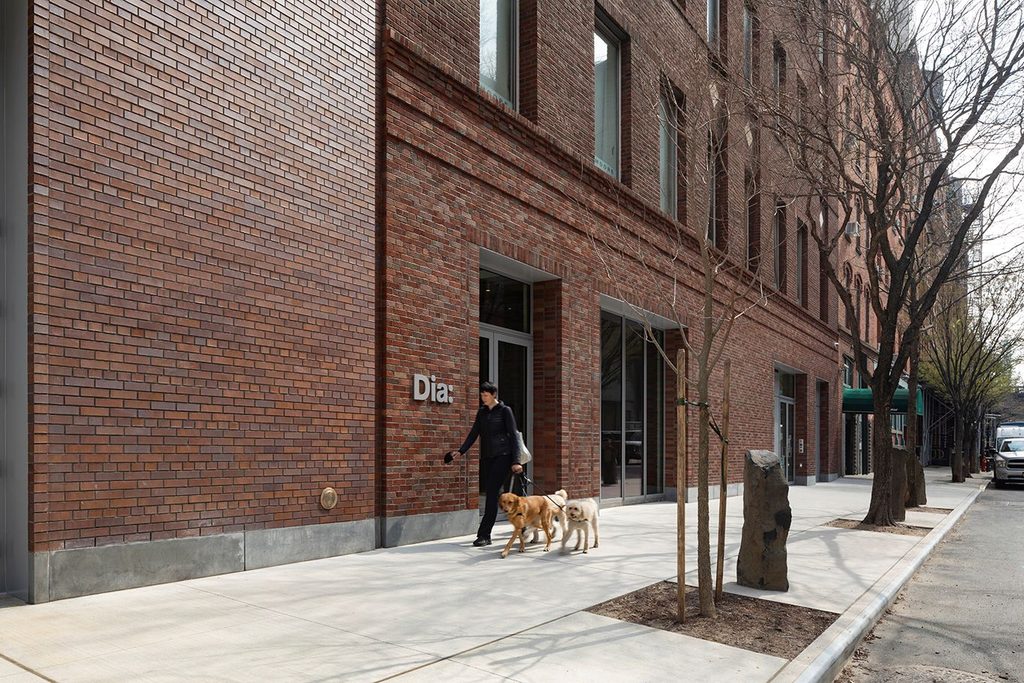
- Along the street where Dia: Chelsea is located, there are 38 oak trees and basalt columns. They are part of Joseph Beuys’s 7000 Oaks project.
- After the renovation, the Dia bookstore reopened in the building, offering books and magazines dedicated to minimalism and landscape design.
- Admission is free at all Dia locations in New York.
History of Dia: Chelsea
The Dia Foundation was founded in New York in 1974 as an organization willing to fund ambitious and costly artistic projects. The name Dia comes from the Greek preposition meaning “through” and reflects the foundation’s idea of helping artists realize projects that might otherwise have remained only on paper.
In 1987, Dia left SoHo and opened a new space on 22nd Street in Chelsea. At the time, the neighborhood was relatively quiet, dominated by warehouses, garages, and workshops. Dia was one of the first major art institutions to occupy buildings of this kind, and galleries soon began opening in Chelsea as well.
During the 1990s and 2000s, Dia’s Chelsea spaces hosted exhibitions and large-scale projects by Franz West, Richard Serra, Donald Judd, and other artists. Part of the program was spread across several buildings on 22nd Street, including 535–545.
In 2003, the foundation opened Dia Beacon, a vast museum in a former Nabisco factory north of New York City. After that, the center of Dia’s exhibition program shifted to Beacon, while the Chelsea location continued operating on a more modest scale.
In 2019, Dia began a major renovation of its Chelsea complex, with a budget of approximately $20 million. Three neighboring buildings were unified behind a common facade and transformed into a single exhibition space designed by Architecture Research Office (ARO). The renovated space opened in April 2021 with two new works by Lucy Raven.
In 2026, one of Dia’s major exhibitions in New York was the largest retrospective in the city devoted to Argentine artist David Lamelas.
Architecture of Dia: Chelsea
Dia: Chelsea is not a single building, but a group of three neighboring buildings. Originally, they were separate industrial structures: warehouses, garages, and spaces with high ceilings and exposed brick walls. This type of architecture is typical of West Chelsea. The neighborhood was once home to factories and workshops, which were later taken over by galleries.
The renovation by Architecture Research Office (ARO) followed a simple but forward-looking idea: preserve the character of the former industrial buildings while making them read as a unified whole. All three buildings were given a shared facade, while additional connections between the galleries were created inside. Visitors can now move easily from one gallery to another without going outside.
Key features of the space include:
- The street-facing galleries open directly onto the sidewalk, allowing visitors to see the art even before entering.
- A separate space is used for lectures, screenings, and conversations with artists.
- Minimalist works require large, open galleries and plenty of space. For this reason, the walls and ceilings are kept as clean and undecorated as possible.
- A bookstore serves as a natural extension of the exhibitions.
The same idea continues outside. Beuys’s trees and basalt columns along 22nd Street extend the museum onto the sidewalk, turning the surrounding block itself into part of the exhibition.
Exhibitions at Dia: Chelsea
Dia: Chelsea does not have a large permanent exhibition. The foundation’s main collection is housed and displayed at Dia Beacon, where you can see works by Donald Judd, Dan Flavin, Richard Serra, Agnes Martin, Robert Ryman, Sol LeWitt, and other artists. Chelsea has a different role: it presents individual projects, new commissions, and selected works from the foundation’s collection in new contexts.

Overall, the Dia collection focuses on a relatively small group of artists from the 1960s and 1970s whose work the foundation collects systematically and in depth, from Minimalism and Conceptual Art to Land Art. This is why a visit to Chelsea complements a trip to Beacon so well: there you see the “permanent classics,” while here you see an ongoing dialogue with them.
When the space reopened in 2021, it presented Lucy Raven’s Ready Mix (2021), a 50-minute film about a concrete plant in Idaho. It was accompanied by Casters X-2 + X-3 (2021), kinetic light sculptures.
Dia: Chelsea has also hosted an exhibition by Colombian artist Delcy Morelos exploring the connection between people and the earth. One of the works was a huge pyramid made of clay and soil — something you would not expect to encounter in a museum, yet something you encounter beneath your feet every day. A mixture of the absurdly familiar and the deliberately exaggerated comes together naturally in this work.


What to See Near Dia: Chelsea
Dia: Chelsea fits easily into a full day in West Chelsea:
- The neighborhood’s galleries: David Zwirner, Pace, Hauser & Wirth, and Gagosian are all within a few minutes’ walk.
- The High Line: The park runs along a former elevated railway nearby, making it a good way to finish the day with a walk above the streets.
- The Hudson River waterfront: The river and its evening sunsets are just a few blocks away.